We remain fully operational. Our teams are working around the clock to ensure your deliveries continue safely.

下载应用程序


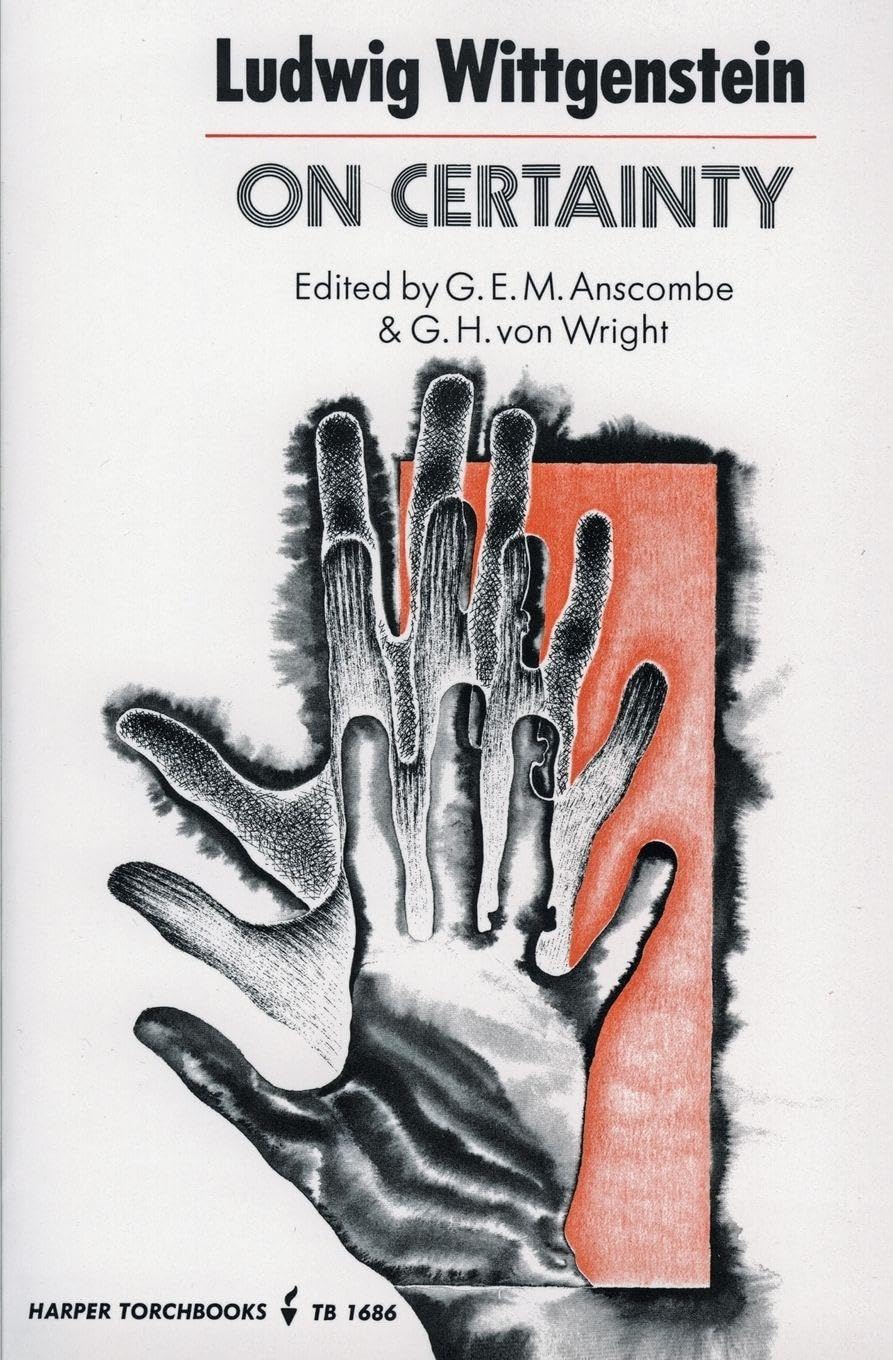
Review: Clearly the top - This should be the central work of modern epistemology Review: Five Stars - Excellent!
| Best Sellers Rank | #733,631 in Books ( See Top 100 in Books ) #490 in Philosophy of Logic & Language #528 in Epistemology Philosophy #1,174 in Modern Western Philosophy |
| Customer Reviews | 4.6 out of 5 stars 98 Reviews |
A**3
Clearly the top
This should be the central work of modern epistemology
T**S
Five Stars
Excellent!
A**R
Five Stars
Excellent text and condition.
A**R
Five Stars
Excellent.
M**.
"It is difficult to begin at the beginning. And not try to go back further."
The basic question addressed by Wittgenstein's On Certainty is: under what conditions can we state that we "know" a statement to be true versus merely "believe" a statement to be true; and, ultimately, can we ever state that we "know" anything with absolute certainty. Wittgenstein's thesis, (pesented in zen koan-like phrases rather than in a didactic style) seems to be that the "language game", and our quest for certainty, is a shifting patchwork of meaning with its own internal rules and logic. Like any game, language, and the ability to state the most simple phrase with certainty (i.e. "this is a tree" or "my name is Ludwig Wittgenstein") depends on the mutual consent of the players involved. As Wittgenstein writes, "But it isn't just that I believe in this way that I have two hands, but that every reasonable person does....To have doubts about it would seem to me madness - of course, this is also in agreement with other people; but I agree with them." Similarly, if one were to ask why does the chess pawn move the way it does, the only appropriate answer can only be because those are the rules of the game. In other words, our mutual social agreement that the stump at the end of my arm shall be called a "hand" and the big green thing growing in my backyard shall be called a "tree" ultimately depends on some basic communal suspension of belief since there is no really good reason why the "hand" could not have been called a "tree" and vice versa. As Wittgenstein writes, "if ever we do act with certainty on the strength of belief, should we wonder that there is much we cannot doubt?" and that the "absence of doubt belongs to the essence of the language game." Just to reiterate - being able to communicate with other people with certainty that "this is a tree" requires a mutual consensual absence of doubt. Our quest for certainty is ultimately an illusion which I think brings us to the development of language itself. "It is so difficult to find the beginning. Or, better: It is difficult to begin at the beginning. And not try to go back further."
R**N
New Strategies for an Ancient Problem
In ON CERTAINTY, Wittgenstein re-visits the age-old question as to whether we actually know that there is world external to our minds. Well, not quite. In this short and quirky, imaginative and profound book, Wittgenstein attempts to turn the tables on the ancient debate between the Skeptic ("you don't know...") and her anti-skeptical interlocutor ("yes, I DO know..."). An anti-skeptic, such as G.E. Moore who claimed to know all sorts of the things about the external world (e.g. This is a hand), does NOT know, according to Wittgenstein, in part because Moore's question-begging response to the skeptic is wholly inadequate. But noting this does not mean that the skeptic wins the battle because, for Wittgenstein, it does not make sense to doubt the existence of the external world. We must affirm certain propositions in order to have inquiry at all, Wittgenstein argues, and among these are those claims which Moore alleges to know, aka 'Moorean facts.' Wittgenstein takes himself to show that we must believe the Moorean facts, but that, contrary to Moore, we do not know them. As bewitching as the Wittgensteinian effort is, it does strike me that he, in no way, demonstrates his central claim - namely, that we cannot sensibly doubt Moorean facts. Despite this rather damning criticism, I highly recommend delving into this brilliant attempt.
W**N
Retrieving Realism
Engaged with three books including Philip Kitcher’s The Nature of Mathematical Knowledge it amazed me how I find reference to Wittgenstein’s On Certainty to be of absolute importance. While Kitcher’s book presents a theory of mathematics that argues our abilities in math come from perception leading to elementary mathematical knowledge on which is built the edifice of further theory he oinly references Wittgenstein on his Remarks on the Foundations of Mathematics and not On Certainty.. At the moment I am reading two other books that reminded me of this argument. One is Retrieving Realism by Charles Taylor and Hubert Dreyfus and the other is Seeing Things as They Are by John Searle (which I have just barely begun) that both strike me as trying to do something similar. That is they are trying to do an end run around what Taylor refers to as the mediational theory that basically cuts knowledge off from reality – or rather, from the possibility that we could have certainty regarding the world apart from our perceptions. Of course, even that summary is mistaken since the issue is more complex than that. Or what might be called disjunctivism (but which he calls Conceptual Dualism) as I understand it in Searle’s argument and Searle says “Austin refuted the argument from illusion.” – which argument is a major step here. But regarding Philip Kitcher’s attempt in the Nature of Mathematical Knowledge we have what may be the most certain type of knowledge being puzzled out regarding the source of that sense of certainty. Recalling Wittgenstein’s statement that the type of certainty one has is a result of the type of language game one is using – we can think of mathematics as the most rigorous language game and so our sense of certainty (a different category than knowledge granted) is greatest in mathematics. But how do we get it? Do we perceive numbers? But this whole project strikes me as suspicious. Haven’t we been convinced that Western Philosophy has been a history of progress? The progress was partially because of the correct step that we are now contemplating reversing in order to retrieve realism? But here we can see the efforts by Kitcher, Taylor, Dreyfus, and Searle who deal adequately I think with the puzzles even if the results are not conclusive. But are we forgetting Wittgenstein in all of this?
C**N
Investigation into the nature of knowledge
On face value, On Certainty is a surprisingly accessible Wittgenstein text, exploring the notions of epistemology (theory of knowledge) and scepticism (idea that true knowledge can be sought but cannot be found) or "knowing" and "doubting", however, the work, on closer examination, cleverly argues these positions in the epistemological tradition from clearly different perspectives, thus On Certainty is more complex than it appears. Written in the last eighteen months of Wittgenstein's life (the last entry days before his death) it is a response to Moore's articles, `Proof of the External World" and "Defence of Common Sense". According to the editors, Anscombe and von Wright, Wittgenstein told Moore that these were his best articles. In entry 83, Wittgenstein writes: "The truth of certain empirical propositions belongs to our frame of reference". This is a foundationalist argument, proposing that our knowledge of the world and its truth, belongs to our particular frame of reference - context is everything, underlying all our assertions. Another perspective that Wittgenstein proposes is the position of Relativism: in this view there are no foundations or absolutes, truth changes with the times, circumstances and social conditions. He writes, 65: "When language-games change, then there is a change in concepts, and with concepts the meaning of words change." Interestingly, relativism is the perfect tool for the sceptic, because knowledge is depended on time and circumstances, and therefore can be sought, but never found. Doubt itself is depended on certainty, as one must hold a premise in order to reject it. 115: "If you tried to doubt everything you would not get far as doubting anything. The game of doubting itself presupposes certainty." In fact this, really, is the core premise of On Certainty that knowledge can only exist if doubt is possible. Doubt relies on content of what we know, our frame of reference that is inherent in all our assumptions regarding existence. Reading On Certainty is a stimulus for thought, pushing us to analyse our assumptions about knowledge, that truth depends on our concept frameworks through which we view the world. Recommended to all students of contemporary philosophy.
TrustPilot
1 个月前
3 周前
1 个月前
2 周前