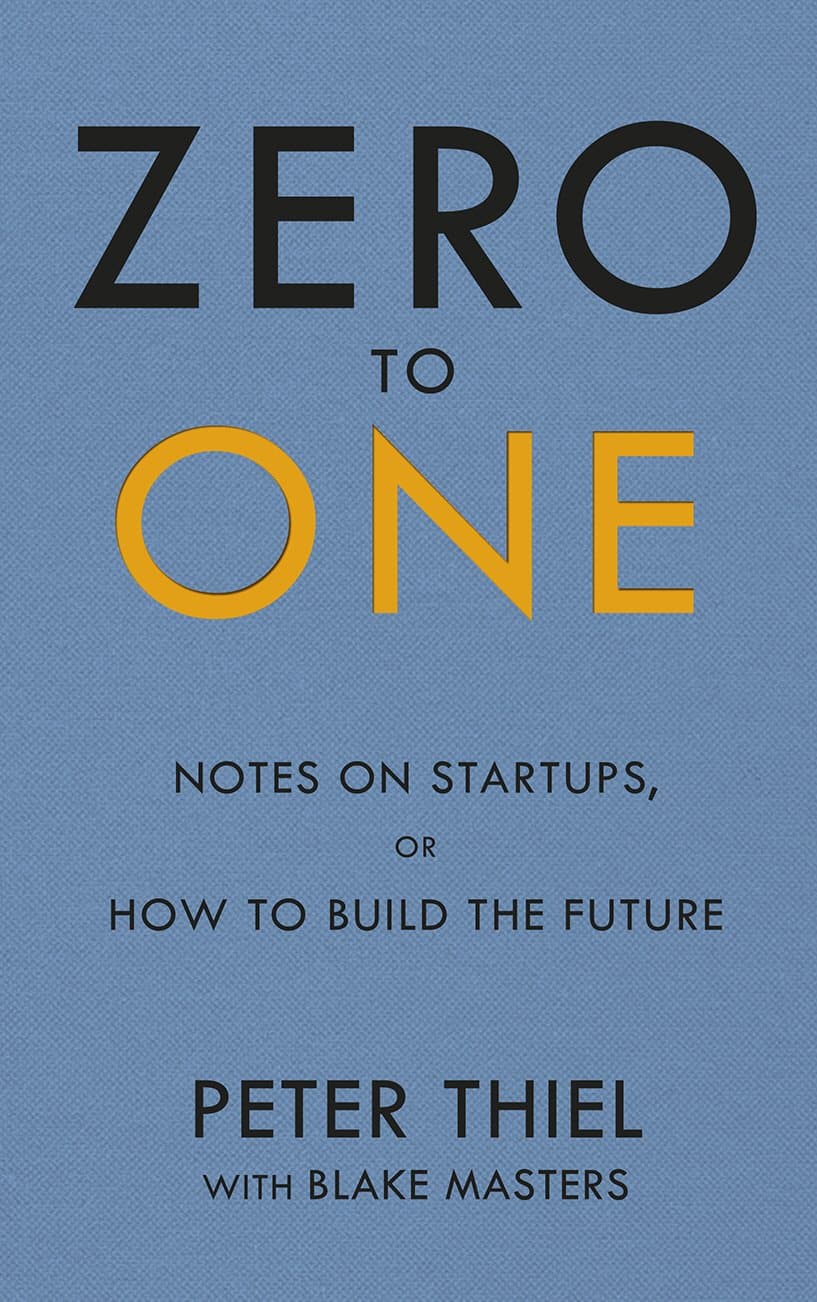
Zero to One: Notes on Start Ups, or How to Build the Future [Peter Thiel; Blake Masters] on desertcart.com. *FREE* shipping on qualifying offers. Zero to One: Notes on Start Ups, or How to Build the Future Review: A Propely Prescribed pair of Specacles that puts the world in focus - This book is like a pair of Prescription Spectacles that put the Innovation Startup Business world, into Sharp Focus. When I first saw the price I almost hit exit. However, I thought “If this guy has the balls to ask this price, this book had better be good”. Else I'm going to roast him in my desertcart review. I ain't roasting!! As usual I attacked reading this book in concept extraction mode for my normal initial scan read. Chapter 6, You are not a Lottery Ticket, hit me with a Baseball bat right between the eyes. and slowed my reading pace down to almost snails'. Despite this slow first read, this Chapter deserved a re-read, at almost letter by letter speed. Almost every word or phrase brings an idea from the past, often vague, to the fore and into sharp focus. When I finished my first highlighting trip, almost every word in this chapter was lit. I had to choose and eliminate some of them. In Zero to One, Thiel explores the world of New Business Creation. I would have loved using the word entrepreneurship but excessive and inappropriate use by “experts” have stripped this word of it's true meaning. We even invented a new version in South Africa under the ANC – Tenderpreneur. True entrepreneurship from basics is the creation of a New business that facilitates Economic Development by providing an Inventive New Product creating a New Market Sector that facilitates New Consumer Productivity enhancing opportunities. In Thiel's thesis, basic human attitudes can be split into a 2x2 matrix. I also tend to think in 2x2 matrixi. So this chapter fitted my mind. But Wow did he blow my mind with his various Definite vs Indefinite and Optimistic vs Pessimistic discussions. Despite many years in multinational business I could not fault the Author on any of his explanations. He clarified a lot for me. One of them “strategically humble” is certainly a new, yet valid descriptor for a company with a profitable monopoly. Yet in their Financial market press releases, they deliberately select a market description that yields for them a minority market share in a large market and not their true market share in the niche they dominate totally. (Are they hiding from Monopoly acuzations?) A few key quotes. ”In the 1950's, Americans thought big plans for the future were too important to be left to experts”. (San Francisco Dam) Ralph Waldo Emmerson is quoted as saying “Shallow men believe in luck, believe in circumstances …...... Strong men believe in cause and effect.” “you should do what you could, not focus on what you couldn't” Is to my mind the Quote of the Year. Another hand clapper was “No one pretended that misfortune didn't exist, but prior generations believed in making their own luck by working hard” I consider the following a nice funny; When Peter had to use either the words he or she in his text he seemed to consistently use she. I suppose this enables him to duck accusations of Sexism. Showing signs of being scared of Indefinite Pessimists? “We have to find our way back to a definite future, and the Western World needs nothing short of a cultural revolution to do it.” “ A startup is the largest endeavor over which you can have definite mastery. You can have agency not just over your own life, but over a small and important part of the world. It begins by rejecting the unjust tyranny of Chance” The rest of the book is devoted to discussing the practicalities of founding Innovative Startups successfully. These are focused at exploiting what is commonly considered a secret simply because nobody has really explored it before. Their uniqueness create innovative monopoly opportunities - the key source of profit. One of the issues discussed is; Power Law; We all know the Pareto principle is valid and 80-20 describes the unequal distribution of results in everything. Peter adds these considerations; “It defines our surroundings so completely that we usually don't see it”. He continues with; “but everyone needs to know exactly one thing that even venture capitalists struggle to understand: we don't live in a normal world; we live under power law.” In this way many other facets of Startup founding are discussed practically. In the end I came away with the following thought pattern; A potential successful startup founder is someone who is a Definite Optimist with a long term perspective, prepared to take risks. Who has a mind open enough to identify factual or human secrets that need illumination. Who is prepared to do the hard work necessary to acquire the factual knowledge needed to explore this secret and find a way to change this mystery into a solution. Who is capable of funding this idea or selling it to Venture Funders to acquire funding. Who is prepared to expend the effort to develop the idea into a useful practical end product that solves something significant for a new market sector. AND; Who then has the flexibility to turn around from dreaming, research and creativity. To then display the tenacity to knuckle down to make this idea work in practice, prepared to live through the low personal income initial loss making era, building the practical business. Thanks – A stimulating read, well worth the time and money – even for retired me! Review: Helpful mindset for entrepreneurs - Good overall read. Not earth shattering or anything but some good insight along the way
| Best Sellers Rank | #929,888 in Books ( See Top 100 in Books ) #9 in Entrepreneurship (Books) #24 in Business & Organizational Learning |
| Customer Reviews | 4.5 out of 5 stars 39,508 Reviews |
P**W
A Propely Prescribed pair of Specacles that puts the world in focus
This book is like a pair of Prescription Spectacles that put the Innovation Startup Business world, into Sharp Focus. When I first saw the price I almost hit exit. However, I thought “If this guy has the balls to ask this price, this book had better be good”. Else I'm going to roast him in my Amazon review. I ain't roasting!! As usual I attacked reading this book in concept extraction mode for my normal initial scan read. Chapter 6, You are not a Lottery Ticket, hit me with a Baseball bat right between the eyes. and slowed my reading pace down to almost snails'. Despite this slow first read, this Chapter deserved a re-read, at almost letter by letter speed. Almost every word or phrase brings an idea from the past, often vague, to the fore and into sharp focus. When I finished my first highlighting trip, almost every word in this chapter was lit. I had to choose and eliminate some of them. In Zero to One, Thiel explores the world of New Business Creation. I would have loved using the word entrepreneurship but excessive and inappropriate use by “experts” have stripped this word of it's true meaning. We even invented a new version in South Africa under the ANC – Tenderpreneur. True entrepreneurship from basics is the creation of a New business that facilitates Economic Development by providing an Inventive New Product creating a New Market Sector that facilitates New Consumer Productivity enhancing opportunities. In Thiel's thesis, basic human attitudes can be split into a 2x2 matrix. I also tend to think in 2x2 matrixi. So this chapter fitted my mind. But Wow did he blow my mind with his various Definite vs Indefinite and Optimistic vs Pessimistic discussions. Despite many years in multinational business I could not fault the Author on any of his explanations. He clarified a lot for me. One of them “strategically humble” is certainly a new, yet valid descriptor for a company with a profitable monopoly. Yet in their Financial market press releases, they deliberately select a market description that yields for them a minority market share in a large market and not their true market share in the niche they dominate totally. (Are they hiding from Monopoly acuzations?) A few key quotes. ”In the 1950's, Americans thought big plans for the future were too important to be left to experts”. (San Francisco Dam) Ralph Waldo Emmerson is quoted as saying “Shallow men believe in luck, believe in circumstances …...... Strong men believe in cause and effect.” “you should do what you could, not focus on what you couldn't” Is to my mind the Quote of the Year. Another hand clapper was “No one pretended that misfortune didn't exist, but prior generations believed in making their own luck by working hard” I consider the following a nice funny; When Peter had to use either the words he or she in his text he seemed to consistently use she. I suppose this enables him to duck accusations of Sexism. Showing signs of being scared of Indefinite Pessimists? “We have to find our way back to a definite future, and the Western World needs nothing short of a cultural revolution to do it.” “ A startup is the largest endeavor over which you can have definite mastery. You can have agency not just over your own life, but over a small and important part of the world. It begins by rejecting the unjust tyranny of Chance” The rest of the book is devoted to discussing the practicalities of founding Innovative Startups successfully. These are focused at exploiting what is commonly considered a secret simply because nobody has really explored it before. Their uniqueness create innovative monopoly opportunities - the key source of profit. One of the issues discussed is; Power Law; We all know the Pareto principle is valid and 80-20 describes the unequal distribution of results in everything. Peter adds these considerations; “It defines our surroundings so completely that we usually don't see it”. He continues with; “but everyone needs to know exactly one thing that even venture capitalists struggle to understand: we don't live in a normal world; we live under power law.” In this way many other facets of Startup founding are discussed practically. In the end I came away with the following thought pattern; A potential successful startup founder is someone who is a Definite Optimist with a long term perspective, prepared to take risks. Who has a mind open enough to identify factual or human secrets that need illumination. Who is prepared to do the hard work necessary to acquire the factual knowledge needed to explore this secret and find a way to change this mystery into a solution. Who is capable of funding this idea or selling it to Venture Funders to acquire funding. Who is prepared to expend the effort to develop the idea into a useful practical end product that solves something significant for a new market sector. AND; Who then has the flexibility to turn around from dreaming, research and creativity. To then display the tenacity to knuckle down to make this idea work in practice, prepared to live through the low personal income initial loss making era, building the practical business. Thanks – A stimulating read, well worth the time and money – even for retired me!
A**Z
Helpful mindset for entrepreneurs
Good overall read. Not earth shattering or anything but some good insight along the way
M**E
A Needed Book for All Organizations
As a minister, I am always looking for interesting business books that can translate into the world of ministry and congregation. Sometimes great books appear, but sometimes these books do not translate well. This book caused me to think deeply about the role of church, and how can we create a future through the church. There are books about running a congregation, and this book causes you to think through the future of your congregation. Let me say it quickly, this is a great book to read. The book is full of wisdom in leading an organization to the future. One must remember that we are leading congregations that will be alive and growing in the next century if it exists. Here is some wisdom from the book. "Instead ask yourself: how much of what you know about business is shaped by mistaken reactions to past mistakes? The most contrarian thing of all is not to oppose the crowd but to think for yourself." "Each company was obsessed with defeating its rivals, precisely because there were no substantive differences to focus on. Amid all the tactical questions— Who could price chewy dog toys most aggressively? Who could create the best Super Bowl ads?— these companies totally lost sight of the wider question of whether the online pet supply market was the right space to be in. Winning is better than losing, but everybody loses when the war isn’t one worth fighting." When I think through this question, and think through what is happening in the churches of Christ, I wonder about the wisdom of following after the community church movement to create vitality within our congregations. On a practical measure, this strategy seems like falling into the trap that Thiel is warning us about. Instead of this approach, perhaps, simple, discipleship, and going back to the bible is something that people will love more than another Christian concert on Sunday morning. Here is another quote. "As you craft a plan to expand to adjacent markets, don’t disrupt: avoid competition as much as possible." Think about this approach in your evangelism. Think back about Saddleback Sam, this is something that was taking place, but than apply this to your context. Instead of an approach of a shotgun, where is the rifle opportunity to reach people in your congregation with the gospel? Here is another. "Actually, a huge board will exercise no effective oversight at all; it merely provides cover for whatever microdictator actually runs the organization. If you want that kind of free rein from your board, blow it up to giant size. If you want an effective board, keep it small." Now apply this to your situation within an eldership. Think through this one too. "However, anyone who doesn’t own stock options or draw a regular salary from your company is fundamentally misaligned. At the margin, they’ll be biased to claim value in the near term, not help you create more in the future." When we let the right people have too much influence in a congregation, without skin in the game ideals, we are stopping the progress of a congregation. There is much more I could share, but this book really got me thinking about the future of church. It might help you too.
R**D
while it was highly recommended, my primary reason for reading the book was ...
http://focusinvestor.com/index.php/blog/item/28-zero-to-one.html Zero to One: Notes on Startups, or How to Build the Future by Peter Thiel with Blake Masters I had reservations about this book because, while it was highly recommended, my primary reason for reading the book was the hope that it might contain some useful perspective on common stock investing. The book is primarily focused on venture capital, not an area that holds a high level of interest to me so I was pleasantly surprised when the first paragraph of the book contained a question that hooked me. The question was one of the author’s favorite interview questions: “What important truth do very few people agree with you on?” The question was an easy one for me to answer as most people believe in diversification, but the truth is the opposite, i.e. portfolio concentration. Too many funds practice a high level of diversification that essentially makes them index funds with much higher fees. This will be an unconventional blog post as most of the items I quote from the book speak for themselves. p. 13: “The first step to thinking clearly is to question what we know about the past.” I'm always surprised that most investing books don't discuss investing history. If you don't take the time to understand historical markets movements you put yourself in a bad position because you will have a much harder time understanding market cycles. The low point of cycles when everyone else is afraid to invest is the ideal time to make outstanding investments. p. 21: What does the author say the lessons of the internet bubble were? 1. It is better to risk boldness than triviality. 2. A bad plan is better than no plan. 3. Competitive markets destroy profits. 4. Sales matters just as much as product. p.23: “The most contrarian thing of all is not to oppose the crowd but to think for yourself.” p.24: “Under perfect competition, in the long run no company makes an economic profit. The opposite of perfect competition is monopoly. p.25-35: He defines a monopoly as”…the kind of company that’s so good at what it does that no other firm can offer a close substitute.” “If you want to create and capture lasting value, don’t build an undifferentiated commodity business.” p.25: This in investing terms would change only slightly to don’t buy an undifferentiated commodity business. Decline of Monopolies p.33: "...old monopolies don't strangle innovation. With Apple's iOS at the forefront, the rise of mobile computing has dramatically reduced Microsoft's decades-long operating system dominance." He talks about IBM, AT&T also eventually declined. Even the best monopolies have finite lives. p.34: "All happy companies are different: each one earns a monopoly by solving a unique problem. All failed companies are the same: they failed to escape competition." p.47: "If you focus on near-term growth above all else, you miss the most important question you should be asking: will this business still be around a decade from now? Numbers alone won't tell you the answer; instead you must think critically about the qualitative characteristics of your business." p. 48: Monopoly Traits: 1. Proprietary technology: "...most substantive advantage a company can have because it makes your product difficult or impossible to replicate. Mentions Google's algorithms and that your product needs to be 10X better. Amazon had 10x inventory. 2. Network Effects Product is more useful as more people use it. He believes that to be successful with this strategy you must start in a small market. 3. Economies of Scale. Monopoly business gets stronger as they get bigger. Can spread costs out. 4. Branding Used Apple as an example - "paid advertising, branded stores, luxurious materials, playful keynote speeches. Reinforces other monopoly traits. Power Law p.87: "At Founders Fund, we focus on five to seven companies in a fund, each of which we think could become a multibillion-dollar business based on its unique framework Whenever you shift from the substance of a business to the financial question of whether or not it fits into a diversified hedging strategy, venture investing starts to look a lot like buying lottery tickets. And once you think that you're playing the lottery, you've already psychologically prepared yourself to lose." What an excellent quote and advice that I wish more people will follow. Investors should approach investing in a rational serious manner which in a perfect world would allow them to make the optimal investment decisions based on the companies available that they can understand and value. p. 90: "The most common answer to the question of future value is a diversified portfolio: "Don't put all your eggs in one basket... investors who understand the power law make as few investments as possible." The author is involved with venture capital an area where the accepted wisdom is to diversify your portfolio, much like what you hear as an accepted truth in the equity investing world. In his fun he tries to purchase companies that "..have the potential to be succeed at vast scale." The only thing I would add from an equity investing standpoint is that valuation must also play a role in your decision making process. To wrap this blog post up I have to say that I really enjoyed the book and would have no problem recommending it to followers of the blog.
H**T
Thiel has more wise things to teach you than just crazy though brilliant visions.
I have been reading Thiel‘s Zero to One in the last days. And after a compilation of his class notes last year, here are a few more comments. His book is as good as his notes but some readers may be puzzled. It’s not a book about how to build start-ups. (For this read Horowitz or Blank) “This book offers no formula for success. The paradox of teaching entrepreneurship is that such a formula necessarily cannot exist; because every innovation is new and unique, no authority can prescribe in concrete terms how to be innovative. Indeed, the single most powerful pattern I have noticed is that successful people find value in unexpected places, and they do this by thinking about business from first principles instead of formulas.” [Page 2] Thiel is a strong believer in exceptional achievements, in innovation just like in art or science. “The entrepreneurs who stuck with Silicon Valley learned four big lessons from the dot-com crash that still guide business thinking today: 1. Make incremental advances 2. Stay lean and flexible 3. Improve on the competition 4. Focus on products, not sales. These lessons have become dogma in the startup world. (…) And yet the opposite principles are probably more correct: 1. It is better to risk boldness than trivaility 2. A bad plan is better than no plan 3. Competitive markets destroy profits 4. Sales matters just as much as product.“ [Pages 20-21] There is one point where I disagree with Thiel. Though I tend to be convinced by his argument that monopoly is good and competition is bad – read Thiel with care for the subtlety of his arguments – I do not think he is right when he writes [page 33]: “Monopolies drive progress because the promise of years or even decades of monopoly profits provides a powerful incentive to innovate”. I prefer Levine and Boldrin. Now I do believe that established players are displaced by new players – not competitors – who innovate when the champions who have become dinosaurs stop being creative. Thiel does not believe in luck. “You are not a lottery ticket” and I agree that you can minimize uncertainty by carefully planning and probably by adapting too. He still quotes [page 59] Buffett who considers himself “a member of the lucky sperm club and a winner of the ovarian lottery”. He also quotes Bezos with his “incredible planetary alignment” (which has not much to do with luck either). According to Thiel. success is never accidental. I also like his piece about founders: “Bad decisions made early on – if you choose the wrong partners or hire the wrong people, for example – are very hard to correct after they are made. It may take a crisis on the order of bankruptcy before anybody will even try to correct them. As a founder your first job is to get the first things right, because you cannot build a great company on a flawed foundation. When you start something, the first and most crucial decision you make is whom to start it with. Choosing a co-founder is like getting married, and founder conflict is just as ugly as divorce. Optimism abounds at the start of every relationship. It’s unromantic to think soberly about what could go wrong, so people don’t. But if the founders develop irreconcilable differences, the company becomes the victim.” [page 108] Ands now about sales: “In engineering a solution either works or fails. [Sales is different]. This strikes engineers as trivial if not fundamentally dishonest. They know they own jobs are hard so when they look at salespeople laughing on the phone with a customer or going to two-hour lunches, they suspect that no real work is being done. If anything, people overestimate the relative difficulty of science and engineering, because the challenges of those fields are obvious. What nerds miss is that it takes hard work to makes sales look easy. Sales is hidden. All salesmen are actors: their priority is persuasion, not sincerity. That’s why the word “salesman” can be a slur and the used car dealer is our archetype of shadiness. But we react negatively to awkward, obvious salesmen – that is, the bad ones. There’s a wide range of sales ability: there are many gradations between novices, experts and masters. […] Like acting, sales works best when hidden. This explains why almost everyone whose job involves distribution – whether they’re in sales, marketing, or advertising – has a job title that has nothing to do with those things: account executive, bus. dev, but also investment banker, politician. There’s a reason for these re-descriptions: none of us wants to be reminded when we’re being sold. […] The engineer’s grail is a product great enough that “it sells itself”. But anyone who would actually say this about a real product must be lying: either he’s delusional (lying to himself) or he’s selling something (and thereby contradicting himself). […] It’s better to think of distribution as something essential to the design of your product. If you’ve invented something new but you haven’t invented an effective way to sell it, you have a bad business – no matter how good the product.” [Pages 128-130] And if you do not like it said this way, watch HBO’s Silicon Valley episode 15… I may come with more comments when I am finished with this great book. In fact I have... and here are a few more comments, less about entrepreneurship than about social issues. Whatever the reputation of Thiel in Silicon Valley as a possible Libertarian, there were a couple of topics he addresses very convincingly. He is not a pure Contrarian. He disagrees with mainstream fashion in a very serious manner. Here are a couple of examples: – The machine will not replace humankind Yes computers have made impressive progress in the recent decades, but not to the point of replacing mankind. He shows very convincingly through the cases of Paypal and Palantir [pages 144-148] that computers cannot solve automatically tough issues but are only (excellent and critical) complements to human beings. Even the Google experiment of recognizing cats “seems impressive – until you remember that an average four-year-old can do it flawlessly” [page 143]. He finishes his chapter about Man and Machine this way: “But even if strong AI is a real possibility rather than an imponderable mystery, it won’t happen anytime soon: replacement by computers is a worry for the 22nd century. Indefinite fears about the far future shouldn’t stop us from making definite plans today. Luddites claim that we shouldn’t build the computers that might replace people someday; crazed futurists argue that we should. These two positions are mutually exclusive but they are not exhaustive: there is room in between for sane people to build a vastly better world in the decades ahead. As we find new ways to use computers, they won’t just get better at the kinds of things people already do: they’ll help us to do what was previously unimaginable” [pages 150-151]. You will not be surprised I prefer this to Kurweil views. – Greentech was a bubble and it was obvious from day 1. I was always puzzled with greentech/cleantech. Why are people so excited about the promise to solve an important problem when we do not have any solution. Thiel is far tougher. First he shows the obvious: it was a bubble. Then he analyzes this industry through his “zero to one” arguments. “Most cleantech companies crashed because they neglected one or more of the seven questions that every business must answer: – Engineering: can you create a breakthrough technology instead of incremental improvements? – Timing: is now the right time to start your particular business? – Monopoly: are you starting with a big share of a small market? – People: do you have the right team? – Distribution: do you have a way to not just create but deliver your product? – Durability: will your market position be defensible 10 and 20 years into the future? – Secret: have you identified a unique opportunity that others don’t see? If you do not have answers to these questions, you’ll run into lots of “bad luck” and your business will fail. If you nail all seven, you’ll master fortune and succeed. Even getting five or six correct might work. But the striking thing about the cleantech bubble was that people were starting companies with zero good answers – and that meant hoping for a miracle” [page 154]. What’s next? Fintech?
M**R
Is Peter Thiel the next robber baron?
In this chest-thumping book, author Peter Thiel comes off as a brilliant young man with a tendency toward exaggeration. Indeed, everything about him seems exaggerated: his businesses successes (founder of PayPal and Palantir), his net worth ($1.5 billion and counting), his educational credits (Stanford BA in philosophy, JD in law), his political views (avowedly libertarian), his energy level (off the charts), his self-confidence (not a doubt in sight), his vision for technology (human longevity, “seasteading” communities, eventual takeover by intelligent machines). And now this book. Let me assure you that Zero to One is worth reading, even if you’re not engaged in the world of startups and venture capital. It’s worth reading in the same way a triple espresso is worth drinking: it makes you feel superhuman, at least for the moment. You can almost hear the caffeine coursing through your veins as you absorb the ideas. You might want to read the book on two levels: both as a business book and as a political manifesto. And because the book is a hybrid, you may need to work a little to separate the baby from the bath water. Thiel’s first point is that creating a game-changing company means going from zero to one—from nothing to something, instead of going from something to a slightly better something. What a zero-to-one company does is lay claim to an uninhabited stretch of market space in order to create a monopoly. A monopoly, in Thiel’s vocabulary, is not the bad kind we associate with bullies. It’s the good kind that opens up valuable market territory by doing something new. Is he simply using the word monopoly to provoke us? Maybe, but it’s an effective way to get our attention so he can deliver the book’s main point, which is simply this: Businesses succeed better when they differentiate rather than compete. Direct competition drains value as companies beat each other up. Differentiation creates value as companies charge more for desirable products and services that customers can’t get anywhere else. It’s the same principle that forms the basis of brand strategy. We’ve already seen many books on the subject, including Positioning in 1981, by Jack Trout and Al Ries, and even classical writings on strategy by Sun Tzu and Carl von Clausewitz. Why play dress-up with old ideas? So Thiel can lash on his peg leg and black eye patch and make room for further piratical assertions. Consider the following: “Creative monopolists” give customers more choices by adding entirely new categories of abundance. The history of progress is the history of new monopolies replacing incumbents. “Every business is successful exactly to the extent that it does something others cannot.” Monopoly, therefore, is not a pathology but a condition of success. While “every monopoly is unique,” he adds, they share these four attributes: “proprietary technology, network effects, economies of scale, and branding.” Without these four, any business will be the equivalent of a family restaurant, where the kids have to wash dishes to keep the place running in the black. He advises us to “err on the side of starting too small.” The perfect place to start is where there’s a small concentration of people served by few or no competitors. From there you can scale it up, as long as you have the advantages of proprietary technology (your secret sauce) and network effects (the tendency of a service to become more valuable as more people use it). Whatever you do, don’t “disrupt” a market, he warns. Disruption has been devalued to “a self-congratulatory buzzword for anything posing as something trendy and new.” Disruptive companies in Silicon Valley often pick fights they can’t win. Also in Silicon Valley, “would-be entrepreneurs are told that nothing can be known in advance; we’re supposed to listen to what customers say they want make nothing more than a ‘minimum viable product,’ and iterate our way to success.” He says that Apple succeeded by doing the exact opposite. He encourages would-be entrepreneurs to ask this question: “What valuable company is nobody building?” Any good answer to this question must necessarily harbor a secret. It can be a secret of nature or secret of human nature, but in both places there are always hidden truths to be discovered—if we only look in a certain way. When you share your secret, you turn others into co-conspirators. With contrarian flair he asserts that the less money a startup pays its CEO, the better it will do. “In no case should a CEO of an early-stage, venture-backed startup receive more than $150,000 per year in salary.” High pay incentivizes him to defend the status quo instead of working aggressively to find and fix problems. “The most important task in business—the creation of new value—cannot be reduced to a formula and applied by professionals.” He observes that most founders are contradictions, bigger-than-life characters who can “make authoritative decisions, inspire strong personal loyalty, and plan ahead for decades.” He cites Richard Branson, Howard Hughes, Bill Gates, and Steve Jobs, and tosses in pop icons such as Elvis, Lady Gaga, Michael Jackson, and Britney Spears. Finally, he examines a range of scenarios for the future of humanity, borrowed from philosopher Nick Bostrom. The most common four are: 1) recurrent collapse, a never-ending oscillation between prosperity and ruin; 2) a plateau, the belief that the rest of the world will catch up to the richest countries, and then we’ll stay at that level; 3) extinction, in which our technology will bring humanity to a cataclysmic end; and 4) takeoff, the idea espoused by transhumanists, in which humans increasingly blend with machines to create a world of complexity and abundance that we can’t even imagine today. Clearly, Thiel is in this camp, although he’s careful not to say it. This is a fascinating collection of thoughts, including some surprising truths and more than a few exaggerations. So which part of the book is the baby, and which is the bath water? Let’s start with monopolies. Do they really serve society better than price-busting competitors? Sure, as long as they unleash creativity and generate broad-based wealth. When they mature into self-perpetuating bullies (such as Microsoft, and increasingly Google, Apple, and Amazon) they tend to block other innovators using any means at their disposal. Next, does every business really succeed exactly to the extent that it does something different? Not quite. First of all, it’s possible to launch a product that’s different but not compelling. Think of Pets.com, Apple Newton, or Clairol Touch-of-Yogurt Shampoo. Second, monopoly status doesn’t always encourage broad success. Monopoly becomes pathology when we create rules that favor a handful of “haves” and in the process hollow out the middle class, as we’re doing now. He notes that every monopoly is unique, sharing only “proprietary technology, network effects, economies of scale, and branding.” This is one of Thiel’s truest observations. Strong companies are those that start with a unique market position; weak companies are those that fail to differentiate, believing the world only wants more instead of different. Erring on the side of starting too small is good advice, too, but what about “Don’t disrupt”? He laments that the concept of disruption has degenerated into anything posing as trendy and new. Granted. But wouldn’t it be better to simply reject the popular definition? He could then reaffirm Clay Christensen’s original epiphany in The Innovator’s Solution—the observation that established products can be upended by cheaper or inferior solutions that don’t at first appear to be threats, then later grow into established products themselves. Christensen was the one who first mapped the road to Monopolyville. Couldn’t Thiel give him the credit? In a sweeping generalization, he claims that Silicon Valley engineers are expected to “listen to what customers say they want” and give it to them. Really? I’ve worked there 35 years and have rarely heard this, except from a few old-school marketers. Even the designers at Apple start with a “minimum viable product” and iterate their way to success. They just do it before they go to market instead of after, so their products seem to spring fully formed from the brow of Tim Cook or Jony Ives. Thiel has said that one of the book’s most valuable contributions is the notion that a monopoly is based on a secret. This is actually a great way to think about it. An interesting fact about these types of secrets is that they tend to stay secrets long after you tell everyone. If an idea is good enough, goes the saying, you’ll have to ram it down people’s throats. Think about the Aeron chair, the Prius, and even PayPal. None of these businesses launched themselves. Another of Thiel’s rules is that the CEO of a startup should never receive more than $150,000 in salary. Nice and concrete. It’s too bad more CEOs of incumbent monopolies couldn’t set a similar example, as Jobs did with his annual salary of $1. What message does a seven- or eight-figure salary send to the employee whose innovative ideas are consistently labeled “too risky?” Finally, are successful monopolists always contradictory characters? Not from where I sit. Warren Buffet, Bill Gates, and Jeff Bezos don’t strike me as particularly contradictory, although I’m sure they’re more driven than they might appear. It could be that Peter Thiel himself is a walking contradiction, and therefore wants to create some positive context for it. He delights in courting controversy, starting at Stanford when he attacked various sacred cows such as political correctness and hate-speech laws in his newspaper The Stanford Review, and now by writing a book that appears to defend monopolists. Despite its exaggerations, pirated ideas, and libertarian swagger—or maybe because of them—Zero to One makes for a lively read. It contains a number of refreshing insights and personal truths that you won’t get from other books on inventing the next big thing. Just keep the baby and throw out the bath water.
J**D
Thanks for the food for thought, but the parts about monopolies seem fit only for a pre-utopian revised social contract.
Peter Thiel navigates many interesting discussions. However, his examples of monopolies are of his own special definition of 'monopoly'--the nearest example being Microsoft towards the end of the Clinton administration, and that only "...monopolistic..." because it wasn't entire and was of a temporary nature. Competition begats redundancy and while that begats negative externalities it also begats a more diverse set of job opportunities for the top tier and also-rans. A society where there were only true monopolies would mean that the proletariat would probably have to starve to death, work for wages insufficient to serve as a positive extrinsic motivator (mostly just enough to narrowly escape the fear of death or a more general suffering), or else we would have to move further and further away from a market based economy to a planned one for the sake of avoiding fates as unemployable marauders, murderers, cannibals, and those who were wealthy enough or minimally viable economic units to murder through indifference and agreement to see the surplus humanity as criminals deserving of their horrible fates. Enjoyed the book, but I think that the hunt for monopoly is delusional. However, that doesn't mean it isn't a good starting point for evaluating the potential of a business. However, competition is inevitable in the short-run unless one has the capital to support research and development on materials and machines with internationally-recognized patent potential. In the long run, it is inevitable anyway because the head-start that having a patent gives you for perhaps 20 years (less if you spend any of it as an NPE) expires and if you wasted capital on failed marketing attempts and failed to up the ante with another well-timed patented improvement on the technology then a competitor who has observed your mistakes will surely come along and leverage your technology and their own patented improvement on it to steal the market you've made. I think that monopolies COULD be desirable within the context of a pre-utopian society that held it as its existential purpose to solve scarcity and put every sentient being to work on a variety of activities that best leveraged their abilities at achieving our collective utopia. Why waste resources when there are other hard problems to solve? However, that's not the world we live in. We live in a world where any sanction against competition means that the carrying capacities of our societies increase suffering and general idleness for the poor. In one of his last books, John Kenneth Galbraith wrote about the importance of jobs for their own sake in some present-to-future state of an economy. Peter Thiel is a libertarian so he presumably doesn't like shiftless bums, but widespread embrace of monopolistic behavior would lead to exactly that and demand that government become even more lionized as moral compass to either employ or subsidize the poor. Everyone is better off when everyone works and monopolies have no social contract with the public to hire people they do not need, while competing firms intrinsically involve occupational redundancy and increase human carrying capacity within a society. If Peter Thiel would like to use his wealth to save the fate of mankind, I have a plan for an alternate form of government called anarcho-technocracy, which seeks to combine direct democracy, rule by consensus of the demonstrably informed, universal employment, and autodidactic lifelong education to support upward mobility in both hobbies and jobbies. As he is a self-avowed Christian, I would like to pitch him on the theological inspiration for the form of government, which previously existed for a period for roughly 260 years in Israel prior to the coronation of Saul . What it comes down to is these points: 1) If you're worth following, then rational people will follow (whether you want them to or not). 2) The will of uninformed or irrational people should not be allowed to supersede the authority of those who cared enough to inform themselves about the policy in question. The barrier to suffrage is one's own commitment to accessing and comprehending freely available and actively promulgated information. If you can't meet that barrier, then it is unjust and immoral that ignorance (regardless of headcount) should win because, with little exception, the number of people who are informed about a narrowly defined public policy or industry topic at a level greater than or equal to a C- is much smaller than the number of people who know less or are indifferent. 3) The cult of personality is always a bad thing and policy grab bags make rational administration of the public good and encouragement of public-private partnerships inconsistent and unreliable. We have achieved an information technology infrastructure sufficient that cults of personality and policy grab bags are neither the fairest, most rational, most expedient, or most informed ways of solving problems any longer. 4) Few rules need to be set in stone beyond redaction and their subversioned or subversive amendments are only ever sub-cultural and so are best left to the local-most level of government (strong federal, strong regions, and strong counties) with rulings on an arbitration between concerned parties (individuals and organizations) fast-tracking directly to the widest scope of government where the preponderance of consequences might be externalized and with votes on any referendum and ruling being weighted towards those with skin in the game yet including anyone who sought to know the facts to at least a C- level. Why do I think that this would work better? Everybody is obligated to work for better instead of being excluded from the process arbitrarily--if you don't like a policy--inform yourself, propose a better idea, persuade others. If the experts and those with capital involved agree, it can happen more quickly without having to convince or bribe those who neither have capital involved nor have bothered to understand the facts let alone their provenance.
V**H
Interesting viewpoints and nuggets about founding companies
Separating the message from the messenger, the book has some interesting and thought provoking viewpoints and nuggets about technology, innovation, and founding companies. Given all that has transpired since the time the book was written and today, it would be interesting to know if and how the authors think about their viewpoints / current stances.
TrustPilot
2 周前
4天前