
下载应用程序


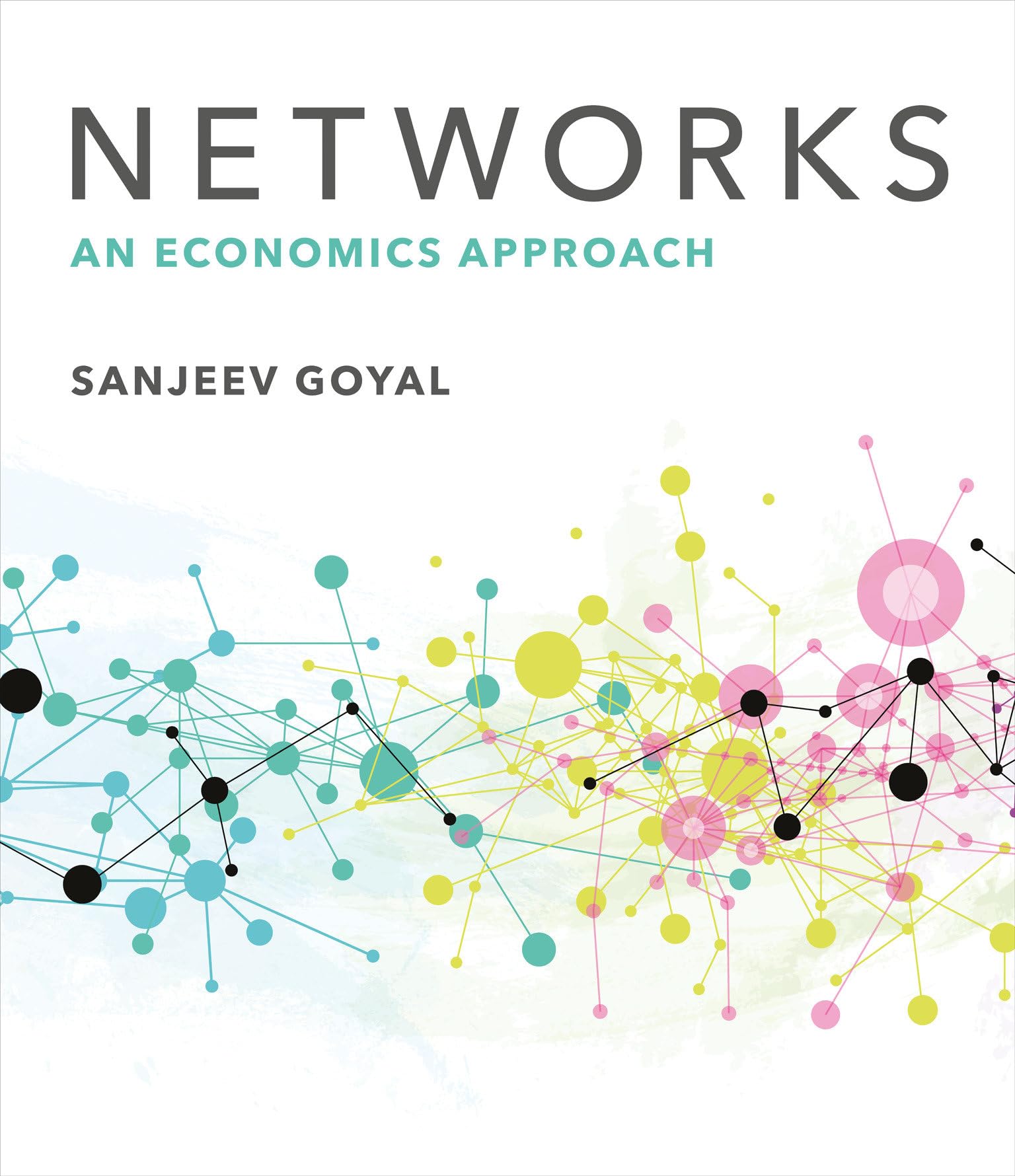
Networks: An Economics Approach: 9780262048033: Economics Books @ desertcart.com Review: The best book on Economics of Networks!! - We live in an in inter-connected, inter-dependent world. Networks are important to understand the spread of ideas and diseases and for finding jobs. They have consequences for war and trade, educational outcomes, crimes and play an important role in cybersecurity. Sanjeev Goyal’s latest book Networks: An Economic Approach provides an excellent comprehensive guide to understanding all these phenomena. The book begins with basics and systematically covers a vast ground. It gives a concise understanding of both the technical mathematical issues while also providing non-technical verbal explanations. On one hand this is a beginner friendly book that starts from the very basics of network theory, while on the other hand it goes deep into the literature providing more complex expositions of the recent developments in the field. While talking about a topic, instead of focusing on a particular paper, the book discusses a number of models on the topic from many different papers and provides numerous examples, thus giving an all-around view. Another great thing about this book is that every chapter is followed by exercises consisting of challenging problems which helps in testing your understanding. Till now it has really difficult to teach a course on networks – one had to rely on a combination of a few textbooks and papers. This book solves that problem - we now have a book to teach a proper networks course. The books is of course great for graduate students, but anyone looking to understand networks through the lens of economics will find this book absolutely vital. It is a must read – not only did I buy a copy for myself but I also got a copy for my two graduate students. If you are familiar with Matt Jackson’s book (which is another excellent book on networks from an economics perspective) then you will find that this book provides a deeper dive into economics topics. The two books complement each other quite well. Incidentally, the book is produced beautifully as well – the colored illustrations make it visually quite appealing too. Review: The book provides a broad and up-to-date coverage of the economics of networks. It has been strongly endorsed by leading scholars in economics, sociology, and computer science. A fascinating book that shows how networks are connected to some of the central ideas in economics, and builds into a far-ranging exploration of how networks operate in the world. Jon Kleinberg, Tisch University Professor, Cornell University Extraordinarily clear and comprehensive, Networks will be an indispensable reference for both students and researchers alike. The text remarkably both distills and details the essential arguments and insights. Rachel Kranton, James B. Duke Professor of Economics, Duke University This fantastic book provides an excellent, highly readable, rigorous introduction to the study of networks. This book is a must-read for anybody interested in the true richness of human interactions. Daron Acemoglu, Institute Professor, MIT All social scientists can learn from Goyal's expansive and beautifully crafted work, a rare but happy balance between technical rigor and the exploration of central economic, political, and social topics. Mark Granovetter, Joan Butler Ford Professor, Department of Sociology, Stanford University Networks is a marvellous distillation of thirty years of progress in one of the most active, interdisciplinary, and exciting areas in social science. Its scope is unmatched. It is indispensable for any scholar working on networks in the social sciences and beyond. Benjamin Golub, Professor of Economics, Northwestern University We are surrounded by networks, often intangible, that shape our opinions, ideas, and actions. Goyal provides a rigorous and accessible guide to understanding how managers and policy makers can incorporate these effects into their strategy. A must-read for anyone interested in business and management studies. Andrea Galeotti, Professor of Economics, London Business School Networks is as stunning in breadth as it is in clarity. Seamlessly integrating mathematical models with empirical data, lab experiments, and fascinating historical accounts, this book could serve as the primary text for a variety of network science courses, both basic and advanced, as well as a valuable resource for researchers. Duncan Watts, Stevens University Professor, University of Pennsylvania Networks of production, financial, transport and other relationships should be at the center of our understanding of the modern economy. This outstanding advanced undergraduate textbook is centered around these networks. Stephen Morris, Peter A. Diamond Professor of Economics, MIT Knowing something about networks is now essential for economists and powerful methods have been developed in recent years for studying them. Sanjeev Goyal is a central figure in the development of these. In Networks, Goyal shares his expertise in a way that will make the ideas accessible to a wide range of backgrounds. It will become a standard reference for years to come. Tim Besley, Professor of Economics and Political Science & W. Arthur Lewis Professor of Development Economics, London School of Economics
| Best Sellers Rank | #480,371 in Books ( See Top 100 in Books ) #44 in Microeconomics (Books) #272 in Theory of Economics |
| Customer Reviews | 4.6 4.6 out of 5 stars (4) |
| Dimensions | 8.25 x 1.63 x 9.31 inches |
| ISBN-10 | 0262048035 |
| ISBN-13 | 978-0262048033 |
| Item Weight | 3.45 pounds |
| Language | English |
| Print length | 824 pages |
| Publication date | April 18, 2023 |
| Publisher | The MIT Press |
S**I
The best book on Economics of Networks!!
We live in an in inter-connected, inter-dependent world. Networks are important to understand the spread of ideas and diseases and for finding jobs. They have consequences for war and trade, educational outcomes, crimes and play an important role in cybersecurity. Sanjeev Goyal’s latest book Networks: An Economic Approach provides an excellent comprehensive guide to understanding all these phenomena. The book begins with basics and systematically covers a vast ground. It gives a concise understanding of both the technical mathematical issues while also providing non-technical verbal explanations. On one hand this is a beginner friendly book that starts from the very basics of network theory, while on the other hand it goes deep into the literature providing more complex expositions of the recent developments in the field. While talking about a topic, instead of focusing on a particular paper, the book discusses a number of models on the topic from many different papers and provides numerous examples, thus giving an all-around view. Another great thing about this book is that every chapter is followed by exercises consisting of challenging problems which helps in testing your understanding. Till now it has really difficult to teach a course on networks – one had to rely on a combination of a few textbooks and papers. This book solves that problem - we now have a book to teach a proper networks course. The books is of course great for graduate students, but anyone looking to understand networks through the lens of economics will find this book absolutely vital. It is a must read – not only did I buy a copy for myself but I also got a copy for my two graduate students. If you are familiar with Matt Jackson’s book (which is another excellent book on networks from an economics perspective) then you will find that this book provides a deeper dive into economics topics. The two books complement each other quite well. Incidentally, the book is produced beautifully as well – the colored illustrations make it visually quite appealing too.
V**E
The book provides a broad and up-to-date coverage of the economics of networks. It has been strongly endorsed by leading scholars in economics, sociology, and computer science. A fascinating book that shows how networks are connected to some of the central ideas in economics, and builds into a far-ranging exploration of how networks operate in the world. Jon Kleinberg, Tisch University Professor, Cornell University Extraordinarily clear and comprehensive, Networks will be an indispensable reference for both students and researchers alike. The text remarkably both distills and details the essential arguments and insights. Rachel Kranton, James B. Duke Professor of Economics, Duke University This fantastic book provides an excellent, highly readable, rigorous introduction to the study of networks. This book is a must-read for anybody interested in the true richness of human interactions. Daron Acemoglu, Institute Professor, MIT All social scientists can learn from Goyal's expansive and beautifully crafted work, a rare but happy balance between technical rigor and the exploration of central economic, political, and social topics. Mark Granovetter, Joan Butler Ford Professor, Department of Sociology, Stanford University Networks is a marvellous distillation of thirty years of progress in one of the most active, interdisciplinary, and exciting areas in social science. Its scope is unmatched. It is indispensable for any scholar working on networks in the social sciences and beyond. Benjamin Golub, Professor of Economics, Northwestern University We are surrounded by networks, often intangible, that shape our opinions, ideas, and actions. Goyal provides a rigorous and accessible guide to understanding how managers and policy makers can incorporate these effects into their strategy. A must-read for anyone interested in business and management studies. Andrea Galeotti, Professor of Economics, London Business School Networks is as stunning in breadth as it is in clarity. Seamlessly integrating mathematical models with empirical data, lab experiments, and fascinating historical accounts, this book could serve as the primary text for a variety of network science courses, both basic and advanced, as well as a valuable resource for researchers. Duncan Watts, Stevens University Professor, University of Pennsylvania Networks of production, financial, transport and other relationships should be at the center of our understanding of the modern economy. This outstanding advanced undergraduate textbook is centered around these networks. Stephen Morris, Peter A. Diamond Professor of Economics, MIT Knowing something about networks is now essential for economists and powerful methods have been developed in recent years for studying them. Sanjeev Goyal is a central figure in the development of these. In Networks, Goyal shares his expertise in a way that will make the ideas accessible to a wide range of backgrounds. It will become a standard reference for years to come. Tim Besley, Professor of Economics and Political Science & W. Arthur Lewis Professor of Development Economics, London School of Economics