
下载应用程序


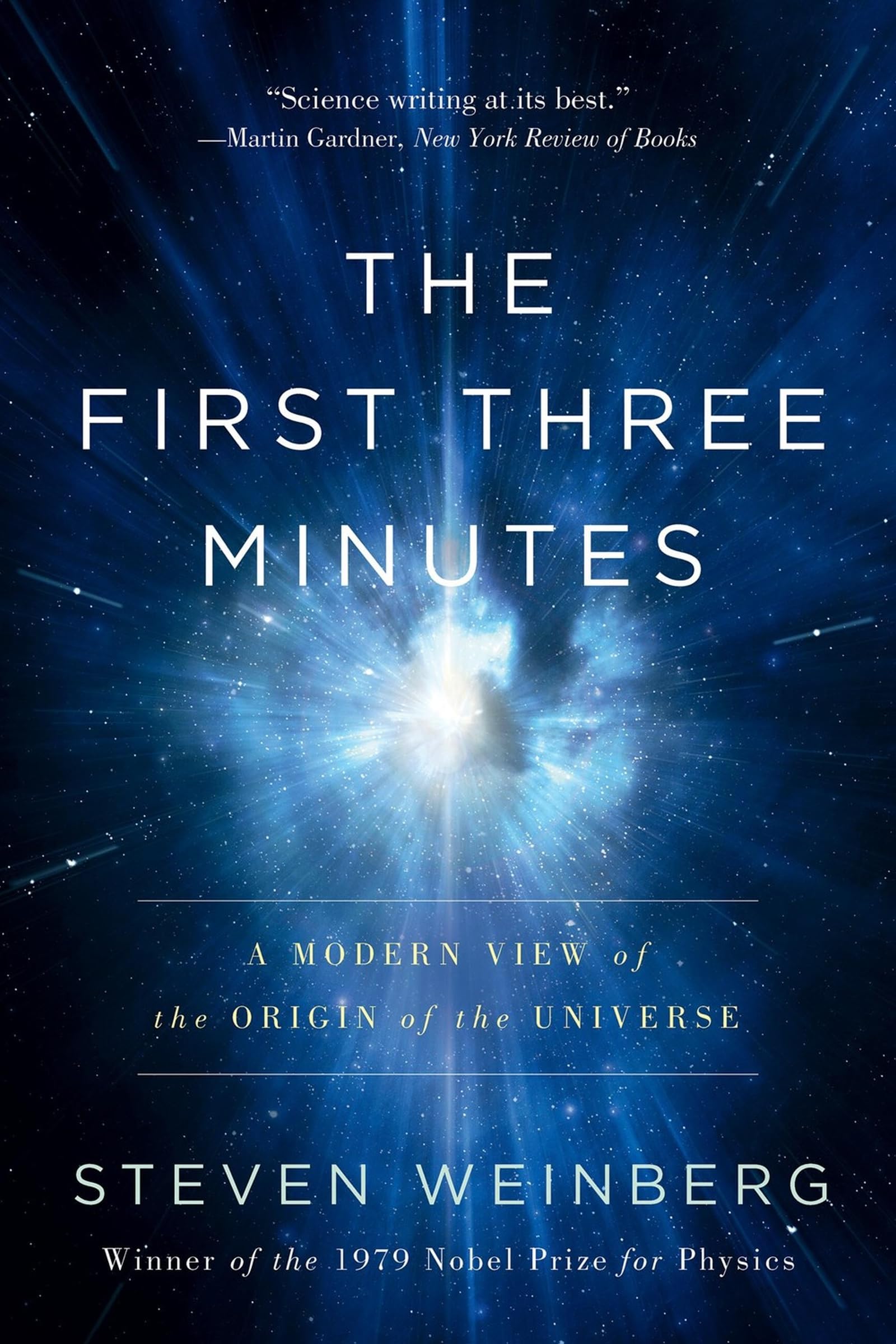
Buy The First Three Minutes: A Modern View Of The Origin Of The Universe on desertcart.com ✓ FREE SHIPPING on qualified orders Review: Black-Body Radiation - Published in 1977 "The First Three Minutes" was an immediate hit with the general lay-public, from teens to adults, and instantly reset the bar for quality science writing for all science books that followed. Written by American theoretical physicist and future Nobel Laureate Steven Weinberg, it introduces the wonders of Cosmology and Physics to "anyone willing to puzzle through some detailed arguments", in this he was eminently successful. In the 1993 edition he wrote a new preface and an "Afterword: Cosmology Since 1977" in which he updates some features of the book, but, for the most part, the main text was left pretty much as is. Though written for interested layperson the book also attracted a lot of attention among his professional colleagues as well and has continued to do so up to the present day. It's not surprising to find Weinberg and/or "The First Three Minutes" referenced in moderne day books by Brian Greene, Michio Kaku, Stephen Hawking and Carl Sagan along with a host of others. Be that as it may, there have been a lot of changes in this branch of Physics, new research and observations have altered the way we look at The Big Bang and the first few minutes of our universe. In spite of these modern alterations the original theory's basic tenet is still valid. Any "stale dated" issues that may or may not be present should not alter the benefits of this book for the general reader. Just keep in mind when the book was written and use that as a jumping off place for more recent works. Dr Weinberg's writing is smooth and entertaining while keeping the scientific jargon and mathematical underpinnings to a minimum. To help the reader understand what science thinks the first minutes were really like Dr Weinberg provides an overview of some other Cosmological properties like; the expansion of the universe, the cosmic microwave background radiation, thermal equilibrium and absolute time units. In the latter half of the book Weinberg takes a brief look at the human side of physics history, specifically the mystery of why it took so long to discover the CMB, he also engages in a little bit of self-criticism as to his part in that long delay. With this background info the reader is ready to tackle the Big Bang's first three minutes and on down to the first one-hundredth second. Modern day theories didn't just come out of nowhere, fully formed and ready to go, they got their start in the minds of forward thinking scientist who often contemplate possible explanations for their observations and research. In reading the 1977 text I noticed a few hints of Things To Come. As the universe expanded there was some indication of a unknown force pushing space outward while some kind of invisible matter seemed to be slowing it down (dark energy and matter?). Weinberg mentions isolated patches of space that were like "Domains" with different rates of expansion and he poses a question: Do we live in one of those Domains? (Sounds like the Multiverse to me). While Weinberg doesn't mention things like Dark Matter/Energy or alternate Universes in the original text he does cover those issues in the 1993 update as well as other modern concepts like String Theory and a kind of super-space filled with a bubbly froth of different universes/dimensions. From this interested layman's point of view "The First Three Minutes" is an important look back at where modern science has come from and where it's going in the future as new research and observations lead us down some previously untraveled roads to a new world-view and a different way of looking at the universe around us. I had no technical or formatting problems with this Kindle edition. Last Ranger Review: qualitative exposition: with a bit of history alongside physics - I review the first hardcover printing (1977, which includes ten-page mathematical supplement). My first reading of this book occurred 1977. My second reading of the book occurred 2017. I wanted to re-read this book ! Between those two years (1977 and 2017) much has transpired: my background education and cosmological research. Regarding my education, I have had the pleasure of studying from Steven Weinberg's great textbooks (beginning with Gravitation and Cosmology and concluding with his Lectures On Quantum Mechanics). Regarding Cosmology, I am young enough (and old enough) to have witnessed the birth of string theory and inflation theory, plus the discoveries of Higgs boson and gravitational waves. There is still 'dark energy' to contend with ! Be that as it may, Steven Weinberg's " First Three Minutes" is the first serious introduction to Cosmology I ever read. It still excites me (that is, the book and Cosmology) ! Let me quote from Steven Weinberg: (1) "...an explosion which occurred simultaneously everywhere, filling all space from the beginning, with every particle rushing apart from every other particle."(page 5). Think about how often this concept, this 'Big Bang' gets muddled in the classroom discussions. Many have failed to read this line ! (2) "However, even if it is eventually supplanted, the standard model will have played a role of great value in the history of Cosmology." (page 9). Think about how often many fail to underscore the provisional nature of theories ! Steven Weinberg is well aware of limitations of physical theory. (3) Read: "As often happens in science, this argument can be used both forward and backward," and "if the universe is isotropic around every point, it is necessarily also homogeneous." (page 23). You have a masterful educator presenting subtleties. Kinematics occupied initial thirty pages, dynamics (Newton and Einstein) begins page 31, and we now know that this will need emendation... (4) Read: "The galaxies are not rushing apart because of some mysterious force that is pushing them apart, rather, the galaxies are moving apart because they were thrown apart by some sort of explosion in the past." (page 35). (5) "No signal can travel faster than the speed of light, so at any time we can only be affected by events occurring close enough so that a ray of light would have had time to reach us since the beginning of the Universe." (page 41). The concepts causality and horizon, thus introduced. (6) Chapter three, Cosmic Microwave Radiation Background, is a favorite. Weinberg's terminology "background radio static" is apt. Weinberg writes-out 'degrees Kelvin,' which, I believe is redundant (one need not write 'degrees' ). Read: "...although in a sense the Universe was expanding very rapidly at first, to an individual photon or electron or nucleus, the expansion was taking plenty of time---time enough for each particle to be scattered or absorbed or re-emitted many times as the Universe expanded. (page 55). It is here where the concept of thermal equilibrium is introduced and it is here where the topic of statistical mechanics first charmed me ! We learn that, strictly speaking "temperature" is only defined for thermal equilibrium and "it is crucial to the argument of this book that the Universe has once passed through a state of thermal equilibrium." (page 56). Much Physics in that one line ! (7) Photons, Black-Body Radiation, Stefan-Boltzmann Law, Planck's Energy Quanta: Chapter Three presents a veritable qualitative course in modern physics. We meet our friend Rainier Weiss (2017 Physics Nobel Prize Laureate). (8) Read: "Eventually, as we look farther and farther back into the history of the Universe, we come to a time when the temperature was so high that collisions of photons with each other could produce material particles out of pure energy." That is a first hint of quantum field theory, read: "to every type of particle in nature, there is a corresponding antiparticle." (page 82 ). Next: "it is the balance between the gravitational field and the outward momentum of the contents of the Universe that governs the rate of expansion." Finally, the conserved quantities electric charge, baryon number and lepton number are described (page 92, chapter four). An introduction to particle physics ! (9) The first hundred pages have been preparation for chapter five: The First Three Minutes. It is here where it is all put together, assembled. Weinberg discusses neutrino background, among other things. Read his concluding words: "the appropriate response to such uncertainties is not to scrap the standard model, but rather to take it very seriously and to work out its consequences thoroughly, if only in the hope of turning up a contradiction with observation. (page 120). Words spoken by an honest scientist ! (10) "The present Universe is so cold that the symmetries among the different particles have been obscured by a kind of freezing; they are not manifest in ordinary phenomena, but have to be expressed mathematically, in our gauge field theories." (page 149). Yet another clue ! The book is completed. There is an eight page Glossary (always helpful) and a ten page mathematical supplement. That supplement includes: doppler effect, critical density, expansion time scales, black-body radiation, Jeans mass, neutrino temperature and density (using algebra and introductory physics). The supplement itself could be utilized for teaching, but being only ten pages the discussion needs to be amplified by the reader. References for further reading concludes the book. Among those references are textbooks which every physicist should study: Gravitation (Misner, Thorne, Wheeler), Large Scale Structure of Space-Time (Hawking and Ellis), Gravitation and Cosmology (Weinberg's own monograph). Returning to "The First Three Minutes"--there is plenty enough in this book to keep you thinking !
| ASIN | 0465024378 |
| Best Sellers Rank | #85,677 in Books ( See Top 100 in Books ) #61 in Astronomy (Books) #62 in Astrophysics & Space Science (Books) #78 in Cosmology (Books) |
| Customer Reviews | 4.3 4.3 out of 5 stars (733) |
| Dimensions | 5.3 x 1 x 8 inches |
| Edition | Updated |
| ISBN-10 | 9780465024377 |
| ISBN-13 | 978-0465024377 |
| Item Weight | 6.4 ounces |
| Language | English |
| Print length | 224 pages |
| Publication date | August 18, 1993 |
| Publisher | Basic Books |
L**R
Black-Body Radiation
Published in 1977 "The First Three Minutes" was an immediate hit with the general lay-public, from teens to adults, and instantly reset the bar for quality science writing for all science books that followed. Written by American theoretical physicist and future Nobel Laureate Steven Weinberg, it introduces the wonders of Cosmology and Physics to "anyone willing to puzzle through some detailed arguments", in this he was eminently successful. In the 1993 edition he wrote a new preface and an "Afterword: Cosmology Since 1977" in which he updates some features of the book, but, for the most part, the main text was left pretty much as is. Though written for interested layperson the book also attracted a lot of attention among his professional colleagues as well and has continued to do so up to the present day. It's not surprising to find Weinberg and/or "The First Three Minutes" referenced in moderne day books by Brian Greene, Michio Kaku, Stephen Hawking and Carl Sagan along with a host of others. Be that as it may, there have been a lot of changes in this branch of Physics, new research and observations have altered the way we look at The Big Bang and the first few minutes of our universe. In spite of these modern alterations the original theory's basic tenet is still valid. Any "stale dated" issues that may or may not be present should not alter the benefits of this book for the general reader. Just keep in mind when the book was written and use that as a jumping off place for more recent works. Dr Weinberg's writing is smooth and entertaining while keeping the scientific jargon and mathematical underpinnings to a minimum. To help the reader understand what science thinks the first minutes were really like Dr Weinberg provides an overview of some other Cosmological properties like; the expansion of the universe, the cosmic microwave background radiation, thermal equilibrium and absolute time units. In the latter half of the book Weinberg takes a brief look at the human side of physics history, specifically the mystery of why it took so long to discover the CMB, he also engages in a little bit of self-criticism as to his part in that long delay. With this background info the reader is ready to tackle the Big Bang's first three minutes and on down to the first one-hundredth second. Modern day theories didn't just come out of nowhere, fully formed and ready to go, they got their start in the minds of forward thinking scientist who often contemplate possible explanations for their observations and research. In reading the 1977 text I noticed a few hints of Things To Come. As the universe expanded there was some indication of a unknown force pushing space outward while some kind of invisible matter seemed to be slowing it down (dark energy and matter?). Weinberg mentions isolated patches of space that were like "Domains" with different rates of expansion and he poses a question: Do we live in one of those Domains? (Sounds like the Multiverse to me). While Weinberg doesn't mention things like Dark Matter/Energy or alternate Universes in the original text he does cover those issues in the 1993 update as well as other modern concepts like String Theory and a kind of super-space filled with a bubbly froth of different universes/dimensions. From this interested layman's point of view "The First Three Minutes" is an important look back at where modern science has come from and where it's going in the future as new research and observations lead us down some previously untraveled roads to a new world-view and a different way of looking at the universe around us. I had no technical or formatting problems with this Kindle edition. Last Ranger
G**Y
qualitative exposition: with a bit of history alongside physics
I review the first hardcover printing (1977, which includes ten-page mathematical supplement). My first reading of this book occurred 1977. My second reading of the book occurred 2017. I wanted to re-read this book ! Between those two years (1977 and 2017) much has transpired: my background education and cosmological research. Regarding my education, I have had the pleasure of studying from Steven Weinberg's great textbooks (beginning with Gravitation and Cosmology and concluding with his Lectures On Quantum Mechanics). Regarding Cosmology, I am young enough (and old enough) to have witnessed the birth of string theory and inflation theory, plus the discoveries of Higgs boson and gravitational waves. There is still 'dark energy' to contend with ! Be that as it may, Steven Weinberg's " First Three Minutes" is the first serious introduction to Cosmology I ever read. It still excites me (that is, the book and Cosmology) ! Let me quote from Steven Weinberg: (1) "...an explosion which occurred simultaneously everywhere, filling all space from the beginning, with every particle rushing apart from every other particle."(page 5). Think about how often this concept, this 'Big Bang' gets muddled in the classroom discussions. Many have failed to read this line ! (2) "However, even if it is eventually supplanted, the standard model will have played a role of great value in the history of Cosmology." (page 9). Think about how often many fail to underscore the provisional nature of theories ! Steven Weinberg is well aware of limitations of physical theory. (3) Read: "As often happens in science, this argument can be used both forward and backward," and "if the universe is isotropic around every point, it is necessarily also homogeneous." (page 23). You have a masterful educator presenting subtleties. Kinematics occupied initial thirty pages, dynamics (Newton and Einstein) begins page 31, and we now know that this will need emendation... (4) Read: "The galaxies are not rushing apart because of some mysterious force that is pushing them apart, rather, the galaxies are moving apart because they were thrown apart by some sort of explosion in the past." (page 35). (5) "No signal can travel faster than the speed of light, so at any time we can only be affected by events occurring close enough so that a ray of light would have had time to reach us since the beginning of the Universe." (page 41). The concepts causality and horizon, thus introduced. (6) Chapter three, Cosmic Microwave Radiation Background, is a favorite. Weinberg's terminology "background radio static" is apt. Weinberg writes-out 'degrees Kelvin,' which, I believe is redundant (one need not write 'degrees' ). Read: "...although in a sense the Universe was expanding very rapidly at first, to an individual photon or electron or nucleus, the expansion was taking plenty of time---time enough for each particle to be scattered or absorbed or re-emitted many times as the Universe expanded. (page 55). It is here where the concept of thermal equilibrium is introduced and it is here where the topic of statistical mechanics first charmed me ! We learn that, strictly speaking "temperature" is only defined for thermal equilibrium and "it is crucial to the argument of this book that the Universe has once passed through a state of thermal equilibrium." (page 56). Much Physics in that one line ! (7) Photons, Black-Body Radiation, Stefan-Boltzmann Law, Planck's Energy Quanta: Chapter Three presents a veritable qualitative course in modern physics. We meet our friend Rainier Weiss (2017 Physics Nobel Prize Laureate). (8) Read: "Eventually, as we look farther and farther back into the history of the Universe, we come to a time when the temperature was so high that collisions of photons with each other could produce material particles out of pure energy." That is a first hint of quantum field theory, read: "to every type of particle in nature, there is a corresponding antiparticle." (page 82 ). Next: "it is the balance between the gravitational field and the outward momentum of the contents of the Universe that governs the rate of expansion." Finally, the conserved quantities electric charge, baryon number and lepton number are described (page 92, chapter four). An introduction to particle physics ! (9) The first hundred pages have been preparation for chapter five: The First Three Minutes. It is here where it is all put together, assembled. Weinberg discusses neutrino background, among other things. Read his concluding words: "the appropriate response to such uncertainties is not to scrap the standard model, but rather to take it very seriously and to work out its consequences thoroughly, if only in the hope of turning up a contradiction with observation. (page 120). Words spoken by an honest scientist ! (10) "The present Universe is so cold that the symmetries among the different particles have been obscured by a kind of freezing; they are not manifest in ordinary phenomena, but have to be expressed mathematically, in our gauge field theories." (page 149). Yet another clue ! The book is completed. There is an eight page Glossary (always helpful) and a ten page mathematical supplement. That supplement includes: doppler effect, critical density, expansion time scales, black-body radiation, Jeans mass, neutrino temperature and density (using algebra and introductory physics). The supplement itself could be utilized for teaching, but being only ten pages the discussion needs to be amplified by the reader. References for further reading concludes the book. Among those references are textbooks which every physicist should study: Gravitation (Misner, Thorne, Wheeler), Large Scale Structure of Space-Time (Hawking and Ellis), Gravitation and Cosmology (Weinberg's own monograph). Returning to "The First Three Minutes"--there is plenty enough in this book to keep you thinking !
A**H
Liked it, bit dated.
I enjoyed reading this book and appreciated its detailed approach to cosmology. However, it does feel a bit dated compared to more recent publications. For someone looking to gain a general understanding of cosmology, I’d recommend exploring newer books for updated insights. This book leans more on mathematical explanations than popular works like Stephen Hawking’s general books, so it’s better suited for readers comfortable with equations. Still, it’s a good resource for those wanting a deeper dive into the subject.
C**.
Un libro ameno y muy interesante. Lectura muy recomendable. Una dosis concentrada de cultura y conocimientos para disfrutar de la lectura.
S**A
I am a physicist and I really enjoied how this book explains the history of the Universe from the beginning, focusing also on the observative data that suggested us the standard model of the Big Bang. Reading this book you can see how the standard model explains all the observations and you can see in which fiele soffrire cosmology did we have to work in late 1970s, when the book was written. There is also an appendix in which Weinberg shows the progresses done from 1970s to 1993. The book is old and it does not contain very recent discoveries in cosmology, lime the acceleration of the expansion or the maps of the CMB, but it gives a very nice overview of the main topics in cosmology. As a teacher of physics I think that the book can be read by an interested secondary school student. The explanations are clear and do not need any specific knowledge in physics, astronomy or maths.
R**N
Steven Weinberg is one of the luminaries of the quantum mechanics world, so how did he write about cosmology? Very well. Much of tyne book is speculation, but when you go so close to God (creation) how can you say anything with certainty? Well conservation laws still apply (or assumed to apply), and you can assume by model that universe was a tiny ball, this leads to some rather interesting conclusions. Want to hear about Creation and something more specific than 'big bang', then there's no better book than this. Note that they're are no equations here. This is not a substitute for narlikar or other cosmology textbooks, but is a popular science read, and is not from a popular science writer but an extremely accomplished physicist. Note 2: it was written in 1978,but standard model hasn't changed, for string theory based popular science books (not fully accepted by scientific community), you may want to check out michio kaku
C**S
A very clear explanation of the facts and a good speculation of what was about to happen next. What is fascinating is that Weinberg asks questions that he couldn't have answered back then, but that led to a lot of the outcome as has been proven experiment today. Sometimes the question is more important than the answer itself.
J**S
ESTE LIBRO ES UN PARTE AGUAS EN LA LITERATURA CIENTÍFICA, NOS DA CONOCER LO QUE PUDO HABER OCURRIDO DENTRO DE LOS 3 PRIMEROS MINUTOS DEL UNIVERSO, TODO ESTO SIN FANTASÍAS, SOLO CIENCIA.
TrustPilot
2 周前
2 个月前