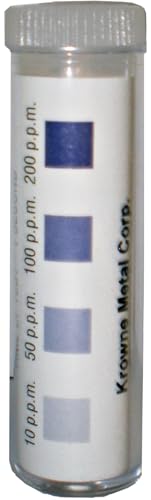

Krowne Chlorine Test Strips, 100 Piece : desertcart.in: Health & Personal Care Review: Simple and classic but still the best solution. The plastic case is also good to avoid moisture Review: I regularly make my own chlorine bleach. Sodium hypochlorite (household liquid bleach) degrades over time and has a shelf life of about 3-5 months. Rather than stock up on bleach only to have it deteriorate over time, I buy pool shock (calcium hypochlorite) and use it to mix up a fresh batch of bleach as needed. I not only have the ability to store extra bleach without having to worry about the shelf life, but I also save a lot of money - a 1 lb package of pool shock is about $4, which can make A LOT of gallons of bleach. I wanted to test the strength of my bleach after it was diluted in a gallon of water to make sure the concentration was correct. I suspected that the most recent gallon I made was not strong enough, and I used these test strips to confirm my suspicion. After adding a bit more calcium hypochlorite to the solution, I was able to get the concentration correct; the test strips were noticeably darker and easy to read. (Just to be clear, I was testing the gallon of water that I'd added bleach to, not the bleach directly). Keep in mind that these test strips are not designed to test chlorine levels in tap water; if that's your purpose, then you need to buy a different product; this type of test strip is designed to measure levels of chorine in different dilutions (added to water) so that you know there is enough to sanitize or disinfect surfaces. For most microorgansims (bacteria and viruses), a level of 200 ppm is considered adequate. For killing mold, a higher concentration is necessary (I believe 2,000 ppm). The CDC has a really helpful list of how many ppm of bleach is required to kill various pathogens. I am very pleased with these test strips; they were easy to use and allowed me to verify the strength of my solution. I also found that I was able to rip a test strip in half so that I can make them last even longer. If you have any questions, I'm happy to try to help. Please consider leaving me feedback below if you found this review helpful.

| ASIN | B003Z9HWQ8 |
| Are batteries included? | No |
| Best Sellers Rank | #481,948 in Health & Personal Care ( See Top 100 in Health & Personal Care ) #50 in Ketone Test Strips |
| Brand | Krowne |
| Customer Reviews | 4.2 4.2 out of 5 stars (339) |
| Date First Available | 10 January 2015 |
| Item Dimensions LxWxH | 10.2 x 1.3 x 7.6 Centimeters |
| Item Height | 3 Inches |
| Item Weight | 10 g |
| Item Width | 0.5 Inches |
| Item model number | S25-123 |
| Model number | S25-123 |
| Product Dimensions | 10.16 x 1.27 x 7.62 cm; 10 g |
| Voltage | 1 Volts |
K**N
Simple and classic but still the best solution. The plastic case is also good to avoid moisture
A**I
I regularly make my own chlorine bleach. Sodium hypochlorite (household liquid bleach) degrades over time and has a shelf life of about 3-5 months. Rather than stock up on bleach only to have it deteriorate over time, I buy pool shock (calcium hypochlorite) and use it to mix up a fresh batch of bleach as needed. I not only have the ability to store extra bleach without having to worry about the shelf life, but I also save a lot of money - a 1 lb package of pool shock is about $4, which can make A LOT of gallons of bleach. I wanted to test the strength of my bleach after it was diluted in a gallon of water to make sure the concentration was correct. I suspected that the most recent gallon I made was not strong enough, and I used these test strips to confirm my suspicion. After adding a bit more calcium hypochlorite to the solution, I was able to get the concentration correct; the test strips were noticeably darker and easy to read. (Just to be clear, I was testing the gallon of water that I'd added bleach to, not the bleach directly). Keep in mind that these test strips are not designed to test chlorine levels in tap water; if that's your purpose, then you need to buy a different product; this type of test strip is designed to measure levels of chorine in different dilutions (added to water) so that you know there is enough to sanitize or disinfect surfaces. For most microorgansims (bacteria and viruses), a level of 200 ppm is considered adequate. For killing mold, a higher concentration is necessary (I believe 2,000 ppm). The CDC has a really helpful list of how many ppm of bleach is required to kill various pathogens. I am very pleased with these test strips; they were easy to use and allowed me to verify the strength of my solution. I also found that I was able to rip a test strip in half so that I can make them last even longer. If you have any questions, I'm happy to try to help. Please consider leaving me feedback below if you found this review helpful.
L**A
I use these to check for remaining bleach after sanitizing my well or after changing whole house filters and sanitizing. Cost effective.
G**L
Test the amount of chlorine mandatory in a mobile food establishment
D**N
I used these to chlorinate my well. Works very well. I was able to get an exact parts per million reading.