We remain fully operational. Our teams are working around the clock to ensure your deliveries continue safely.

下载应用程序


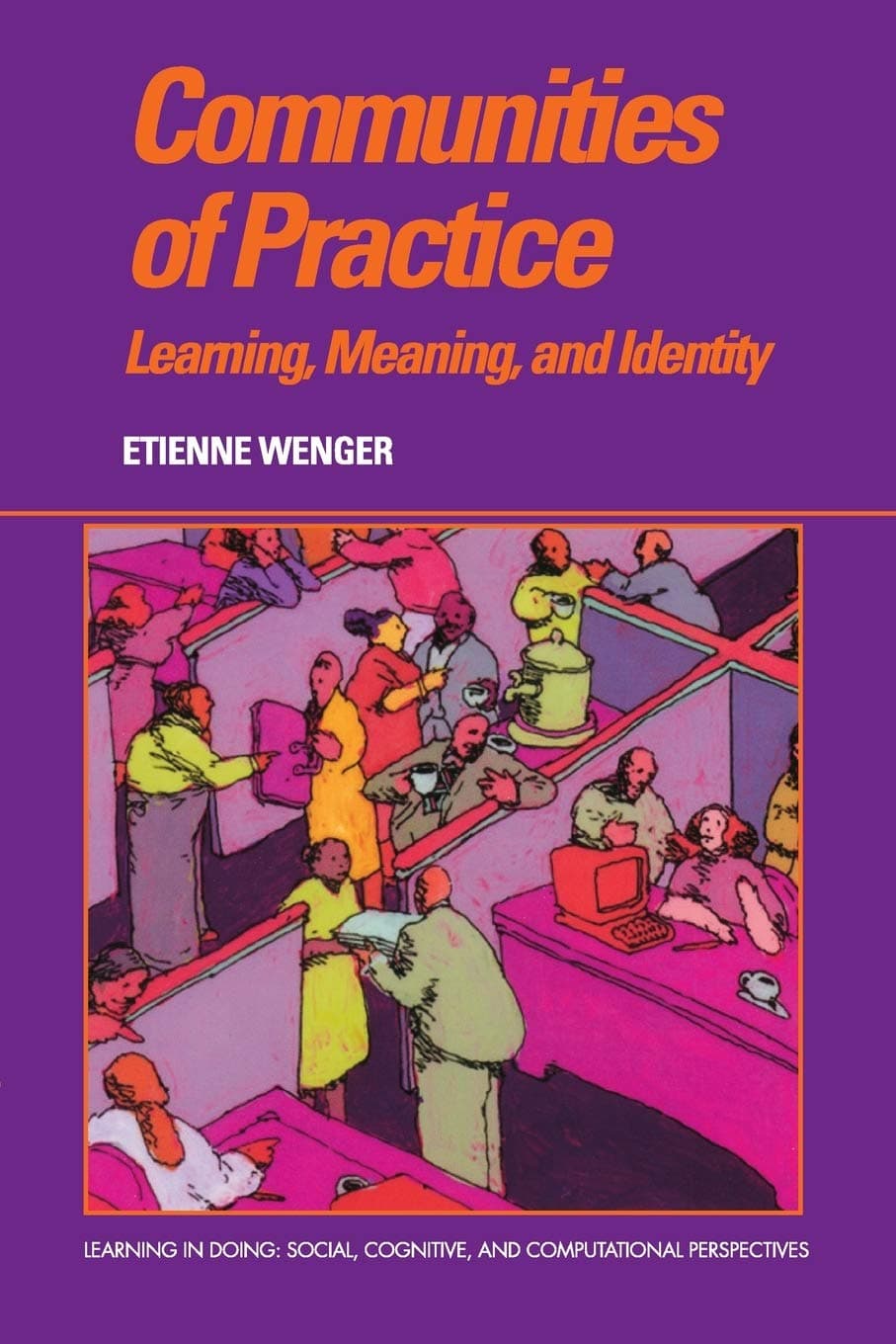
Buy Communities of Practice: Learning, Meaning, and Identity by Wenger, Etienne online on desertcart.ae at best prices. ✓ Fast and free shipping ✓ free returns ✓ cash on delivery available on eligible purchase. Review: Cet ouvrage est très intéressant pour tous les sociologues et anthropologues! Mais achetez le en français, ce sera tout de même plus compréhensible ;) Review: As new. It was wonderful! No marks at all in the book! :D
| ASIN | 0521663636 |
| Best Sellers Rank | #160,820 in Books ( See Top 100 in Books ) #310 in Medical Social Psychology & Interactions #482 in Cognitive Psychology (Books) #503 in Popular Social Psychology & Interactions |
| Customer Reviews | 4.5 4.5 out of 5 stars (137) |
| Dimensions | 6 x 0.76 x 9 inches |
| Edition | 1st |
| ISBN-10 | 9780521663632 |
| ISBN-13 | 978-0521663632 |
| Item Weight | 1.05 pounds |
| Language | English |
| Print length | 336 pages |
| Publication date | September 28, 1999 |
| Publisher | Cambridge University Press |
M**E
Cet ouvrage est très intéressant pour tous les sociologues et anthropologues! Mais achetez le en français, ce sera tout de même plus compréhensible ;)
Z**N
As new. It was wonderful! No marks at all in the book! :D
E**R
もともと、私たち自身、家族、仕事場、友達など複数のコミュニティと通していろいろな知識やスキルをまなんでいる。そしてコミュニティへの参加は、自分の関心、知識の有無、社会的状況などの影響により中心的または周辺的におこなわれている。この絶え間ない連鎖によって、思想や知識、それに対する実践が再構築されていくのである。 この本は、上記のように人間の成長(社会の構成、構築)を人間のコミュニティへの参入という形を描きながら、主張しているのである。教育に関心あるものは読んでおいても損はないであろう。
D**S
This book was a slow, arduous read, but well worth the effort. I teach at a school that is part of the Professional Learning Communities (PLC) movement. Wenger's book has shed light on why "top-down" implementation of school improvement has failed. The guru of the PLC movement, Richard Dufour (2004), claims that the three big ideas of PLC's are ensuring that students learn, a culture of collaboration and a focus on results. It is in this context that I found Wenger's book valuable in understanding the poverty of the PLC movement. Wenger claims that communities of practice are learning communities. Are Professional Learning Communities true learning communities as described by Wenger? The answer is no. In a learning community there is interplay between reification and participation. Reification is the artifacts and procedures of previous practice. Participation is the activity engaged in by the practitioner for the organization that results in reification. It is not an either/or model, but dualism. It is within this interplay that learning about practice and the ownership of meaning and identity formation takes place. Teachers directed by their employer to become PLCs are required to make such large changes in their teaching practices that they become overwhelmed and lost in establishing new practices. The reason for this is that the PLC regime does not consider the requisite identity work and the time required for teachers to own the meaning of new practices. PLCs are not true learning communities. What about schools? Wenger claims a community of practice emerges when an organization sets forth a structure to accomplish its goal: "... the existence of a community of practice is a response to an institutional mandate, it is not the mandate that produces the practice, it is the community" (p. 244). The practices in which teachers are engaged are developed over time in the process of reification and participation. Schools represent an effort to manage learning and the acquisition of knowledge regardless of public policy statements. PLCs represent an extreme example of knowledge management by viewing students as disembodied intellects. There is no consideration given to the identity formation of students. According to the PLC mantra, teachers should lead the learning process so that students learn more. Under the PLC regime students can repeat information given and are deemed to have acquired essential learning. However, according to Wenger, unless the student owns the meaning of what is learned, it is not true learning (p. 265). Wenger rightly judges that "Learning and teaching are not inherently linked. Much learning takes place without teaching, and indeed much teaching takes place without learning" (p. 266). Because teaching cannot control its own effects, Wenger advocates that teachers must be opportunistic and work at recognizing the "...emergent character of learning" (p. 267). Wenger advocates developing architecture for learning. This architecture will afford for the three modes of belonging: engagement, imagination and alignment. The interplay and trade-offs allow for identity formation and the acquisition of meaningful knowledge. He further describes the dimensions for learning architecture. These dimensions are found in the dualities of participation/reification, designed/emergent, local global and identification/negotiability (p. 231-236). The reader will find some of Wenger's theory (along with other theorists) reflected in Gherardi's Organizational Knowledge: The Texture of Workplace Learning (Organization and Strategy) and Mitchell and Sackney's Sustainable Improvement . Wenger's book is well worth reading for those in public education who want to better understand the phantom of learning in school. Dr. John Merks Teacher Riverview High School Riverview New Brunswick
E**A
Arrived in new condition.
TrustPilot
4天前
1 个月前