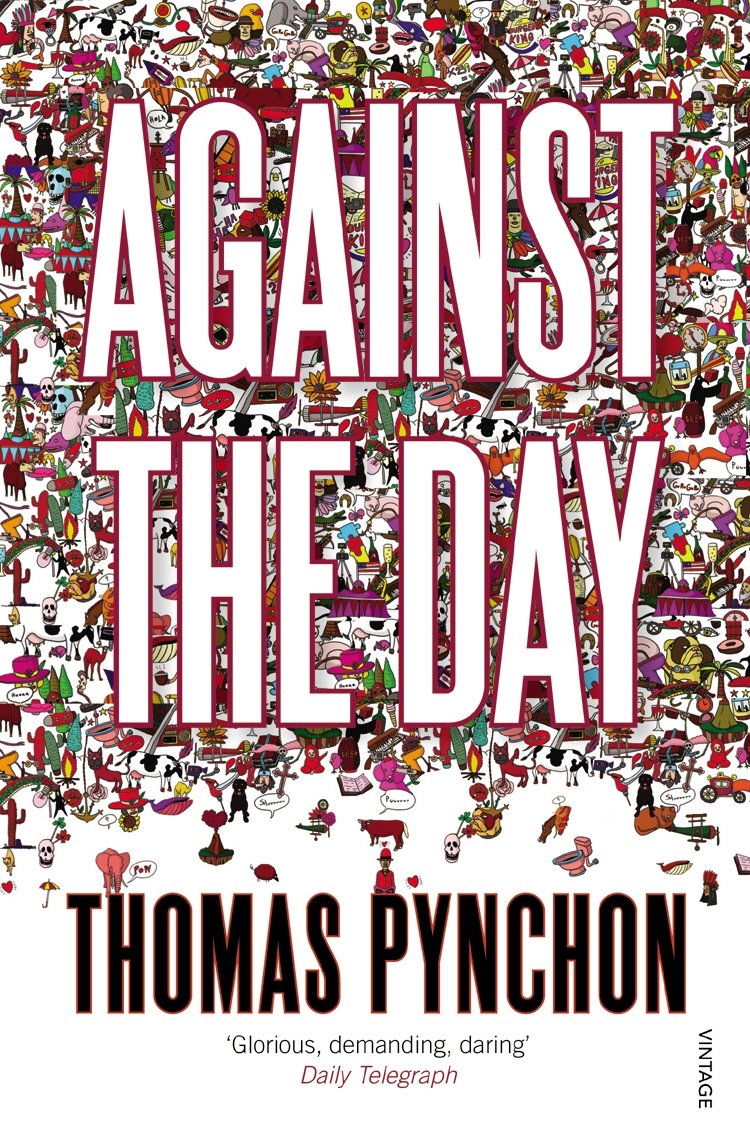
Against the Day

T**N
Brilliant introduction to Pynchon
Had never read Pynchon before hearing a chance reference to the brilliance of his prose and boy did this live up to it. Some reviews compare it unfavourably with his older stuff, which I haven't read. But this vast sprawling wildly surreal epic washed over me like a tidal wave. It's not remotely like Ulysses - but in a similar way the enjoyment of swimming through its language is as much about the travelling as the destination. The tone is resonantly anti capitalist, and ranges from gripping suspense through erudite humour to the lyrically evocative and the deviantly erotic. And yet the going isn't as heavy as that all sounds. Though Pynchon is spitting feathers wherever he depicts the brutal exploitation of the have-nots by the haves, much of the time he is giving free rein to a life-affirming & exuberant sense of fun.NB: I bought and enjoyed this on audiobook first and listened to it over six weeks or so - the prose is so dense and resonant that it bears repeated listening. Would warmly recommend it as a way into this novel - Dick Hill's narration is masterful. On the second time through it was clear that I was still missing so much that I bought the printed book as well.
M**D
Magnificent Pynchon epic which is surprisingly accessible
I freely admit I struggled a little with Gravity's Rainbow and Mason & Dixon. There were times reading those books when I couldn't really figure out what was going on. So before reading Against the Day, the Pynchon book I'd enjoyed the most was The Crying of Lot 49. In my opinion, ATD is just as accessible as TCOL49. It's just so much longer, which equals so much more fun.It's so filled with great ideas it's mindblowing. At times you read 10 pages and you feel like there was enough material there for an entire novel. And then it's onto the next 10 pages.Recently I was reading Infinite Jest by David Foster Wallace (clearly influenced by Pynchon). I started off a little overwhelmed by how much reading I had in front of me. Then about 60% of the way through it dawned on me just how damned good the book was and I regretted not really truly savouring the book from the beginning. A similar thing happened to me with Against the Day, but this time with reference to all the Pynchon books I'd previously read. This was the moment that's going to send me back to read all of them again.
M**Y
Awesome novel by an awesome writer
Awesome novel by an awesome writer. A proper mind-bender that takes stamina to keep up with but is definitely worth it.
G**S
Being a review of "Against the Day;" incorporating certain suggestions for reading Pynchon
Thomas Pynchon's "Against the Day," published in 2006, is quite a doorstopper at no less than 1220 pages in this paperback edition. It follows the fortunes of probably about 30 main characters, whose paths are interlinked in various ways, and it spans the period 1898 to after the end of the First World War. In scope, as well as in size, it is massive, as it attempts a sort of alternative history of the period, encompassing the Mexican Revolution, the burgeoning trade union movement, the struggles in the Balkans, and much else. Of especial interest to Pynchon is Capitalism, and its increasing stranglehold on the world's economy at this time. Pynchon sees Capitalism as exalting the ruthless and crushing the innocent, its evil personified in the character of Scarsdale Vibe. Pynchon's critique of Capitalism is detailed and considered, and even when not being directly addressed, its spectre haunts many of the events of the book. But there are many other strands to this gargantuan work: expositions on the work of electrical engineer Nikola Tesla, and very complex discussions of the nature of light, for example. Also explorations of the ideas of time-travel and bilocation, and technical descriptions of the processes involved. Not being scientifically-minded, I was somewhat lost during these sections, but that is to be expected with Pynchon, whose books often contain passages of Engineering, Physics and various areas of Mathematics(in this book, principally vectors). Pynchon also gives evidence of great knowledge of History, languages and a technical knowledge of Music. The density and ambition of his prose is staggering. But Pynchon is also the most natural of writers, his style is immediately recognisable, combining the stately with the slangy, as one of the reviews quoted on the cover says ("Against the Day" shows a definite Dickensian influence on the style, to my mind). He is also very funny; he is not primarily a comic writer but he employs comedy frequently throughout his work, sometimes in surprising contexts, and almost always with great success. He is a rare thing: a writer who can make you laugh out loud."Against the Day," though Pynchon's longest work, is not his most difficult, I would say. It is easier to follow than "Gravity's Rainbow." Although there are many inexplicable elements to the plot(including the supernatural) , the characters are all following a definite arc so once you have memorised and can distinguish them the story can be followed quite easily in general terms, though certain specifics cause confusion. The best thing to do, I feel, is just to keep reading, there is no need to understand it all. There is plenty to be gained by taking what one can get and leaving the rest for, possibly, a rereading, or just leaving it for the post grads and literary critics. I think this goes for all Pynchon's longer works. My recommendation would be to read his debut, "V," first. Sure, Pynchon's most recent novel, "Inherent Vice" is more accessible, but it's not particularly Pynchonian. Reading it will give little insight into why Pynchon has attained the stature he has. "V" is complex, multi-stranded and enigmatic, without being wilfully confusing in the manner of Pynchon's most famous work, "Gravity's Rainbow". It made it clear at once that here was a writer with a completely original voice, and a purely personal vision. It was my introduction to Pynchon, and it certainly worked for me. As for "Against the Day," it's a sprawling work, not always comprehensible but always engaged, always bearing the hallmarks of Pynchon's genius and wit. It's probably for fans only but really everybody should be a fan of the most original and unmistakeable American writer of recent times.
P**S
Legend..
As far as i'm concerned Thomas Pynchon is a legend and all of his books are of legendary status!
TrustPilot
4天前
1 周前