
下载应用程序


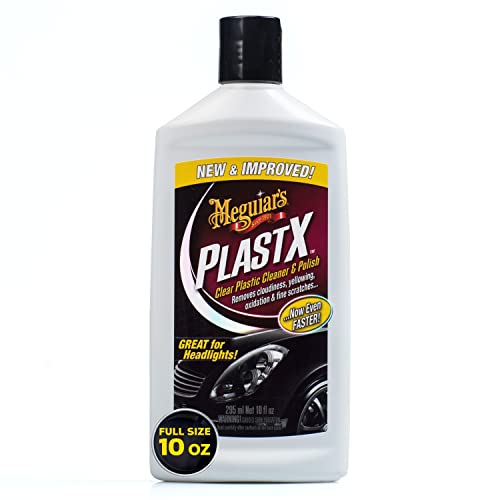

✨ See the road like never before with Meguiar’s PlastX Clear Plastic Polish!
Meguiar's PlastX Clear Plastic Polish is a fast-acting, micro-abrasive formula designed to restore clarity and remove oxidation, yellowing, and cloudiness from uncoated plastic surfaces on vehicles. Ideal for headlights, taillights, soft tops, and plexiglass, it leaves a water-resistant polymer shield that enhances nighttime visibility and extends plastic life—offering a cost-effective, professional-grade solution trusted for over a century.











| ASIN | B0000AY3SR |
| Best Sellers Rank | #16,493 in Automotive ( See Top 100 in Automotive ) #45 in Automotive Plastic Care Products |
| Brand | Meguiar's |
| Date First Available | July 1, 2003 |
| Department | unisex-adult |
| Global Trade Identification Number | 00070382101237 |
| Grit Material | Micro-Abrasive |
| Grit Type | Fine |
| Is Discontinued By Manufacturer | No |
| Item Weight | 11.3 ounces |
| Item dimensions L x W x H | 1.55 x 3.26 x 7.63 inches |
| Item model number | G12310 |
| Language | Spanish |
| Manufacturer | Meguiar's |
| Material | Plastic |
| National Stock Number | 7930-01-600-0594 |
| Number of Items | 1 |
| Product Dimensions | 1.55 x 3.26 x 7.63 inches |
| UPC | 070382101237 |
M**.
Really Works Good and Easily
This wont make brown headlight plastic perfect and it won't remove small pits however, It really gets pretty close to new looking with not a lot of effort. Put it on about half the lamp surface. Then rub it gard with an old cloth until it dries and sqeaks. Wipe off and the brown crust from the lamp will be on the cloth. The lamp will look amazingly good. This polish cuts a bit heavier than most others so works faster. If you are fussy, they make a finer polish that you can micro finish with. I have some nicro but never need to bother with it.
W**O
Know It's Intended Purpose and it works great.
This does not remove scratches as many people suggest, not even minor ones. What it does do is remove various types of oxidization that causes plastic to look stained. I even tried it on my bathtub where you can get these greyish stains overtime from likely soap build or hard water build up. Almost nothing worked well and this does remove that film/stain but it's too expensive to practically use but it was a good experiment. Point is, think film, stains, oxidization remover not scratch remover. I assume the reason it works on some CDs is it might remove clean up the actual scratch grooves but it's definitely not repairing the scratches. It does work good on headlights.
S**M
Works ok on my cell phone and eyeglasses
Meguiar's recommends you use their least aggressive product that gets the job done. That sounds reasonable, but what if trial and error at your expense is not a good strategy for you? In that case, start with Plastx. Why? Because Meguiar's M10 Clear Plastic Polish does no scratch removing at all, and M17 Clear Plastic Cleaner removes scratches only if you have great reserves of time, energy and patience. My cell phone's screen was buffed by years of wear in my pocket. It's an old LG slider phone with clear plastic over the screen, not a gorilla-glass-protected smart phone. It had both fine scratches and a partially worn off anti-glare coating. Fine scratches polish away fairly easily with PlastX applied with a microfiber cloth. If you're a perfectionist then you can fill in any slight imperfections with M10 and get a deeper, richer gloss. PlastX is only fair for removing the anti-glare coating. The coating yielded after 2-3 dozen applications and a lot of rubbing. The result is a screen that is clearer than it was when new because there is no anti-glare coating to distort the image on the screen. Depending on the lighting there will be more glare after using PlastX because the screen is so smooth. I'd rather have occasional glare than a cloudy screen. After restoration the screen will collect new scratches, and PlastX is great for maintaining the screen. I don't recommend PlastX to remove the anti-glare and anti-wear coatings on prescription eyeglasses. Armour Etch is a better product for removing coatings, although the maker doesn't recommend it. But you had better believe the reviewers of Armour Etch who warn you not to rub it on. If you have scratches after using Armour Etch then PlastX is the next step. I tried Armour Etch and Meguiar's products on an old pair of prescription eyeglasses that were so compromised by degraded coatings and fine scratches that I had nothing to lose. Scratches remained on my eyeglasses after Armour Etch removed the coatings. Meguiar's M17 took forever to have a slight effect on the scratches. PlastX worked a lot faster. I applied PlastX with a microfiber cloth and buffed off the residue with a microfiber cloth. It took repeated applications of PlastX to get the desired result. Now my eyeglasses aren't like new, but they're useful again for distance vision. PlastX is too mild to have a noticeable impact on the prescription. It isn't aggressive enough to remove deep scratches completely, but if it was then it would probably alter the prescription. I don't use the bifocal part of these glasses because the bifocal prescription is obsolete. PlastX doesn't have a strong odor. It is neater to work with than either M10 or M17 which are runny liquids. PlastX hasn't been great in my experience, but it has been good. In Meguiar's defense they never intended for it to be used on cell phones and eyeglasses. Four stars.
D**S
Good product
Works great, just takes a bit of time!
C**R
This truly works!
I've used this polish for two very different tasks and it worked brilliantly! 1. I have an older Casio wrist watch that had a heavily scratched and clouded plastic face to the point it was barely readable. I'd already purchased the same make/model as a replacement; but ordered this as a potential repair since the watch (though inexpensive) had sentimental value. I used the polish with a damp paper towel and a 1/2 pea-sized amount with a little elbow grease with light swirling. The first pass improved the clarity to a readable state, second pass looked better with just the deepest scratches remaining, third pass and the watch face looked nearly new! Damn! 2. My MIL's GMC Truck had some minor oxidized/clouded headlights which needed cleanup. I'd used other kits and been happy with the results, but these also require using a power drill and a lot of effort. Using an old, dry, cotton T-Shirt and 25 cent piece, I repeated the same procedure I'd used on my watch. It took another 3-4 passes, but the results were excellent and saved at least a couple of hundred $ for the MIL.
A**H
What can I say, at INR 2000 this is not a small investment. But when you have car OCD, you gotta do it. Meguiar's is a trusted brand they say, and I trust it now. Although, you have to follow the instructions and your arm is gonna complain for a good 30 minutes after you are done. Great quality, easy to clean, and can be used on other clear plastic surfaceds, so versatile. The product is gooey and thick, don't dilute it for best results. Microfiber: AmazonBasics Car: Skoda Rapid
M**T
Gör sitt jobb
A**K
Was kann PlastX? Was kann es nicht? Also, es ist kein Wundermittel. Aber ich vergleiche es gerne mit den Mitteln, die man für den größten Teil der Außenhaut vom Auto verwendet, nämlich dem Lack. Seinen Lack pflegt man nämlich im Normalfall. Er wird schmutzig beim fahren, er ist der Witterung ausgesetzt und wird dadurch langsam matter und läuft an der Oberfläche an. Man wäscht das Auto und dabei wird der Lack zusätzlich belastet. Daher geht man im Normalfall, je nach Alter des Autos und persönlichem Geschmack, so ein-, zwei- oder dreimal im Jahr dabei und wachst bzw. poliert seinen Lack. Jeder hat aber bestimmt auch schon Autos auf der Straße gesehen, bei denen man denkt: "Na, der ist aber matt. Der könnte auch mal poliert werden". Aber die Abdeckungen der Scheinwerfer, die kann man mit üblichen Autowachs nicht gleich mit behandeln. Dabei werden die auch schmutzig, sind der Witterung ausgesetzt, werden durch Waschwasser belastet usw. Hier kommt nun PlastX ins Spiel. Ist praktisch wie eine Autopolitur, aber eben für die Kunststoffabdeckungen der Scheinwerfer. Und so wie man mit einer Lackpolitur matten Lack wieder "frisch machen" kann, wirkt es auf den Abdeckungen. Ich habe es nach Herstelleranweisung eingesetzt, also auf einen Baumwolllappen gegeben (hab meiner Frau ein Geschirrtuch "entwendet" - ich hoffe sie liest dies nicht) und dann heißt es polieren, polieren, polieren ... Ich habe pro Scheinwerfer eine Stunde poliert. Wobei man sagen muss, nach einem Drittel der Zeit war das Ergebnis schon recht ordentlich. Aber ich wollte eben ein möglichst optimales Bild erzielen. Und wenn manche anderen Rezensionen bemängeln, man würde keine Steinschläge entfernen können, kann ich nur bestätigen: das stimmt. Aber, wenn ich den Lack poliere, was kriege ich dann weg? Matt angelaufene Stellen im Lack und kleine Kratzer. Und der Lack glänzt wieder. Aber Steinschläge mit Politur entfernen? Erwartet da doch auch niemand. Und genau so ist es bei den Scheinwerferabdeckungen. Nicht mehr und nicht weniger. Ohne Poliermaschine und ohne abschleifen waren es hinterher wieder Klarglasabdeckungen. Und nicht mehr so undurchsichtig matte, gelblich angelaufene Dinger. Bei denen alle "empfohlenen Hausmittel" wie Silberputzmittel, Scheuermilch und Zahnpasta schon ihr Versagen unter Beweis gestellt hatten. Ich persönlich empfehle übrigens, das "Headlight Protectant" von diesem Hersteller auch gleich zu bestellen. Um beim Vergleich mit dem Lack zu bleiben: PlastX ist die Politur Headlight Protectant ist dann das "Wachs", das man hinterher auf einen polierten Lack ja auch auftragen sollte. ---------- UPDATE ---------------------------------------------- Eine DVD war ab Werk zerkratzt und lies sich nicht mehr ansehen. Natürlich erst sehr spät bemerkt, es war nämlich eine Box mit einer Fernsehserie. Staffel 9, Disk 1, gerade als neue Charaktere vorgestellt werden, konnte ich nicht anschauen. Heftige Kratzer, länglich die Spuren entlang, die DVD lies sich nicht lesen. Die Standardverfahren, also mit Spülmittel reinigen und polieren mit einem Seidentuch, brachten trotz stundenlangem Polieren keine Verbesserung. Meine Überlegung war nun, dass es sich bekanntlich beim Schutzlack auf DVDs um einen Acryllack handelt. Acryllack? Acrylglas? Gleiche Bindemittelbasis! Also das PlastX rausgeholt und knapp 10 Minuten die DVD poliert. UND ALLES IN ORDNUNG! Nicht einmal mehr einen Ruckler! Das nenne ich Zusatznutzen!
D**.
Incroyable ce produit! Utilisé sur le plexiglass du compteur de mon renault master de 2002 qui était complètement rayé et terni. Dommage que je n'ai pas pris la photo du avant. C'était vraiment micro-rayé de partout comme si on avait passé le côté vert de l'éponge 😅 La première photo c'est en cours de polissage.
H**S
Uso para polimento de plásticos pretos brilhantes ou foscos com resultados muito bons. É um produto caro, mas rende muito. O último que comprei durou alguns anos (meu uso não é profissional). Recomendo.