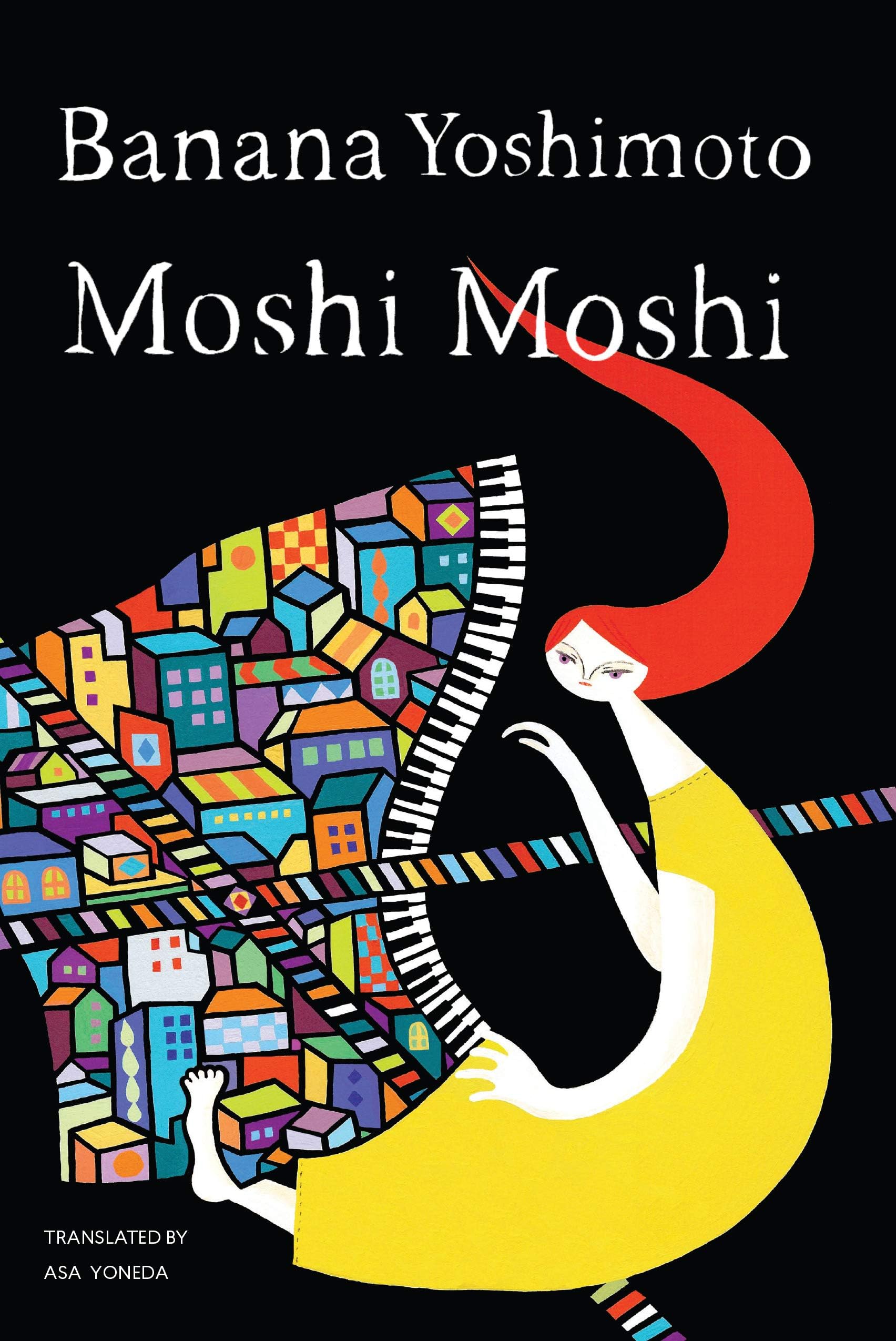
Moshi Moshi
Product ID: 99359816
Desertcart purchases this item on your behalf and handles shipping, customs, and support to Malaysia.
Moshi Moshi - Kindle edition by Yoshimoto, Banana, Yoneda, Asa. Download it once and read it on your Kindle device, PC, phones or tablets. Use features like bookmarks, note taking and highlighting while reading Moshi Moshi. Review: Loved it! - Loved it! Couldn't put it down. I love the way she writes...it's like having a good friend telling you what's going on with her. Review: Less Bananas, more Yoshimoto, than the book blurb makes it sound like, but that's not a bad thing necessarily - Banana Yoshimoto's books are very close to my heart. I've read all her English translated novels, and I kind of know what to expect when I am going to read one her books. For example, Yoshimoto will analyze every single sentence her characters say to one another, provide you with insight into the character's thought process, and basically, keep you in the headspace of all the characters as much as possible. It's somehow impossible to read Yoshimoto's books and not feel like you're being given the grand tour of your best friend's brain. I feel this way every single time with Yoshimoto's novels. So Moshi Moshi Shimokitazawa is, more or less, no exception. The main character, you can't help but feel for her. She lost her father in one of the worst ways imaginable, and so what does she do? Moves to one of the best neighborhoods in all of Tokyo. Heck, all of Japan, for that matter. I've been to Shimokitazawa several times in my life, and Yoshimoto perfectly captures its essence, its vibe... everything about it feels very real to me in her descriptions. I guess that makes sense, too, as you read Yoshimoto's afterword at the end of the book and she states that much of her description of Shimokitazawa comes from real life people and restaurants that are there even today. I think the process of healing through a move like the main character did, as it relates to coping with the loss of a parent, is perfectly laid out here, and you'll feel by the end of the book that you weren't cheated with how the main character starts out at the beginning of the book and where she ends up in the final part of the book are two very different places. I won't tell you whether it's a good or bad kind of different, but the journey is definitely visible, and I would say rewarding in some respects as well. Now, my critiques are small ones, and really I suppose I'm being more nitpicky than anything else. First, I wished that the book's jacket description matched what the book actually was about. I was thinking that this book could've been Yoshimoto's first real attempt to write something with a largely supernatural twist, i.e., her father's ghost hanging out with her, or something that defies the normal that makes up every single one of Yoshimoto's stories. But no, it didnt' happen. I'm not complaining, but I found the description of the book misleading. So there's that. The other issue is that the translation and the actual book editing are not as great as I like them both to be. For example, Michael Emmerich has notably done almost all of Yoshimoto's English translations in the past. All the big stories from Yoshimoto that we know, that's Emmerich. He's an exceptional translator, perhaps the best Japanese to English translator in existence, and for some reason, this was translated by Asa Yoneda. I feel it was a bit rough, in certain spots of the story, in terms of the translation. I can't be more specific than that... it was more of a feeling I had based on all the Emmerich translation's of Yoshimoto vs. this book with Yoneda's translation. In regards to the grammar issues, I counted no less than five grammar mistakes in this book. For example, on page 178, there is this sentence: "I bowed my towards the distance....." It should say, "I bowed my HEAD towards the distance...", right? There are little omissions like this that blow my mind, given this was published by Counterpoint. I think they need to do another printing and fix all these silly little mistakes, since it reduces the experience of reading what the author intended with her words because I have to guess now what she wanted to say... and I should never have to guess what an author wanted to say because the words aren't there. My final point is that at the end of the book, it felt a little hasty in wrapping things up. And Yoshimoto also can't seem to make up her mind as to whether this book's ultimate message is about healing from the loss of a parent, or about the culture of Shimokitazawa and how things have changed there and time has erased some of that neighborhood's charm. I can see the parallel in both and how these two relate, but it just felt forced to me to even talk about Shimokitazawa at the end of the book. Overall, this is a great read, and certainly one of the more easier reads from Yoshimoto. If you like characters who literally will explain every single thing they say to somebody, and every single thing they are thinking, then you'll have no problem with this book if you are a first time Yoshimoto reader. If you are a veteran reader like I am, you'll find Yoshimoto's charm hasn't disappeared after all these years, not by a long shot. Definitely a must have to add to the English translated Yoshimoto library.
| ASIN | B01MQ01UQR |
| Accessibility | Learn more |
| Best Sellers Rank | #773,007 in Kindle Store ( See Top 100 in Kindle Store ) #3,244 in Coming of Age Fiction (Kindle Store) #3,433 in Romance Literary Fiction #3,983 in Parenting & Relationships (Kindle Store) |
| Customer Reviews | 4.2 4.2 out of 5 stars (771) |
| Enhanced typesetting | Enabled |
| File size | 3.5 MB |
| ISBN-13 | 978-1619028661 |
| Language | English |
| Page Flip | Enabled |
| Print length | 219 pages |
| Publication date | December 1, 2016 |
| Publisher | Counterpoint |
| Screen Reader | Supported |
| Word Wise | Enabled |
| X-Ray | Not Enabled |
N**B
Loved it!
Loved it! Couldn't put it down. I love the way she writes...it's like having a good friend telling you what's going on with her.
D**I
Less Bananas, more Yoshimoto, than the book blurb makes it sound like, but that's not a bad thing necessarily
Banana Yoshimoto's books are very close to my heart. I've read all her English translated novels, and I kind of know what to expect when I am going to read one her books. For example, Yoshimoto will analyze every single sentence her characters say to one another, provide you with insight into the character's thought process, and basically, keep you in the headspace of all the characters as much as possible. It's somehow impossible to read Yoshimoto's books and not feel like you're being given the grand tour of your best friend's brain. I feel this way every single time with Yoshimoto's novels. So Moshi Moshi Shimokitazawa is, more or less, no exception. The main character, you can't help but feel for her. She lost her father in one of the worst ways imaginable, and so what does she do? Moves to one of the best neighborhoods in all of Tokyo. Heck, all of Japan, for that matter. I've been to Shimokitazawa several times in my life, and Yoshimoto perfectly captures its essence, its vibe... everything about it feels very real to me in her descriptions. I guess that makes sense, too, as you read Yoshimoto's afterword at the end of the book and she states that much of her description of Shimokitazawa comes from real life people and restaurants that are there even today. I think the process of healing through a move like the main character did, as it relates to coping with the loss of a parent, is perfectly laid out here, and you'll feel by the end of the book that you weren't cheated with how the main character starts out at the beginning of the book and where she ends up in the final part of the book are two very different places. I won't tell you whether it's a good or bad kind of different, but the journey is definitely visible, and I would say rewarding in some respects as well. Now, my critiques are small ones, and really I suppose I'm being more nitpicky than anything else. First, I wished that the book's jacket description matched what the book actually was about. I was thinking that this book could've been Yoshimoto's first real attempt to write something with a largely supernatural twist, i.e., her father's ghost hanging out with her, or something that defies the normal that makes up every single one of Yoshimoto's stories. But no, it didnt' happen. I'm not complaining, but I found the description of the book misleading. So there's that. The other issue is that the translation and the actual book editing are not as great as I like them both to be. For example, Michael Emmerich has notably done almost all of Yoshimoto's English translations in the past. All the big stories from Yoshimoto that we know, that's Emmerich. He's an exceptional translator, perhaps the best Japanese to English translator in existence, and for some reason, this was translated by Asa Yoneda. I feel it was a bit rough, in certain spots of the story, in terms of the translation. I can't be more specific than that... it was more of a feeling I had based on all the Emmerich translation's of Yoshimoto vs. this book with Yoneda's translation. In regards to the grammar issues, I counted no less than five grammar mistakes in this book. For example, on page 178, there is this sentence: "I bowed my towards the distance....." It should say, "I bowed my HEAD towards the distance...", right? There are little omissions like this that blow my mind, given this was published by Counterpoint. I think they need to do another printing and fix all these silly little mistakes, since it reduces the experience of reading what the author intended with her words because I have to guess now what she wanted to say... and I should never have to guess what an author wanted to say because the words aren't there. My final point is that at the end of the book, it felt a little hasty in wrapping things up. And Yoshimoto also can't seem to make up her mind as to whether this book's ultimate message is about healing from the loss of a parent, or about the culture of Shimokitazawa and how things have changed there and time has erased some of that neighborhood's charm. I can see the parallel in both and how these two relate, but it just felt forced to me to even talk about Shimokitazawa at the end of the book. Overall, this is a great read, and certainly one of the more easier reads from Yoshimoto. If you like characters who literally will explain every single thing they say to somebody, and every single thing they are thinking, then you'll have no problem with this book if you are a first time Yoshimoto reader. If you are a veteran reader like I am, you'll find Yoshimoto's charm hasn't disappeared after all these years, not by a long shot. Definitely a must have to add to the English translated Yoshimoto library.
A**A
Beautiful story about life and emotions
Beautiful and thoughtful book that makes u think about life and it's meaning and how everyone is unique in experiencing it
A**O
Could use a better translator
The book starts out well but drags on after a while with a lot of repetition. It doesn't seem well translated either, with lots of awkward phrasing. OK to pass the time on the train but not a great read.
N**B
A good eastern book
I cannot beat the Eastern writers, with their so detailed and perfect descriptions of hardly tangible things. The air, the silence, all materialized in words. How they have their palates open to so many flavors whenever I finish a book or even a movie I make a list of dishes to try.Yocchan is going through mourning for the loss of his father who died suddenly in a suicide pact with a woman unknown. "Moshi, Moshi" is the classic greeting that is received from who answers the phone on the other side in Japan, in his dreams Yocchan receives the call that his father could not make before he died, and through food and people in the Japanese neighborhood of Shimokitazawa she and her mother begin to overcome the pain and find a way to move on. Yocchan by far is the character that I liked the most; At times it was a tangle of thoughts and ideas, crumbling the flavors and aromas in an irresistible menu. It is a very nice book to recommend especially to those who may have read writers like Kazuo Ishiguro and felt they did not understand or were disappointed in the end. Banana Yoshimoto will not disappoint them, she is far from the best oriental writers, there is even the idea that she is the lost daughter of Murakami☺️
A**R
Comforting
This book made me feel less lonely as a human during a time of so much isolation and uncertainty. Highly recommend.
K**A
Five Stars
typical dreamy and catching novel by banana yoshimoto
J**Y
Really enjoyed it.
Though not my usual type of book and a bit on the slow pace side, it was..intriguing. The way it was written allowed for a genuine feel and easy understanding of the character and Japanese society, though some of the writing/translating seemed to convey the story awkwardly at times. But nothing that would prevent me from enjoying or understanding the story at all. Not action or suspense orientated and more soft and thought provoking tone. Definitely look forward to checking out more of the author's books (this is a 1st by her for me).
V**A
Non so se sia stata una mia svista, ma alla fine il testo è in inglese.. lo leggo comunque ma avrei preferito fosse èiù chiaro sull'inserzione del libro in vendita
D**A
Banana Yoshimoto has written a very interesting book. Our heroine's father has apparently committed suicide along with his mistress. She moves out of her home into a small apartment. She works for a restaurant selling French food. Out of the blue her mother moves in with her. The apartment has bad vibes. She also is experiencing bad dreams about her father and in the dreams feels that her father is trying to phone her. She meets someone in the restaurant and experiences her first love affair. Dealing with her mother, her first boyfriend and experiences with her deceased father makes for a compelling read. Banana has written other best sellers.
A**U
Came damaged and did not get a refund for the damages
K**M
Tokyo is a vibrant part of this beautiful strange story. Characters move through grief together, as if in a dream. Shimokitazawa is drawn as an urban village and a comforting place, as unique and changing as a person. There's some weird Electra complex guff that the story could have done without, but for the most part, this is great.
G**D
Banana Yoshimoto is my favourite writer. I love the off-beat quirkiness of her novels. I first discovered her more than twenty years ago when I read "Kitchen" and was struck by its stark originality. Over the years I have followed her career and waited patiently for the somewhat infrequent publication of her work into English. Her latest novel is true to form. A left-of-centre tale of a mother and daughter trying to cope with the mystery surrounding the suicide of a father/husband. Dreams, unknown people from the past, hovering around a relationship, each part of the story moving forward to a realisation that time has passed. I loved it.
Trustpilot
2 weeks ago
1 month ago