We remain fully operational. Our teams are working around the clock to ensure your deliveries continue safely.

DOWNLOAD THE APP


Customer Services
Copyright © 2025 Desertcart Holdings Limited
DOWNLOAD THE APP
📖 Unlock your mind, join the thinkers’ circle!
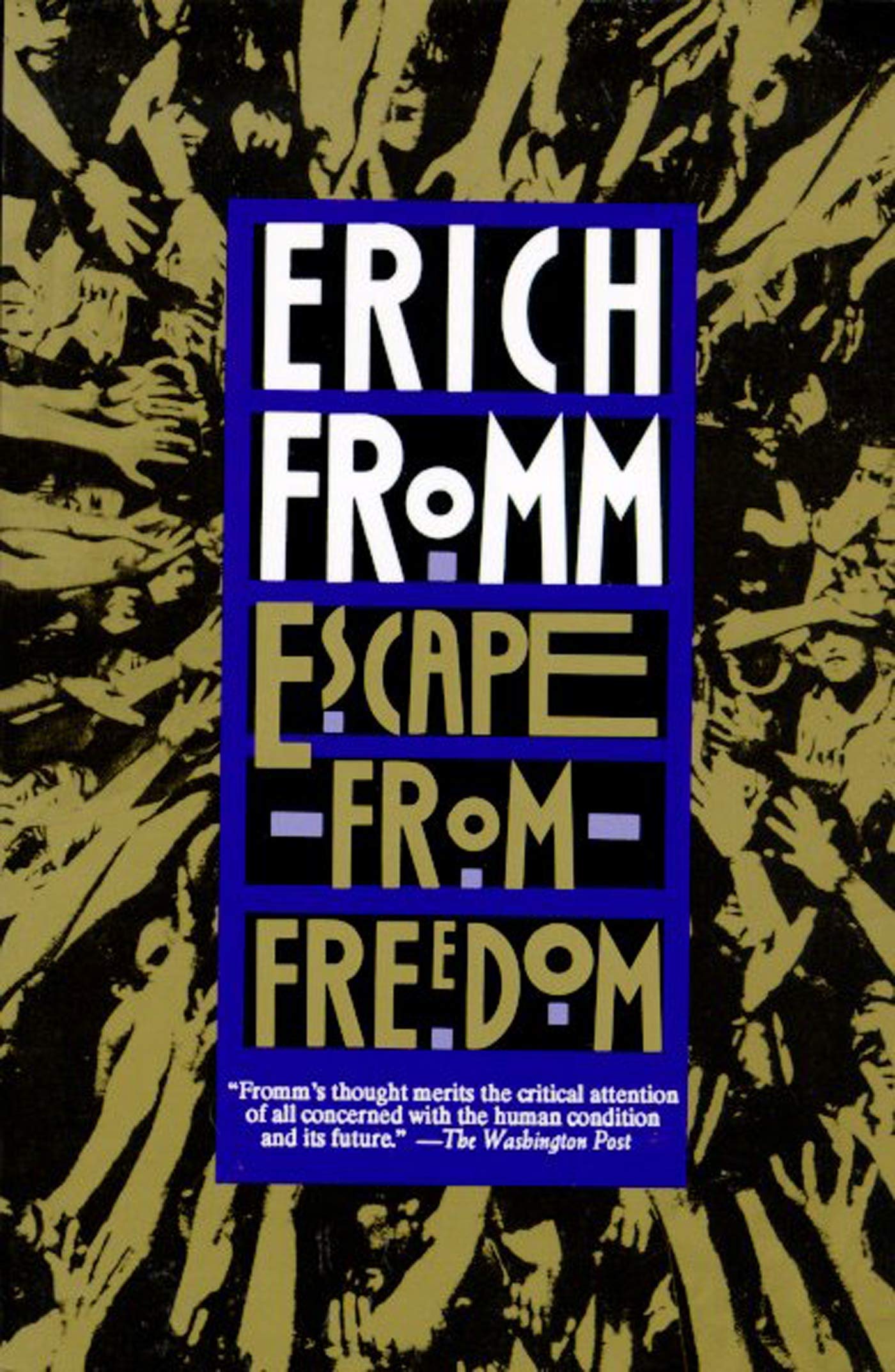
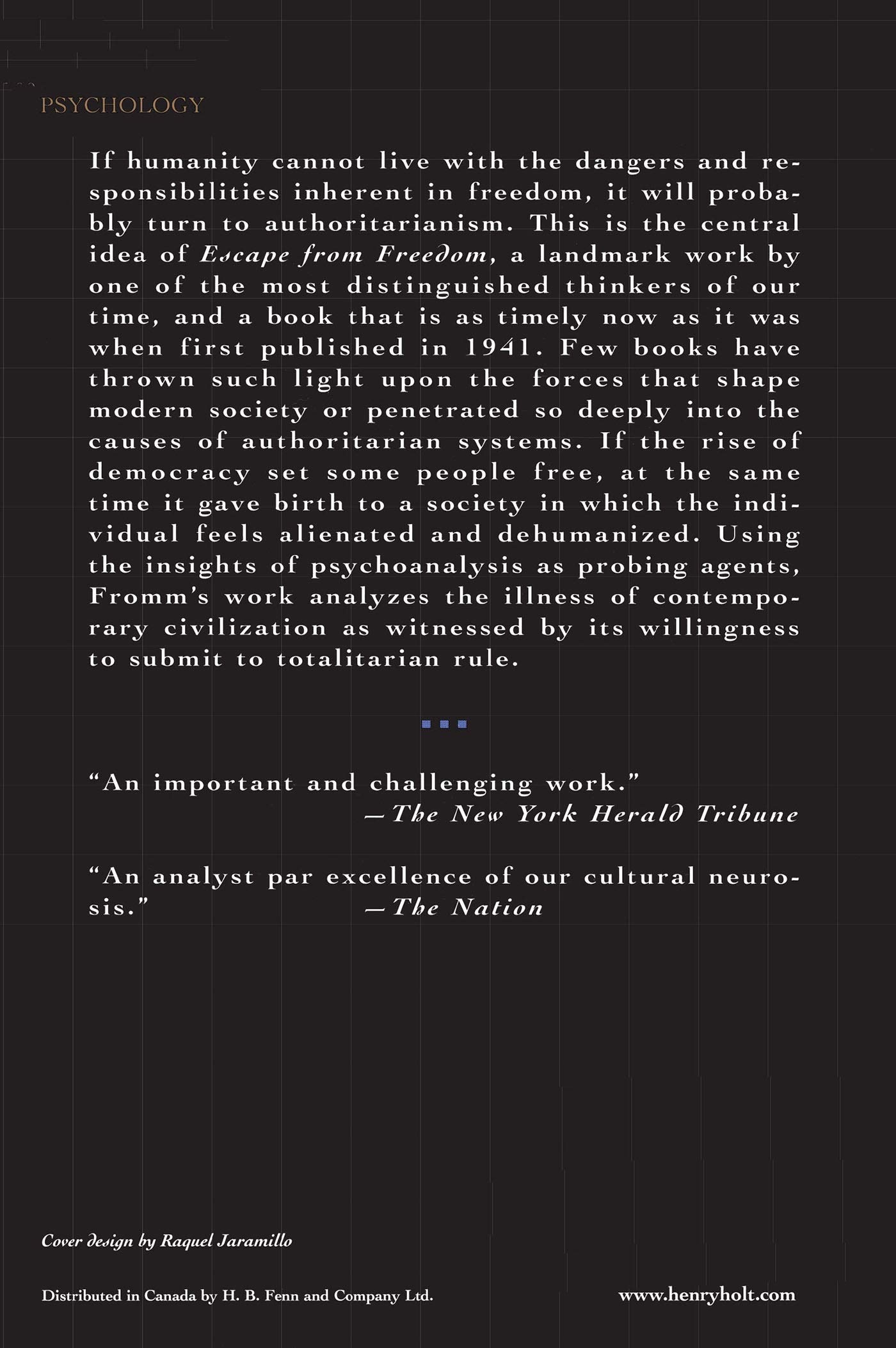
Escape from Freedom by Erich Fromm is a highly rated Holt Paperback that explores the psychological and social dimensions of freedom. With a 4.6-star rating from 998 reviews and a top 30 rank in psychoanalysis theory, this classic challenges readers to rethink their relationship with freedom and society.


| Best Sellers Rank | 1,989,973 in Books ( See Top 100 in Books ) 30 in Theory of Psychoanalysis 324 in Applied Psychology (Books) 5,190 in Society, Politics & Philosophy |
| Customer Reviews | 4.6 out of 5 stars 998 Reviews |
M**K
Great read .... this could change your whole way of being and living
Thought provoking , challenging our prejudices and encouraging us to think again
L**M
Excellent from Erich Fromm
An excellent book by Erich Fromm. It is relevant still today with the further alienation from our true nature. I would recommend it as a book we should all read.
D**S
Fantastic psychological insight, poor application of theory
Freedom is a burden on man, and he must find meaning in a chaotic world or he shall resort to authoritarianism. This is the simple argument of Erich Fromm, who expands on this strain of thought in a psychoanalytic/sociological thesis. The idea of freedom being a burden, and that man must find a purpose or shall resort, unconsciously, to psychological defence mechanisms in order to escape the insecurities that freedom offers, is a fascinating, very coherent and highly plausible theory. Fromm talks of freedom from (negative freedom) and freedom to (positive freedom) as having different psychological impacts on individuals. Those unable to stand freedom shall unconsciously form a persona of sorts (perhaps I am too Jungian!) that seeks to deal with the insecurity by either submitting to, superficially becoming, or attempting to destroy authority. The alternative is to become everyone else – to erase the self through conformity. In addition, as modern man submits to life as a cog of part of the machine of modern society (with economic productivity and material gain having religious importance), modern man is plagued with uncertainty in a life devoid of meaning, claims Fromm. This is why he chooses to escape from freedom. Unfortunately, whilst the thesis is fantastically insightful psychologically, Fromm oversimplifies history and even his own psychological analysis to fit his sociological analysis. Fromm is too keen to implement a Marxist view of the social classes where it is quite simply inapplicable (or at least far less relevant), in order to conduct his analysis. For example, there was no middle class identity (and practically no middle class, certainly in the modern sense) in 16th century Europe. As for later discussions of the (particularly lower) middle class, Fromm appears to completely forget his prior emphasis on the individual, using the phrase “petty bourgeois” to describe what is likely to be several million people, giving them a character structure of rage and uncertainty that appears to have been placed upon them to make his theory to work. Indeed, the strong terminology used is based off assumptions used as psychodynamic explanations for historical events that would have been far more complex for each and every individual involved. Clearly Marxist class paradigms and assumptions take priority over a genuine discussion of the individual in a historical context, although the appendix goes some way to redeeming this oversimplification. Similarly, his analysis of Nazism ignores clear historical facts as Fromm attempts to impose his psychoanalytic philosophy onto historical events. Quotes such as “Nazism never had any genuine political or economic principles” showcase historical ignorance that damages the quality of his work. As for the economic discussion, there are some bizarre assertions and linguistic games going on. Fromm is certain that a corporatist economy equates to capitalism (in its monopolistic phase). This is a question that will likely never cease to generate debate, the question being whether or not this is capitalism (as the markets are not free). Fromm, however, is clearly in error when he states that the Nazi regime “did not really interrupt the development of German monopolistic capitalism but furthered it with the means at her disposal.” A centralised economy and capitalism are clearly two different economic structures. Fromm is even more confused when he later states that many of these economic problems faced by free peoples “must be replaced by a planned economy that represents the planned and concerted effort of society as such.” So was the Nazi system the correct system? Was the Soviet system correct? Well, according to Fromm, neither is genuine socialism (no true Scotsman?), and the Soviet system is in actual fact “a powerful bureaucracy that manipulates the vast mass of the nation.” Surely Fromm should recognise that centralising the economy may end up conflicting against the desires and wishes of an individual seeking “freedom to?” The answer is sort of. He admits that creating a benevolent centralised economy would be very difficult, but still maintains his utopian vision, as if, despite all that has been said before, only he knows and can guide others to true liberation of the self. Overall, the main aim of this work, from what I can tell, was to provide a psychological analysis into the effect of freedom on individuals. From this perspective the book is a resounding and fantastic success, but Fromm’s attempts to apply his theory into the real world see him use glaring methodological flaws and contradictions which unfortunately limit the insight of his thesis. Nevertheless, it is a fine work from a fine mind, and I would recommend to anyone interested in the subject.
J**G
Excellent
Received the book, well packaged and good delivery.
P**E
Enjoyable. Not dated.
The summary as written on line prepared one for this book. No great surprises. Enjoyable to read if this is your taste in literature
D**N
Freedom Explained
An excellent review of the meaning of freedom, its place in the modern world and the price we have to pay to achieve individual freedom.
A**R
Background knowledge helpful.
Great book, Erich Fromm is very erudite on his subject and able to explain his theory using, fairly, simple language. However, the quality of the print by ishi press was very poor.
F**O
I knew the book. Interesting the 2nd preface ( after 25 years ). On Amazon UK, there are dozens of enthusiastic rewiews. For the Italian edition, only 2 plus 1. Does it mean something?
C**Y
This book is relevant now more than ever.
P**L
Un livre pilier, essentiel, une clef de voute. D'une profonde intelligence, humanité. Il n'y a rien de plus à dire. Régalez-vous. Bonne lecture.
M**Z
Ya lo he leído varias veces en castellano. Excelente libro, aunque ahora los "demonios" que atentan contra la Libertad son otros, básicamente las drogas y la Televisión.
G**S
This book delivers the psychology that surrounds Freedom while analyzes the life of people during the Reformation (Calvinism and Lutheranism), Hitler and some other cases, getting even a bit into the subject of dreams, repressed thoughts, lack of individuality and critical sense. It also covers the origin of destructiveness and sado-masochism, which are present in people who are Escaping FROM Freedom instead of Escaping TO Freedom. This book is highly recommended to someone who wants to understand Hitler's behavior or to uncover the origins of your own destructiveness or sado-masochistic behavior. I also recommend to someone who wants to improve quality of life by delving into the unconscious and solving your lack of love, growth and expression.
Trustpilot
1 month ago
1 month ago