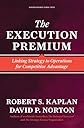





Buy Execution Premium 1 by Kaplan, Robert S., Norton, David P. (ISBN: 9781422121160) from desertcart's Book Store. Everyday low prices and free delivery on eligible orders. Review: Great book about strategy execution. - This is the fifth book by Kaplan and Norton about strategy and Balance Scorecard framework. If you are seriously interested in the strategy process this is must. Review: Excellent for strategy students or business people that haven't read any Kaplan & Norton - Excellent - Don't hesitate to buy this if the overview is in an area you want more knowledge on. Excellent for strategy students or people that haven't read any Kaplan & Norton. Easy to follow considering it's a respected blueprint for double-stitching strategy through operations'. The Execution Premium: Linking Strategy to Operations for Competitive Advantage
| Best Sellers Rank | 461,342 in Books ( See Top 100 in Books ) 27,815 in Business, Finance & Law |
| Customer reviews | 4.5 4.5 out of 5 stars (147) |
| Dimensions | 16.51 x 2.54 x 24.13 cm |
| Edition | 1st |
| ISBN-10 | 142212116X |
| ISBN-13 | 978-1422121160 |
| Item weight | 658 g |
| Language | English |
| Print length | 336 pages |
| Publication date | 17 Jun. 2008 |
| Publisher | Harvard Business Review Press |
M**O
Great book about strategy execution.
This is the fifth book by Kaplan and Norton about strategy and Balance Scorecard framework. If you are seriously interested in the strategy process this is must.
G**D
Excellent for strategy students or business people that haven't read any Kaplan & Norton
Excellent - Don't hesitate to buy this if the overview is in an area you want more knowledge on. Excellent for strategy students or people that haven't read any Kaplan & Norton. Easy to follow considering it's a respected blueprint for double-stitching strategy through operations'. The Execution Premium: Linking Strategy to Operations for Competitive Advantage
G**E
Six-stage management framework to link strategy and operations
Robert S. Kaplan is professor at Harvard Business School, while David P. Norton is the founder of Balanced Scorecard Collaborative and a director of Palladium Group. This book was published in 2008 and consists of 10 chapters plus a short preface and acknowledgement. There is considerable history behind this book, which goes back to 1992 when the authors introduced the balanced scorecard as a performance management system. The balanced scorecard made it possible for managers to express and measure operational performance. The framework was built around 5 management principles: (1) Mobilize change through executive leadership; (2) translate strategy into operational terms; (3) align the organization to the strategy; (4) motivate to make strategy everyone's job; and (5) govern to make strategy a continual process. This has resulted in four previous books by the authors, which focused primarily on the first 4 principles. In the preface Kaplan and Norton explain that while they set out to document the best practices for the fifth principle, "we ended up with a self-contained and comprehensive mangement system that links strategy and operations." In the first introductory chapter, the authors explain that although many of the building tools for strategy development, strategic planning and operational planning already exist, but that a comperehensive framework to integrate all these tools is still lacking. They therefore introduce a six-stage comprehensive, closed-loop management system that integrates management tools to help companies with strategy execution. In addition, they introduce a new organizational unit that helps design the integrated system. The six-stage framework is almost broken by chapter. Chapter 2 contains a detailed description of the 3 strategy development process. Chapter 3 describes the first 2 strategy planning processes. Chapter 4 describes the 3 initiative management processes. Chapter 5 describes the best practices companies use to align organizational units and employees to the strategy. Chapter 6 discusses the linkaged of strategy to process improvements. Chapter 7 describes the conversion of a strategy plan into plan for resource capacity and for operating and capital expenses. Chapter 8 presens the structure, frequency, partipants, agenda, and actions fo operational and strategy review meetings. Chapter 9 provides detais and several case examples of the test and adapt meetings. Chapter 10 finalises the book and describes the roles and responsibilities for a new unit termed "office of strategy management", who should become the architect, process owner, and integrator of the process embedded in the management system. However, the authors make one explicit additional remark to the 6 strategy management stages: "... leadership is so important to the strategy management system we believe it to be both necessary and sufficient." The necessary condition comes from the authors' experence with the more than 100 enterprises around the world who have become members of the Balance Scorecard Hall of Fame. The sufficiency claim is even bolder as the authors believe that each of the six stages is doable, when guided by a senior management office. However, "we cannot provide a blueprint for visionary and effective leadership." Yes, I do like this book. It does perhaps not bring many new issues to the table, apart from the office of strategy management, but I still believe that the highly visual aspects of the balanced scorecard and this 5-stage framework assist to explain strategy, measures, targets, processes, reviews and findings to all parties involved in organizations. The framework povides great guidelines to organizations to execute their strategy better through improved operations. Highly recommended.
R**B
Excellent.
Exactly as advertised. Excellent.
R**S
"Vision without execution is hallucination." Thomas Edison
I have read and reviewed all of Robert S. Kaplan and David P. Norton's previous books and consider this one their most valuable...thus far. Why? Here are three reasons. First, I agree with Kaplan and Norton that managing strategy differs from managing operations but both are vital and need to be integrated. I appreciate their mastery of what Roger Martin characterizes as "integrative thinking" in The Opposable Mind. That is, they agree with Thomas Edison's observation that serves as the title of this review: "Vision without execution is hallucination." They also agree with Peter Drucker who once observed, "There is surely nothing quite so useless as doing with great efficiency what should not be done at all." According to Michael Porter, "The essence of strategy is choosing what not to do." That is why Kaplan and Norton devote almost all of their attention to focusing on (a) what is most important in terms of linking strategy to operations for competitive advantage and (b) how to do that with resources and initiatives that are cohesive, comprehensive, and cost-effective. Also, they make brilliant use of various reader-friendly devices to highlight, consolidate, and summarize, and emphasize especially important points. For example, Figures: Figure 1-1 "Strategy management: State-of-the-art practices," Page 5; Figure 3-14 "Establishing targets based on cause-effect-scenarios," Page 92; Figure 9-9 "Strategy map and scorecard for Store 24's new Ban Boredom strategy," Page 267; and Figure 10-3 Strategy management: An integrated closed-loop process," Page 289. I also appreciate the dozens of checklists that are strategically inserted throughout the lively but eloquent narrative. Together with the Figures, the various checklists facilitate, indeed expedite frequent review of key points. Finally, as in their previous books, Kaplan and Norton share information, insights, and advice that all relevant to any organization, whatever its size and nature may be. No two organizations are exactly the same...nor is any organization the same today as it was a year ago or will be a year from now. Kaplan and Norton do everything humanly possible to educate their reader with regard to what is needed to link strategy to operations for competitive advantage but they also help their reader to develop what I characterize as the "executive premium" mindset: challenge all assumptions and premises, seek out and welcome principled dissent, be receptive to unorthodox ideas (especially from unexpected sources), and meanwhile focus (as do Kaplan and Norton) on what is most important and measure all initiatives, viewing each setback not as a failure but as a precious learning opportunity.
U**S
Final picture
I have not yet practical experience in strategy and operational management. I just past those courses in MBA programm. In parallel I have read Kaplans abd Nortons Strategy Maps, Balance scorecard, Strategy focused organization. I was really amazed. They were answering lot of questions I had. However these books were like parts of whole picture. With no practical experience it was not easy to put together these peaces and make whole picture. Execution premium puts together those peaces. I think this book is a "must have" for COO, CFO and CEO.
K**R
Reduced to 3-stars for repetitiveness
I think there's a lot of great stuff in The Execution Premium in terms oif concepts and case studies. However I found it quite repetitive (and like wading through treacle) and this made it difficult to stay engaged. All that being said, I have flagged a lot of case study snippets to revisit and The Execution Premium will go back on my bookshelf as a reference resource. Reduced to 3-stars for repetitiveness!
お**よ
いつも思うのだが,Kaplan,Norton の英語は論理的・明快で難しい言葉も少なく,大変読みやすい。日本語訳もあるが,原文で読めれば訳語の妥当性を気にする煩わしさもない。英語がそれほど苦にならない人,ビジネス英語を勉強したい人は挑戦されると良いかも知れない。 大きなストーリーとしては,BSC(Balanced Score Card)に基づき,戦略(strategy)を展開して現実の事業活動(operation)に落とす。それの実施状況をモニターし再び戦略の見直しを行う。これで経営管理(management system)のサイクルが一回りし,戦略を実際に実行し得るフレームワークが完成する。このサイクルを6ステップに分けて詳述している。 6ステップのうち,"Develop the Stragegy","Plan the Strategy","Allign the Organization",くらいまではこれまでのBSCコンセプトの祖述に近く,少々長く感ずるが,"Plan Operateions"はTD-ABC(time-driven ABC)を用いて実行計画(operation Planning)やリソース計画(Resource Planning)まで落としてゆく話で段々と新味が出てくる。 全体的に「BSCだけでそんなにうまく行くのか?」「TD-ABCだけでリソース計画への展開がそんなにうまく行くのか?」という疑問を抱きつつも,こういう一本骨の入った,合理的な経営管理フレームワークを導入してゆく必要性を納得させてくれる本である。
E**A
Excelente material, después de su Balanced Scorecard, Kaplan y Norton continúan vigentes en la administración de empresas, a través ahora de esta guía más práctica.
C**E
Excellent book. Recommended if you want to really learn on operations
N**I
This is a wonderful book for Strategic Management. It draws an excellent road map for starting with strategy development through strategy execution and performance management. The stages the book goes through are as follows: 1. Developing the strategy 2. Planning the strategy 3. Aligning organizational units and employees with the strategy 4. Planning operations by setting priorities for process management and allocating resources that will deliver the strategy. 5. Monitoring and learning from operations and strategy 6. Testing and Adapting strategy The book then closes with a chapter on establishing a function called the the Office of Strategy Management as the new function responsible for the above whole strategic process. A wonderful book and I think it should be part of the MBA Strategic Management and Operations Managmenet course
A**E
I receveid the book in great state and it is an excellent book that I heartily recommend to any entrepreneur
Trustpilot
2 weeks ago
1 week ago