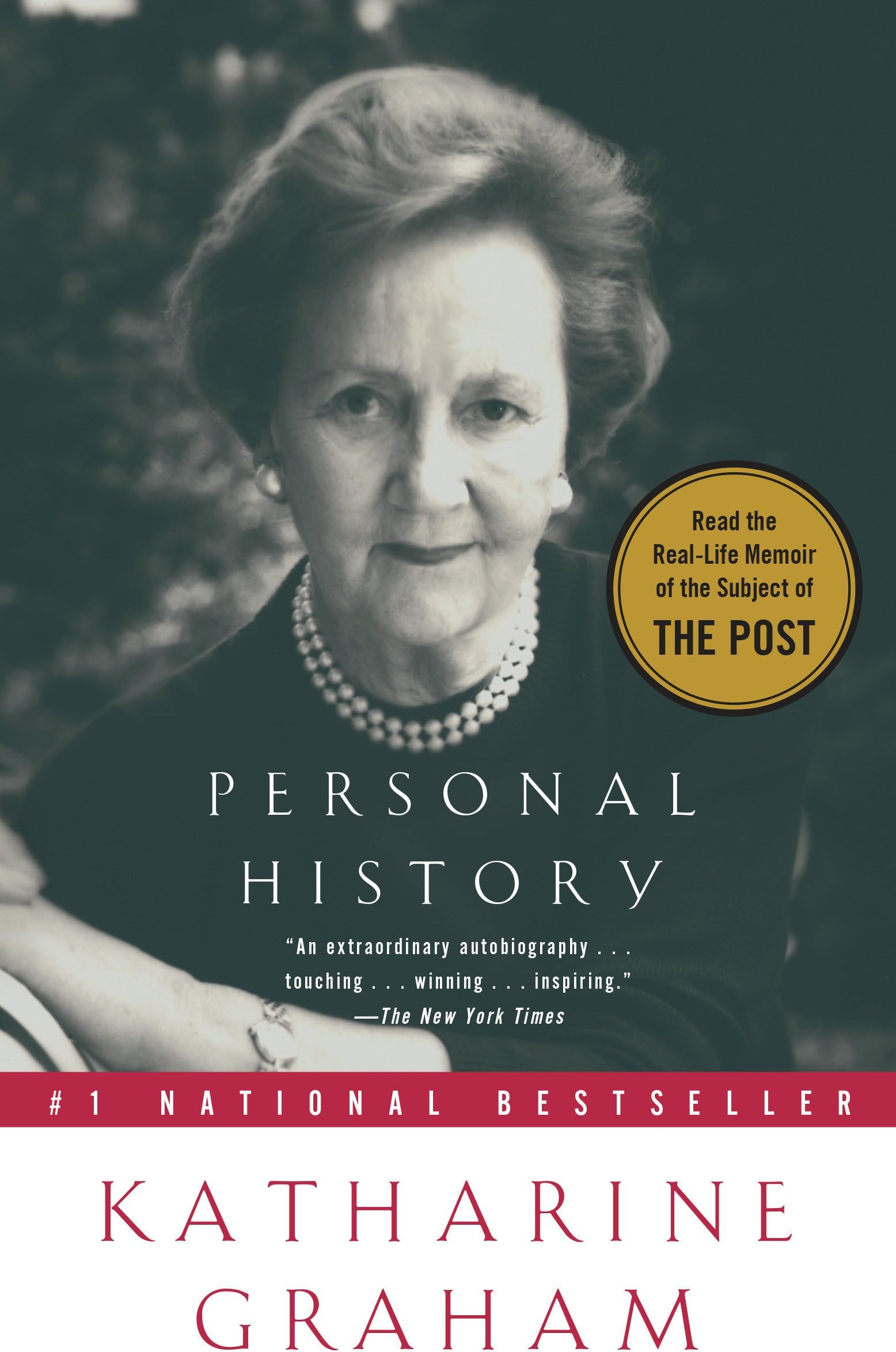
Personal History (Pulitzer Prize Winner): A Memoir
Product ID: 6014143
🏆Pulitzer Prize Winner
📈#1 National Bestseller
📰Inside Story of Washington Post Leadership
Desertcart purchases this item on your behalf and handles shipping, customs, and support to Malaysia.
📚 Own the story behind the headlines — where history meets fearless leadership.
Personal History is Katharine Graham’s Pulitzer Prize-winning memoir chronicling her transformative journey as the first female CEO of The Washington Post. Set against the backdrop of landmark events like the Pentagon Papers and Watergate, this bestselling book offers an intimate look at the challenges of leading a major media empire with integrity and courage during America’s most turbulent political eras.

| Best Sellers Rank | #27,785 in Books ( See Top 100 in Books ) #2 in Book Publishing Industry #7 in Journalism Writing Reference (Books) #12 in Journalist Biographies |
| Customer Reviews | 4.4 out of 5 stars 2,297 Reviews |
C**N
Graham led a productive, meaningful, and impactful life
Born into privilege, Katharine Graham’s life was defined by and devoted to her family’s company, The Washington Post. While she could have taken it easy and led a life of leisure (she didn’t know how to fold her own clothes in college because “that was always done for me”) she instead took on the stress and challenges of operating a Fortune 500 company. She did this despite her obvious lack of experience and being the only women in the room, pretty much all the time. “Since I regarded myself as inferior,” she wrote, “I failed to distinguish between, on the one hand, male condescension because I was a woman and, on the other hand, a valid view that the only reason I had my job was the good luck of my birth and the bad luck of my husband’s death.” There was plenty of both, but Graham managed to find success through sheer determination and a deep desire to bring good journalism to the people. While her start at The Washington Post was rocky, her confidence grew over the years as she grew into the job and began to accumulate some successes. She covered many presidents (and knew a few personally) from JFK and LBJ to Nixon and eventually Reagan, Bush, and Clinton. Graham’s autobiography is also a biography of The Washington Post newspaper and company—the family owned Newsweek magazine for many years in addition to a few local television and radio stations in select cities around the country. The paper, originally founded in 1877, was sold to Graham’s father at auction in 1933. Keeping it in the family, he eventually passed ownership on to Katharine’s husband Philip in 1946. The burdens of the job (and an undiagnosed mental illness) would eventually lead Phil to take his own life in 1963, catapulting Katharine into the position of president and CEO, one which she held for nearly thirty years before eventually passing the family torch once again to her own son Donald. While ownership of the company passed from one generation to the next, Graham always did her best to maintain her integrity with her readership and insisted on impartial journalism. Today, much of journalism feels as though it is written with a specific ideology behind it, but that was not always the case in the United States. “People who may disagree on politics must still be able to communicate, and it’s crucial for all of us in the press to listen to all sides,” she writes of her time at the newspaper. “I consider it the role of the head of a newspaper to be bipartisan and to bring journalists together with people from government. I think that an easy relationship is constructive and useful for both sides: it helps the publication by opening doors, and provides those who are covered in the news with the knowledge of whom they can suggest ideas to, complain to, and generally deal with.” As a means of honoring their bipartisanship, The Post maintained a precedent of not endorsing political candidates for many years, until eventually breaking this pattern in the 1976 election when they officially endorsed Jimmy Carter. The relationship between government and press is a vital one to a free and open society, and as one of the most prominent news sources in the capital city of Washington D.C. Graham and her associates at The Post had an important job: keeping those in power in check. While her career spanned many important years, there are two distinct events that had massive impact on her tenure. The first was the publication of the Pentagon Papers—which revealed the US’s involvement in Vietnam to be much more vast and devastating than the public originally knew about—and the second was the Watergate Scandal. Watergate, which progressively unfolded from 1972-1974 and eventually culminated in President Nixon’s resignation from office, was a political scandal unlike any other. “Its sheer magnitude and reach put it on a scale altogether different from past political scandals,” Graham remembers, “in part because of the unparalleled involvement of so many men so close to the president and because of the large amounts of money raised, stashed, and spent in covert and illegal ways.” The story revealed the depths of corruption throughout the different branches of government and the lengths to which Nixon was willing to go to cover it all up. Graham herself spent much of her time during the scandal as one of the top names on Nixon’s list of public enemies. Despite the immense pressure to drop the investigation, Graham pushed her reporters to continue pulling at the strings until the entire sweater unravelled. “As astounding as Watergate was to the country and the government, it underscored the crucial role of a free, able, and energetic press.” In conclusion, I found two important take-aways from reading this entertaining and informative book: The importance of a free press in keeping those in power in check, and the importance of leading a life of purpose. Graham could have easily taken her family’s money and done whatever she wanted with her life, including nothing at all. Instead, her parents pushed her (and her four siblings) to live lives of fulfillment and productivity. She then passed these same sentiments on to her own children. Playing a central role in the production of news and the diagnosing of politics led Graham to live an extraordinary life, one of equal parts joy and hardship. Her mark on history was made in the face of gender-discrimination and is a shining example to us all of the importance of leading a life of purpose.
K**R
Good read, but book was used.
This is a good book, however, I was put off by the used condition. It was advertised as a new book in description. However, someone had used a “six flags” amusement park card as a book mark, which fell out as I opened the book. There was some sticky stuff of the book cover (back cover). Also found pen parks and underlined sentences inside. So I have deducted a star.
A**R
I had to laugh
The book was interesting and in good condition, however, If you’re going to charge $ for used book you should remove the 25 cent garage sale masking tape from it before shipping it off
K**I
the trifecta of an excellent book: readable, entertaining, edifying
This book is phenomenal. I believe that I have found the inspiration for Forrest Gump. Born into very serious privilege, Katherine Graham's introspective autobiography spans the Gilded age to the 1980s, from her parents' childhoods, to how they met, to her childhood, marriage, and life beyond marriage and kids. Besides a jaw-dropping list of family friends ranging from Rodin to Kissinger (and all presidents between Roosevelt and Carter) and Curie to Buffet, Ms. Graham occupied a rarified strata where she didn't know how to fold her clothes in college "because that was always done for me." Despite her incredible privilege, Ms. Graham was a hard-working and earnest person who engaged in her marriage and motherhood enthusiastically, if not, according to her, somewhat less than completely adeptly. Her story is one of a woman born in the early 1900s, widowed in the 1960s and heading up an F500 company, her family's paper the Washington Post, at a time where she was the only female in the boardroom. Kind of ever. She relates interesting anecdotes about her insecurities in running a company, particularly in an age where women were encouraged to stay and home and raise children. In her memoir is a compelling story of a woman persisting in a man's world, relying upon her sensibilities and succeeding despite her propensity to "burst into tears" when confronted with aggressiveness or bad news. I thoroughly enjoyed this well-written and engaging memoir for its historical perspective, its insight into privilege and its trajectory of a very impressive person who was also a woman. I highly, highly recommend this book - it is readable, entertaining and edifying - the trifecta of an excellent book.
B**S
Good, but bad
WARNING this 600+ page book has no chapter tiltes (other than 1, 2, 3, etc) or dates to orient the reader, and it is very poorly indexed. What was K.G. thinking! She was responsible for a publishing empire in which dates and subject matter was crucial, but altho a pulitzer prize winner, it has no guideposts for the reader. That makes it like trying to swim in an ocean of heavy algae. Skip it and watch the PBS story of her life. If you have the real-time time to read it, have at it.
J**N
Great piece of Washington History
This book is for anyone who is interested in Washington DC History and the Newspaper Business, of which I am also I lived through Watergate. Fortunately for Mrs. Graham, she led an extraordinary life. She was born into privilege and money to Mr and Mrs. Eugene and Agnes Meyer, who are interesting in their own rite. If her father had not rescued the failing Washington Post, she still might of had an interesting life, but maybe not so noticeable. After college she began work as a reporter, set up by the father in Los Angeles. She cam back to DC and met Phil Graham who became her Dads fair hair boy, to pass the Post on to, she had ups and downs while being a wife, mother, and runner of the household (who husband's just think happen). Her bucolic life takes a sudden turn with the death of her sister, her father and the mental illness, betrayal and death of her husband. She then moves into the corporate world of the newspaper business and all the Post Company business, as she learns to play with big boys. She also takes us through how political life in Washington affects her and the Post as we enter the 60's and 70's, through all the political changes, Watergate and on to the Pressman's Strike. She gives the reader a look at her thoughts and feelings about herself, her parents, her children, and her famous friends and not so famous friends throughout the book, its a long but great read.
K**R
Lived history well told
Her description of the almost exclusively white and male world of newspaper journalism in the 1970s and beyond is painful to recall. But true. Sadly vestiges remain in 2026, with mindsets in government today. There were some parts of the book I thought could have used more editing, like less hammering on the self-deprecating aspects of her thoughts. So she didn't go to Harvard Business School! So she learned things -- often the hard way! But learn them she did!
V**I
an extraordinary woman worth learning from
I must have read this book ten times by now but find myself returning to it constantly. Here is a woman who was born into such privilege and wealth that she could have led a perfectly meaningless life. Yet her parents had solid values, she married an ambitious, smart man, and when he died, she oversaw the Washington Post through its most interesting period, the sixties through the eighties. Just reading about the events of her life is like getting the CliffNotes version of American history. The cast of characters is like a Who's Who of influential people, but not once does the reader feel that she's bragging. In many instances she talks frankly about her mistakes, big and small, without giving the impression that her account of the story of self-serving. She talks about her own self absorption and neglect of her two younger children after her husband's mental illness and subsequent suicide. Of particular note is a particularly unflattering description of her written by Robert Redford (who starred in All the President's Men). Redford's letter (quoted in the book) seems to confirm to us -- the readers -- our deepest suspicions about Kay Graham, that she is snobby and blue-blooded to the core, but she explains herself remarkably well without offering excuses. I find it hard not to admire her frankness and willingness to tell us the less flattering bits. Personal History essentially covers her four or five different lives, and she goes into the major events with enormous detail. Every successive life she has is more incredible than the last -- never does the reader feel that she has glossed over parts of the story. In fact, she often goes into elaborate detail and includes dialogue from old letters, etc. One thing I've read in some negative reviews is that she's 'just a spoiled rich girl.' In fact she spends a lot of time making it perfectly clear that she is privileged and that a lot of things she has had in life had little to do with her own abilities -- the acquisition of The Post by her father, for example. But what's remarkable is that she never ran away from what she was supposed to do. And for this -- as well as for her honesty -- she is an inspiration to us all. This is by far my favorite book!
F**S
Excelente libro
Una historia maravillosa, creo que vale toda la pena saber la historia de este personaje tan controversial. Les resultará fascinante Altamente recomendado
R**Y
Good print, poor content
The 3 star rating is for the product, not the content. The content gets at most 2 stars. First the good: the print is good, with good quality paper and print. No typos. This is something Indian publishers should learn, especially Penguin whose prices are high for cheap paper editions. The content: It is just like listening to your neighbour's family tale. Nothing deep or taxing your brain. Only difference is, here the story teller was rich and famous and hence the book became famous. This criticism is not on the writer, who just wanted to tell her life story. Rather, the comment is on the rave reviews even from Time and New York Times. Time says it is immensely readable. Really? The prose is just bland. NYT said it is extraordinary. Is it? Millions of people in this world go through such struggles. It is just that the writer of this story was the rich daughter of a successful newspaper baron.
C**A
Simplesmente Maravilhoso
Simplesmente maravilhoso. Narrativa sincera, envolvente, muito bem escrita. Sempre admirei muito a Katharine Graham, mas ultrapassou as expectativas. Excelente, Adorei.
K**9
Sehr gutes Buch
Ich bin froh es gekauft zu haben.
A**Z
Muy interesante
Es muy interesante lo que cuenta.
Trustpilot
1 month ago
1 day ago