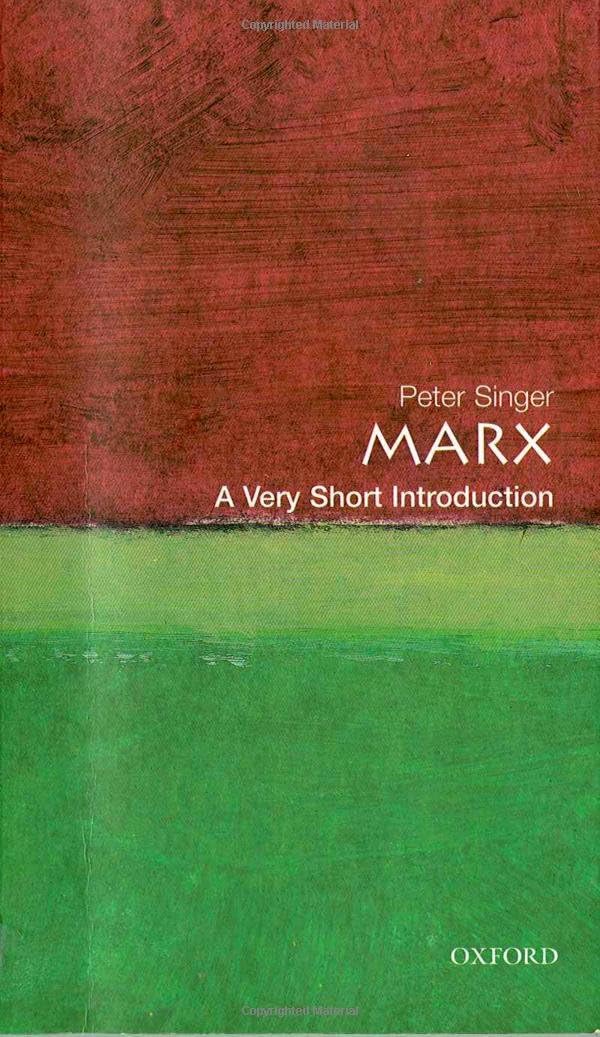
Marx: A Very Short Introduction
Product ID: 48491937
Peter Singer identifies the central vision that unifies Marx's thought, enabling us to grasp Marx's views as a whole. He sees him as a philosopher primarily concerned with human freedom, rather than as an economist or a social scientist. He explains alienation, historical materialism, the economic theory of Capital, and Marx's ideas of communism, in plain English, and concludes with an assessment of Marx's legacy. ABOUT THE SERIES: The Very Short Introductions series from Oxford University Press contains hundreds of titles in almost every subject area. These pocket-sized books are the perfect way to get ahead in a new subject quickly. Our expert authors combine facts, analysis, perspective, new ideas, and enthusiasm to make interesting and challenging topics highly readable. Review: Excellent if you are a beginner - If you don't know anything, or know very little about Marx and his ideas and you need to brush up but don't have the time to sit for hours in a library, then get this book. I am a complete beginner with Marx, I had heard of him but knew nothing about his ideas. I had to acquire this knowledge in a very short space of time for an essay that I was writing for my Masters. This book was perfect, just enough information to give me the basics without getting to indepth AND in an easy to read format. It covers events in his life as well as his main achievements and ideas. This book makes no assumptions that you know anythign about Marxism so it is very easy to follow whilst avoiding being patronising or school bookish. In fact the Very Short Introduction series are actually written by very eminent scholars in the field so it by no means superficial or textbook material. This is an excellent introduction to Marxism, it will give you the basics and will help you identify areas of further reading or study if you are so inclined. If you need an indepth, detailed look at his ideas/theories/life, then this isn't the book for you. Review: A quick, simple guide to Marx - worth reading - I first picked up The Communist Manifesto by Karl Marx and Friedrich Engels when I was sixteen. Of course, I didn’t feel like a precocious sixteen-year-old then. I felt like a free-thinking young intellectual discovering poetry and politics, and exploring the vast literary landscape with a hunger and delight that, frankly, I wish I could maintain now. Like many significant works of literature this little book had its own killer line. Not quite the first line, but certainly as memorable as the best of them. It read: ‘The history of all societies is a history of class struggle.’ I read on eagerly. Thus The Communist Manifesto became my first conscious encounter with what I later learned was a ‘worldview’ and it was exhilarating to read something that claimed to know what was really going on in the world. My teenage romance with Marxism didn’t last too long and suffered numerous blows as I discovered not its power to transform but, disappointingly, its consistent failure. And when I later became president of the Students’ Union at a small college in Sussex I was appalled at the sanctimonious reverence Marx was paid. The primary example of this happened not at the National Conference but at an (ironically) exclusive and somewhat secretive gathering of three Students’ Union presidents at Sussex University. Our host, the Sussex Uni president, asked us to be seated. He then proceeded to unveil, by pulling down on a little fluffy cord, a red velvet curtain, behind which were revealed portraits first of Marx, then Lenin, and finally the then General Secretary of the Soviet Union, Yuri Andropov. Once this ceremony was complete he opened the meeting. It was both strangely religious and hopelessly sad. But that kind of obsequious nonsense was the least of it. The philosophy itself was problematic. Apart from his impressive, often accurate view of the past, Marx’s vision for future revolution and collective ownership had already obviously failed in the terrifyingly authoritarian regimes that claimed him as their founder. Even George Orwell said – somewhere in Homage to Catalonia – that he only saw communism work once, and then only for about three weeks, after which the usual egotistical impulse for status reasserted itself. One set of status/power/money lovers had been replaced by another set who soon began to act like those they replaced. The Significance of Marx Marx and Engels felt they had discovered a scientific assessment of social progress akin to Darwin’s theory of evolution. The parallel is oddly appropriate for many Christians: we may agree with much of what both Darwin and Marx observed, but may also have considerable doubts about the projections they made based on the observation. And so to Peter Singer’s highly readable, Marx, A Very Short Introduction. He asks, ‘Can anyone now think about society without reference to Marx’s insights into the links between economic and intellectual life? Marx’s ideas brought about modern sociology, transformed the study of history, and profoundly affected philosophy, literature, and the arts. In this sense of the term – admittedly a very loose sense – we are all Marxists now.’ (3) Hegel, History, and God There were a number of points at which the thinking of others encouraged Marx to see religion as ultimately negative (for Marx this inevitably meant Christianity). In describing Hegel and the young Hegelians who influenced Marx Singer writes, ‘The goal of history became the liberation of humanity; but this could not be achieved until the religious illusion had been overcome.’ (22) Of course! Singer has unintentionally sent us back to a conversation in Eden in Genesis 3. And later, ‘theology is a kind of misdirected anthropology. What we believe of God is really true of ourselves. Thus humanity can regain its essence, which in religion it has lost.’ (23) And in an inevitable statement of absolute naturalism, ‘Thought does not precede existence, existence precedes thought.’ (24) Christians love the fact that in the beginning was thought and word, and all creation came into existence as a result of thought and word. But Marx only saw the way religion created compliance rather than progress. Economic Injustice and its Cure When Marx came on to his views of economic injustice we find some of his arguments compelling but his solutions naive. When pointing out that driving wages down to as close as is necessary to merely keep workers alive, while keeping for themselves a significant amount of the value the workers create, Marx is highlighting a genuine manipulation of human resources. (33) Sure. We need just laws, and we ought to have them. But Marx asserted ‘the solution is the abolition of wages, alienated labour, and private property in one blow. In a word, communism.’ (36) and claimed, ‘Communism…is the genuine resolution of the antagonism between man and nature and between man and man…It is the riddle of history solved and knows itself as this solution.’ Singer adds, ‘One might expect that Marx would go on to explain in some detail what communism would be like. He does not – in fact nowhere in his writings does he give more than sketchy suggestions on this subject.’ (37) Marx and Engels consistently preached for a kind of millennial era of liberation, freedom from oppression, and peace among men. In one sense, the very best motivations of the communist vision are a kind of echo of genuine Christianity, but with man, not God, at the centre. In fact it’s difficult to imagine the birth of Marxist philosophy in any but a Christian cultural environment, and a muscular 19th century Christianity at that. ‘From each according to his ability, to each according to his need,’ could have been bellowed out by William Booth and the Salvation Army; could, in fact, have been written by Luke in the Book of Acts (see Acts 2.45 [i], and 4.34 [ii]). Marx was also echoing a widely held Christian sentiment when he asserted that history has a definite goal; that of humanity reaching its greatest potential in an era of liberation and freedom. He probably didn’t realise how much a view of God’s sovereignty, of providence, and the millennial hope he carried in his thinking about the future. Singer brings us up to post-Christian speed: ‘Few historians…now see any goal in history. They do not explain history as the necessary path to anywhere. They explain it by showing how one set of events brought about another.’ (57) Revolution and Transformation Marx believed that Capitalism would force its own failure as workers would realise their exploitation, rise up, and redistribute wealth on a fair and equal basis. Private property would be abolished. The State would draw the allegiance of all men and the common good would be the goal of all. Absolutely wishful thinking. Singer: ‘According to Marx’s view of history, as the economic basis of society alters, so all consciousness alters. Greed, egoism, and envy are not ingrained forever in the character of human beings. They would disappear in a society in which private property and private means of production were replaced with communal property and socially organized means of production. We would lose our preoccupation with our private interests. Citizens of the new society would find their own happiness in working for the good of all. (81) Surely only the most inexperienced revolutionary could believe that? ‘It has been said that later in life Marx developed a less Utopian view of communism, but it is difficult to find much evidence of this.’ (83) His view was so utopian in fact that he believed communism would become fully international in its reach, and therefore single nation-states would cease to exist, thus eradicating the impulse for war between nations. Armed forces would become a thing of the past. Cue not-the-only-dreamer, John Lennon. Actually though, while it’s certainly not imaginable now, it is nevertheless a hope that’s deeply embedded in the human psyche (we’re made in the image of God after all) and it echoes an idea worked out in Christian eschatology. How do we assess Marx’s philosophy? Singer: ‘More than a century after Marx made these predictions, most of them are so plainly mistaken that one can only wonder why anyone sympathetic to Marx would attempt to argue that his greatness lies in the scientific aspects of his work. Judged by the standards of Marx’s time, the gap between rich and poor has narrowed dramatically throughout the industrialized world…Real wages have risen. Factory workers today earn considerably more than they need in order to remain alive and reproducing…Capitalism has gone through several crises, but nowhere has it collapsed as a result of its alleged internal contradictions. Proletarian revolutions have broken out in the less developed nations [Marx predicted it would happen in the more developed ones]. (88) He supposed ‘that real wages would remain around subsistence level; in fact the increase in productivity has allowed real wages to rise.’ (91) The ‘conception of freedom Marx espoused contains within it a difficulty Marx never sufficiently appreciated, a difficulty which can be linked with the tragic mutation of Marx’s views into a prop for murderously authoritarian regimes. This is the problem of obtaining the co-operation of each individual in the joint endeavour of controlling our society.’ (92) ‘Marx never intended a communist society to force the individual to work against his or her own interests for the collective good.’ (97) Marx’s view of human nature was hopelessly optimistic. The economic injustices he identified were not simply the result of capitalist systems (though those systems enabled them) but of fallen human nature, sinful nature. And even though today we can see improvement to human rights and progress in many areas, enacted in many laws, the fundamental problem of human sin is still wildly underestimated. This doesn’t let capitalism off the hook of course, let alone individuals greedy for their own advancement at the expense of others. In fact, those Christian leaders and pastors living in countries with ever-widening gaps between rich and poor need to develop a healthy desire and determination to work for a more just society. Nevertheless, the communism that was experienced in the twentieth century was never the utopia Marx dreamt of; that dream of equality only ever appeared in propaganda films. Equally unconvincing are the arguments that true Marxism has never been properly tried. The reason it never lasts longer than a few weeks is because the philosophy radically over-estimates the goodness of human nature. What is needed is a philosophy that (goes beyond philosophy and) gets into the heart and changes human nature, that leads to repentance from sin and faith in Christ, and produces an unwavering resolve for social justice. To put it in the words of the most famous prayer, ‘Thy Kingdom come, Thy will be done on earth as it is in heaven.’
| Best Sellers Rank | 608,553 in Books ( See Top 100 in Books ) 200 in Philosopher Biographies |
| Customer Reviews | 4.4 out of 5 stars 540 Reviews |
L**N
Excellent if you are a beginner
If you don't know anything, or know very little about Marx and his ideas and you need to brush up but don't have the time to sit for hours in a library, then get this book. I am a complete beginner with Marx, I had heard of him but knew nothing about his ideas. I had to acquire this knowledge in a very short space of time for an essay that I was writing for my Masters. This book was perfect, just enough information to give me the basics without getting to indepth AND in an easy to read format. It covers events in his life as well as his main achievements and ideas. This book makes no assumptions that you know anythign about Marxism so it is very easy to follow whilst avoiding being patronising or school bookish. In fact the Very Short Introduction series are actually written by very eminent scholars in the field so it by no means superficial or textbook material. This is an excellent introduction to Marxism, it will give you the basics and will help you identify areas of further reading or study if you are so inclined. If you need an indepth, detailed look at his ideas/theories/life, then this isn't the book for you.
L**X
A quick, simple guide to Marx - worth reading
I first picked up The Communist Manifesto by Karl Marx and Friedrich Engels when I was sixteen. Of course, I didn’t feel like a precocious sixteen-year-old then. I felt like a free-thinking young intellectual discovering poetry and politics, and exploring the vast literary landscape with a hunger and delight that, frankly, I wish I could maintain now. Like many significant works of literature this little book had its own killer line. Not quite the first line, but certainly as memorable as the best of them. It read: ‘The history of all societies is a history of class struggle.’ I read on eagerly. Thus The Communist Manifesto became my first conscious encounter with what I later learned was a ‘worldview’ and it was exhilarating to read something that claimed to know what was really going on in the world. My teenage romance with Marxism didn’t last too long and suffered numerous blows as I discovered not its power to transform but, disappointingly, its consistent failure. And when I later became president of the Students’ Union at a small college in Sussex I was appalled at the sanctimonious reverence Marx was paid. The primary example of this happened not at the National Conference but at an (ironically) exclusive and somewhat secretive gathering of three Students’ Union presidents at Sussex University. Our host, the Sussex Uni president, asked us to be seated. He then proceeded to unveil, by pulling down on a little fluffy cord, a red velvet curtain, behind which were revealed portraits first of Marx, then Lenin, and finally the then General Secretary of the Soviet Union, Yuri Andropov. Once this ceremony was complete he opened the meeting. It was both strangely religious and hopelessly sad. But that kind of obsequious nonsense was the least of it. The philosophy itself was problematic. Apart from his impressive, often accurate view of the past, Marx’s vision for future revolution and collective ownership had already obviously failed in the terrifyingly authoritarian regimes that claimed him as their founder. Even George Orwell said – somewhere in Homage to Catalonia – that he only saw communism work once, and then only for about three weeks, after which the usual egotistical impulse for status reasserted itself. One set of status/power/money lovers had been replaced by another set who soon began to act like those they replaced. The Significance of Marx Marx and Engels felt they had discovered a scientific assessment of social progress akin to Darwin’s theory of evolution. The parallel is oddly appropriate for many Christians: we may agree with much of what both Darwin and Marx observed, but may also have considerable doubts about the projections they made based on the observation. And so to Peter Singer’s highly readable, Marx, A Very Short Introduction. He asks, ‘Can anyone now think about society without reference to Marx’s insights into the links between economic and intellectual life? Marx’s ideas brought about modern sociology, transformed the study of history, and profoundly affected philosophy, literature, and the arts. In this sense of the term – admittedly a very loose sense – we are all Marxists now.’ (3) Hegel, History, and God There were a number of points at which the thinking of others encouraged Marx to see religion as ultimately negative (for Marx this inevitably meant Christianity). In describing Hegel and the young Hegelians who influenced Marx Singer writes, ‘The goal of history became the liberation of humanity; but this could not be achieved until the religious illusion had been overcome.’ (22) Of course! Singer has unintentionally sent us back to a conversation in Eden in Genesis 3. And later, ‘theology is a kind of misdirected anthropology. What we believe of God is really true of ourselves. Thus humanity can regain its essence, which in religion it has lost.’ (23) And in an inevitable statement of absolute naturalism, ‘Thought does not precede existence, existence precedes thought.’ (24) Christians love the fact that in the beginning was thought and word, and all creation came into existence as a result of thought and word. But Marx only saw the way religion created compliance rather than progress. Economic Injustice and its Cure When Marx came on to his views of economic injustice we find some of his arguments compelling but his solutions naive. When pointing out that driving wages down to as close as is necessary to merely keep workers alive, while keeping for themselves a significant amount of the value the workers create, Marx is highlighting a genuine manipulation of human resources. (33) Sure. We need just laws, and we ought to have them. But Marx asserted ‘the solution is the abolition of wages, alienated labour, and private property in one blow. In a word, communism.’ (36) and claimed, ‘Communism…is the genuine resolution of the antagonism between man and nature and between man and man…It is the riddle of history solved and knows itself as this solution.’ Singer adds, ‘One might expect that Marx would go on to explain in some detail what communism would be like. He does not – in fact nowhere in his writings does he give more than sketchy suggestions on this subject.’ (37) Marx and Engels consistently preached for a kind of millennial era of liberation, freedom from oppression, and peace among men. In one sense, the very best motivations of the communist vision are a kind of echo of genuine Christianity, but with man, not God, at the centre. In fact it’s difficult to imagine the birth of Marxist philosophy in any but a Christian cultural environment, and a muscular 19th century Christianity at that. ‘From each according to his ability, to each according to his need,’ could have been bellowed out by William Booth and the Salvation Army; could, in fact, have been written by Luke in the Book of Acts (see Acts 2.45 [i], and 4.34 [ii]). Marx was also echoing a widely held Christian sentiment when he asserted that history has a definite goal; that of humanity reaching its greatest potential in an era of liberation and freedom. He probably didn’t realise how much a view of God’s sovereignty, of providence, and the millennial hope he carried in his thinking about the future. Singer brings us up to post-Christian speed: ‘Few historians…now see any goal in history. They do not explain history as the necessary path to anywhere. They explain it by showing how one set of events brought about another.’ (57) Revolution and Transformation Marx believed that Capitalism would force its own failure as workers would realise their exploitation, rise up, and redistribute wealth on a fair and equal basis. Private property would be abolished. The State would draw the allegiance of all men and the common good would be the goal of all. Absolutely wishful thinking. Singer: ‘According to Marx’s view of history, as the economic basis of society alters, so all consciousness alters. Greed, egoism, and envy are not ingrained forever in the character of human beings. They would disappear in a society in which private property and private means of production were replaced with communal property and socially organized means of production. We would lose our preoccupation with our private interests. Citizens of the new society would find their own happiness in working for the good of all. (81) Surely only the most inexperienced revolutionary could believe that? ‘It has been said that later in life Marx developed a less Utopian view of communism, but it is difficult to find much evidence of this.’ (83) His view was so utopian in fact that he believed communism would become fully international in its reach, and therefore single nation-states would cease to exist, thus eradicating the impulse for war between nations. Armed forces would become a thing of the past. Cue not-the-only-dreamer, John Lennon. Actually though, while it’s certainly not imaginable now, it is nevertheless a hope that’s deeply embedded in the human psyche (we’re made in the image of God after all) and it echoes an idea worked out in Christian eschatology. How do we assess Marx’s philosophy? Singer: ‘More than a century after Marx made these predictions, most of them are so plainly mistaken that one can only wonder why anyone sympathetic to Marx would attempt to argue that his greatness lies in the scientific aspects of his work. Judged by the standards of Marx’s time, the gap between rich and poor has narrowed dramatically throughout the industrialized world…Real wages have risen. Factory workers today earn considerably more than they need in order to remain alive and reproducing…Capitalism has gone through several crises, but nowhere has it collapsed as a result of its alleged internal contradictions. Proletarian revolutions have broken out in the less developed nations [Marx predicted it would happen in the more developed ones]. (88) He supposed ‘that real wages would remain around subsistence level; in fact the increase in productivity has allowed real wages to rise.’ (91) The ‘conception of freedom Marx espoused contains within it a difficulty Marx never sufficiently appreciated, a difficulty which can be linked with the tragic mutation of Marx’s views into a prop for murderously authoritarian regimes. This is the problem of obtaining the co-operation of each individual in the joint endeavour of controlling our society.’ (92) ‘Marx never intended a communist society to force the individual to work against his or her own interests for the collective good.’ (97) Marx’s view of human nature was hopelessly optimistic. The economic injustices he identified were not simply the result of capitalist systems (though those systems enabled them) but of fallen human nature, sinful nature. And even though today we can see improvement to human rights and progress in many areas, enacted in many laws, the fundamental problem of human sin is still wildly underestimated. This doesn’t let capitalism off the hook of course, let alone individuals greedy for their own advancement at the expense of others. In fact, those Christian leaders and pastors living in countries with ever-widening gaps between rich and poor need to develop a healthy desire and determination to work for a more just society. Nevertheless, the communism that was experienced in the twentieth century was never the utopia Marx dreamt of; that dream of equality only ever appeared in propaganda films. Equally unconvincing are the arguments that true Marxism has never been properly tried. The reason it never lasts longer than a few weeks is because the philosophy radically over-estimates the goodness of human nature. What is needed is a philosophy that (goes beyond philosophy and) gets into the heart and changes human nature, that leads to repentance from sin and faith in Christ, and produces an unwavering resolve for social justice. To put it in the words of the most famous prayer, ‘Thy Kingdom come, Thy will be done on earth as it is in heaven.’
T**R
Excellent intro to Marx
Excellent appraisal and explanation of the great genius. Five stars from me. I was engrossed by every page.
M**N
Excellent
Excellent in introduction to Marxism. Really gives a good overview (better than an overview actually). Chapters are small and it is easy to skip the complex bits (eg the chapter on Hegel) if they are not for you. Well laid out and good print and quality paper all contribute to this being an good read. I would definitely recommend it for students (A level) wanting to get a grip with Marxism and Marxist Literary Theory as it is very clear.
O**T
The Riddle of History (Singer's Marx)
Peter Singer has written a critical introduction to the principal points of Karl Marx's thought, and although I did not like the hectoring tone of some of those criticisms, I nevertheless felt that the quality of Marx's insight still shone through. It was from this book that I drew the idea of the economic imperatives acting upon the individual determining his day-to-day existence, pretty much from the cradle to the grave. The most obvious of these being the need to go to work, in order to earn the money to pay the rent, the utility bills, to pay for food and clothing, etc. This in itself goes some way towards confirming Marx's idea that the economic relations of society determine all of the other relations - social, political, cultural and legal - where the law is really just the codification (or making explicit) of the existing economic relations. The class structure of society will also reflect this, where your position in the hierarchy (your status, power and influence) are determined by how much land, property, money, capital and resources you own. The kind of clothes you buy, the kind of food you eat, the kind of people you mix with, the kind of place you live in and where it is located will also be decided by your economic circumstances. As a consequence of this, Marx thought that in order to change society, you had first to alter the economic foundations of society - to shift them into a pattern which produced greater equality and a fairer share in the wealth and resources of society for all of its members. And in order to do that, you had also to take the ownership of these things out of the hands of the few aggressively acquisitive capitalists who already held them. Given, too, their ownership of the media and their massive funding of those politicians and parties which represent their interests, this is a task which is easier said than done - but one which can, nevertheless, be achieved. And I am of the view that it can be achieved within the overall context of a capitalist society. I found myself in agreement with Marx that human nature is a mutable thing. Human values are chameleon-like and change to accord with whatever the dominant values of society, in their time, happen to be. And in Marx, those values are determined by 'the economic relations' which characterize a given society, at a given time. Consciously alter 'the economic relations' and you change society itself, hopefully in the direction of greater economic equality, and then other forms of equality will follow. In Marx, there can be no true equality in any area of our lives without first establishing economic equality, precisely because it is 'the economic relations' which determine all of the other relations of society. Whilst always taking care to denounce him to their camp followers, it strikes me that nowhere have the ideas of Marx been more thoroughly introjected than on the right, where they are used for the achievement of ends opposite to those intended by Marx - most obviously, the deliberate widening of the chasm between rich and poor, and the re-creation of the ugly attitudes and consequences which flow from it. In my view, this is very much a feature of our own time. The more 'laissez-faire' capitalism becomes, the more it drags the whole of society back to the model which Marx first criticised in the nineteenth century. And the nineteenth century was followed by the twentieth. It is sad to think that capitalism may have us caught up in that kind of historical loop. In explaining Marx's view of the state at the pre-communist stage of development, Singer writes that it is out of the '...contradiction between the interest of the individual and the community that the state develops as an independent entity.' I interpreted those words to mean that it is the role of the state to establish an harmonious balance between capitalist greed and the needs of the people. Not only does this confirm the need for a strong state, but it also provides it with a role which has constantly to be performed. Personally, I feel that communism occupies the same place in Marx's thought that 'Pure Form' does in Plato's. It is an ideal of perfection which probably cannot be translated into material reality. And perhaps for this reason, I felt there was something of a correspondence between those two thinkers. In my view, Marx's communist ideal in no way detracts from the analysis and criticism of laissez-faire capitalism which precedes it, and which, I think, constitutes the substance of his work. According to Singer, one of Marx's more troubling predictions for capitalism is that it would eventually implode, taking down 'the bodies of the workers' with it. I wonder how very far removed from our current situation that might be. Finally, if Marx did make errors then he is entitled to them. Show me the great thinker who did not make errors. It is up to you, the reader, with an additional two hundred years of historical experience to draw upon, to make good his errors and to further develop his thought by using it as a springboard for your own. Then, perhaps, you will be the one to coin a fresh post-Marxist solution to "the riddle of history". But if you do, then I suspect that it will still owe a great deal to his work.
J**N
Well Written, Well Informed and Well Done
This book is well written, well informed and well done. It reveals the life of Karl Marx and his influences, amazingly only in approximately 100 pages. Probably other books that would follow well from this would be 'Communism,' 'Socialism,' or 'Democracy,' that are also in the 'Very Short Introductions' compilation. If anything, there is a lot to remember (although this book is good for giving you the 'jist' of everything)and that it's rather short but then again, the clue was in the title.
L**H
The view from 1980
I bought this after finishing Paul Mason's "Post Capitalism" to get a different view. This was written originally back in 1980 and suggests Marx was wrong about some things that now seem right, such as "the theory that under capitalism economic crises will become more and more severe." Singer also suggests that Marx was wrong to say that the "The income gap between capitalists and workers will increase." If there is any clear consequence of neoliberalism it is that this income gap continues to widen however much it may have narrowed prior to the 1980s. What Singer points out in his assessment is that the attempts at Communism in the 20th Century failed in part because of the "problem" of human nature. As I understand from this book it is an article of faith for a Marxist that when society changes so will human nature. Singer suggets that this is based on the idea that Marx discovered some scientific laws governing the direction of history. Singer argues that there is nothing scientific about Marxism, but rather that it is a philosophical system. Whilst behaviours and attitudes will indead change as economics circumstances change, there is no iron rule that behaviours will alter in a benevolent, altruistic way. If anything the lessons of history suggest otherwise. He ends by saying that "the construction of a free and equal society is a more difficult task than Marx realised." That may be true, but the current severe and potentially terminal crisis in the capitalist world order makes this task more urgent than ever. Since Marx anticipated this his ideas are as important to consider as ever.
F**A
VeRy UsEfUl book, especially for beginners who start to study Marx's world for the very first time!!!
This is a brief and a very well-done guide into the Marxist view of the society of his time.... if you want to understand The Capital, this book could be the right first step to approach Marx's conception of history and economy... Not only is this book useful to students of economics but also to students of literature, like me, thanks to its easy and clear language! This is a perfect "preview"/"summary" of the Marx's studies..... so, if you want to make a detailed research on Marx, you need to read some of his major works, as this guide just wants to present his studies to the readers who are unfamiliar with Marxist world :-)
L**U
Short to the point.
Excellent intro by a great philosopher.
G**U
Nice overview of a difficult topic
While communist regimes in the world have been significantly reduced, and some of the existing ones (like China) ressemble more of capitalism, Marx's economic and philosophical ideas are still a polarizing topic. In my opinion, the author of this book does a great job presenting essential elements from Marx theories and keeping a balanced view on their relevance and failure in today's world. I recommend the book for someone who wants to have an initial understanding of Marx thoughts, without being lost to his tough language in his works.
E**N
Short and sweet
Probably no name turns off more Americans than "Marx". That's unfortunate, because the 20th century communism associated with Karl Marx is not really a fair representation of Marx's ideas. Not that Marx wasn't wrong on a number of key issues, such as thinking that eliminating private property would produce true individual freedom. But Marx didn't have much use for government, so it's ironic that he's associated with a Leninist-Stalinist model that attempted to put all aspects of life under government control. Besides Marx the political revolutionary who felt compelled to correct the dreadful condition of the 19th century working class, there's the Marx who's regarded as one of the founders of sociology. "Consciousness does not determine life, but life determines consciousness." (C.f. the then-current Enlightenment view that every decision we make can be as rational as we want it to be, and thus every individual is responsible for his own state in life.) But on to the review. There's a ton of books about Marx available, as well as pounds of Marx's own writings, so why read this book? Because Prof Singer has written a very readable, very understandable description of Marx's thinking: contradictions, mistakes, and all. And done it concisely. Prof Singer is sympathetic to Marx the philosopher -- no philosopher ever gets it all right -- and less sympathetic to Marx the economist and "scientific historian". But Singer presents it all in a very well organized fashion, with lots of references to Marx's writings, so that the reader can easily follow along with the main ideas as well as continue on his own. Personally, I think Singer is too harsh towards Marx the economist, e.g. Marx's prediction that a capitalist system must eventually collapse. Whereas Marx recognized that government would side with the ruling class, i.e., the capitalists, he couldn't have predicted that government would grow powerful enough to bail out the economic system whenever it was near collapse. I doubt if any 19th century economist could have guessed that. Marx also failed to note, as Karl Polanyi did much later, that the general public would require government to restrict the worst activities of the capitalists, e.g. child labor, monopolies, pollution, near-zero wage rates. And this would make society more livable for workers -- thus postponing, perhaps permanently, capitalism's end. Singer, interestingly, shows that Marx may have overstated his case intentionally at times, in order to have more effect. We can certainly see that among modern writers, who know that the more extreme the statements they make, the more attention they get and the more books they sell. Despite the things that Marx got wrong, he got many things right: the boom-bust cycle of capitalism, the alienation of factory workers from their work, the need for capitalists to find ever- wider markets, the growing disparity (though irregular) of income between capitalists and workers, the concentration of economic power into fewer and fewer hands, the influence of someone's economic situation upon the decisions he makes.... A basic knowledge of Marx is really a prerequisite for understanding many of the issues and conflicts that we still deal with today. Prof Singer's book provides that introduction in the most easily-digestible form that I've seen.
J**S
Excellent read
Peter Singer’s style is clear and accessible and this book is just that. Very informative read on one of history’s most famous figures and a balanced view of Marx’s theories.
A**E
klare Kaufempfehlung
Eine wunderbare Einführung in das Leben und Werk Karl Marx'. Singer schafft es tatsächlich auf wenigen Seiten die Entstehung und die grundlegenden Züge der marxschen Theorie gut verständlich zu erklären und in ihren historischen Kontext einzuordnen. Klare Kaufempfehlung für alle, die einen Überblick zum Marxismus suchen, aber (noch) nicht das "Kapital" lesen wollen.
Trustpilot
1 week ago
1 month ago