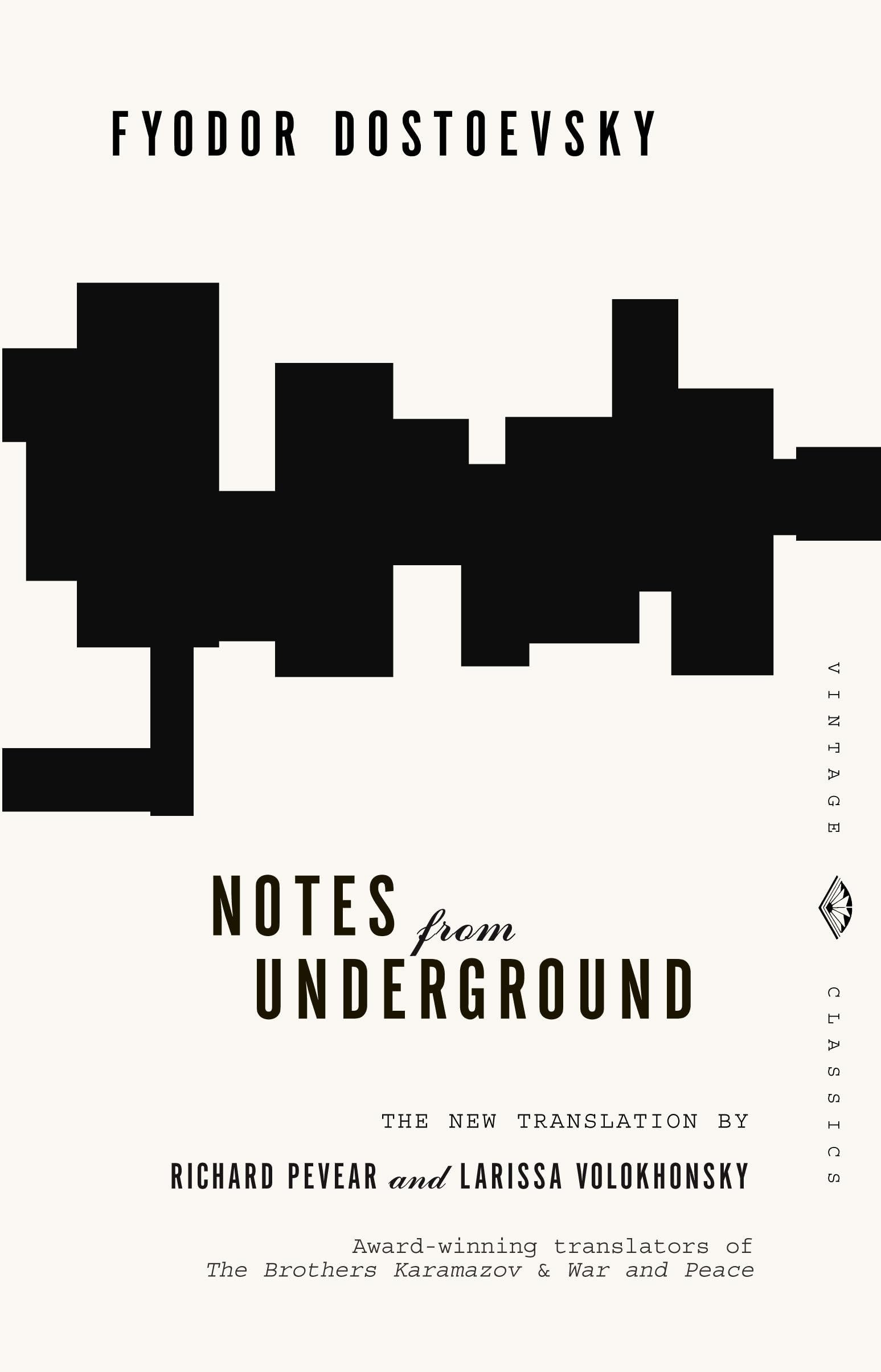
Notes from Underground (Vintage Classics)
Product ID: 4605187
📚Classic Russian literature masterpiece
🔥Top #3 in Russian & Soviet Literature
🖋️Award-winning Pevear & Volokhonsky translation
Desertcart purchases this item on your behalf and handles shipping, customs, and support to Malaysia.
📖 Unlock the underground mind of genius—where rebellion meets philosophy.
Notes from Underground (Vintage Classics) is a celebrated translation by Richard Pevear and Larissa Volokhonsky, offering a faithful and updated rendition of Dostoevsky’s groundbreaking novel. Ranked #3 in Russian & Soviet Literature and boasting a 4.7-star rating from over 2,800 readers, this edition invites readers into the tormented psyche of one of literature’s most complex narrators, blending tragedy, dark comedy, and profound social critique.



| Best Sellers Rank | #710 in Books ( See Top 100 in Books ) #3 in Russian & Soviet Literature (Books) #19 in Teen & Young Adult Classic Literature #26 in Contemporary Literature & Fiction |
| Customer Reviews | 4.7 out of 5 stars 2,828 Reviews |
M**G
My Favorite Dostoevsky Novel
"And in fact I'm now asking an idle question of my own: which is better-cheap happiness, or lofty suffering? Well, which is better?" Probably my favorite of Dostoevsky's work. I've read "Crime and Punishment" and "Brothers Karamazov." Comical, easy readability, philosophical, only wish it ended on better terms. Then again, that wouldn't be a Dostoevsky ending.
K**A
Very good translation
Cool book. It's hard to criticize Dostoevsky
B**B
An Underground Scrooge without redemptive Christmas ghosts
I re-read Notes from Underground after re-reading Invisible Man because Ralph Ellison, in his introduction to the 30th anniversary edition of that novel, mentioned the influence of the Dostoevsky novella. The structure is similar, in that it is the present day ruminations of a person driven into isolation for various reasons recalling the events of 15-20 years earlier that led to his current state. Ellison's novel is one of a series of works that fall under the shadow of the Underground Man and his ramblings and ravings. He compares himself to an insect and I detect an influence on Kafka's metaphor turned literal transformation in "The Metamorphosis"; his isolated anti-hero tries to rescue a prostitute as Travis Bickle in Martin Scorsese's film Taxi Driver would do over a century later. While the Underground Man merely talks of liberation and realizes even as he says it that it is mere lip service to vague notions, Travis carries his crusade into overt, destructive action. I will not cover ground that dozens of critics before me have trod--Dostoevsky's parody of the `rational egoism of philosopher Chernyshevsky, specifically his utopian novel What is to Be Done? or the movement of radical socialism with which Dostoevsky parted ways after his prison sentence to Siberia. All of Dostoevsky's works reflect the issues and philosophical/social movements of the Russia of his time and many have commented extensively on how those movements made their way into his stories and novels. If Dostoevsky were merely a chronicler of his time I don't think he would have exerted such a powerful influence on philosophers and literary artists of subsequent generations or that his works would still be in print via fresh translations such as Richard Pevear's and Larissa Volokonsky's acclaimed works. Dostoevsky was writing of the Russia of his time and yet his depiction and dissection of human nature is universally relevant to the present day. In Notes from Underground the nameless Underground Man is an anti-hero of sorts or has been taken as one and he has also been interpreted as an exaggerated fictional counterpart to Dostoevsky himself. While he shares many of his creator's characteristics I do not think Dostoevsky ever intended this character to be a model to aspire to for anyone although the character is a mouthpiece for what Dostoevsky considered valid criticisms of his society. Like Dickens' Ebenezer Scrooge, the Underground Man has become bitter and cold-hearted and has retreated from the warmth of human companionship. However, whereas Scrooge's journey could be summarized as youthful idealism corrupted by love of the acquisition of material wealth to the exclusion of human relationships redeemed by spiritual, godly intervention, the Underground Man was only slightly less bitter in his youth and now his inheritance has given him the opportunity to retire and retreat from even the minimal human contact that an occupation would require of him. There are no benevolent spirits ready to administer tough love on the Underground Man. He is rooted in his rut and will probably never emerge from it. Sixteen years earlier, he briefly yielded to compassionate impulses as he urged a prostitute named Liza to leave her life of degradation. After his inevitable humiliation and the collapse of his fortress of egoism, Liza did reach out to him with unselfish concern. He could not accept unconditional compassion and retreated into his current misanthropic state. Dostoevsky's depiction of the Underground Man is more than simply a matter of opening or closing the heart. The Underground Man, like Hamlet, is very intelligent. Like Hamlet, he also overanalyzes. In fact, his intelligence and his overactive mind is his undoing more than anything else. He thinks himself into a state of misery. He possesses warring, contradictory impulses that most of us possess. Whereas most of us temper and censor these thought, the Underground Man's mind and imagination run rampant. He is self-analytical and at one point says that underground men such as him should be tethered. Everything that he accuses others of doing he does in multiples. He criticizes others for being cowardly and yet by retreating to his hovel he is the ultimate coward. Perhaps his bravest act is in writing these `notes' where he is relentlessly ruthless in his honesty, to the extent that he can be honest with himself. He is not only the forerunner of Dostoevsky's series of conflicted protagonists but also provides a template for many of the anti-heroes of literature for the next century and a half.
B**E
They find others stupid who, when they act
This book was written as a response to Nikolai Chernyshevsky's "What Is to Be Done?" and this presents a problem as many of the things the unerground man is railing about concern that book. The book is also written in two parts with the first part being the underground man speaking through a crack in the floor to people outside his cellar apartment and the second part, which takes place before the first part, are the actions that brought the underground man to the state he is in. The first part is quite confusing as the underground man is on a rant - he claims that Russia has been overly and wrongly influenced by European philosophies and cultures that do not apply to the unique Russian experience. His target is Chernyshevsky's program for revolution as espoused in his book. The underground man also rails against western philosophies and writings of Rousseau, Goethe, Fourier and George Sand. You can pick out the nub of his arguments by reading closely. In general the underground man and those following Chernyshevsky's philosophy rationalize to the point of inaction. They find others stupid who, when they act, act for all the wrong reasons whereas the underground man is incapable of acting at all. Ironically the underground man lives in a basement alone it is no utopia and is scattered in his thoughts to the point of being totally whack. The second story revolves around a school friend who is being assigned somewhere in Russia and his friends want to throw him a going away party. The underground man is disliked by all the attendees including Zverkov the officer going away but the underground man gets himself invited anyway. The whole thing ends badly of course with the underground man attempting to challenge Zverlov to a duel. When he goes to the whore house, he finds them gone and ends up spending the night with Liza a new recruit to the establishment. He talks her out of being a prostitute abut when she comes to his house to be with him he's totally changed his mind. In the end even Liza pities him and won't take his money - next stop the basement. Oddly the underground man is not a revolutionary at all. There's nothing there that makes hime even political so why he was acting out Chernyshevsky's political philosophy is beyond me. People who actually did act on Chernyshevsky's philosophy actually did some damage (or good depending on your political bent) including the assassination of Tsar Alexander II in 1881 and Lenin and the Bolsheviks who actually help rid Russia of Tsar Nicholas II as well as greatly diminishing the power of the Russian Orthodox church. Dostoevsky died in 1881 and never saw these things and would have strongly disagreed with those socialists and nihilists who, unlike the underground man, actually did something other than equivocate. Dostoevsky after being sent to Siberia for his radicalism turned to the Russian Orhodox church and embraced the tsar as the father figure of the Russian people. This book, however, distant the philosophies that drove it become is relevant because Dostoevsky was a great writer and this book represents the working out of problems and ideas he would carry through to his greates novels, Crime and Punishment, The Demons and The Brothers Karamazov. It's a tough 42 pages at the beginning but once through that the rest is a pretty easy read. I had just finished Pevear and Volokhosky's translation of War and Peace and I wanted to see how they did with Dostoevsky. It's probably the best book to begin reading Dostoevsky but it was worth the effort and there's never been a character quite like the underground man in literature. The second part of the book tells us how he got to where he is. This part of the story is a more traditional narrative. The three main stories told are about how the underground man goes about seeking revenge on an officer who offends him. He finally decides he will bump into him.
S**S
Fascinating perspective.
Fascinating first-person narration approach. What starts as inane babbling becomes quite a fascinating collection of observations of the human condition, iterated in such an unfiltered sense. Compared to modern literature, it feels so real and relatable; feels human.
M**N
The man who couldn't become even an insect
My first encounter with Notes From the Underground was in college, when I wasn't doing well psychologically. I saw a lot of myself in the Underground Man, who is never properly named in this bleak novel. It's difficult to say what the Underground Man's chief problem is. He's neurotic, a little narcissistic, a little vain, a little cowardly, stuck in his ways, and so aware of his flaws that he's filled with self-loathing. Yet, at the same time, he has people he looks down upon, such as Apollon, those he sees as his equals, such as Liza for a bit, and those above him, whom he despises. Unable to live a more, say, *heroic* real life, he's become bookish, imagining a world and life that cannot be, leading him to humiliate himself at every turn. His neuroses and vanity have prevented him from connecting with others. His bookishness gets him into trouble again and again. Instead of taking responsibility for all of this, the Underground Man assumes that he's better than others (while also insisting, perhaps a little unconvincingly, that he's trash), has a more developed consciousness, that of course people want to make themselves miserable if that means they have a choice, etc. Notes From Underground follows the narrator through a dinner party and a illicit winter visit to a millner's at night. He also details his head-in-the-cloud dreams of duels, of honor, of being the hero, being lauded, and as he does, it becomes obvious why something as prosaic as a dinner party or a visit with a lady of the night would be such major events in his forty years of life. Coming back to this book almost twenty years (making me almost the same age as the narrator) after I first read it was a weird experience. It's been more than a few years since I was anywhere near the headspace, though at times I still sense glimmers of it. For those who see themselves in the narrator, Notes From the Underground is a warning against vanity, narcissism, and protecting your ego by sticking your head in the clouds. For everyone else, it's a view into someone beaten down by their own flaws (and no doubt helped there by poverty), unable to take responsibility, unable to change, and unable to *really* be honest with himself. The translation is pretty good. It needed a lot more paragraphs, but the story gets across just fine.
C**R
I enjoyed it.
I got this for a Friedrich Nietzsche class that is through Peterson Academy. This book became one of my favourites. I read through it quickly. I enjoyed it. I've recommended it to others
Q**N
Good read
Good story. Seems like a great introduction to Dostoevsky
C**O
It’s a classic for a reason
Book came in perfect condition. Loved it
M**K
Difficult but essential reading
An astonishing insight into the darkest corners of the human psyche. The narrator represents the duality and paradoxical nature of being human, and his underground musings, polemic and reflections hit deep. Every interaction, from characters to the ideas of the time, act as a mirror to the face of the Underground Man, drawing up his fears, resentments - both sustaining him and tempting him to wield power over it. At times darkly comic, and terrifying, this is quite incredible - but not an easy read.
S**A
.
Fram sidan av boken fick lite böj men tror de har med leveransen att göra med, annars helt perfekt!
M**O
A better translation!
I read this for my book club: this excellent translation is sending me back to all of the Russian greats, as long as they're translated by these two!
G**O
Avaliação
Top
Trustpilot
3 weeks ago
4 days ago