Desertcart purchases this item on your behalf and handles shipping, customs, and support to Malaysia.
โก Elevate your DIY projects with relay control that means business!
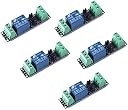
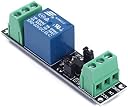
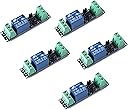
The SongHe 1 Channel DC 3V Relay Module is a compact, high-performance control board designed for microcontrollers like Arduino and ESP32. Featuring a 10A switching capacity at up to 250VAC/30VDC, optocoupler isolation for noise immunity, and versatile power options, this module delivers reliable, professional-grade relay control in a pack of fiveโideal for makers and engineers aiming for seamless integration and robust performance.
| ASIN | B07XGZSYJV |
| Brand | Teyleten Robot |
| Brand Name | Teyleten Robot |
| Coil Voltage | 3 Volts |
| Connector Type | Crimp |
| Connector type | Crimp |
| Contact Current Rating | 10 Amps |
| Contact Material | Silver |
| Contact Type | Normally Open |
| Contact material | Silver |
| Contact type | Normally Open |
| Current Rating | 10 Amps |
| Current rating | 10 Amps |
| Customer Reviews | 4.6 out of 5 stars 212 Reviews |
| Item Weight | 0.01 Ounces |
| Manufacturer | SongHe |
| Maximum Switching Current | 10 Amps |
| Maximum Switching Voltage | 250 Volts |
| Minimum Switching Voltage | 3 Volts |
| Model | RK-S1B4-G97L |
| Mounting Type | Panel Mount |
| Mounting type | Panel Mount |
| Number of Terminals | 2 |
| Operation Mode | Manual |
| Part Number | RK-S1B4-G97L |
| Specification Met | cULus |
| UPC | 724545020568 |
| Unit Count | 5 Count |
K**E
Does the job, works at 3.3V as advertised.
Can be used from a ESP32 system which has 3.3V logic without any additional circuitry. Has screw terminal blocks for both sides of the relay making it easy to integrate with microcontroller board. Has a red LED that lights when the relay is activated, giving good operational feedback. Only niggle is that the screw holes are a bit small. i had to enlarge them with a file to fit normal sized standoff screws.
G**A
These work great
They come attached, but are easy to split off individually if needed. Theyโre working great, controlled by simple GPIO pins from an ESP32 board.
A**C
Ignore most of the reviews
There are a lot of reviews for these clearly written by people using them in ways they are not intended to be used. I am using these to trigger different animatronics from an ESP32. I have 3 of them run in parallel with a 3v LED at the end of the chain. I am powering them from the ESP32's 3V3 pin. I am using a GPIO as the trigger. The ESP32, connected via usb to a computer, still provides enough amperage to trigger all 3 at the same time in addition to powering the LED. The relays support 250V@30A on the output side ONLY. Some people mentioning theirs caught on fire, but clearly are running voltage to the wrong rails. There's no documentation on the jumpers, but basically they are ground and VCC. I am not sure why they would be there, but I guess you could use them as headers to not use the screw terminals? this seems silly though as IN would still need to use the screw terminal. Overall these work great for my project.
D**T
Works well with an ESP32
Awsome little rely boards. I am using them with an ESP32 and they are switching 24 VAC for zone valves and to trigger my boiler's circulator pump and burner. My only complaint is the screw holes are too small and very close to the terminal blocks, however, they still deserve 5 stars. Some have mentioned issues powering these. They are happiest receiving 5 volts to the VCC pin and ground and they have no issues with the 3.3 volt signal from the esp32. Just something to keep in mind when using these. I have a buck converter that reduces the 24 Volts AC to 5 volts DC with a 2 Amp capacity. I am running 10 sensors, 2 ESP32s, a SSR and 5 of these relays off a single converter so power draw isn't an issue. The boards are well made and the components are mounted very well. The indicator LED is nice to have and the relays have a solid and satisfying click when they are engaged.
D**S
Works great with a Pi Pico W
I decided to build a custom pool pump controller using a Pi Pico W and needed something to use for physical interface. This works perfectly using the Pico's 3.3v source and driving the relays from the GPIO pins. Of the five relays, I'm using four to switch 28 VAC to control a variable speed pump and to open/close a water valve. The fifth relay is switching 240 VAC for the axillary pump. It may or may not be the relays' fault, but I found that switching relays sometimes caused noise problems on the wire I had connected to the Pico's reset pin, so beware of that kind of thing.
Trustpilot
3 weeks ago
1 month ago