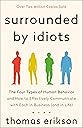

Do you ever think you’re the only one making any sense? Or tried to reason with your partner with disastrous results? Do long, rambling answers drive you crazy? Or does your colleague’s abrasive manner rub you the wrong way? You are not alone. After a disastrous meeting with a highly successful entrepreneur, who was genuinely convinced he was ‘surrounded by idiots’, communication expert and bestselling author, Thomas Erikson dedicated himself to understanding how people function and why we often struggle to connect with certain types of people. Surrounded by Idiots is an international phenomenon, selling over 1.5 million copies worldwide. It offers a simple, yet ground-breaking method for assessing the personalities of people we communicate with – in and out of the office – based on four personality types (Red, Blue, Green and Yellow), and provides insights into how we can adjust the way we speak and share information. Erikson will help you understand yourself better, hone communication and social skills, handle conflict with confidence, improve dynamics with your boss and team, and get the best out of the people you deal with and manage. He also shares simple tricks on body language, improving written communication, advice on when to back away or when to push on, and when to speak up or shut up. Packed with ‘aha!’ and ‘oh no!’ moments, Surrounded by Idiots will help you understand and communicate with those around you, even people you currently think are beyond all comprehension. And with a bit of luck you can also be confident that the idiot out there isn’t you! Review: Eye-Opening Insights Into How People Think and Behave - Surrounded by Idiots completely changed the way I interpret other people’s actions. Instead of assuming someone is “difficult” or “wrong,” the book breaks down behavior into clear personality profiles and shows why people communicate, react, and make decisions the way they do. What really stood out was how practical and relatable it felt — suddenly coworkers, friends, and even family members made more sense. It’s not about labeling or judging; it’s about understanding motivations, communication styles, and stress triggers so you can respond better and work together more effectively. If you’ve ever felt frustrated or confused by other people’s behavior, this book gives you a framework to decode it — and more importantly, to approach relationships with empathy and strategy instead of frustration. A game-changer for work and life. Review: A Literary Review for Graduate Study - This book describes four behavior types by sorting them into colors: red, blue, green and yellow. People that are sorted into these behavior types typically exhibit the same characteristics. For example, the book claims that green individuals are typically laid back and sometimes struggle to make decisions. Since teachers need to be able to understand and manage behavior, this book can be a foundation for how we interpret different social situations with students. While Erikson does point out that we should not use this classification method on children, it does give us some background knowledge on students and what drives behavior (e.g. environment). There are many aspects of the book that I enjoyed. The book begins with a description of how and why he and his father began classifying behavior in this way. They used what is called the DISC method to establish these four behavior types. He explains that most people are a combination of two or three behavior types; very few people are just one type. Erikson describes the basis of behavior – what causes us to behave in the way that we do. He then moves on to provide an overview of the system, listing characteristics of each color in a diagram provided on page thirteen. After this introduction, he dives into how we can recognize each behavior type, how each behavior type deals with stress, which behavior types are best suited to work together, how to give feedback to each behavior type and so on. In chapter nineteen, Erikson provides examples of how people who have been sorted into the different behavior types react to different questions about their behavior and the book. Each of these people who were interviewed have read the book and are able to explain how they feel about the portrayal of individuals who belong to the group they do – most of them seem almost annoyed. For example, Hakan seems annoyed that the interviewer points out what he says is contradictory. The book ends with an interactive quiz, which is perhaps one of my favorite parts. It allows the reader to self-assess and determine what they took from this book and how they (now) understand the different behavior types. While there are not many things that I would change about the book, there are some pieces that could help provide some clarity for the reader. I loved how each behavior was talked about in detail; however, there were some parts where I really had to stop and think about what behavior was being talked about and reflect on what was said about that “color” chapters beforehand. This was likely due to the fact that it would spend the course of four chapters talking about each behavior type individually in relation to one concept or situation. It may have been better for the author to adjust this so that each situation was talked about for a single behavior type. For example, perhaps chapters four through nine could have talked about just green behavior, describing the different situations, scenarios and ideas that are discussed for that behavior throughout the book. This was not a huge issue since there were a variety of visuals, but it may be difficult for some readers who lack reading comprehension skills or have problems organizing information in their minds.
| Best Sellers Rank | #62,993 in Books ( See Top 100 in Books ) #8 in Communication Skills #10 in Communication & Social Skills (Books) #35 in Interpersonal Relations (Books) |
| Customer Reviews | 4.4 out of 5 stars 6,267 Reviews |
C**K
Eye-Opening Insights Into How People Think and Behave
Surrounded by Idiots completely changed the way I interpret other people’s actions. Instead of assuming someone is “difficult” or “wrong,” the book breaks down behavior into clear personality profiles and shows why people communicate, react, and make decisions the way they do. What really stood out was how practical and relatable it felt — suddenly coworkers, friends, and even family members made more sense. It’s not about labeling or judging; it’s about understanding motivations, communication styles, and stress triggers so you can respond better and work together more effectively. If you’ve ever felt frustrated or confused by other people’s behavior, this book gives you a framework to decode it — and more importantly, to approach relationships with empathy and strategy instead of frustration. A game-changer for work and life.
A**P
A Literary Review for Graduate Study
This book describes four behavior types by sorting them into colors: red, blue, green and yellow. People that are sorted into these behavior types typically exhibit the same characteristics. For example, the book claims that green individuals are typically laid back and sometimes struggle to make decisions. Since teachers need to be able to understand and manage behavior, this book can be a foundation for how we interpret different social situations with students. While Erikson does point out that we should not use this classification method on children, it does give us some background knowledge on students and what drives behavior (e.g. environment). There are many aspects of the book that I enjoyed. The book begins with a description of how and why he and his father began classifying behavior in this way. They used what is called the DISC method to establish these four behavior types. He explains that most people are a combination of two or three behavior types; very few people are just one type. Erikson describes the basis of behavior – what causes us to behave in the way that we do. He then moves on to provide an overview of the system, listing characteristics of each color in a diagram provided on page thirteen. After this introduction, he dives into how we can recognize each behavior type, how each behavior type deals with stress, which behavior types are best suited to work together, how to give feedback to each behavior type and so on. In chapter nineteen, Erikson provides examples of how people who have been sorted into the different behavior types react to different questions about their behavior and the book. Each of these people who were interviewed have read the book and are able to explain how they feel about the portrayal of individuals who belong to the group they do – most of them seem almost annoyed. For example, Hakan seems annoyed that the interviewer points out what he says is contradictory. The book ends with an interactive quiz, which is perhaps one of my favorite parts. It allows the reader to self-assess and determine what they took from this book and how they (now) understand the different behavior types. While there are not many things that I would change about the book, there are some pieces that could help provide some clarity for the reader. I loved how each behavior was talked about in detail; however, there were some parts where I really had to stop and think about what behavior was being talked about and reflect on what was said about that “color” chapters beforehand. This was likely due to the fact that it would spend the course of four chapters talking about each behavior type individually in relation to one concept or situation. It may have been better for the author to adjust this so that each situation was talked about for a single behavior type. For example, perhaps chapters four through nine could have talked about just green behavior, describing the different situations, scenarios and ideas that are discussed for that behavior throughout the book. This was not a huge issue since there were a variety of visuals, but it may be difficult for some readers who lack reading comprehension skills or have problems organizing information in their minds.
M**H
Interesting
To be completely honest, I decided to read this book, titled Surrounded by Idiots - The Four Types of Human Behavior and How to Effectively Communicate with Each in Business (and Life), after a particularly difficult day of teaching high school students. I saw the words “Surrounded by Idiots” in the list of options and thought, yup that’s the one. Every teacher can relate to those difficult days sometimes, but the ideas Erikson writes about in this book can be relatable to anyone at any time. He starts off explaining that we, in fact, are not surrounded by idiots. We are simply surrounded by people who are different than us and who think differently than us. Everyone has a tendency to think people who are different than us are idiots, but that is not necessarily the case. Perhaps if I was having a better day when I chose to read this book, I would have looked at the rest of the title – “The Four Types of Human Behavior and How to Effectively Communicate with Each in Business (and Life).” This is a little more descriptive of the ideas Erikson touches on. The four types of human behavior, as Erikson explains it, is broken down into four different colors. This is just his way of organizing the information, but I find it clever and easy to follow. Erikson says on page 13, that most of the population is a combination of two colors, while few are purely one color or a mixture of three colors. He starts off with just describing personality characteristics of each color and how to recognize if someone in your life is a red, yellow, green, or blue. I very much enjoyed this, because I could pin point exact people in my life and what color they are. My sister is a dead on Red for instance. Throughout all the chapters of Surrounded by Idiots, I could confirm my sister is a Red in the way she handles conflict, in her body language, in how she sends emails (my sister and I are also coworkers), and in what “makes her mad as hell” as Erikson puts it. I am a self-proclaimed Green. My Red sister and I get along great in social situations, but when it comes to making plans… that is a different story. Erikson talks about how the different colors work together and what challenges they may face starting on page 193. This got me thinking more about work related relationships, and I’ve got to say, Erikson is completely right in his assessment of collaborating colors. I won’t spoil all the details for you, but again it brought up situations I’ve been in with coworkers, etc. You may be able to tell from what I’ve written so far, but it was extremely difficult for me to not think of every single person in my life (work or social) and how they match up with the different colors in this book and the relationship I have with people of each personality type. This was enjoyable to me. Erikson touches on many character traits, in work and social situations, of all four colors and how they communicate with the other colors – hence the more descriptive part of the title. He also gives plenty real life examples of coworkers of his or friends of his and their interactions. This made it realistic or relatable to me. I will say, it is kind of hard not to get defensive or think “nu uh, you’re wrong Erikson!” when he describes the weakness of the color(s) you identify with most. But keep in mind, and Erikson will remind also remind you, we are all human and no one or one personality color is perfect or superior. Overall, I very much enjoyed reading Surrounded by Idiots even though it was not the book I thought it was when I hit “buy with one click” on Amazon. As a teacher, I would highly recommend this book to other teachers because you will think of certain students or coworkers who are Red, Yellow, Green, or Blue as you read and get insight on how to work with them in a productive and empathetic manner. I’d give the book a 4.5/5. (I’d give it a 5, but it touched on some of my Green insecurities). The book is $14.99 here on Amazon and is 270 pages in length.
A**C
Worth the read
"Surrounded by Idiots" is basically a fun dive into why sometimes it feels like you're the only sane person in the room. The guy behind it, Thomas Erikson, uses this color system to break down personality types: Red for those bossy types who take charge, Yellow for the life-of-the-party folks, Green for the chill, laid-back ones, and Blue for the detail-oriented planners. It's kind of like having a cheat sheet for dealing with everyone from your boss to your in-laws. Erikson, who knows a ton about how people tick, makes all this psychology stuff feel like a breeze to get. He’s filled the book with stories and examples that make you go, "Ah, so that's why they do that!" And even though he's laying down some pretty deep thoughts, he keeps it light with some laughs along the way. Now, sure, the idea that everyone can be neatly sorted into just four types has got its fair share of eye rolls. Life and people are way more complicated than that. And, of course, not all the stories and tips will hit the mark for everyone. But, getting the gist of these personality colors can really change the game in how you get along with people. Whether it's at work, trying to navigate a project with a team that's all over the place, or at home, figuring out why your partner is so obsessed with planning every minute of a vacation, Erikson's got a point: knowing a bit about these types can smooth things over. So, even with its simplifications and generalizations, "Surrounded by Idiots" is a hit for a reason. It’s got a casual, friendly way of clueing you into why people act the way they do, and it dishes out advice on how to handle it without losing your mind. Whether or not you buy into the whole color-coded personality thing, there's something pretty cool about getting a new lens to see why the world—and everyone in it—works the way they do.
A**R
The title is all wrong. The book has nothing to do with dealing with incompetent coworkers.
A fairly good read about the different personalities at work. Stuff I already am familiar with. If I had a chance to check this book out at the library or a brick and mortar bookstore, I probably would not have bought it. It talks about the various personalities you might encounter at the workplace. A good read for twenty-somethings who are learning how to navigate the workplace. Not a good book for older professionals.
W**N
A very useful book!
Solid read, it helps me to spot when and why meetings go off the rails, it has helped me to pull a few meetings back to being productive uses of my time.
M**L
Worth it
In great condition, excellent book highly recommend.
L**7
Terrible Title Okay Book
Reading the profile for this book made me curious, so I had to read the entire book. The author has lumped the entire human race into four basic personality categories, Red, Yellow, Green, and Blue. For the record, no one believes they are surrounded by idiots, unless of course it might be a Red or the type-A and very dominant personality category. I confess to being able to think of someone who fit into the Red and Blue category almost perfectly, but anyone with the Green and Yellow categories have mixed color personality traits. Yellows are outgoing and cheerful talkers who never listen to anyone else, but they communicate well. Greens are agreeable and easygoing and make excellent listeners, do not change well. The Blue personality is the perfectionist who does everything well, always knows the answers to everything, is always on time, and will be upset if you aren’t. I found this interesting if a little like a horoscope and you can fit anyone into them if you try hard enough. It did say that people could be a little of multiple categories, so maybe even all of them at one time or another. There was a section where the author discussed a party where alcohol was served and people who were absolutely one color when sober was a completely different color when drinking. My conclusion is that you should read this for yourself, but I took it with a grain of salt. It was interesting enough to rate 3.5 stars rounded up to 4.
S**P
Finished this book in 2 days 💯
I’m not a pro reader, but I can binge read books that are really good - Simple, fun, and teach you something you can immediately apply. Surrounded by idiots caught my attention from the first few pages. It is one of those books that make you wonder how different society would be if everyone read it once. After I finished this book, I made a list of all the closest people I interact with (family, friends, coworkers, lovers) and tried to identify their “colors”. My perception of these people went from being “aggressive” or a “pushover” to “Red” and “Green”. It subconsciously became second nature to me to quickly identify what colors someone I am talking to falls under and so naturally you start understanding why people are the way they are and how YOU can adapt to them better to make the most out of that interaction/relationship. One area in which I found this information to be quite amusing and helpful to analyze is in the context of romantic relationships. I started seeing the “true colors” of my past partners and inherently saw why the relationships were either great, or not, and where they went wrong and how knowing this information now and applying the knowledge in the next relationship will be drastically life changing. I realized why as a Yellow, Red with hints of Blue I was having problems with someone that was Red and Blue - My “yellow side” clashed with their “blue side” while actually complementing their “red side”. Our common "redness" led us to fall for each other as we both like someone with the same qualities, but also played a role in weakness as it brought some subconscious competitiveness that is not good in a romantic partnership, especially if one or both partners aren’t emotionally mature enough to see things for what they are instead of falling prey to the supposed societal norms and perceptions that are unfortunately being reinforced in everyday social media content. It’s truly remarkable once you realize how humans self sabotage and this book definitely helps you realize that. I can also now see the downfall of my past relationship with a mostly Green person. My Red side could not only not tolerate being with a Green person, but it made my redness go into overdrive and into survival model (instinctual human behavior) which ultimately caused the imbalance that led to a breakup. In my personal view, It’s important to not see this as a lesson of « I can’t entertain a prospect with a color that challenges mine » as 1) though challenging, it is actually *goals* to be with someone that has some opposing qualities so both partners can adopt traits that can help them become a more upgraded and newer version of themselves that will open new doors in life. Remember, a partner should ultimately make you grow, not just make you feel comfortable. As a yellow, you want and need to become more blue, and as a blue you would most definitely benefit from being more yellow; in fact, it’s exactly those lack of yellow traits that have you somewhat stuck in your life and same goes for the yellow person - they both represent the characteristics that are needed to take their lives to the next level! and 2) because you come to understand that unless yo are both 100% one color, everyone (~85% of the population) will have a mix of colors and that you will have to learn to adapt to each other. I think couples needs to read this book more than anybody! In summary this book is a 9.5/10. Fun, simple, and impactful. Must read!
大**ゆ
Communication master
I bought this couple months ago because I am simply interested in understanding people through communication. It was well written.
P**M
Received an old second hand copy
The book I received was far from new, completely faded by the sun, corners broken and pen markings all over. Total scam !!
K**I
Interesting but limited
The book is interesting to a certain degree.
J**D
Ameno
Definitivamente te engancha. Tiene mucho material para entender lo que el autor plantea. Te servirá para el trabajo.
Trustpilot
1 month ago
3 weeks ago