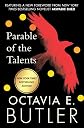

desertcart.com: Parable of the Talents: 9781538732199: Butler, Octavia E.: Books Review: Phenomenal follow up to Parable of the Sower - Must read! - Parable of the Sower and Parable of the Talents have been on my must-read list for years, and finally found time to read both over the summer. Both fantastic stories in their own right and well worth reading for anyone engaged and interested in the many issues we currently face as a society. Phenomenally well-written by Octavia Butler, a renowned science fiction writer with the most amazing instinct for addressing (almost 30 years ago!) issues that we are now facing with climate change, uber-rich/poverty wealth inequality, white supremacy/fascism, and use of MAGA Christianity to “Make America Great Again”. Incredible that Butler could have foreseen the MAGA threat decades ago, citing the slogan in the novel. Butler was a brilliant writer and these novels do not disappoint. Just wish she had completed Parable of the Trickster, her planned third installment! The two novels stand strongly together, but I could easily have read another in the series. She’s just that good. Review: Prophetic, insightful, inspiring, but very oppressive - I didn't exactly expect a cheery celebration of the power of the human spirit and thinking differently and so on after reading the _Parable of the Sower_, but even so, I found the book a little too grim to take. If you read _Sower_, you know things were going comparatively well at the end of the book. As you might have guessed by now, Octavia Butler is not the kind of writer who is interested in a novel-length exploration of the growing pains of a new society. Very early, the stability that Acorn offered is lost, and a long, painful journey is under way. The book continues to explore Earthseed, the philosophy (or religion?) introduced in _Sower_. I think it's pretty much essential to read _Sower_ first or else you will not have the grounding in Earthseed to understand what happens throughout this novel. For me, Earthseed is a very striking philosophy with real-world utility. It makes me wish keenly that there were more Earthseed philosophy to read. And the philosophy and wanting to see how it played out in the lives of the characters is really what kept me going through this novel, even through parts that I found really difficult to handle emotionally. Other reviewers have remarked on how prescient the setting and events of the novel are - the order of events is all that so far separates it from the reality we have witnessed over the last half-decade, and as of this writing, despite the seeming defeat of the "Make America Great Again" folks, it seems all too likely that we will get closer to the vision of "Christian America" the book offers before we get past it. For that alone, it's worth a read. Butler was tapping into a zeitgeist hardly conceivable in 1998, and correctly identified many of the problems that would confront the world in the 2020s and 2030s at a time when, sadly, myopic policymakers and media figures couldn't stretch their minds to do the same. [CW: sexual violence] But for me, the book was very difficult to get through, due to the frequency of the instances of rape and brutal violence, particularly against women. It should not have been unexpected - I started reading Butler with _Kindred_, then _Sower_, and I know it is a theme of many of her other works as well. And I know that as a Black woman in America, Butler experienced continual threats to her body in ways that I as a white man have not. I would expect that writing a story of survival through such horrible situations was cathartic, and that for many women reading it is cathartic too in the way that many horror movies are. Nevertheless, it took a lot of effort for me to keep going through the middle section of the book. The book ends in an all-too-realistically bittersweet note - one theme that powerfully hits home for me is how genetic families have the power to hurt in ways that even one's chosen family cannot quite make up for. Some might find the ending a letdown, but I thought it was pretty much perfect. I will be thinking of this book and of Earthseed for a long time to come.

| Best Sellers Rank | #2,856 in Books ( See Top 100 in Books ) #5 in Black & African American Science Fiction (Books) #54 in Dystopian Fiction (Books) #427 in Literary Fiction (Books) |
| Book 2 of 2 | Parable |
| Customer Reviews | 4.6 4.6 out of 5 stars (10,362) |
| Dimensions | 7.05 x 1.13 x 8.65 inches |
| Edition | Reprint |
| ISBN-10 | 153873219X |
| ISBN-13 | 978-1538732199 |
| Item Weight | 12.2 ounces |
| Language | English |
| Print length | 448 pages |
| Publication date | August 20, 2019 |
| Publisher | Grand Central Publishing |
M**K
Phenomenal follow up to Parable of the Sower - Must read!
Parable of the Sower and Parable of the Talents have been on my must-read list for years, and finally found time to read both over the summer. Both fantastic stories in their own right and well worth reading for anyone engaged and interested in the many issues we currently face as a society. Phenomenally well-written by Octavia Butler, a renowned science fiction writer with the most amazing instinct for addressing (almost 30 years ago!) issues that we are now facing with climate change, uber-rich/poverty wealth inequality, white supremacy/fascism, and use of MAGA Christianity to “Make America Great Again”. Incredible that Butler could have foreseen the MAGA threat decades ago, citing the slogan in the novel. Butler was a brilliant writer and these novels do not disappoint. Just wish she had completed Parable of the Trickster, her planned third installment! The two novels stand strongly together, but I could easily have read another in the series. She’s just that good.
R**Y
Prophetic, insightful, inspiring, but very oppressive
I didn't exactly expect a cheery celebration of the power of the human spirit and thinking differently and so on after reading the _Parable of the Sower_, but even so, I found the book a little too grim to take. If you read _Sower_, you know things were going comparatively well at the end of the book. As you might have guessed by now, Octavia Butler is not the kind of writer who is interested in a novel-length exploration of the growing pains of a new society. Very early, the stability that Acorn offered is lost, and a long, painful journey is under way. The book continues to explore Earthseed, the philosophy (or religion?) introduced in _Sower_. I think it's pretty much essential to read _Sower_ first or else you will not have the grounding in Earthseed to understand what happens throughout this novel. For me, Earthseed is a very striking philosophy with real-world utility. It makes me wish keenly that there were more Earthseed philosophy to read. And the philosophy and wanting to see how it played out in the lives of the characters is really what kept me going through this novel, even through parts that I found really difficult to handle emotionally. Other reviewers have remarked on how prescient the setting and events of the novel are - the order of events is all that so far separates it from the reality we have witnessed over the last half-decade, and as of this writing, despite the seeming defeat of the "Make America Great Again" folks, it seems all too likely that we will get closer to the vision of "Christian America" the book offers before we get past it. For that alone, it's worth a read. Butler was tapping into a zeitgeist hardly conceivable in 1998, and correctly identified many of the problems that would confront the world in the 2020s and 2030s at a time when, sadly, myopic policymakers and media figures couldn't stretch their minds to do the same. [CW: sexual violence] But for me, the book was very difficult to get through, due to the frequency of the instances of rape and brutal violence, particularly against women. It should not have been unexpected - I started reading Butler with _Kindred_, then _Sower_, and I know it is a theme of many of her other works as well. And I know that as a Black woman in America, Butler experienced continual threats to her body in ways that I as a white man have not. I would expect that writing a story of survival through such horrible situations was cathartic, and that for many women reading it is cathartic too in the way that many horror movies are. Nevertheless, it took a lot of effort for me to keep going through the middle section of the book. The book ends in an all-too-realistically bittersweet note - one theme that powerfully hits home for me is how genetic families have the power to hurt in ways that even one's chosen family cannot quite make up for. Some might find the ending a letdown, but I thought it was pretty much perfect. I will be thinking of this book and of Earthseed for a long time to come.
P**S
Definitely worth reading.
The Parable of the Sower and Parable of the Talents are without a doubt the finest examples of framed narrative I have read, period. I name them both in this review because they are essentially the same book broke up into two parts. The nebula award wouldn't have been awarded to Talents as a stand-alone book so be certain read the Parable of the Sower first. In a nation recovering from vast economic, environmental, and social upheavals the main-character's life is presented via her daughter who has obtained copies of her mother's personal journals. It chronicles the creation of "Earthseed" a religious movement (cult) whose beginnings originate from the mother's childhood musings from within the walled community of her home presented in the Parable of the Sower. The musings can most easily be summarized by the oft repeated phrase "God is Change". From the mother's perspective Butler makes a variety of cultural and political statements denouncing the dangers of religious fundamentalism, laissez faire economic policies, and the sort of intentional ignorance humanity uses to protect itself from unsettling truths (poverty, slavery, war, etc.). She also promotes amongst other things universal education (no school vouchers for her) and a world-view completely devoid of faith in the supernatural and centered around the need for humanity to colonize space, this being the only real "heaven". My favorite quote from the second book comes from Lauren (the mother) in chapter twenty: "The truth is, preparing for interstellar travel and then sending out ships filled with colonists is bound to be a job so long, thankless, expensive and difficult that I suspect that only a religion could do it." The views presented by Butler from Lauren's perspective are quite extreme and would probably have turned even myself away from this book had not both her daughter (the narrator) and Marc (Lauren's brother and only other surviving relative) been written in such sharp contrast to the Lauren. These two contrasting points of view save the book from degenerating into a long attack on Christian Fundamentalist values and Republican environmental and economic policy. Instead I was able to better appreciate the depth of Octavia Butler's characters and the passion with which they acted out their parts in her story. This story is in my opinion a much more valuable novel than The Handmaid's Tale which it has been compared to, but failed to draw me into it to the extent that George Orwell's masterpiece 1984 did. (4.5/5 stars)
L**E
A must read. For everyone. Periodt
M**B
I read it not only admiring her strong, original prose and tight plot, but with my mouth open that she had somehow had the insight to see where we were going. It’s all here, but written decades ago. Read, learn and reflect!
F**I
Great book
A**R
Great book everyone should read it
C**P
How is this book not a film? It has the first use of the phrase “Make America Great Again” and it has a dream of thinking and thoughtfulness at the centre of a good SciFi story of the US finding its feet again after a difficult time.
Trustpilot
5 days ago
2 months ago