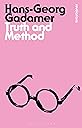
Truth and Method (Bloomsbury Revelations) Reprint Edition
Product ID: 1699754
Desertcart purchases this item on your behalf and handles shipping, customs, and support to Malaysia.
Full description not available
A**S
Essential Philosophy
Several years ago there was a lot of interest in my field, data science, invigorating new life into the humanities. For example, whether there was actually a decline in interest in religion in the early twentieth century could be answered by looking at the frequency of terms in digitized texts of that era.Hans Gadamer, however, takes an entirely different tack. The major question of Truth and Method is the basis of the humanities as approached from a philosophical perspective.Essentially, Gadamer criticizes the view of Schleiermacher that one should enter into the mind of the author to discern what is meant by a text. It is impossible, according to Gadamer, to surpass one’s historical moment. We are embedded in a tradition, linguistic and philosophical, that can only be fused with the horizon of a text to provide a contemporary interpretation. Later historical eras will read a text differently as they are thrown into a new stage of tradition. A text is then a living body subject to endless new discoveries through a dialectic process.Perhaps the clearest example Gadamer provides is in the context of legal hermeneutics. In determining the meaning of a legal text you do not simply act as an historian entering into the mind of the author. Instead, one looks at the tradition of how the law has historically been interpreted to determine its meaning in our era. There is a fusion of a contemporary worldview with those of the whole tradition accompanying the text.And, argues Gadamer, all the humanities can be viewed from this hermeneutic perspective. Thus, rather than appeal to the methods of the hard sciences, the humanities should embrace the hermeneutical perspective he so painstakingly elaborates.There’s so much more to Truth and Method than what I’ve been able to describe. Suffice it to say that it contains extensive exegeses of Plato, Dilthey, Heidegger and others that I haven’t even mentioned.Though thoroughly understanding it requires grounding in the German intellectual tradition, it’s still a text that anyone interested in the state of the humanities should read. While it doesn’t appear that they’re taking the turn Gadamer proposed, it’s essential to at least understand this influential perspective. Perhaps saving the humanities will not come from turning them into lesser cousins of the hard sciences but instead by embedding them in hermeneutics. Only time will tell.
J**B
The Horizon of Being
This is one of those great moments where a great student follows his master (Heidegger) yet gives us a new product and not simply a repetition of his master. In short, for Gadamer language is the horizon of being. As Kant was wrong to seek a thing-in-itself, so we also should beware of a "meaning-in-itself."Gadamer begins and ends his work on a strange note: the aesthetics and interpretation of art. It’s not that art determines how we interpret text, but art allows Gadamer to illustrate (no pun intended) the tension given that great works of art are considered “timeless,” yet they were produced in historical, finite circumstances. This tension points to the horizon, a key Gadamerian term.Every experience has implicit horizons of before and after and finally fuses with the continuum of experiences present in the before and after to form a unified flow of experience (246). Df. horizon = not a rigid boundary but something that moves with and invites one to advance further. Everything that is given as existent is given in terms of a world and hence brings the world horizon with it. As a horizon phenomenon “world” is essentially related to subjectivity, and this relation means also that it exists in transciency.”Hermeneutical circle: possesses an ontological positive significance. We have already fore-projected before we even approach the text. This creates an openness which situates our meaning with other meanings. Understanding is a participation in the event of tradition and not so much a subjective act (302).Horizons are temporally-conditioned. Time is not a gulf to be crossed by a supportive ground in which the present is rooted. We cannot stand outside of our situation. “All self-knowledge arises from what is historically pre-given, what Hegel calls “substance’” (313). Horizon: every finite present has its limitations. Every situation represents a standpoint that limits the possibility of vision. Horizons move with us. When we understand something, we fuse the horizons between text and interpreter. Fusion of horizons: We regain concepts of a historical past in such a way that it also includes our own comprehension of them (382).This will go down as one of those truly great books. Ground-breaking works. It’s not super-hard to read simply because it is well-written. However, he does presuppose a good bit of Hegel and Heidegger, so keep that in mind.A note about the reprint: I have the Bloomsbury edition and the text is fine. SHucks, I even got mine used. Yes, the spine willl crease when you read it, but that's true of most books. The spine, though, will not break.
O**6
Great
This is the best summary of the current historical method ( as far as I am concerned) that I have read. It incorporates postmodern insights without being overwhelmed by them. For a german philosopher he seems ( or his translator is) remarkably clear.
S**S
Great book, great translators, terrible reprint.
Truth and Method is one of the most important works of philosophy of the 20th century, and this revised translation by Weinsheimer and Marshall is the authoritative translation. I give both the work and the translation a 5+ star rating. This edition, however, has mistakes all over the place; they obviously scanned the pages of the Continuum edition and did little to no proof reading. (For example, key German terms are misspelled.) The font is also horrible and the line spacing is weird; and there are no margins to write in. Spend the money and buy the Continuum edition.
S**Y
Good quality
Better than advertised. On time.
C**R
Five Stars
Not quite an obscure German philosopher, but an important one.
A**R
Five Stars
Excellent reading for anyone interested in literary criticism.
L**E
Interesting content, terrible durability.
The book itself is terrible quality. It's required reading for one of my classes, and many of my classmates' books are falling apart. Mine has fallen apart into three separate pieces.Not recommended if you plan to write in the book (although practically impossible in such small margins).The text can be pretty dry (and there's nothing wrong with that) but it's as if the font tries to beg that it's not, and that's a little conflicting when trying to read it.
Trustpilot
3 days ago
3 weeks ago