
Buy anything from 5,000+ international stores. One checkout price. No surprise fees. Join 2M+ shoppers on Desertcart.
Desertcart purchases this item on your behalf and handles shipping, customs, and support to Malaysia.
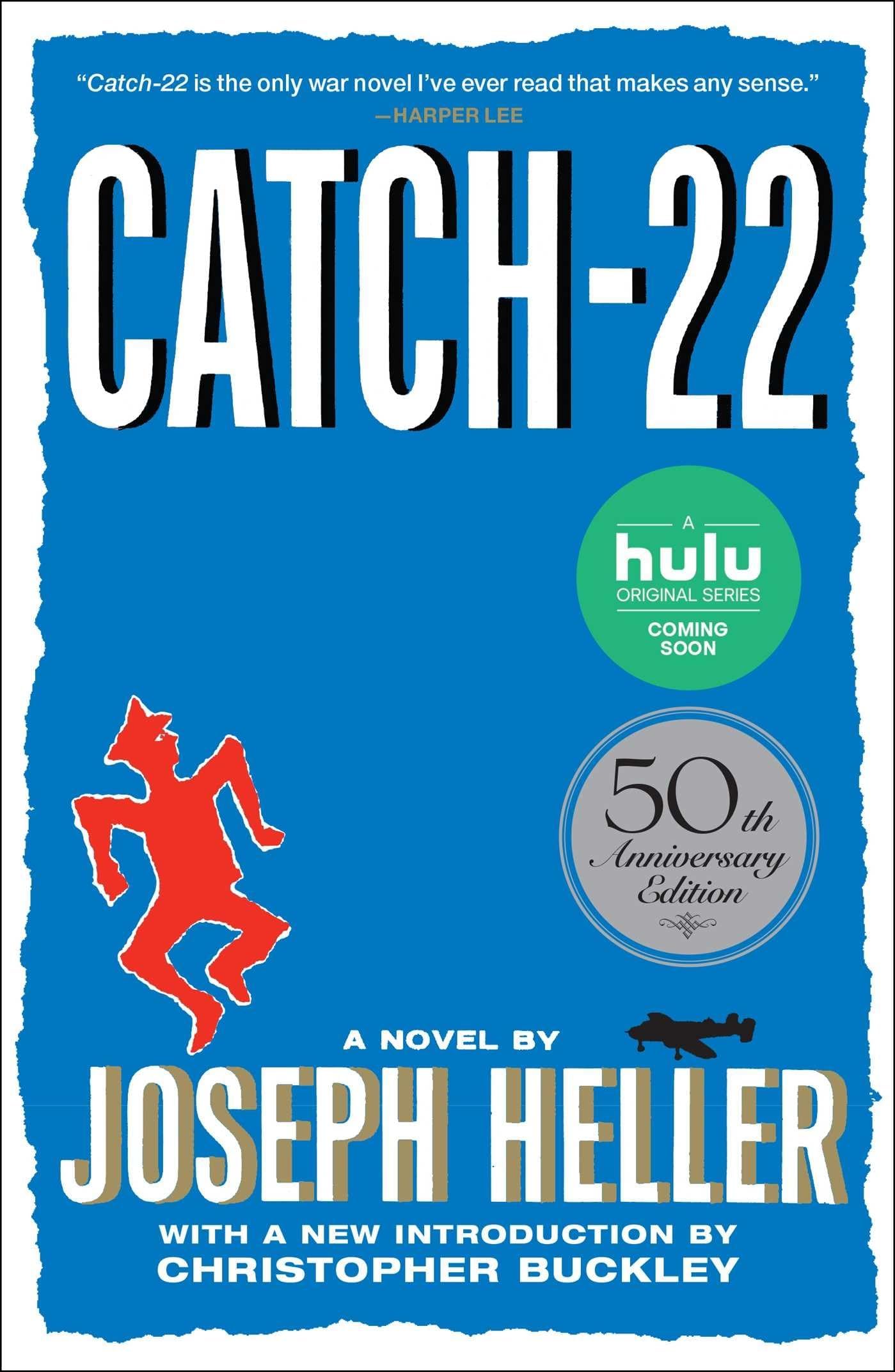
This fiftieth-anniversary edition commemorates Joseph Hellerโs masterpiece with a new introduction; critical essays and reviews by Norman Mailer, Alfred Kazin, Anthony Burgess, and others; rare papers and photos; and much more. Nominated as one of Americaโs best-loved novels by PBSโs The Great American Read. Now a Hulu limited series starring Christopher Abbott, George Clooney, Kyle Chandler, and Hugh Laurie. Fifty years after its original publication, Catch-22 remains a cornerstone of American literature and one of the funniestโand most celebratedโbooks of all time. In recent years it has been named to โbest novelsโ lists by Time, Newsweek, the Modern Library, and the London Observer. Set in Italy during World War II, this is the story of the incomparable, malingering bombardier, Yossarian, a hero who is furious because thousands of people he has never met are trying to kill him. But his real problem is not the enemyโit is his own army, which keeps increasing the number of missions the men must fly to complete their service. Yet if Yossarian makes any attempt to excuse himself from the perilous missions heโs assigned, heโll be in violation of Catch-22, a hilariously sinister bureaucratic rule: a man is considered insane if he willingly continues to fly dangerous combat missions, but if he makes a formal request to be removed from duty, he is proven sane and therefore ineligible to be relieved. This fiftieth-anniversary edition commemorates Joseph Hellerโs masterpiece with a new introduction by Christopher Buckley; a wealth of critical essays and reviews by Norman Mailer, Alfred Kazin, Anthony Burgess, and others; rare papers and photos from Joseph Hellerโs personal archive; and much more. Here, at last, is the definitive edition of a classic of world literature. Review: This uproarious satirical novel by Joseph Heller prompted me... - This uproarious satirical novel by Joseph Heller prompted me to think of Robert Crichton's 'The Secret Of Santa Vittoria', another novel blending WWII and comedy. Published in 1961, 'Catch-22' was the forerunner of Richard Hooker's 1968 novel, 'Mash: A Novel About Three Army Doctors'. It's not about Army Doctor's in Korea, but about Army Air Force pilots and bombardiers during WWII stationed on the small island of Pianosa, west of Italy. In order to understand the insanity of this story, the reader has to comprehend what Catch-22 means. In chapter five, Doc Daneeka explains to Yossarian ( main character ) and Orr, his roommate, why he can't ground them due to insanity: "There was only one catch and that was Catch-22, which specified that a concern for one's own safety in the face of dangers that were real and immediate was the process of a rational mind. Orr was crazy and could be grounded. All he had to do was ask; and as soon as he did, he would no longer be crazy and would have to fly more missions. Orr would be crazy to fly more missions and sane if he didn't, but if he was sane he had to fly them. If he flew them he was crazy and didn't have to; but if he didn't want to he was sane and had to. Yossarian was moved very deeply by the absolute simplicity of this clause of Catch-22 and let out a respectful whistle."That's some catch, that catch-22," he observed."It's the best there is," Doc Daneeka agreed." This catch was why none of the bombing personnel were able to avoid flying mission after mission. The main character is Captain Yossarian, a bombardier who is convinced he is going to die on a mission. In chapter two, he explains to fellow officer, Clevinger why: "They're trying to kill me," Yossarian told him calmly. "No one's trying to kill you," Clevinger cried. "Then why are they shooting at me?" Yossarian asked. "They're shooting at everyone," Clevinger answered. "They're trying to kill everyone." "And what difference does that make?" Yossarian's fear of dying on a bombing raid was enhanced by his group commander, Colonel Cathcart. His lack of compassion was buoyed by his desire to be a general and more importantly, to be featured in 'The Saturday Evening Post'! If the Air Force wanted 40 missions before you could go home, the Colonel wanted 45. Every time someone came close to obtaining the target number of missions for being sent home, Colonel Cathcart raised the required number again. The Colonel is only one of the complex characters in this novel. I have many favorite characters and situations in this sometimes disturbing, but whimsical story. The first is Lt. Milo Minderbinder, the mess hall officer. From day one, he wheels and deals like no other war time entrepreneur. He gets away with his shenanigans by telling everyone that they have a share in his enterprises. In chapter 22, he explains his egg business: ..." I make a profit of three and a quarter cents an egg by selling them for four and a quarter cents an egg to the people in Malta I buy them from for seven cents an egg. Of course, I don't make the profit. The syndicate makes the profit. And everybody has a share." He gets into so many businesses that he even deals with the Germans! In chapter 24, he takes a contract from the Germans to bomb his own base: "This time Milo had gone too far. Bombing his own men and planes was more than even the most phlegmatic observer could stomach, and it looked like the end for him...Milo was all washed up until he opened his books to the public and disclosed the tremendous profit he had made." Then he says in the same chapter: "I'd like to see the government get out of war altogether and leave the whole field to private industry. "As the Milo character gets deeper into the book, it only gets more humorous. My second favorite is Major Major Major Major, the squadron commander, who looked like Henry Fonda! People who met him were always impressed by how unimpressive he was! In chapter nine, we learn: "With a little ingenuity and vision, he had made it all but impossible for anyone in the squadron to talk to him, which was just fine with everyone, he noticed, since no one wanted to talk to him anyway." In chapter ten, we find that: "Major Major never sees anyone in his office while he's in his office." But you can see him, if he is not in his office. If you try to barge into his tent, he goes out the window. I know it's confusing, but his first, middle and last name was Major, thus the four 'majors' when he got promoted to, you guessed it, Major.This book is a riot. My third favorite is Major-------de Coverley, Major Major Major Major's executive officer. Throughout the novel he has a blank for his first name. His function is uncertain at best. He basically pitches horseshoes all day, kidnaps Italian workers, and rents apartments for his men to use on rest leave. As soon as he hears of a city that the U.S.Army has captured, he's on his way there, usually at the head of the procession in a Jeep. No one ( friend, or foe ) knows who he is! But the reader knows that he is there just to rent apartments for his men. His picture appears in many publications, as if he is is leading the conquering army. I'm telling you this book is a gas. There are two subplots that are absolutely hysterical. The first involves the Chaplain's hostile assistant, Cpl. Whitcomb. The corporal comes up with the following generic condolence letter: "Dear Mrs., Mr., Miss, or Mr. And Mrs. Daneeka: Words cannot express the deep personal grief I experienced when your husband, son, father, or brother was killed, wounded, or reported missing in action."This one was sent to Doc Daneeka's wife, even though the Doc wasn't dead. Col. Cathcart feels this letter will prove his concern for his men and finally get him in The Saturday Evening Post. He promotes Whitcomb to sergeant! The second subplot revolves around our hero, Yossarian. After Yossarian tells Lt. Nately's whore that Nately was killed in action, She tries to kill Yossarian and she relentlessly pursues him chapter, after chapter. Nobody knows why she wants to slay him, but it is funny. The reader will also meet: Chaplain Tappman, who is intimidated by everyone; Nurses Cramer and Duckett; Hungry Joe and his screaming nightmares; Chief White Halfoat, who knows he is going to die of pneumonia; Aarfy, the navigator; and Huple, the fifteen year old pilot, just to mention a few. How Joseph Heller kept track of all these characters is unbelievable.There is so much going on in this book that I had to take notes to remember who is who, and who did what.This is a great American classic and should be read by book lovers of all genres. The great American author Studs Terkel states in the `other voices' section of this book: "You will meet in this astonishing novel, certainly one of the most original in years, madmen of every rank: Major Major Major, on whose unwilling frame the gold leaf is pinned because of his unfortunate resemblance to Henry Fonda; Doc Daneeka, who is declared dead despite his high temperature; Hungry Joe and his fistfights with Huple's cat; ex-pfc Wintergreen, who has more power than almost anybody." Enough said? Review: It was love at first sight - That was fifty years ago. I was ten or eleven, Catch 22 was a year old or maybe two. My brother, in college, recommended this book. I liked it so much I read it beginning on New Year every year until I went to college. I just reread it for the first time in forty some years. Itโs still brilliant. Itโs still startlingly funny and it still hurts down deep. It rose above the realistic novels written immediately after the Second World War. It rose above Mailer and Jones and Shaw. When asked why heโd never written another book like Catch 22, Hellerโs answer was โWho has?โ Of course he was right. A couple of the great wave of novels that followed the Second World War stand shoulder to shoulder with the catch; Slaughter House Five and Gunter Grassโs Dog Years come to my mind. Lots of very good novels came out of the war, first novels from writers like Gore Vidal and Norman Mailer, Irwin Shaw and James Jones, Thomas Heggens, who won a Tony for the stage version of his novel, Mr. Roberts, James Gould Cozzens, who won a Pulitzer for Guard of Honor. None of those good books compare. Catch 22 entered the language. For a few years the blue paperback with the dancing soldier puppet was everywhere. Yossarian, the novelโs hero, spends the novel trying not to die in the war. A difficult job, since his colonel raises the number of missions he must fly from twenty-five to seventy, in an attempt to impress the Saturday Evening Post. Since I last read this I served in the army, where sooner or later everybody winds up working for Colonel Cathcart. Iโm thinking that besides its anarchic appeal for youth, there were at that time millions of Veterans many of whom shared itโs cynicism about the organizations they worked for. If youโve never read it, youโve missed a great read. If you read it a long time ago It might be time to enjoy it again. I suspect youโll still laugh whenever Heller tells you to. And like love at first sight it will probably still break your heart.
| Best Sellers Rank | #4,757 in Books ( See Top 100 in Books ) #72 in War Fiction (Books) #174 in Classic Literature & Fiction #309 in Literary Fiction (Books) |
| Customer Reviews | 4.4 out of 5 stars 14,882 Reviews |
R**O
This uproarious satirical novel by Joseph Heller prompted me...
This uproarious satirical novel by Joseph Heller prompted me to think of Robert Crichton's 'The Secret Of Santa Vittoria', another novel blending WWII and comedy. Published in 1961, 'Catch-22' was the forerunner of Richard Hooker's 1968 novel, 'Mash: A Novel About Three Army Doctors'. It's not about Army Doctor's in Korea, but about Army Air Force pilots and bombardiers during WWII stationed on the small island of Pianosa, west of Italy. In order to understand the insanity of this story, the reader has to comprehend what Catch-22 means. In chapter five, Doc Daneeka explains to Yossarian ( main character ) and Orr, his roommate, why he can't ground them due to insanity: "There was only one catch and that was Catch-22, which specified that a concern for one's own safety in the face of dangers that were real and immediate was the process of a rational mind. Orr was crazy and could be grounded. All he had to do was ask; and as soon as he did, he would no longer be crazy and would have to fly more missions. Orr would be crazy to fly more missions and sane if he didn't, but if he was sane he had to fly them. If he flew them he was crazy and didn't have to; but if he didn't want to he was sane and had to. Yossarian was moved very deeply by the absolute simplicity of this clause of Catch-22 and let out a respectful whistle."That's some catch, that catch-22," he observed."It's the best there is," Doc Daneeka agreed." This catch was why none of the bombing personnel were able to avoid flying mission after mission. The main character is Captain Yossarian, a bombardier who is convinced he is going to die on a mission. In chapter two, he explains to fellow officer, Clevinger why: "They're trying to kill me," Yossarian told him calmly. "No one's trying to kill you," Clevinger cried. "Then why are they shooting at me?" Yossarian asked. "They're shooting at everyone," Clevinger answered. "They're trying to kill everyone." "And what difference does that make?" Yossarian's fear of dying on a bombing raid was enhanced by his group commander, Colonel Cathcart. His lack of compassion was buoyed by his desire to be a general and more importantly, to be featured in 'The Saturday Evening Post'! If the Air Force wanted 40 missions before you could go home, the Colonel wanted 45. Every time someone came close to obtaining the target number of missions for being sent home, Colonel Cathcart raised the required number again. The Colonel is only one of the complex characters in this novel. I have many favorite characters and situations in this sometimes disturbing, but whimsical story. The first is Lt. Milo Minderbinder, the mess hall officer. From day one, he wheels and deals like no other war time entrepreneur. He gets away with his shenanigans by telling everyone that they have a share in his enterprises. In chapter 22, he explains his egg business: ..." I make a profit of three and a quarter cents an egg by selling them for four and a quarter cents an egg to the people in Malta I buy them from for seven cents an egg. Of course, I don't make the profit. The syndicate makes the profit. And everybody has a share." He gets into so many businesses that he even deals with the Germans! In chapter 24, he takes a contract from the Germans to bomb his own base: "This time Milo had gone too far. Bombing his own men and planes was more than even the most phlegmatic observer could stomach, and it looked like the end for him...Milo was all washed up until he opened his books to the public and disclosed the tremendous profit he had made." Then he says in the same chapter: "I'd like to see the government get out of war altogether and leave the whole field to private industry. "As the Milo character gets deeper into the book, it only gets more humorous. My second favorite is Major Major Major Major, the squadron commander, who looked like Henry Fonda! People who met him were always impressed by how unimpressive he was! In chapter nine, we learn: "With a little ingenuity and vision, he had made it all but impossible for anyone in the squadron to talk to him, which was just fine with everyone, he noticed, since no one wanted to talk to him anyway." In chapter ten, we find that: "Major Major never sees anyone in his office while he's in his office." But you can see him, if he is not in his office. If you try to barge into his tent, he goes out the window. I know it's confusing, but his first, middle and last name was Major, thus the four 'majors' when he got promoted to, you guessed it, Major.This book is a riot. My third favorite is Major-------de Coverley, Major Major Major Major's executive officer. Throughout the novel he has a blank for his first name. His function is uncertain at best. He basically pitches horseshoes all day, kidnaps Italian workers, and rents apartments for his men to use on rest leave. As soon as he hears of a city that the U.S.Army has captured, he's on his way there, usually at the head of the procession in a Jeep. No one ( friend, or foe ) knows who he is! But the reader knows that he is there just to rent apartments for his men. His picture appears in many publications, as if he is is leading the conquering army. I'm telling you this book is a gas. There are two subplots that are absolutely hysterical. The first involves the Chaplain's hostile assistant, Cpl. Whitcomb. The corporal comes up with the following generic condolence letter: "Dear Mrs., Mr., Miss, or Mr. And Mrs. Daneeka: Words cannot express the deep personal grief I experienced when your husband, son, father, or brother was killed, wounded, or reported missing in action."This one was sent to Doc Daneeka's wife, even though the Doc wasn't dead. Col. Cathcart feels this letter will prove his concern for his men and finally get him in The Saturday Evening Post. He promotes Whitcomb to sergeant! The second subplot revolves around our hero, Yossarian. After Yossarian tells Lt. Nately's whore that Nately was killed in action, She tries to kill Yossarian and she relentlessly pursues him chapter, after chapter. Nobody knows why she wants to slay him, but it is funny. The reader will also meet: Chaplain Tappman, who is intimidated by everyone; Nurses Cramer and Duckett; Hungry Joe and his screaming nightmares; Chief White Halfoat, who knows he is going to die of pneumonia; Aarfy, the navigator; and Huple, the fifteen year old pilot, just to mention a few. How Joseph Heller kept track of all these characters is unbelievable.There is so much going on in this book that I had to take notes to remember who is who, and who did what.This is a great American classic and should be read by book lovers of all genres. The great American author Studs Terkel states in the `other voices' section of this book: "You will meet in this astonishing novel, certainly one of the most original in years, madmen of every rank: Major Major Major, on whose unwilling frame the gold leaf is pinned because of his unfortunate resemblance to Henry Fonda; Doc Daneeka, who is declared dead despite his high temperature; Hungry Joe and his fistfights with Huple's cat; ex-pfc Wintergreen, who has more power than almost anybody." Enough said?
J**Y
It was love at first sight
That was fifty years ago. I was ten or eleven, Catch 22 was a year old or maybe two. My brother, in college, recommended this book. I liked it so much I read it beginning on New Year every year until I went to college. I just reread it for the first time in forty some years. Itโs still brilliant. Itโs still startlingly funny and it still hurts down deep. It rose above the realistic novels written immediately after the Second World War. It rose above Mailer and Jones and Shaw. When asked why heโd never written another book like Catch 22, Hellerโs answer was โWho has?โ Of course he was right. A couple of the great wave of novels that followed the Second World War stand shoulder to shoulder with the catch; Slaughter House Five and Gunter Grassโs Dog Years come to my mind. Lots of very good novels came out of the war, first novels from writers like Gore Vidal and Norman Mailer, Irwin Shaw and James Jones, Thomas Heggens, who won a Tony for the stage version of his novel, Mr. Roberts, James Gould Cozzens, who won a Pulitzer for Guard of Honor. None of those good books compare. Catch 22 entered the language. For a few years the blue paperback with the dancing soldier puppet was everywhere. Yossarian, the novelโs hero, spends the novel trying not to die in the war. A difficult job, since his colonel raises the number of missions he must fly from twenty-five to seventy, in an attempt to impress the Saturday Evening Post. Since I last read this I served in the army, where sooner or later everybody winds up working for Colonel Cathcart. Iโm thinking that besides its anarchic appeal for youth, there were at that time millions of Veterans many of whom shared itโs cynicism about the organizations they worked for. If youโve never read it, youโve missed a great read. If you read it a long time ago It might be time to enjoy it again. I suspect youโll still laugh whenever Heller tells you to. And like love at first sight it will probably still break your heart.
B**B
The Existential Catch
The breadth of the absurdity becomes apparent once you realize that the โcatchโ of the title is the foundational principle upon which the existence of all participants in a war is based. Almost every choice is between two mutually exclusive, opposing alternatives. Joseph Hellerโs 1961 novel was perfectly positioned in time. Written by a World War II veteran about WW II, yet informed by the mounting insanity of the Korean and Cold War 50โs, it was released at the beginning of the 1960โs and became a clarion call for all those who protested the insanity of yet another war in Vietnam. Its sentiments reverberated throughout the decade and acquired a universal relevance to life beyond its literary source. The syndrome of โCatch-22โ existed before Hellerโs novel, though maybe not to such an exaggerated extent. Heller gave it a name and a narrative to illustrate how it manifested and spread like a virus. The bombardier Yossarian tries to be sick to get out of flying more missions. Having โalmost jaundiceโ is not sick enough. He tries to be crazy to get the doctor to restrict him from flying missions. He canโt get crazy enough. In fact, his expression of insanity brings him to collide with a definitive articulation of โCatch-22โ: โOrr would be crazy to fly more missions and sane if he didnโt, but if he was sane he had to fly them. If he flew them he was crazy and didnโt have to: but if he didnโt want to he was sane and had to.โ Yossarian sees the perfection in such a clause: โYossarian saw it clearly in all its spinning reasonableness. There was an elliptical precision about its perfect pairs of parts that was graceful and shocking, like good modern art, and at times Yossarian wasnโt quite sure that he saw it all, just the way he was never quite sure about good modern art.โ There are dozens of examples of how various characters embody โCatch-22โ. Yossarianโs commanding officer Colonel Cathcart is driven by a vain desire to be the subject of a feature in the Saturday Evening Post, just like one of his rivals. He feels that if his regiment flies more missions than any other thatโs a significant accomplishment worthy of a feature article. Therefore, once any of his soldiers are within sight of reaching the previous goal of 40 missions, say, he will raise the number of missions to 45. He keeps raising the number throughout the rest of the novel so that the end total is somewhere in the 80โs. Yossarian may not know the reason Cathcart keeps raising the number as we the readers do but he feels the immediate effect of such capriciousness. The major named Major Major Major Major (his fatherโs bizarre sense of humor inspired him to give his son a first and middle name to match his surname) is mystified by his promotion as he has done absolutely nothing to merit it. He didnโt ask for more responsibility and he refuses to accept it. Therefore, he devises a modus operandi that is permeated with โCatch-22โ: โFrom now on,โ he said, โI donโt want anyone to come in to see me while Iโm here. Is that clear?โ โYes, sir,โ said Sergeant Towser. โDoes that include me?โ โYes.โ โI see. Will that be all?โ โYes.โ โWhat shall I say to the people who do come to see you while youโre hereโ โTell them Iโm in and ask them to wait.โ โYes sir. For how long?โ โUntil Iโve left.โ โAnd then what shall I do with them?โ โI donโt care.โ โMay I send them in to see you after youโve left?โ โYes.โ โBut you wonโt be here then, will you?โ โNo.โ One person who has used the climate of Catch-22 and seized the opportunity to use it to his advantage is Yossarianโs friend Milo Minderbinder. Milo is ostensibly the mess hall manager. However, he has used his mess hall title as a jumping off point to build a commercial empire. He has become the super profiteer, taking free enterprise to the soldiers, buying at a discount, selling at a profit, buying as part of a complex trade rendering an even greater profit, all in the name of the โsyndicateโ. Everyone wins because everyone owns a share. The fact that the syndicateโs shareholders include enemies as well as allies does not stop Milo from doing business with them in the least. Yossarian and his friends usually go to Rome when they get any leave and visit the same brothel. Yossarian has become especially friendly with one whore, Luciana, and Nately has fallen in love with another and wants to marry her. Their pimp is a 107-year old Italian who sits in the middle of the floor and pontificates. When he says that America will lose the war, Nately takes issue and says America is the strongest nation on earth. The old man concedes that Italy is a weak country but contends that it will prevail: โThe Germans are being driven out, and we are still here. In a few years you will be gone, too, and we will still be here. You see, Italy is really a very poor and weak country, and thatโs what makes us so strong. Italian soldiers are not dying any more. But American and German soldiers are. I call that doing extremely well. Yes, I am quite certain that Italy will survive this war and still be in existence long after your own country has been destroyedโฆAll great countries are destroyed. Why not yours? How much longer do you really think your own country will last?โ Nately says he talks like a madman: โBut I live like a sane one. I was a fascist when Mussolini was on top, and I am an anti-fascist now that he has been deposed. I was fanatically pro-German when the Germans were here to protect us against the Americans, and now that the Americans are here to protect us against the Germans I am fanatically pro-American. I can assure you, my outraged young friendโโthe old manโs knowing, disdainful eyes shone even more effervescently as Natelyโs stuttering dismay increasedโโthat you and your country will have no more loyal partisan in Italy than meโbut only as long as you remain in Italy.โ Yossarianโs roommate, the aforementioned Orr, has a scheme that is only apparent near the novelโs end. Orr flies plenty of missions. However, most of them end with his plane going down in the ocean. Yossarian views Orr as a bad-luck charm and refuses to fly any more missions with him. The pattern goes, Orr flies, Orrโs plane goes down, Orr is rescued, Orr flies again. And repeat. Near the end of the novel, Orr has disappeared. His remains were never found. No trace of him was found. Later, it is discovered that he has made his way all the way to neutral Sweden, sanity and safety. His scheme was the cleverest of any of them and he inspires Yossarian, who is finally given terms under which he can go home. However, to do so he is presented with another untenable catch. He will be a decorated war hero and he must say only nice things about his commanders. Orrโs success, however, provides him with another option WITHOUT a Catch-22. โCatch-22โ is, without doubt, an important and influential novel. Heller articulates certain realities of war and being the pawn of military gamesmanship that many had felt before. Iโm not sure that the scrambled time sequence really contributes to the impact of the brutal satire, although it does provide a narrative equivalent to the circular reasoning that forms the basis for most of the decision-making in the novel. There are also so many characters in the novel and few of them are clearly delineated so that when they speak with Catch-22 reasoning, theyโre mouthpieces for Heller more so than characters with unique identities. Despite these shortcomings, โCatch-22โ caught the zeitgeist of its time and reflected it back to a receptive audience ready to not conform and not accept choices within which were somewhere buried a Catch-22.
G**E
YOSSARIAN!
I have never hated more characters in my life. I LOVE THIS BOOK! It keeps you in a constant state of dramatic irony with its structure, and you really start to enter the logic of the minds of the characters after a while. Superb!
A**P
Catch-22 CW review
The novel "Catch-22" was written by Joseph Heller to show how crazy the Air Force made people during World War Two. The characters are trapped in the Air Force by the catch known as Catch 22, it was meant to stop crazy people from compromising missions by preventing them from flying. What the catch really did was prevent anybody from being grounded (sent home). The catch works where if someone was crazy all they had to do was ask somebody to ground them, the only problem was that when they asked to be grounded the catch said that the person was no longer crazy and could not be grounded. This along with the number of required missions constantly being raised prevents anybody from leaving the Air Force. Being forced to stay takes its toll on the soldiers as they slowly lose morale and drift into madness. The main character, Yossarian, realizes that there is no escape other than death, which he, more than anyone, wants to avoid. This prompts him to plot how to avoid going on missions. Heller writes this story not in any particular chronological order, and instead connects the chapters at random in order to portray the insanity that the characters experience. The story is analogous to a jig-saw that is given ten pieces at a time. The reader must remember was has already been said and connect it to what has just been said. Heller's writing style of using a plethora of ironies and hyperboles adds to the satire of the book, which isn't so much satirizing WW2, but war in general. His way of writing the character's dialogue also contributed to the insanity that he was trying to portray. The characters speak in what feels like circles, where the character says what the last character said in a slightly different way. After a while of this, the conversation loses its original meaning and makes even the reader question his sanity. The novel effectively satirizes World War Two and possibly all other wars, and conveys themes of power in bureaucracy, the inevitability of death, and a loss of religion.
R**Y
Clever satire in spots but too long and repetitive, then mean
I waited too long to read this novel. I wanted to like it more than I did. I'm in my early 50's. I think if I'd read it in my early 20's, or really late teens, without much life experience at all--and during the 1970s--I would have thought much better of it (probably not; I was old at 15). As it is, I come to this novel now with my own books and poetry published and much of life lived already, and here nearly halfway into the 2010s--and enough experiences to fill two lives or more. Experience colors perspective. Of course. I won't get into plot details here. What little there are. I'm just providing some feedback after reading the book, and my take on things based on my perspective. I've not a veteran; my experience comes from sitting down and talking in-depth with many veterans (special operators among them) about their service and combat experiences, from WW2 to Iraq (and several other locales in between). My father served 2 and a half years in the Pacific Theater during WW2 and was awarded four bronze service stars. I've talked with and listened to men relate their experiences of losing limbs and watching men die in combat alongside them. I know much more than the average non-military person about the meaning of the words loyalty, duty, respect, service, honor, discipline, and personal courage. These are traits mocked and denigrated in this novel, and these are traits that are mocked and denigrated in our popular culture today. I told you that as preface to telling you this: Catch-22 is a funny (satirical and absurdist) novel in some little bits, but it's also a tedious and repetitive novel. I agree with Norman Mailer's assessment in an essay in my copy of the 50th anniversary edition that you could remove 100 pages from the middle of Catch-22 and you wouldn't notice as a reader; and, jokingly Mailer writes, neither would Heller: "not even the author could be certain they were gone." By the time I'd read to page 125 I'd read all of what Heller had to give stylistically, primarily (more later). That is: each of the chapters from that point on presents essentially the same thing: a character, a little plot detail (what little narrative arc there is) to link to the greater "plot," then a self-contained "story" (really just a slice of life experience of that chapter's sort-of main character). In other words, as Mailer points out: Cut 100 pages in the middle and you've lost nothing of the experience of the novel. As the novel progresses it becomes bitter and even mean-spirited. Heller lets loose in certain parts of the novel, showing his absurd anti-war sentiments. (Similar to John Lennon's dangerously childish and naive Utopian cult hit "Imagine.") You'll also get this from the extra material in the back of the 50th anniversary edition. Heller absolutely hated war. At all costs. His fictionalized account of American fighter planes strafing Americans is not funny, it's twisted. Read Heller's essay "Reeling in Catch-22" to see what the man really thought. How there was in the 1960s a "change in spirit, a new spirit of healthy irreverence." He goes on to call "Americanism....horsesh**." How it doesn't work. How it's not true. I wanted to say, Really, Mr. Heller? Well, I have a friend who served 2 years in a Chinese re-education camp who came to the U.S. who thinks, pretty much, exactly the opposite as you do. Or read Alexander Solzhenitsyn. Heller's attitude gels with Utopian peaceniks of the 1960s. It doesn't work so well in the modern realities of Russian gulags and Chinese re-education camps. And the post-modern world of new Islamic jihadist caliphates. So, for me, where this novel fails miserably is when Heller is tearing down the appropriateness and necessity of war, and when he treads into bitter, completely absurd territory. In some spots I actually was pissed off at how the character Yossarian places other men in danger because of his actions, because he doesn't want to do his duty. That's beyond cowardly; it's not at all funny; it's inhuman. Having said all that I will say this: I did enjoy portions of the book. Heller's take on the absurdities of the military bureaucracy are funny. There are laugh-out-loud moments, mostly early on, but as the novel goes on the humor lessens and the dreariness and repetitiveness and absurdity settles in and all around. Commanding officers up and down the chain are idiots and worthy of contempt. It wears thin after a while. Back to my "more later" comment above: Curiously, the final 50 pages of the book are written in a serious (not completely absurdist-satirist) tone. Then the last 5 pages returns to Yossarian's nuttiness. The end. During the Vietnam War this novel may have served its purpose to give some Americans what they thought they needed: an alternative "narrative" to what they thought America represented. At least what it represented to them living in their cocooned lives out in suburbia. Here we stand at the end of American empire in the first decade of the 21st century, and the novel reads to me like a child stomping its feet in front of its parents about how unfair the world is and how mummy and daddy don't know nothing about nothing and about how everything would be alright if only we could all play nice. Here's a news flash, Mr. Heller: Life's not fair. The world doesn't care about you. Life doesn't owe you anything. Very often you are asked to look outside yourself and give yourself to something society deems the greater good; this is called real life. There is evil in this world. That's why there's no playing nice. And sociopaths (and a**holes) are at the top because their personalities give them the skills to stomp on good and just people's heads to get there, and stay there. That's the way it is. If there's an analogy to be made in the movie world, it may be this: Catch-22 is to "war" what Office Space is to "the job". Both poke fun at the "insanity" of their environments by using exaggeration, but we all know that's not how it really is. At least, we should know. It's OK: 3/5 on Amazon 2/5 on Goodreads
G**H
Wonderful Quality Print and Binding with Acid-Free Paper
Catch-22 is among my favorite books, so when I read of the quality paper and binding of the Everyman's Edition printings, I decided it was time to replace my 1980s-era softcover which was falling apart after so many re-rereads. The quality of this edition did not disappoint; I look forward to decades of enjoyment from it!
D**S
Product was as described and delivered as promised.
R**N
A great great book
I bought the book on the strength of its reputation, not quite knowing what to expect. A pleasant surprise it was, with some passages downright hilarious.
R**L
Incredible book
Not really impressed with the cover paper material but the book is really good.
P**.
low quality paper and bleeding ink
More about the book itself than the story - the quality of the paper is low and the ink bleeds so the words aren't sharp. Buying this paperback is an advert for switching to an ereader.
T**K
One of the best novels!
A masterpiece
J**R
Brilliantly witty, brutally wise
Catch-22 is perhaps the most bizarre novel I've read. It's tangential, disjointed funny and sad. It's very much tongue-in-cheek for the vast majority of the time, but when it it's not, it's poignant. From some of the most insane dialogue to scenes of personal horror, the book ties together the literal madness of war and the gritty truth of it. The idea of Catch-22 has become part of the general vernacular in most English speaking nations since the 1970s and most of us have used it to describe a damned if you do, damned if you don't situation. The catch stems from the idea that as a combat pilot, you can only be grounded in perfect physical health if you're mad. If you ask to be grounded though, you must be sane because only mad men want to fly combat missions. Having asked to be grounded, how do you then prove you're mad? Do you go on parade naked? Do you attend a funeral sitting naked up a nearby tree? Do you have horrific nightmares at the thought of flying no more missions? You can try, but you won't succeed because of Catch-22. When you read this novel, you'll quickly discover that such a catch can only exist because everyone is mad. From Private to General, there is not a sane man to be found. Even the psychiatrist is quite plainly mad. The result is some real laugh out loud moments as we follow Yossarian through his struggles to be sent home alive. But when we read of the horrors through which he has lived, we begin to understand. There isn't too much dwelling on the facts of post-traumatic stress, and if you didn't know of such a thing, you would find it hard to spot in the novel - it is never discussed, never referred to and the resulting madness seems part of everyday life on base. I found I came to like Yossarian and think him the most sane of all, especially in comparison to the likes of Hungry Joe, Colonel Korn and General Scheisskopf (you don't need to know much German to see what Heller did there!). I found Catch-22 wasn't a novel I felt compelled to keep reading, largely because of its disjointed nature - it does hop around in time and space a lot - but when I did pick it up, I flew through it, often smiling to myself, often with an eyebrow raised. I smiled when I finished the book because ultimately I really enjoyed it. I now want to get my hands on the film and see just how true to the book it manages to stay.
Trustpilot
1 month ago
2 days ago