We remain fully operational. Our teams are working around the clock to ensure your deliveries continue safely.

下载应用程序


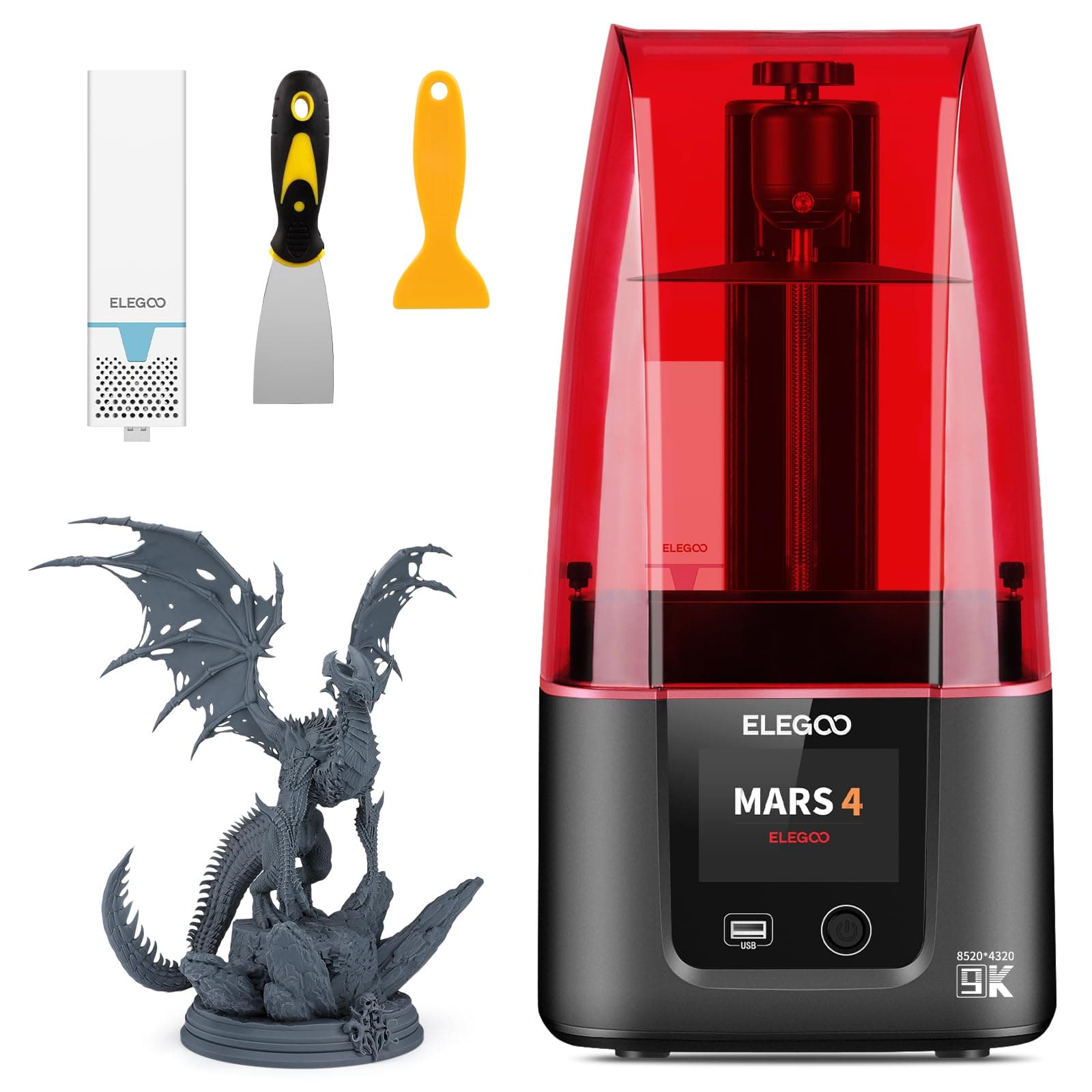
About Brand Vision Create the future, interpreted as "Using programming and 3D printing technology, we can create almost anything - Elegoo offers geeks the key to a new world." Basic Parameters XY resolution: 18*18um [9K 8520*4320] Z-axis accuracy: 0.02mm Layer thickness: 0-0.2 mm Printing time: Max 70 mm/h Power requirements: 100-240V; 50/60Hz; 24V/3A Dimensions: 227mm (L) x 227mm (W) x 438mm (H) Construction Volume: 153mm(L)*77.8mm(W)*175mm(H) Net Weight: 5.5 kg System: EL3D-3.0.1 Technology: MSLA Stereolithography Light source: COB (wavelength 405nm) Slicer Software: Chitu Box & Voxeldance Tango Connectivity: USB Operation: 3.5 inch touch screen Precautions Keep the 3D printer and its accessories out of the reach of children. Fill the resin tank not less than 1/3 of the volume, but do not exceed the MAX line position. Place the printer in a dry environment and protect it from rain and moisture. If you encounter an emergency during operation, first turn off the power supply of the 3D printer. Use the printer indoors and avoid direct sunlight and dusty environment. Use 95% (or higher) ethyl alcohol or isopropyl alcohol to wash your model, unless you use water washable resin. If printing fails, you need to clean the excess cured resin in the resin tank and replace the resin, otherwise it may cause damage to your printer. When using the 3D printer, wear a mask and gloves to avoid direct skin contact with the photopolymer resin. If the release film in the resin tank is white, scratched or has no elasticity, the pressure error rate is high, replace the release film in time. Review: Update #2 - I figured I'd reach out to Elegoo customer service. Within 24 hours they're already getting me a replacement LCD. I'm actually really impressed. Customer for life, now. <3 Update: whelp, it happened. I guess a tiny fragment of resin made some pressure and cracked the LCD. Nothing like a $90 repair less than 90 days in. I wish I had grabbed a different model. The Mars 3 has an LCD that is only $29 to replace. Also, I started having issues shortly after the initial review with the Z bar groaning towards the bottom of the print when it would be just lowering the build plate to the screen. I used some gun oil to lube it up and the groaning went away, but it started resulting in warped prints even before the cracked lcd. I don't recommend this product - look for one that is far more sturdy. I'm so disappointed. I love this thing. I love it SO much. I love making minis, I love painting them. I love model kits. This thing can help me make all of those things AND... it can pay for itself - print some things for your pals, have thempay you a little $ for the resin, pay off your own machine and the resin. Win/win/win. The -only- complaint I have is that the instruction manual is way too empty. There are so many things to research about resin printing or 3D printing in general. Here's the best "general help guide" I can give. 1. You're going to want to print more things than just the Rook file on the thumb drive. You'll need to use software to do so. There are programs on the drive, I personally prefer Lychee Slicer. It crashes way less (almost never), the options are much easier to understand... I think it's just all around better. Look up Youtube guides on how to use this software. They will help IMMENSELY because the instructions don't say so but knowing how to use the software is CRUCIAL to having solid prints. 2. Your prints will fail. It is okay. When they do, clean everything up. Strain your resin (as long as it hasn't been contaminated with rubbing alcohol or any water, etc) through a mesh strainer to get rid of ANY hard/cured bits. I personally would strain it into an empty bottle or something but I put mine back in the OG bottle because I didn't know what was and wasn't safe for liquid resin lol. But just remove the cured bits out of the resin vat, gently pop off the cured bits on the FEP (clear plastic screen at the bottom of the vat) and REALLY try not to scratch/dent that up. Remove anything from your build plate, clean up with some IPA 99% if you want (I do because I like to just make sure everything is clean and ready to go like new to avoid gunk building up) and go back to the software to review your structures. Also there are a TON of groups online of people who support each other and share tips on printing. Facebook/Reddit/Discord/Telegram etc. Look them up! You do NOT have to level your build plate after the first time leveling it unless you get a failed print, then you may want to. The instructions say to use a "card" to level the build plate - just put a piece of paper between the plate and the LCD screen and press down on it "firmly" (don't hulk smash it, just hold it down like you're trying to keep the paper from flying away) and then tighten the screws. Zero it, lift it, put the vat it, hit Home - IF IT MAKES A HORRIBLE GRINDING NOISE WHEN GOING DOWN AND WONT ZERO OUT - the plate is super uneven and trying to force its way down another fraction of a mm and can't because one of the corners is likely super uneven. Just do the level once. The piece of paper is there to see if it's not super uneven, you don't have to worry about perfect spacing. As long as the plate sortof grips the paper while you pull away, that's fine. That crunching noise or popping noise when the plate is coming up? That's totally fine. It's actually good - it means your resin is being pulled off of the FEP, so listen for that beautiful fffffffpop noise <3 3. Wanna know how your print is doing? Just pause the print. It'll raise the build plate all the way up and you'll be able to check the status. Wanna resume? Hit the play button. Just try not to keep it from doing its thing for too long, especially in an area where the resin might be in danger of curing (though I'd keep the machine out of the sun at all costs tbh) Also - you can hollow out prints to save resin, time, money, and weight. It's frustrating at first because you'll learn about suction cups and drain holes. Holy cow, they're annoying to figure out lol. This is why I like Lychee's slicer the best - the drain holes are awesome and there are even "objects" you can put into the mesh of your STL to prevent hollowing and to plug holes. They're called "blockers" and work great. I hope this helps. Overall, I think the print quality of this machine is stellar. As good as any WotC mini I've bought at the store. It's satisfying to use, though the frustration behind the very vague manual is there. That's the worst part, in my opinion. Although, Elegoo, I have experience with technical support, troubleshooting, and customer service support. I'd be happy to help you write something a little more in-depth that might help you avoid returns and refunds. Just a thought! TL;DR: The Elegoo Mars 4 resin 3D printer is a great tool that prints high quality miniatures, model kits, and other objects with the added bonus of potential profitability. While the instruction manual lacks depth, personal tips include exploring software like Lychee Slicer, managing print failures effectively, simplifying build plate maintenance, monitoring print progress, and utilizing advanced techniques for efficiency. Despite manual frustrations, the printer's superb print quality makes it a worthy investment for hobbyists and professionals alike. Review: Todo llego bien,falta hacer las pruebas correspondientes,recomiendo.


| ASIN | B0BP28MP8S |
| Manufacturer | ELEGOO |
| Manufacturer reference | US-SO-3D-M4 |
| Product Dimensions | 61 x 30 x 28 cm; 5.5 kg |
Z**.
Update #2 - I figured I'd reach out to Elegoo customer service. Within 24 hours they're already getting me a replacement LCD. I'm actually really impressed. Customer for life, now. <3 Update: whelp, it happened. I guess a tiny fragment of resin made some pressure and cracked the LCD. Nothing like a $90 repair less than 90 days in. I wish I had grabbed a different model. The Mars 3 has an LCD that is only $29 to replace. Also, I started having issues shortly after the initial review with the Z bar groaning towards the bottom of the print when it would be just lowering the build plate to the screen. I used some gun oil to lube it up and the groaning went away, but it started resulting in warped prints even before the cracked lcd. I don't recommend this product - look for one that is far more sturdy. I'm so disappointed. I love this thing. I love it SO much. I love making minis, I love painting them. I love model kits. This thing can help me make all of those things AND... it can pay for itself - print some things for your pals, have thempay you a little $ for the resin, pay off your own machine and the resin. Win/win/win. The -only- complaint I have is that the instruction manual is way too empty. There are so many things to research about resin printing or 3D printing in general. Here's the best "general help guide" I can give. 1. You're going to want to print more things than just the Rook file on the thumb drive. You'll need to use software to do so. There are programs on the drive, I personally prefer Lychee Slicer. It crashes way less (almost never), the options are much easier to understand... I think it's just all around better. Look up Youtube guides on how to use this software. They will help IMMENSELY because the instructions don't say so but knowing how to use the software is CRUCIAL to having solid prints. 2. Your prints will fail. It is okay. When they do, clean everything up. Strain your resin (as long as it hasn't been contaminated with rubbing alcohol or any water, etc) through a mesh strainer to get rid of ANY hard/cured bits. I personally would strain it into an empty bottle or something but I put mine back in the OG bottle because I didn't know what was and wasn't safe for liquid resin lol. But just remove the cured bits out of the resin vat, gently pop off the cured bits on the FEP (clear plastic screen at the bottom of the vat) and REALLY try not to scratch/dent that up. Remove anything from your build plate, clean up with some IPA 99% if you want (I do because I like to just make sure everything is clean and ready to go like new to avoid gunk building up) and go back to the software to review your structures. Also there are a TON of groups online of people who support each other and share tips on printing. Facebook/Reddit/Discord/Telegram etc. Look them up! You do NOT have to level your build plate after the first time leveling it unless you get a failed print, then you may want to. The instructions say to use a "card" to level the build plate - just put a piece of paper between the plate and the LCD screen and press down on it "firmly" (don't hulk smash it, just hold it down like you're trying to keep the paper from flying away) and then tighten the screws. Zero it, lift it, put the vat it, hit Home - IF IT MAKES A HORRIBLE GRINDING NOISE WHEN GOING DOWN AND WONT ZERO OUT - the plate is super uneven and trying to force its way down another fraction of a mm and can't because one of the corners is likely super uneven. Just do the level once. The piece of paper is there to see if it's not super uneven, you don't have to worry about perfect spacing. As long as the plate sortof grips the paper while you pull away, that's fine. That crunching noise or popping noise when the plate is coming up? That's totally fine. It's actually good - it means your resin is being pulled off of the FEP, so listen for that beautiful fffffffpop noise <3 3. Wanna know how your print is doing? Just pause the print. It'll raise the build plate all the way up and you'll be able to check the status. Wanna resume? Hit the play button. Just try not to keep it from doing its thing for too long, especially in an area where the resin might be in danger of curing (though I'd keep the machine out of the sun at all costs tbh) Also - you can hollow out prints to save resin, time, money, and weight. It's frustrating at first because you'll learn about suction cups and drain holes. Holy cow, they're annoying to figure out lol. This is why I like Lychee's slicer the best - the drain holes are awesome and there are even "objects" you can put into the mesh of your STL to prevent hollowing and to plug holes. They're called "blockers" and work great. I hope this helps. Overall, I think the print quality of this machine is stellar. As good as any WotC mini I've bought at the store. It's satisfying to use, though the frustration behind the very vague manual is there. That's the worst part, in my opinion. Although, Elegoo, I have experience with technical support, troubleshooting, and customer service support. I'd be happy to help you write something a little more in-depth that might help you avoid returns and refunds. Just a thought! TL;DR: The Elegoo Mars 4 resin 3D printer is a great tool that prints high quality miniatures, model kits, and other objects with the added bonus of potential profitability. While the instruction manual lacks depth, personal tips include exploring software like Lychee Slicer, managing print failures effectively, simplifying build plate maintenance, monitoring print progress, and utilizing advanced techniques for efficiency. Despite manual frustrations, the printer's superb print quality makes it a worthy investment for hobbyists and professionals alike.
C**S
Todo llego bien,falta hacer las pruebas correspondientes,recomiendo.
H**A
Ni 4 meses duro, se apagaba sola al encender la pantalla para imprimir la primera capa, solo use 2 litros de resina. Ya no puedo imprimir. Da muy buena calidad en las impresiones pero parece programada para fallar, un amigo compro la misma maquina y fallo igual como a los 4 meses mismo problema se apagaba al encender la luz. Daria cero estrellas si se pudiera.
A**O
Gran compra. Vale la pena.
A**C
i had some skepticism when i purchased this but i've been able to make quite a few things over the time i've owned it, ranging from household QOL items, BJD dolls for friends, the print size helps and if you need something a bit larger you can always change the angle of the print, i haven't had any issues with the bed leveling its pretty simple to adjust and the assembly was practically nonexistent just right out of the box and ready to print.
TrustPilot
2 周前
2 个月前