We remain fully operational. Our teams are working around the clock to ensure your deliveries continue safely.

下载应用程序


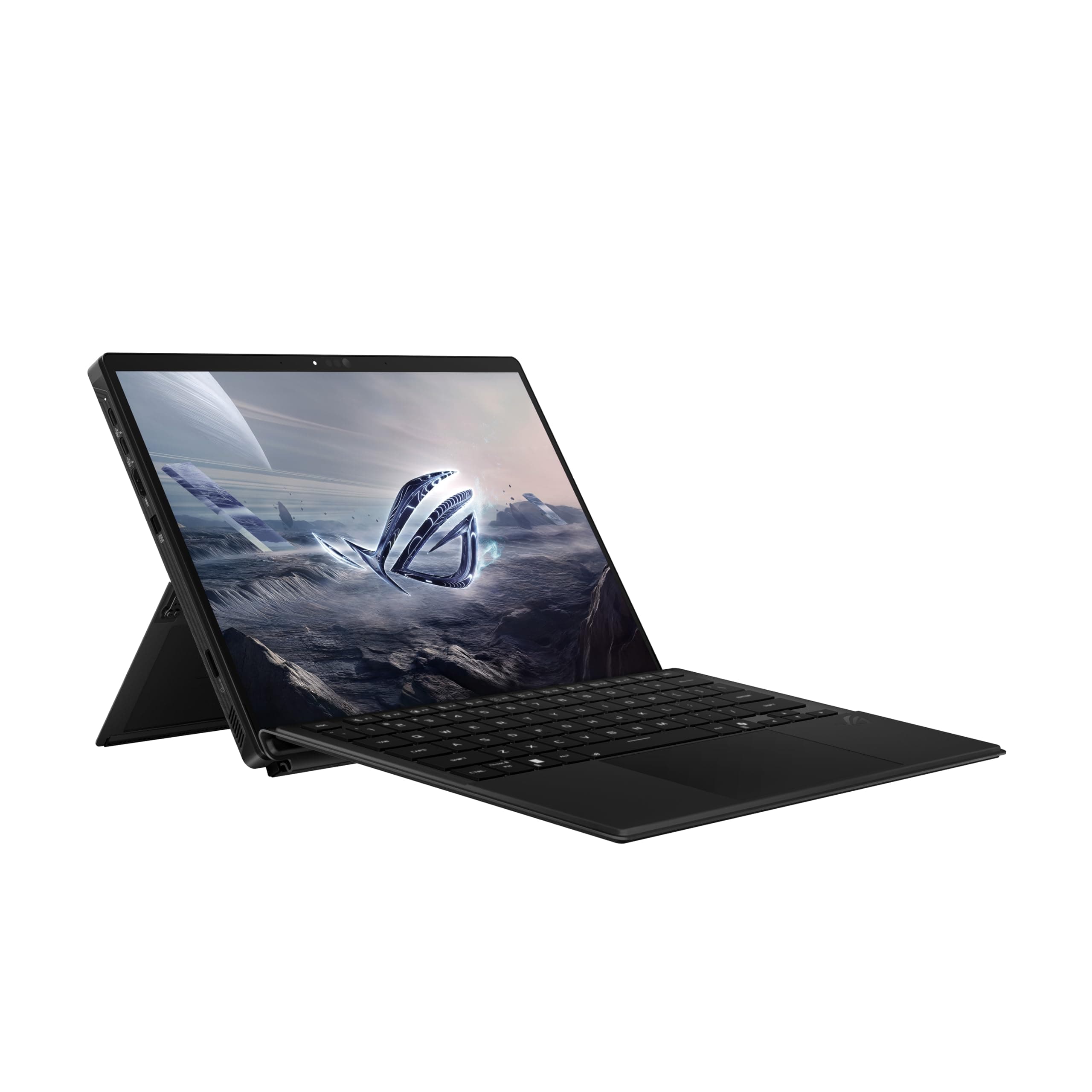
🎮 Power Meets Portability — Game, Create, and Dominate Anywhere!
The ASUS ROG Flow Z13 is a cutting-edge 13.4-inch convertible gaming notebook powered by a 16-core AMD Ryzen AI MAX+ 395 processor, 32GB of ultra-fast LPDDR5X RAM, and a stunning 2.5K 180Hz touchscreen display. Designed for professionals and gamers who demand desktop-level performance in a sleek, portable form factor, it features AI-assisted productivity tools, a flexible 170° kickstand, and up to 10 hours of battery life. Ideal for high-end gaming, content creation, and even advanced AI workloads, this device redefines what a 2-in-1 gaming notebook can do.


| ASIN | B0DT7MNLTD |
| Audio Output Type | 1 x 3.5 mm Headphone/Microphone Combo Jack |
| Audio Recording | Yes |
| Audio features | 2 x 2 Watt Speakers, Dolby Atmos, Hi-Res certification (for headphone), Smart Amp Technology |
| Automatic Backup Software Included | 1-month trial for new Microsoft 365 customers with a credit card required, McAfee 30 days free trial, Xbox Game Pass for PC: 3 months |
| Battery Cell Type | Lithium Ion |
| Best Sellers Rank | #984 in Computers & Accessories ( See Top 100 in Computers & Accessories ) #28 in 2 in 1 Laptop Computers |
| Bluetooth Version | 5.4 |
| Bluetooth support? | Yes |
| Brand | ASUS |
| Built-In Media | GZ302EA-XS96, Powercord & Adapter, Userguide |
| CPU L1 Cache | 16 MB |
| CPU L3 Cache | 64 MB |
| CPU Model Generation | 6th Gen |
| CPU Model Number | AMD STRIX HALO-16C/BGA |
| CPU Model Speed Maximum | 5.1 GHz |
| Cache Memory Installed Size | 80 MB |
| Chipset Type | AI MAX+ 395 |
| Color | off black |
| Compatible Devices | External displays, mice, keyboards, storage devices, printers, etc. |
| Connectivity Technology | Wi-Fi 7, Bluetooth 5.4, HDMI, USB, USB Type-C, AUX |
| Customer Reviews | 4.3 4.3 out of 5 stars (86) |
| Display Resolution Maximum | 2560x1600 |
| Display Technology | In-plane Switching (IPS) Technology |
| Display Type | LED |
| Form Factor | Gaming Notebook |
| Graphics Coprocessor | Radeon Graphics |
| Graphics Description | Integrated |
| Graphics Ram Type | DDR5 SDRAM |
| Hard Disk Description | SSD |
| Hard-Drive Size | 1 TB |
| Has Color Screen | Yes |
| Human-Interface Input | Touchscreen |
| Item Dimensions L x W x Thickness | 11.81"L x 0.51"W x 8.03"Th |
| Item Weight | 2.65 Pounds |
| Keyboard Description | Backlit |
| Keyboard Layout | QWERTY |
| Lithium-Battery Energy Content | 70 Watt Hours |
| Manufacturer | ASUS |
| Maximum Display Brightness | 500 Nit |
| Memory Speed | 8000 MHz |
| Model Name | ROG Flow Z13 |
| Model Number | GZ302EA-XS96 |
| Model Year | 2025 |
| Native Resolution | 2560 x 1600 pixels |
| Number of Ports | 4 |
| Operating System | Windows 11 Pro |
| Other Special Features of the Product | Support Stylus |
| Processor Brand | AMD |
| Processor Count | 16 |
| Processor Series | AMD A8 |
| Processor Speed | 4.6 GHz |
| RAM Memory Installed | 32 GB |
| RAM Memory Technology | LPDDR5 |
| RAM Type | DDR5 RAM |
| Ram Memory Maximum Size | 32 GB |
| Refresh Rate | 180 Hz |
| Resolution | 2560 x 1600 |
| Screen Finish | Glossy |
| Screen Size | 13.4 Inches |
| Specific Uses For Product | Gaming |
| Total Number of HDMI Ports | 1 |
| Total Usb Ports | 3 |
| Touch Screen Type | capacitive |
| UPC | 197105882751 |
| Unit Count | 1.0 Count |
| Video Output | HDMI |
| Video Processor | AMD |
| Warranty Description | 1 Year |
| Warranty Type | Limited |
| Webcam Capability | Yes |
| Wi-Fi Generation | Wi-Fi 7 |
| Wireless Compability | 802.11ax |
| Wireless Technology | Wi-Fi 7, Bluetooth 5.4 |
A**A
Like a new toy gives you excitements
I’ve been using the ASUS ROG Flow Z13 (with 128 GB main memory configuration) for a while now, and overall it’s an impressive piece of hardware—especially if you value portability without giving up serious performance. First, the design is one of its strongest points. It’s essentially a gaming laptop in a tablet form factor, which makes it extremely versatile. The detachable keyboard is convenient, and the build quality feels premium and solid. It’s easy to carry around, whether you’re commuting or just moving between rooms. Performance-wise, this machine delivers. With 128 GB of RAM, multitasking is effortless—you can run demanding games, heavy applications, and background processes simultaneously without noticeable slowdown. It’s clearly built not just for gaming, but also for content creation, virtualization, or any RAM-intensive workflows. Games run smoothly with high settings, and load times are minimal. The display is another highlight. It’s sharp, bright, and responsive, which enhances both gaming and everyday use. Touch functionality is a nice bonus, although most gamers may not rely on it much. However, there are a few downsides. Battery life is average at best, especially under heavy load—you’ll likely need to stay plugged in for gaming sessions. Also, because of its compact design, it can get warm and the fans can be noticeable when pushed hard. The keyboard, while functional, may not feel as comfortable as a traditional gaming laptop keyboard for long sessions. Overall, the ASUS ROG Flow Z13 is a powerful and innovative device that blends portability with high-end performance. It’s ideal for users who want a flexible, compact gaming system without sacrificing capability. If you’re okay with the trade-offs in battery life and thermals, it’s definitely worth considering.
J**H
Local AI datacenter on the go
Most reviews of the ASUS ROG Flow Z13 focus on gaming benchmarks and frame rates. This review is different. I tested this machine as a Local AI Workstation, pushing it to the absolute physical limit with Llama 3.1 70B, massive 128k context windows, and asynchronous multi-agent Python workflows. The verdict? The AMD "Strix Halo" chip inside this tablet is a monster that breaks the rules of what a laptop is supposed to be capable of. The "Killer Feature": 112GB of Unified Memory The single most important spec for Local AI is VRAM. NVIDIA RTX 4090 Laptop: Caps at 16GB VRAM. NVIDIA RTX 4090 Desktop: Caps at 24GB VRAM. ASUS ROG Flow Z13 (Strix Halo): Access to 96GB+ of VRAM. This is the game-changer. By adjusting a specific setting in Armoury Crate (or BIOS), you can allocate nearly all of the system's 128GB LPDDR5X RAM directly to the GPU. Real-World Impact: While RTX 4090 users struggle to fit a quantized 70B model into memory (often resorting to aggressive splitting or slow CPU offloading), the Z13 loads Llama 3.1 70B (Q4_K_M) with a full 128k Context Window entirely into VRAM. It feels less like a laptop and more like a portable Mac Studio Ultra or a dual-3090 rig. The Stress Test: "Scanner & Reader" Architecture To test the limits, I ran a custom Python compliance engine using LM Studio as the backend. 1. The "Scanner" (Llama 3.1 8B) Task: Rapidly chunking and analyzing 50+ sections of text. Performance: Blistering speed. The 8B model is so small relative to the 96GB VRAM that I could run AsyncIO concurrency, firing off 10 requests simultaneously with a batch size of 8192. 2. The "Reader" (Llama 3.1 70B) Task: Deep reasoning over massive 30-page blocks of text (120,000 characters per prompt). Performance: This is where Strix Halo shines. Loading a 70B model and filling a 128k context window requires ~60GB+ of VRAM. The Z13 handled it without crashing, processing massive contexts that would OOM almost any other consumer device. Proof of Power The screenshot shows Llama 3.1 70B loaded with a full 128k Context Window and an Evaluation Batch Size of 10,240. This configuration is usually reserved for data center nodes. Loaded also concurrently is Llama 3.1 8B. The "Gotchas": It's Not Plug-and-Play Unlike the "It just works" experience of NVIDIA (CUDA), the AMD Strix Halo architecture is bleeding-edge. You will have to tune it. 1. The "Reverse Bottleneck" Crash I discovered that if you allocate too much RAM to the GPU (e.g., 96GB), you starve the Windows OS (leaving it only ~16GB). The Crash: Attempting to load a 42GB model file caused an immediate crash because there wasn't enough System RAM to stage the file. The Fix: I had to disable mmap in LM Studio to stream data directly to the GPU, bypassing the System RAM bottleneck. Alternatively, setting the GPU allocation to 64GB (leaving 48GB for System) provided the perfect stability balance. 2. Driver Quirks (The "pp buffer" Error) The AMD ROCm/Vulkan drivers are strict about buffer sizes. Pushing context to 128k caused failed to allocate compute pp buffers errors at first, but it took some trial and error to tune the right settings in LM Studio to find the right combination to make it work. The Fix: Enabling Flash Attention was mandatory. It linearized the memory usage, preventing the driver buffer from overflowing during massive prompts. 3. Hardware Gremlins The rear RGB window has a mind of its own, often getting stuck or conflicting with Windows Dynamic Lighting. A toggle reset in Armoury Crate usually fixes it, but it's a minor annoyance on a premium chassis. Summary The ASUS ROG Flow Z13 (Strix Halo) is currently the only portable device on the market that can comfortably run a 70B Parameter Model with a 128k Context Window locally. If you are a gamer, get an RTX laptop. But if you are an AI Engineer who needs to run Enterprise-grade models on a plane, in a coffee shop, or at a secure on-site client meeting, this device has no equal. Pros: ✅ Massive VRAM capacity (up to ~110GB usable for AI). ✅ Runs 70B models entirely on GPU with high batch sizes. ✅ "Shared Memory" speed is surprisingly fast (LPDDR5X bandwidth). ✅ Extremely portable form factor for the power. Cons: ❌ Requires significant BIOS/Software tuning. ❌ AMD software ecosystem (ROCm/LM Studio) requires more configuration than CUDA. ❌ Battery life evaporates when the AI Engine is running full tilt, but hey it's a tablet after all. Final Score: 9.5/10 for Local AI Utility.
B**.
Well worth the upgrade/purchase. The battery life is much better with the Ryzen.
If you have used the previous models this will live up to the hype. With the new Ryzen CPUs the battery life on normal tasks is several hours, no longer the hour it has been with the GPUs. This was a pleasant surprise. For years I've looked for a good 2 in 1 laptop tablet for travel and work. Many of the units don't have the power. Ports are always missing. Charging is a pain. I even tried the original EVE Tech V as a possible option (don't bother with EVE Tech/Dough, hype over performance and delivery). These provide power, charging through any USB C (albeit slow on small bricks, LoL), quality screens, a keyboard that doesn't suck (expectations tempered for those of us with mechanical keyboards), an overall quick and quality experience. The only place these did not shine was in battery life but with everything else covered that has been acceptable to me. A 10,000mAh batter plugged in USB C has often gotten me through a few hours of work moving around a construction site or job project.
C**H
Well received.
A**T
This is undoubtedly one of the best performance devices available. Amazing hardware quality, and not only for gaming, but all workloads are processed super smooth and hyperfast.
K**O
After three months with this laptop, I want to share a clear, honest review. Gaming performance is excellent. I bought it mainly to play Black Myth: Wukong (BMW), and I’m happy to say I finished all challenge modes on this machine. For that alone, it feels worth it. The downside: it’s an AMD laptop, but mine shipped with an Intel-leaning Windows setup/drivers, and that caused the exact issues others warned about—freezes, random lockups, and forced hard resets. Reinstalling Windows with the proper AMD drivers/software stack should solve it. For a 3K laptop (especially in Canada), ASUS should have done better out of the box. That said, it’s still one of the coolest-looking laptops I’ve owned. Just make sure you understand the trade-offs before buying.
C**G
Very powerful machine and ideal for local LLM development, it will get hot when running LLM or playing video games. But unlike other typical laptop that the weight is on the keyboard side, this one is on the screen side. The good thing is that the keyboard is nice and cool. The cooling system is letting air flow from the back and out at the top, so make sure there are enough room from the wall, that said, do not cover the back with any cover.
L**R
Super expensive for what it is. -There are laptops with higher performance at a lower cost. -There are tablets that are lighter with longer battery for 1/5 of the cost. You'll need an exact use case for this hybrid. For me, I didn't want to "upgrade" my ROG Ally to the Ally X. It's a whopping 10 percent performance increase. I'm now using the Z13 along with XR glasses to fully play all my PC games on the comfort of my bed. It's something that the ROG Ally *can* have problems with depending on the game. No more wondering if it's going to lag, the Z13 crushes every game in my steam library at 1080p 120hz (the resolution of my XR glasses). ... It's still expensive AF.
TrustPilot
2 个月前
4天前