We remain fully operational. Our teams are working around the clock to ensure your deliveries continue safely.

下载应用程序


🎶 Amplify Your Creativity with Every Project!
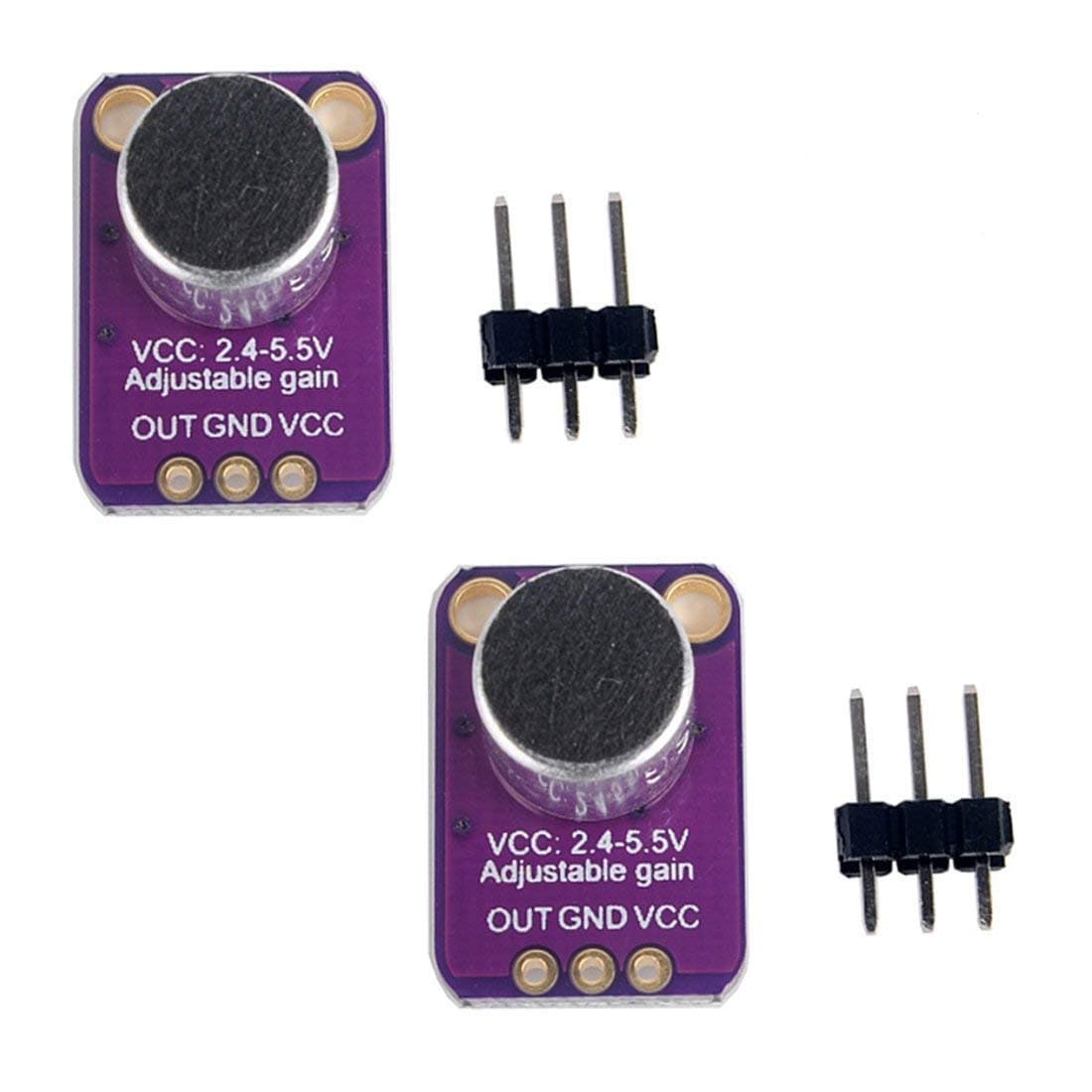
The HiLetgo MAX4466 Microphone Amplifier Module is a compact and versatile audio solution, featuring a soldered electret microphone and adjustable gain. Ideal for various applications, it operates efficiently on a supply voltage of 2.4 to 5 volts, making it perfect for DIY enthusiasts and professionals alike.
| Material Type | Plastic |
| Number of Channels | 1 |
| Minimum Supply Voltage | 2.4 Volts (DC) |
| Mounting Type | Surface Mount |
| Voltage | 5 Volts |
| Maximum Supply Voltage | 5 Volts (DC) |
S**Y
These are excellent.
Not only can they be used as sound level meter sensors used in many projects, they are actual microphones that can be hooked directly to a pre-amp, mixer, or an analog to digital converter. If you use 5 volt power, output levels, even from background noise, will be almost 5 volts, and any intended input will clip. Using 3.3 volts on Arduino or Pi will give you about a 2 volt floor that will eliminate most clipping. There is some slight noise in the output, so I am going to try 2.5 volt vcc. Great find.
H**R
Works pretty well, but seems to eat batteries.
I rigged the microphone up with an old amplifier and some earphones to facilitate conversation with my hearing impaired wife. The setup works really well, except that I powered the mike with a couple of AA batteries. Sadly the batteries don't last very long. I haven't measured the current drain yet, but it must be fairly hi,
E**Y
Item received as expected.
Prompt service. I ordered these for a students project. Unfortunately I threw the package away and had to reorder. Second order arrived quickly. No issues with devices. Student has will install next week.
E**O
Amplified mic
This is a nice microphone for DIY projects. It has only three connections, power, gnd, and signal. It is amplified, but I found it works better when the sound is close by. I plan on using it to detect sound by a small robot.
J**H
Must be very close to mic for any sensitivity
I see there are a lot of great reviews but these microphones need to be very close to whatever you want them to pickup. I tried to make a music reactive display using them. Unless the speakers playing music were a couple inches away it wouldn't pick up anything. The little trim pot on the back of the mic doesn't seem to adjust sensitivity.
B**3
Excellent except sensitivity control
This little package worked *great*, and there was even a datasheet available online somewhere. But I could not for the life of me figure out the sensitivity control and the instructions were sorely lacking. Ended up breaking one trying to turn the little screw thinking it was the sensitivity. Still, used it in my project very successfully.
I**R
Superior Amplifier Version
These are super cool and accurate. My arduino is giving me a nice fat range of values to utilize.There are other microphone sensors WITHOUT the amplifier and let me say they are NOT worth the time because they will return noisey and inaccurate values.Try these out - I'm using them for robot eyes that wake up when you talk, open widely when you shout, and fall asleep if quiet.
C**H
Used for a Mandalorian costume!
Great little mic for a simple voice amplification project.