
下载应用程序



Desert Online General Trading LLC
Warehouse # 7, 4th Street, Umm Ramool, Dubai, 30183, Dubai
下载应用程序
Desert Online General Trading LLC
Warehouse # 7, 4th Street, Umm Ramool, Dubai, 30183, Dubai


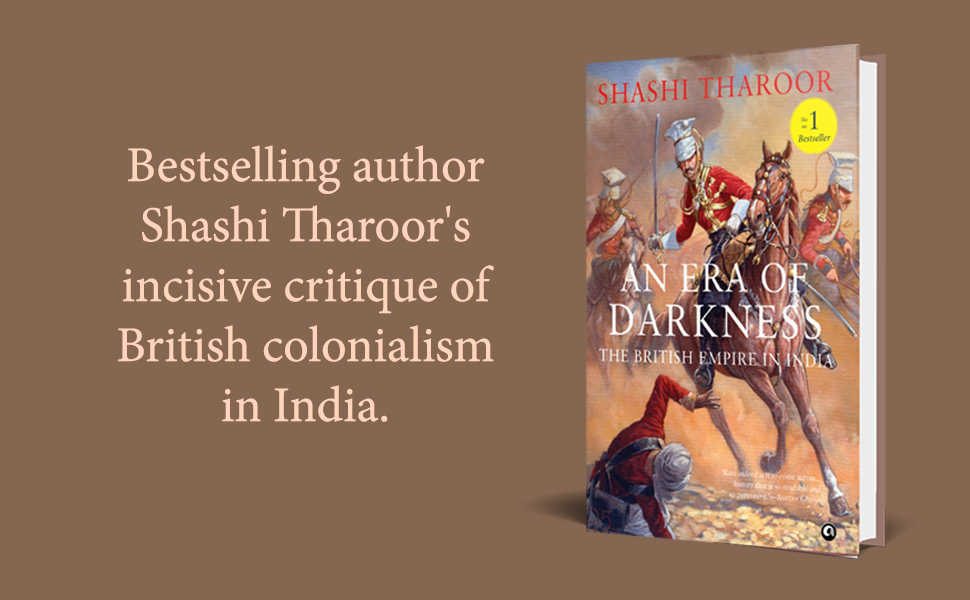
An Era of Darkness: The British Empire in India : Shashi Tharoor: desertcart.in: Books Review: Shining light on an Era of Darkness - Shashi Tharoor whose brilliance enchanted over 3 million people on YouTube with his debating skills at an Oxford Union debate continues in the same vein in his new book "An era of darkness". Essentially the debate was about whether colonialism was good or bad. It may seem anachronistic and even cruel for the victims of Colonialism in Asia, Africa and Latin America that such thing can even be debated. But anything can be debated in public school debating clubs of UK ! In the English tradition all these schools prepare you for a legal or a parliamentary career where you could argue either way on any issue depending on the context. Many of our own parliamentarians are trained in the same tradition and argue brilliantly in Indian courts as well as in the Indian Parliament and we can see them hold forth brilliantly on the pro of a policy and equally brilliantly on the cons of it depending on whether they are in the treasury benches or in the opposition, inducing inevitable cynicism. However the sincerity of Tharoor in arguing that British colonialism did inestimable all sided harm to India shows through this tome where he marshals literally hundreds of facts (well organised quotes run into nearly 300). His passion for the subject comes through every page, his sardonic tone and twist of the English phrase even while cursing the power that imposed English language with "Tommy jackboots" hits the reader with a genuine force. Along with accolades from Indians in all walks of life, including PM, Narendra Modi, Tharoor got some feeble criticism as well after his short Oxford Union talk. That has prepared him for much more disdainful and patronising vitriol from apologists of British colonialism. All his arguments and quotes seem to be in preparation of that assault. He does not leave any leaf unturned in his endeavour including the Tea leaves of Assam, Bengal and Oooty. In fact the topics he chooses to argue include the whole gamut of issues which are normally quoted as "gifts" of two centuries of British rule over India: good governance, English sense of fairplay, Austinian judicial system, Railways, social reform of Hindu society, Cricket, Tea and even the English language. He tears them up one by one with profuse facts and anecdotal quotes from largely British and other Western sources. Some of the insights he provides are important for colonial studies. He points out that the public finance in pre-colonial India was based on taxing trade where as the British themselves being traders made a drastic change and made agriculture and land revenue the focus, (and even called their chief district level representative: Collector) thereby causing immense hardship to peasantry. He traces the creation of the landless peasant and the increased dependence of large segment of the population on agriculture for livelihood due to the destruction of artisans and manufacture and also large scale man made famines under colonialism. In these days when corruption, its roots and elimination often becomes a matter of public discussion he narrates its massive rise due to the practices of the East India Company and its officers. He makes an astute observation that despite historical animosities between England and Scotland a compact was established to include Scotland into the United Kingdom ( though initiated by a fudged parliamentary vote in 1707) by promising plum positions for Scots in colonial India. That explains the unusually large proportion of Scots in the administration and the army in India. Twisting the knife further he adds that perhaps the loss of this income from India into Scottish homes is leading to disenchantment and fueling separatism in Scotland ! His remarks on the creation of a decadent gentry of Rai Bahadurs and Diwan Bahadurs and even the more abhorrent profligate and promiscuous Princes replacing the older far more grounded aristocracy are insightful. Besides going into the financing of Indian Railways and how gold plating was done by many an English investor assured of guaranteed returns and how Railways during construction and later were used to drain the Indian economy and increase the national debt, Tharoor makes an important point that in the operational finances of Railways it was the third class passengers traveling in sub human conditions that subsidised freight and the first class ! His discussion of British communal divide and rule as well as re-imposition of caste inequalities through the Gentoo Code under Warren Hastings and in the post-1857 construction of colonial state are extremely important but often forgotten in the modern Indian discourse on communalism and casteism. It is an enjoyable read, passionately written smooth in flow while being richly cross referenced. The blemishes are few. Note worthy ones are his quoting Marx completely out of context to show purportedly that Marx supported British colonialism in India which is contrary to facts; and frequent comparisons of genocidal massacres under British with unsubstantiated figures of deaths caused supposedly by Stalin etc. Perhaps we can ascribe it to his anxiety towards taking a swipe at his leftist political rivals in his parliamentary constituency in Kerala. Other weakness of the "Era of Darkness" is total neglect of the role of Ghadar revolutionaries, Bhagat Singh and his comrades and even the war of Independence --the Great Ghadar of 1857, chronicled as the biggest war of 19th century world, and the colonial tactics of chicanery and brutality employed by British, while Tharoor does bring out such facets from the rest of colonial history. I would recommend every young Indian to read this book to get a perspective of our colonial past in the present day mesmerising euphoria of the global village in spite of Trump. Review: A simple line like “Nadir Shah stole it fair and square” does it - 4.5 rating I can’t seem to recall the exact quote by John Oliver which went something along the line that most, if not all, international problems of the world today can be traced back to a the last 100 years with A few white men in a room with a map and drawing lines. Believe me I spent almost a day searching for it. Haven’t found it yet but I am sure it’s there. I digress. The reason for the publishing of this book is quite a well known fact. Shashi Tharoor (former diplomat, current politician and a Member of Parliament) made an impassioned speech at the Oxford University during a debate on British colonisation of India back in 2015. There, he highlighted the degradations of Indian society at the hands of the British, and their long-lasting after effects (hint: they’re not good). Once the video got online and took a viral life of its own, earning praise from most of the Indians, irrespective of their own political stance. People came forward to support him and asked him to write a book on the subject. This book is a detailed version of that talk. It starts with the comparison of Indian economy’s percentage in the world to that of British and other European nations. From there, it moves through the 200 year rule the British maintained in the subcontinent, first the company and then the Crown rule. The rule wasn’t benign or even mostly harmless (as some people choose to describe). It was out and out exploitation of resources, both human as well as material. All the ‘gifts’ the empire imparted to the subcontinent, including education, the English language, railways, parliamentary system of government, and even cricket, were incidental and not an objective. This can clearly be seen by comparing the statistics the country had right after the independence and the current numbers. Although the book covers quite extensively covers all the major events in the struggle, some points are misrepresented or simplified for the sake of the narrative (I’m not sure if it was intentional or just glossed over to fir the author’s political stance). For example, Jinnah’s retreat to London and his change of attitude towards secularism is attributed to Gandhi’s fame whereas it was a little more complex. Also, there seems to be no mention of backstabbing by INC (Indian National Congress) when they chose not to honour the agreement the party had with the Muslim League post election. Furthermore, it is mentioned that Tagore gave up his Knighthood and Gandhi his title Kaiser-i-Hind to protest the Jallianwalla Bagh Massacre, when the reality is that they gave up their titles because the British, instead of punishing the perpetrator General Dyer, chose to honour him. This little change in the reason of giving up the title and protesting help in understanding that they weren’t irrational in their protests, but gave a chance to the other party to accept their fault. On a side note, the release year of the movie Lagaan is erroneously mentioned as 2003 instead of 2001, but that’s just nitpicking. The book treads some slippery slopes and becomes quite self-aware when it comes to discuss the author’s own command over English language and his fondness for a sport the empire gave to the country, cricket. But somehow, it manages to not sound hypocritical and still be engaging and informative. Apart from all the seriousness of the book and the subject, it somehow manages to squeeze in a few moments where you would chuckle, or at the very least put a smile on the face. A simple line like “Nadir Shah stole it fair and square” does it. Also, when talking about a certain Mr. Nirad C Chaudhuri, the author choosing the most eloquent of words manages to say something on lines of “the ill-informed scholar had his nose up the colonial ass”. If I had my way, I’d recommend this as a compulsory read in all the schools of India, in whatever language possible. It not only gives an objective outlook of the 200 history during the British Empire, but also a subjective point of view to comprehend the scale. Although, that somehow becomes slightly biased however hard the author tries to maintain to not be so. However, the writing and the language are again top notch. Definitely worth a read

S**K
Shining light on an Era of Darkness
Shashi Tharoor whose brilliance enchanted over 3 million people on YouTube with his debating skills at an Oxford Union debate continues in the same vein in his new book "An era of darkness". Essentially the debate was about whether colonialism was good or bad. It may seem anachronistic and even cruel for the victims of Colonialism in Asia, Africa and Latin America that such thing can even be debated. But anything can be debated in public school debating clubs of UK ! In the English tradition all these schools prepare you for a legal or a parliamentary career where you could argue either way on any issue depending on the context. Many of our own parliamentarians are trained in the same tradition and argue brilliantly in Indian courts as well as in the Indian Parliament and we can see them hold forth brilliantly on the pro of a policy and equally brilliantly on the cons of it depending on whether they are in the treasury benches or in the opposition, inducing inevitable cynicism. However the sincerity of Tharoor in arguing that British colonialism did inestimable all sided harm to India shows through this tome where he marshals literally hundreds of facts (well organised quotes run into nearly 300). His passion for the subject comes through every page, his sardonic tone and twist of the English phrase even while cursing the power that imposed English language with "Tommy jackboots" hits the reader with a genuine force. Along with accolades from Indians in all walks of life, including PM, Narendra Modi, Tharoor got some feeble criticism as well after his short Oxford Union talk. That has prepared him for much more disdainful and patronising vitriol from apologists of British colonialism. All his arguments and quotes seem to be in preparation of that assault. He does not leave any leaf unturned in his endeavour including the Tea leaves of Assam, Bengal and Oooty. In fact the topics he chooses to argue include the whole gamut of issues which are normally quoted as "gifts" of two centuries of British rule over India: good governance, English sense of fairplay, Austinian judicial system, Railways, social reform of Hindu society, Cricket, Tea and even the English language. He tears them up one by one with profuse facts and anecdotal quotes from largely British and other Western sources. Some of the insights he provides are important for colonial studies. He points out that the public finance in pre-colonial India was based on taxing trade where as the British themselves being traders made a drastic change and made agriculture and land revenue the focus, (and even called their chief district level representative: Collector) thereby causing immense hardship to peasantry. He traces the creation of the landless peasant and the increased dependence of large segment of the population on agriculture for livelihood due to the destruction of artisans and manufacture and also large scale man made famines under colonialism. In these days when corruption, its roots and elimination often becomes a matter of public discussion he narrates its massive rise due to the practices of the East India Company and its officers. He makes an astute observation that despite historical animosities between England and Scotland a compact was established to include Scotland into the United Kingdom ( though initiated by a fudged parliamentary vote in 1707) by promising plum positions for Scots in colonial India. That explains the unusually large proportion of Scots in the administration and the army in India. Twisting the knife further he adds that perhaps the loss of this income from India into Scottish homes is leading to disenchantment and fueling separatism in Scotland ! His remarks on the creation of a decadent gentry of Rai Bahadurs and Diwan Bahadurs and even the more abhorrent profligate and promiscuous Princes replacing the older far more grounded aristocracy are insightful. Besides going into the financing of Indian Railways and how gold plating was done by many an English investor assured of guaranteed returns and how Railways during construction and later were used to drain the Indian economy and increase the national debt, Tharoor makes an important point that in the operational finances of Railways it was the third class passengers traveling in sub human conditions that subsidised freight and the first class ! His discussion of British communal divide and rule as well as re-imposition of caste inequalities through the Gentoo Code under Warren Hastings and in the post-1857 construction of colonial state are extremely important but often forgotten in the modern Indian discourse on communalism and casteism. It is an enjoyable read, passionately written smooth in flow while being richly cross referenced. The blemishes are few. Note worthy ones are his quoting Marx completely out of context to show purportedly that Marx supported British colonialism in India which is contrary to facts; and frequent comparisons of genocidal massacres under British with unsubstantiated figures of deaths caused supposedly by Stalin etc. Perhaps we can ascribe it to his anxiety towards taking a swipe at his leftist political rivals in his parliamentary constituency in Kerala. Other weakness of the "Era of Darkness" is total neglect of the role of Ghadar revolutionaries, Bhagat Singh and his comrades and even the war of Independence --the Great Ghadar of 1857, chronicled as the biggest war of 19th century world, and the colonial tactics of chicanery and brutality employed by British, while Tharoor does bring out such facets from the rest of colonial history. I would recommend every young Indian to read this book to get a perspective of our colonial past in the present day mesmerising euphoria of the global village in spite of Trump.
S**N
A simple line like “Nadir Shah stole it fair and square” does it
4.5 rating I can’t seem to recall the exact quote by John Oliver which went something along the line that most, if not all, international problems of the world today can be traced back to a the last 100 years with A few white men in a room with a map and drawing lines. Believe me I spent almost a day searching for it. Haven’t found it yet but I am sure it’s there. I digress. The reason for the publishing of this book is quite a well known fact. Shashi Tharoor (former diplomat, current politician and a Member of Parliament) made an impassioned speech at the Oxford University during a debate on British colonisation of India back in 2015. There, he highlighted the degradations of Indian society at the hands of the British, and their long-lasting after effects (hint: they’re not good). Once the video got online and took a viral life of its own, earning praise from most of the Indians, irrespective of their own political stance. People came forward to support him and asked him to write a book on the subject. This book is a detailed version of that talk. It starts with the comparison of Indian economy’s percentage in the world to that of British and other European nations. From there, it moves through the 200 year rule the British maintained in the subcontinent, first the company and then the Crown rule. The rule wasn’t benign or even mostly harmless (as some people choose to describe). It was out and out exploitation of resources, both human as well as material. All the ‘gifts’ the empire imparted to the subcontinent, including education, the English language, railways, parliamentary system of government, and even cricket, were incidental and not an objective. This can clearly be seen by comparing the statistics the country had right after the independence and the current numbers. Although the book covers quite extensively covers all the major events in the struggle, some points are misrepresented or simplified for the sake of the narrative (I’m not sure if it was intentional or just glossed over to fir the author’s political stance). For example, Jinnah’s retreat to London and his change of attitude towards secularism is attributed to Gandhi’s fame whereas it was a little more complex. Also, there seems to be no mention of backstabbing by INC (Indian National Congress) when they chose not to honour the agreement the party had with the Muslim League post election. Furthermore, it is mentioned that Tagore gave up his Knighthood and Gandhi his title Kaiser-i-Hind to protest the Jallianwalla Bagh Massacre, when the reality is that they gave up their titles because the British, instead of punishing the perpetrator General Dyer, chose to honour him. This little change in the reason of giving up the title and protesting help in understanding that they weren’t irrational in their protests, but gave a chance to the other party to accept their fault. On a side note, the release year of the movie Lagaan is erroneously mentioned as 2003 instead of 2001, but that’s just nitpicking. The book treads some slippery slopes and becomes quite self-aware when it comes to discuss the author’s own command over English language and his fondness for a sport the empire gave to the country, cricket. But somehow, it manages to not sound hypocritical and still be engaging and informative. Apart from all the seriousness of the book and the subject, it somehow manages to squeeze in a few moments where you would chuckle, or at the very least put a smile on the face. A simple line like “Nadir Shah stole it fair and square” does it. Also, when talking about a certain Mr. Nirad C Chaudhuri, the author choosing the most eloquent of words manages to say something on lines of “the ill-informed scholar had his nose up the colonial ass”. If I had my way, I’d recommend this as a compulsory read in all the schools of India, in whatever language possible. It not only gives an objective outlook of the 200 history during the British Empire, but also a subjective point of view to comprehend the scale. Although, that somehow becomes slightly biased however hard the author tries to maintain to not be so. However, the writing and the language are again top notch. Definitely worth a read
D**B
An amazing work by Dr. Tharoor
This book depicts the immense and deep knowledge of author on Pre Independence era. His exhaustive research and the way he garlands the points into a meaningful lecture, binds the reader to the very last page. However, there happens to be some incidents, where it would have been more useful to get some reference. For example the railway accident in 1861 between Connogor and Bally, or why Brits chose Darjeeling, Assam and Nilgiris for the tea plantation, etc. Inspite of that this book gives an insight into how Brits mere exploited this land for their own benefits and later manipulating us to believing they did a greater favour to us rather than being unconditionally apologetic. Its a shame that 80 percent of the current Brits still have a racial outlook towards Indians, and that they did a great job in uplifting the Indians, rather than oppressing them. Anyways, this book is extremely insightful and that must be read by every Indians across the globe.
A**T
Nice read
The book is of good quality and worth the money. The photos and the actual product matches. Recommended!
A**S
Sehr detailreich und gut belegt wird der britische Kolonialismus in seiner ganzen Scheinheiligkeit entlarvt.
D**D
This 2016 book about British colonial rule made me understand the meaning and force of “check your privilege.” The author, Shahhi Tharoor, has written many books and has had an extensive career (after earning his PhD at 22 years!) as an Indian politician and international diplomat. Tharoor’s documents how the British harmed existing, thriving communities during their rule and explains how their misguided and/or intentionally harmful policies still undermine development in the Indian subcontinent. (Recall that the East India Company [EIC] converted trading posts into a de facto colonial rule between 1613 and 1857. After the Indian Mutiny of 1857, the Crown ruled the territories as part of the British Empire, also called the Raj. These territories included present day India, Pakistan and Bangladesh, but I will refer to them collectively as “India.” The Empire had significant influence on Sri Lanka, Nepal and Afghanistan. The book does not cover events in other territories of the Raj, but they show up as colonial administrators in London move people, goods and money in one giant game of Risk.) **Aside: my personal story** Long time readers will know that I have some connections to India, so I was fascinated by Tharoor’s steady demolition of the legends and excuses justifying White Man’s rule over Brown People who neither asked for nor received “development”. This book contextualized my family’s history in colonial India. First, there is the fact (via DNA testing) that my father is “one-third” Indian. This ratio is unfamiliar to anyone who thinks of ancestors in terms of halves, quarters, and so on, but it reflects (I think) the intermingling of various (un)acknowledged ancestors over the many generations. (All 4 of my father’s grandparents were born in India. At least half his great-grandparents were, with the rest “born unknown.”) Tharoor notes that the British were far more open to forming families and marrying in the EIC era, so it is easy for me to believe that our ancestors were having children in the open or in secret, whether or not their names appeared in official records or their original (native) spellings. Second, Tharoor provides abundant evidence of how the British lived at native expense. Wages to white men were 20-40x higher than wages to locals doing the same jobs. Such wealth explains why white mem-sahib’s had servants for every domestic task . White men also enjoyed privileged trading rights, government contracts and other sources of “rents” that would allow them to make easy money on the initiative and hard work of locals forced to use them. (These contracts are still used to enrich citizens of Gulf States — Saudi Arabia, Kuwait, Dubai, et al. — who act as local partners of the foreigners who want to do business there.) My grandfather worked as one of a dozen Assistant Under Secretaries. His brother traded goods with the “home country.” (I would love to get more information on these roles, but I’ve never had the time to dive into the archives.) Third, the British enjoyed a degree of political power and legal impunity that made it easy for them to (literally) get away with murder. They were allowed to do as they pleased, since Indians had hardly any power to question, judge or condemn abuses. I wish I could ask my father’s parents about their transition from power to forced retirement on their 1949 “return” to England — a place they may never have seen. I assume their pension was entirely inadequate to support a colonial lifestyle in Post-WWII England, and I am sure they were shocked to meet the English working classes. **Interesting facts and ideas** I highlight passages that are novel or present familiar ideas in elegant ways. These notes are neither balanced nor complete because they omit ideas I know and emphasize ideas that interest me. Tharoor points out early on that Indians share responsibility for their development as well as (for some) collaboration with the British. These facts aside, he asserts that colonialism hindered India’s development. British at home complained of colonial “nabobs” (a mispronunciation of the Indian title of “nawab”) who had grown rich without talent and then returned as nouveaux riches to invade high society. The EIC levied swinging taxes on farmers and returned no public goods. The money was sent to London, and poverty and hunger skyrocketed among peasants. The British displaced village and regional judicial, economic and political governing bodies with centralized rule by whites who had no historic, cultural or linguistic connections to those they ruled, destroying institutions with a thousand years of functional experience. One 24-year old ruled over one million people across 4,000 square miles as tax collector, criminal and civil judge, land administrator, and 7-8 other titles! EIC rule grew more despotic as time passed. In the 1750s, the EIC was taking over territory by force and seizing tax powers from the local rulers they defeated in “treaties.” (This pattern dates back to the conquest of the New World in the 1500s and extended into the colonization of Africa in the late 1800s. Such “treaties” were also used to subjugate China after the Opium Wars of the mid-1800s, which may explain China’s nonchalant pursuit of similar policies in recent years.) The British obsession with written procedures and binding decisions subjected locals to inflexible, one-size-fits-all rules that connected locals would try to influence while the majority suffered. In the pre-colonial past, local rulers had debated and ruled in public, according to local conditions. Tharoor, a member or Parliament, thinks that India needs a different political system, i.e., one that separates executive and political roles. Given the shambles of India’s Parliament, where 35 percent of MPs face criminal charges and personalities dominate parties and platforms, I agree. India was originally a “gender fluid,” sexually tolerant society (have you seen its temples?), but the British criminalized most non-heterosexual, unmarried lifestyles. Nearly all British laws — on sex, free speech, labor, etc. — were intended to strengthen rule rather than foster development. It is in this sense that the British set India‘ s development back a few centuries. India and Britain’s share of world GDP were 23 and 1.8 percent in 1600. At independence (1947), these shares had reversed to 3 and 10 percent. Tharoor shows how colonialism introduced intolerance, corruption and dysfunction. The British did not try to understand India’s ethnic, religious, and caste diversity as much as simplify, categorize and fossilize divisions into familiar boxes imported from home. It did this to facilitate rule by outsiders ignorant of local nuances, to impose their superior culture on others (most obviously by codifying fluid and changeable castes to match their notions of class), and to divide and rule by emphasizing Muslim minority status and Brahmin’s “natural” rule over lower castes. It is hard to understate the massive damage of these interventions, which are — in my opinion — mostly responsible for ongoing sectarian strife within India and between India and Pakistan as well as the corruption of caste-based political parties and discriminatory laws. (The ruling BJP trying to remove Muslims from its history, culture and geography.) Hindus and Muslims cooperated during the 1857 Mutiny. The shocked British expanded their “divide and rule” techniques to emphasize the differences between these groups (and many other subdivisions). The prejudices they introduced resulted in the split of East and West Pakistan from India, several wars, and endless sectarian strife. India had always produced enough food, but 35 million starved due to British policies of exporting food to “home.” Note that the population during the colonial era was around 200 million, so that’s also a massive share (around 5 percent) of the population, equivalent to, say, 15 million Americans dying today of government-induced starvation. (Not even Trump is that bad.) In the 1519-1939 period, the British “migrated” 5.3 million people, of whom 58 percent were African slaves, 36 percent were Indian indentured laborers, and 6 percent were convicts. The death rate en route among transported Indians was worse than that of slaves. Much of India’s diaspora in the Americas and Southeast Asia was brought by force. The railways were built to exploit locals. Passengers subsidized freight and investors made a fortune lending money for a system that cost nine-times the price per mile of American railways. Locals were prevented from running the system; equipment had to come from the UK. The British used education for exploitation. They shut down the continent’s system of local schools and switched students to English because that was the language of the rulers. In the process they destroyed higher education. (Nalanda University had 2,000 teachers and 10,000 students learning in Sanskrit, Urdu, Persian and Arabic before Oxford or Cambridge were founded.) The British had no use for local knowledge or education. At independence, India had fewer schools than centuries earlier and a literacy rate of 24 percent for boys and 8 percent for girls. Post-independence India’s disastrous turn to socialism (and ongoing embrace of chaotic bureaucracy) can be traced to a rejection of “capitalism” (as practiced on them) and a colonial educational system devoted to paper-pushing. Read “The Brown Man’s Burden” here for a rejoinder to Kipling’s “White Man’s Burden.” **The impact of colonialism on development** Turning from my notes, I’d like to make a few observations of the importance of colonialism on the growth (quantity) and development (quality) of a country. First, institutions (formal rules and informal norms) play an enormously important role in how people interact in peer-to-peer (e.g., community and markets) and power (e.g., political governance) settings. Colonial rule usually displaces and interferes with local institutions with disastrous results because colonial powers are often interested in transferring wealth “home” rather than building prosperity locally. Second, colonials mistook power for wisdom. Local culture takes decades to understand, let alone augment. Colonial powers ignored that fact and replaced local solutions to local problems with imported, oversimplified, mistaken policies that failed. Third, colonials were interested in resources they could carry away (gold, wood, fish, oil) rather than local economic activities or the local environment. In such a “resource curse” situation, they would favor the resource sector, undermine the local economy, and destroy the environment that residents needed for there physical and mental health. Their administrative systems of exploitation also undermined democracy and popular participation, as the one and only goal was wealth extraction. Fourth, colonial shocks put the vast majority of the world’s population on a worse development path. With the exception of Europe, the “Anglosphere” colonies (Australia, Canada, New Zealand, and the US) and the few non-colonized countries in the world, the net damage (benefit to colonizers less harm to those colonized) is surely negative in terms of wealth, physical and mental health, and political autonomy and freedom. Fifth, the disaster of Brexit is being mismanaged by the same types who mis-ruled India and the rest of the Empire. Sixth, many academics have a hard time explaining the impacts of colonialism because they compare different post-colonial results (using “colonized by the French” or “colonized by the English” as dummies in regressions) rather than considering where the countries (or regions, given how inappropriate colonial borders were) would be in the “counterfactual” world without colonialism. It is in this sense that we both underestimate the damage of colonialism and overestimate the success of “the West.” My one-handed conclusion is that anyone lucky enough to live in a country with a colonial past (and that includes the US) should remember that much of their current prosperity and opportunity relative to colonized countries reflects historic rape and pillage more than virtuous hard work. I highly recommend that you read this book (or others written by colonial subjects) to learn how lucky you are — and the challenges that others face.
B**Z
The Bristish Empire has killed more people than Hitler could ever hope to do. This book gives a glimpse into the evil that is the Bank of England, and The British Royal Family
A**I
Libro letto e riletto almeno una dozzina di volte, offre una visione spesso trascurata dell’ era imperiale inglese. Consigliatissimo per tutti gli appassionati.
J**S
We often say, "Whatever is done is done," but we cannot allow the suffering to be in vain. If we fail to understand how the legacy of colonization affects current global issues, we will be unable to resolve conflicts and build a better future together. Colonization has inflicted tremendous destruction on cultures and destabilized regional harmony. Its go-to method of "divide and rule" has created friction among races that were once good neighbors rather than enemies. We must ensure that the mistakes of the past are not replaced by neo-imperialism, which continues to torment developing countries even today. As Dr. Tharoor wisely stated, the world is not seeking vengeance against former colonizers; rather, it yearns for acknowledgment of the destruction, pain, and suffering they inflicted. Recognizing this history is vital for fostering reconciliation and understanding, allowing us to move forward together.