We remain fully operational. Our teams are working around the clock to ensure your deliveries continue safely.

下载应用程序


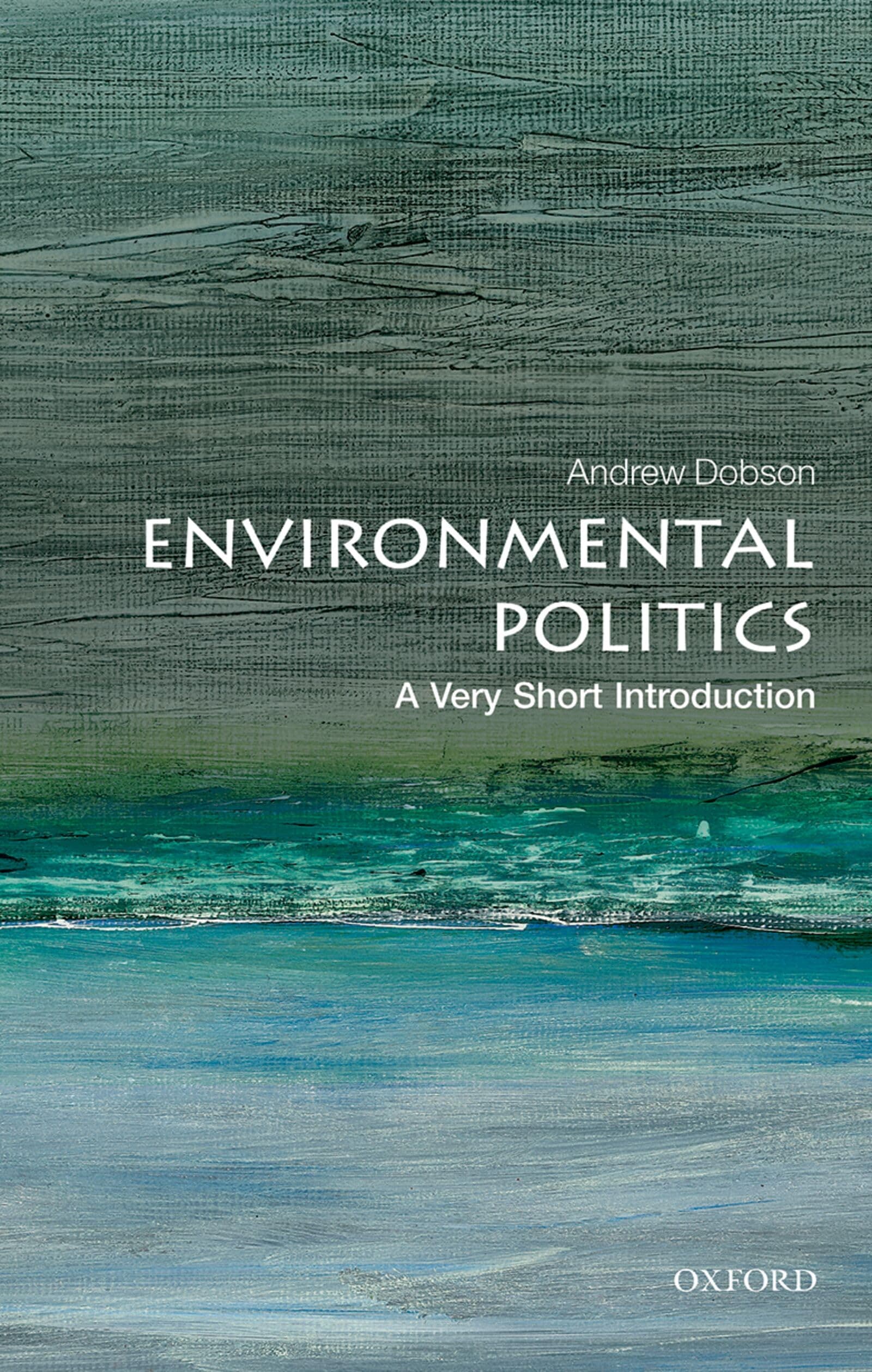
Buy Environmental Politics: A Very Short Introduction Illustrated by Dobson, Andrew (ISBN: 9780199665570) from desertcart's Book Store. Everyday low prices and free delivery on eligible orders. Review: Good value for money - Bought for a level student as part of coursework. desertcart enabled getting the book quickly and reliably Review: A great concise introduction that was recommended reading by a lecturer ... - A great concise introduction that was recommended reading by a lecturer in support of my masters in Renewable Energy Systems. Also good for general reading / knowledge if you are interested.


| Best Sellers Rank | 443,359 in Books ( See Top 100 in Books ) 238 in Natural Resources Management 1,936 in Environment (Books) 1,986 in Environmental Conservation |
| Customer reviews | 4.7 4.7 out of 5 stars (64) |
| Dimensions | 1.27 x 10.67 x 17.02 cm |
| Edition | Illustrated |
| ISBN-10 | 0199665575 |
| ISBN-13 | 978-0199665570 |
| Item weight | 1.05 kg |
| Language | English |
| Print length | 160 pages |
| Publication date | 28 Jan. 2016 |
| Publisher | OUP Oxford |
A**R
Good value for money
Bought for a level student as part of coursework. Amazon enabled getting the book quickly and reliably
A**R
A great concise introduction that was recommended reading by a lecturer ...
A great concise introduction that was recommended reading by a lecturer in support of my masters in Renewable Energy Systems. Also good for general reading / knowledge if you are interested.
Y**R
GOOD BUT DOUBTFUL PERSPECTIVE
My interests in reading this book focuse on the risks posed to humanity by anthropogenic climate changes, as one item in a set of global catastrophic dangers. I think this is the most important perspective because the future of the human species as a whole is at stake. If so, a book on environmental politics should focus on global politics rather than local activities; and on assuring the existence of humanity, rather than equity and the UN Millennium Goals, however important. Furthermore, ways to cope with climate change and other environmental damages should be considered within what I call “humanity-craft” as a whole, all the more so as climate change is not the most dangerous of all the risks facing humanity. In short, environmental politics and its discussion should focus on “thinking globally and acting globally,” and not “thinking globally, acting locally” as emphasized in the book. The fate of the 100,000 inhabitants of the Maldive islands (p.102), however deserving help, is not a main consideration for global policies when millions are killed, maimed and exiled in Syria and other conflicts without any regard for the duty to prevent and protect as stipulated by the United Nations. As sense of proportion is essential for coping with the fateful challenges facing our species – and this I miss in the book. Thus, global environmental politics depends largely on the peak greenhouse gas producers great powers, especially the USA and China; and also on countries endangering the largest forests, namely Indonesia and Brazil. But the book pays much more attention to green politics in Europa with special attention to the UK, which are minor actors in global anthropogenic climate change, while China is ignored and the USA treated very inadequately. Still, parts of the book are relevant for global perspectives. Thus, important is the comparison between the relative success of the 1987 Montreal Protocol on Substances that Deplete the Ozone Layer and the failure (in my assessment full, not “relative,” failure) of the (very inadequate) Kyoto Protocol and its follow-ups (pp.87ff.). But much more attention should be paid to the critical significance of President George Bush (senior) renouncing the Kyoto Protocol as “a threat to the American way of life” (p.97). An author is entitled to choose his point of view, but it has to be justified. Regretfully, this book does not do so. No reasons are provided for paying more attention to local actors than to shapers of global policies. Also, it takes for granted putting equity and helping the poor into one package with protecting the environment, which is partly justified locally but not on the level of future-shaping global “great politics.” Still, the descriptions and discussions in this well-written book permit at least one conclusion salient to the human species perspective which, I think, should have received priority: There is little hope that political processes similar to those associated with environmental issues can cope with the much more acute, and more complex by order of magnitude, dangers posed to humankind by likely misuses or unanticipated consequences of bio- and nano-technologies, general artificial intelligence equipped “machines,” deep enhancement and more. Ergo, a new kind of politics and a novel genre of political leaders are essential for saving humanity from itself. Professor Yehezkel Dror The Hebrew University of Jerusalem
V**A
Good, quick easy read introduction.
Basic taster of subject. Easy read.
A**R
but quite tedious towards the end
A decent overview, but quite tedious towards the end. Not as good as some of the other Very Short Introduction books
A**A
Environmental politics is the sum of organised actions relating to our environment, as individuals, organisations, and as a society. As such, it is a relatively new politics, and is essentially international in demands and ambitions. Environmental politics is based on environmental ethics, concerned with the different reasons to look after the environment and care for the human impact on it. This book on environmental politics is not a list of environmental political agendas and actions. It is much more, as it summarises concepts, origins, ideas, scientific evidences, and environmental movements shaping environmental politics. The strength of the book is to synthesise these different strands into a great overview on the topic. It shows how different the political approaches to the environment may be, which considerations drive and change political decisions, and discusses some case studies of environmental policy and its difficulties – e. g. the “ozone diplomacy” as a relative success study, and the “climate change diplomacy” as a relative failure. This is a superb introduction to the topic and guides the reader through the main themes and concepts, always engaging, and always interested in analysis as much as basic facts. Highly recommended.
♫**♫
Good overview of environmental politics -- the issues, strategies, histories, questions. In general these Oxford University Press "very short introductions" are quite decent.
W**R
I think this book is for those who want to understand reasons behind the evolution of environmental politics. It also covers brief history of environmental laws, conventions both global and to some extent at local level. Regards
L**N
excellent introduction, well summarized
T**I
Informative guide to a topic of growing importance.
TrustPilot
2 周前
3天前