We remain fully operational. Our teams are working around the clock to ensure your deliveries continue safely.

下载应用程序


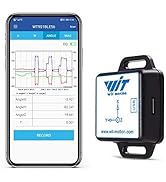
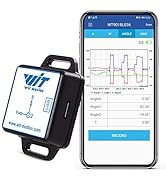
![[Bluetooth 5.0 Accelerometer+Inclinometer] WT9011DCL MPU9250 High-Precision 9-axis Gyroscope+Angle(XY 0.2° Accuracy)+Magnetometer with Kalman Filter, Low-Power 3-axis AHRS IMU Sensor for Arduino](https://m.media-amazon.com/images/I/51P2Z1ByfHL.jpg)
🚀 Elevate your motion sensing game with precision and wireless freedom!
The WT9011DCL is a compact, high-precision 9-axis IMU sensor featuring Bluetooth 5.0 for wireless data transmission up to 50 meters. It delivers accurate acceleration, gyroscope, angle (0.2° XY accuracy), and magnetic field measurements with advanced Kalman filtering for stable output. Designed for low power consumption, it offers around 10 hours of battery life and supports multi-device connections. Compatible with Android, iOS, and Windows, it includes a Type-C interface and comes with comprehensive SDKs and dedicated customer support, making it ideal for professional-grade Arduino and industrial applications.




| ASIN | B0BQ9QTS4D |
| Batteries | 1 Lithium Ion batteries required. (included) |
| Best Sellers Rank | #62,825 in Industrial & Scientific ( See Top 100 in Industrial & Scientific ) #18 in Acceleration Sensors |
| Brand | WITMOTION |
| Date First Available | March 25, 2019 |
| Item Weight | 1.06 ounces |
| Item dimensions L x W x H | 1.26 x 0.92 x 0.45 inches |
| Item model number | WT9011DCL |
| Manufacturer | WitMotion Shenzhen Co.,Ltd |
| Material | Acrylonitrile Butadiene Styrene |
| Maximum Supply Voltage | 5 Volts |
| Measurement Accuracy | High |
| Measuring Range | Acceleration: ± 16g, Gyroscope: ± 2000 ° / s, Magnet Field: ± 4900 uT |
| Mounting Type | Flange Mount |
| Output Type | Digital |
| Product Dimensions | 1.26 x 0.92 x 0.45 inches |
| Sensing Distance | 50 Meters |
| Style | Type-C |
| UPC | 604787286772 |
| Upper Temperature Rating | 85 Degrees Celsius |
M**Y
Sensor is great and wireless works great. Company support is A++
The sensor works great, USB-C to charge, lasts all day it seems. Connects via bluetooth and its simple. The software that comes with it (via google drive) is good. The company support is great. I had different needs on the scales in the graphing software and they updated the software and sent me a personal link with the update I needed. You can't beat that. The output can be several container types and I can import that sensor data to most other software no problem via CSV or txt, etc, and even Open Office reads it fine in SpreadSheets for custom graphing as needed (images included). Their custom software has great features (see my first image of all the real time data streaming in and graphing). I use this to measure acceleration changes to understand relationships of vibration and coupling as a form of tactile response with audio and transducers.
J**E
Does more than show acceleration in XYZ axis. Does rotation around 3-axis.
Took off 1-star because App needs further work when it comes to display's chosen language. Too much is still in Mandarin, even when English is selected as language. As accelerometer it works in all 3-axis XYZ and rotation around those 3-axis. Not sure about what one menu selection is trying to show when it comes to moving differentiation.
S**N
I wish I could speak to a lawyer about how bad this is.
Ships with pathetically bad software, it's actually so bad in comparison to the hardware, I actually refuse to believe the people that made the machine made the software,unless they were enginners, in which case that explains everything they did wrong. Very very expensive piece of junk as it is, but only because to actually use this thing in any remotely useful way, you also need to know how to develop software from the ground up, starting with sending handshakes as the bit level. Very sensitive hardware, lovely hardware. The software is so bad I wish I could sue for psychological damages, and no I am not joking, it's worse than windows 95 era software, and looks like it too. zero data for accuracy, zero data for battery life, zero data for sensor quality. Software quality: I'd rather put my nuts in a blender than touch this STD again.
J**T
Very hard to get working, then pretty cool. Excellent customer service.
The package is supposed to include a QR code that leads you right to the correct software. Mine did not. Nor could I find an app by searching the Google Play store despite what their website says. And there's no download section on their website. Very frustrating. Eventually I found a YouTube video which told me to click on a certain symbol on their website which led me to a list of apps that were in zip format. Apparently with motion has many versions of this accelerometer and none of the apps had my exact product number so I chose the closest one. I had to use two programs to unzip it and get it to run. The label on the device has a different product number than what shows up on the Bluetooth list. Needless to say if I wasn't a power user and very interested in getting this thing to run I would have given up by now. But after about an hour I got the thing loaded onto my Android 13 phone and it looks pretty good, however there's no way to set and fix the range setting on their chart even though there's a button to do that it's not functional. Without this feature it will be hard to compare acceleration plots from the various devices I wish to try. Update April 2024: I tried again to contact this company because I was unable to use the recorder or even set permissions for file access. To my surprise they responded immediately (and how rare is that these days) and fixed the problem. For that I had to bump them up to five stars.
A**R
Very cool, easy to use, SW installed and works fine.
Great product, SW installed easy and works as advertised. Very happy with my purchase, great price for what it does.
Z**M
Lots of latency if you can get it to connect
Don’t know if my unit is just hinky but this is the worst WIT IMU I’ve used yet. It will eventually connect but then it appears to update between 1 and 20 times per second
D**C
Great Little Sensor
Great little sensor.
G**N
Handy, fairly easy to connect, but some suspicious timestamps
I am an inveterate tinkerer, and I love playing with sensors and coming up with new uses for them. Frankly, I didn't have a particular project in mind when I ordered this, but it seemed full of possibilities - a small, rechargeable 9 axis accelerometer that I can connect to with bluetooth. This is a very nice device in a lot of ways; its very small and light, with built-in calibration routines. As a mathematician, I really appreciate that it outputs quaternions (no gimbal-lock!). I haven't yet tried to connect code directly to the device; the documentation for that does describe some sort of protocol, but it looks like a serial protocol, with little information on how to actually pair with the sensor. Instead, I've mostly been evaluating it by using the iOS app and the raw serial output. This probably isn't as well developed as the Android or Windows Desktop apps, but I don't have easy access to those. The iOS app (WITMOTION) allows you to monitor, configure, calibrate, and record data from the device. The sensor is quite sensitive; it can (just barely) pick up a signal when I lay it down, and tap nearby on the table. Most useful is the recording ability, which creates a CSV file with all the relevant fields that you can then download. It's here that I found the first real problem. I'm not sure if it's an artifact of the iOS app, or if it's an issue with the sensor itself, but the timestamps for the reading seem rather suspicious. First of all, several rows had duplicate timestamps. The sensor values were different, meaning it wasn't duplicate data. Next, the jitter between the timestamps was quite large; I believe I had it set to return at 50 Hz, but the time between readings varied from 0.0002 to 0.29 seconds. If the timestamps are being recorded from my phone, I suppose that kind of makes sense, given the vagaries of wireless communication. However, the sensor protocol does include time fields, so I think the timestamps are being generated from the sensor itself. This large jitter could be problematic if your application includes any kind of vibration measurement or motion tracking; it's unclear what kind of filtering you would need to do to get accurate results. Of course, if you don't need deterministic timestamps and just want to track orientation then that's not a major factor. I also would like to know if this issue is specific to the iOS platform or not. If you want to connect serially via USB, the sensor will automatically spit out a simple packets containing the 9 axes that's pretty easy to parse. This doesn't include the timestamps or quaternions, but those are available with a pretty simple protocol (though I haven't actually implemented that yet). I'd like to see if the timing jitter occurs here too; I'll update this review if I find more data. Anyway, I'm still exploring this device; I do wish there was more information on how to connect to it via bluetooth (which GATT services/characteristics to use, or example code), and I'm less than thrilled about the timing issues. Still, it is a neat little sensor that despite its flaws has lots of applications.
A**.
Got it for a hobby project. The hardware device works well. Setting up the phone app was easy. Documentation is pretty lacking and the PC software was a little hard to set up, but i eventually got it. I was able to write a simple python program to connect via bluetooth and extract the data feed in real time.
M**G
Good sensor for acceleration but up to now, I haven't found a way to augment the resolution for the vibration I need to monitor.
I**R
Very cool device in a super compact package. Interfaces with smartphone effortlessly and provides reliable, quick data. Ideal for drones. I used it in a model rocket
D**Y
amazing. great value so fun
A**T
It only has TWO accelerometer axes. Too bad. And it did not connect well.
TrustPilot
4天前
5天前