We remain fully operational. Our teams are working around the clock to ensure your deliveries continue safely.

下载应用程序


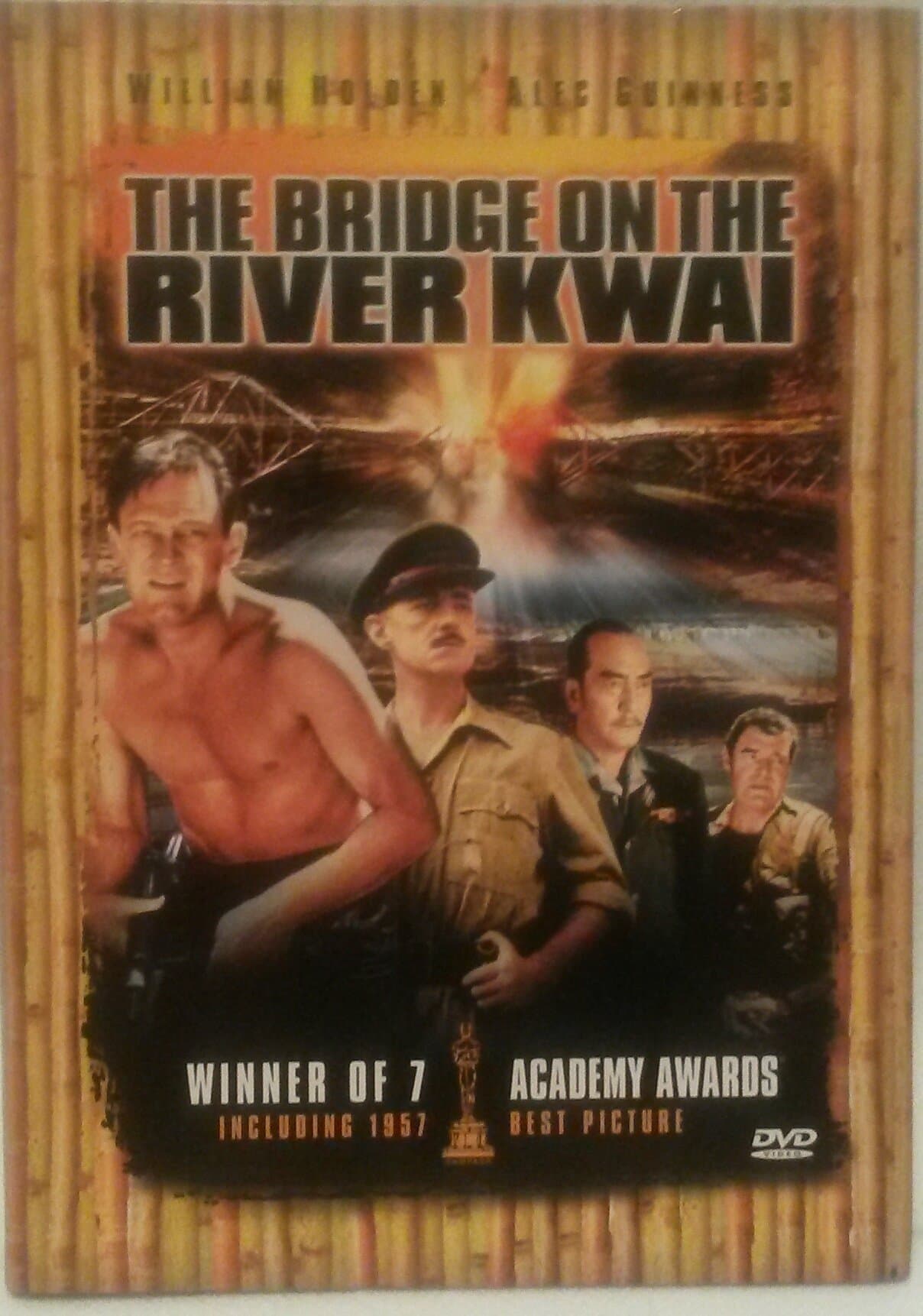
Spectacularly produced, and the winner of seven Academy Awards® (1957), including Best Picture, Best Director and Best Actor (Alec Guinness), THE BRIDGE ON THE RIVER KWAI continues to be one of the most memorable cinematic experiences of all time. Experience director David Lean?s legendary classic like never before with this 60th anniversary edition. Review: A Film You Will Never Forget; Masterful From The First Minute Until The Last - Richly deserving its 1957 "Best Picture" Academy Award, "The Bridge On The River Kwai" is truly one of the best motion pictures I have ever seen (and I had never seen it even once until just a few days before writing this review). Directed expertly by David Lean and produced by Sam Spiegel, "The Bridge On The River Kwai" never falters. From the very first well-composed "CinemaScope" frame, right through to its exciting climax, everything about this motion picture is spot-on perfect. The film tells the World War 2 story of a group of British P.O.W.s who are handed the assignment of constructing a railway bridge across the Kwai river, deep within an Asian jungle in the hot and steamy summer of 1943. Each actor in this movie shines brightly in his respective part -- beginning with Alec Guinness' absolutely wonderful award-winning portrayal of "Colonel Nicholson", who undergoes more than his fair share of torture and abuse at the hands of the Japanese "Colonel Saito" (played by Sessue Hayakawa). Guinness' Nicholson is a man guided by an immovable set of rigged principles. And he ends up winning his battle of nerves (and torture) against his Japanese enemy. A truly remarkable performance by Mr. Guinness. It's no wonder he was nominated for the "Best Actor" Oscar for his role in this film. And, rightfully so, he won the award as well. The great William Holden (age 38 here) earned a healthy 1-million-dollar salary for his part as "Shears" in the movie (plus he got a portion of the film's box-office receipts too). And he earned every cent, as far as I'm concerned. While his part is not quite as deeply-layered or extensive as Alec Guinness' in the picture, Holden's character is still a vital and integral part of the film, as he plays a soldier who sets out on a mission to destroy the River Kwai bridge. Jack Hawkins rounds out the main cast, as "Major Warden", the hard-nosed leader of the Allied Commando team assigned to blow up the just-finished Kwai railway bridge. An interesting thing hit me a day after I finished watching this movie for the first time -- I found myself re-living portions of the film over again in my head, and (of course) found myself whistling the unforgettably-sensational "River Kwai March" theme tune (aka "Colonel Bogey March"), which is something that's likely to stay with you for quite a long time. (The DVD Menus make sure you won't forget the melody either.) Plus, the day after I saw it, I also found myself already beginning to appreciate the "timelessness" and award-winning flavor and grandeur of this epic-scale motion picture. And I even felt a strong desire to watch the whole 162-minute film all over again the very next day. When a movie can have that much impact on a viewer, what better compliment can there be to emphasize its greatness? Columbia TriStar Home Entertainment released the 2-Disc edition of "The Bridge On The River Kwai" on November 21, 2000, and it's a great-looking DVD in all respects, in my opinion. Sporting a beautiful and colorful Anamorphic Widescreen print of the film, Disc One of this two-disc set contains the full-length film in its original CinemaScope aspect ratio of approximately 2.55:1. The lush quality of the photography shines through brilliantly here via this nice, crisp-looking Widescreen version. I'd hate to think of having to watch this movie in a hacked-to-pieces Pan-&-Scan Full-Screen version. Luckily, such torture is not required here, because the original Widescreen format is available on this DVD. There are multiple Dolby Digital soundtracks to choose from for the movie -- a 5.1 Surround track plus a 2.0 Surround option as well. Both of these tracks sound very good to me. Lots of subtitling options are available as well, plus an "Isolated Music Score" soundtrack too. Several fulfilling bonus features take up residence on Disc #2, including a nicely-done 53-minute Making-Of documentary, as well as an original 1950s-era vintage behind-the-cameras featurette ("The Rise And Fall Of A Jungle Giant"), which has a satisfying old-time "nostalgic" feel to it. While I very much enjoyed the "Jungle Giant" mini-featurette (which lasts for a little more than 6 minutes) for its unique behind-the-scenes type of footage -- I couldn't help but scratch my head in bewilderment when the final portion of the program seemingly is cut off abruptly without explanation. The narration and video build the viewer's suspense, taking us right up to the brink of the dramatic one-take-only scene of the bridge being blown to bits, then there's a splice in the film just prior to seeing any behind-the-scenes stuff of the actual detonation, with the film then trailing off into its closing few seconds (an "epilogue" of sorts). Very odd I thought. Makes me wonder if that bridge-blowing sequence was somehow lost and not able to be recovered for some reason. Additional DVD Extras --- A "USC Short Film" (with an introduction by William Holden), which runs for just under 16 minutes. This is a kind of a "lesson" in filmmaking techniques, with "The Bridge On The River Kwai" used as an example of what goes into feature filmmaking. Lots of behind-the-scenes footage on the sets of "Kwai" is included here. Another featurette on Disc 2 is "An Appreciation By Filmmaker John Milius". This is an 8-minute "appreciation" of "The Bridge On The River Kwai" by Mr. Milius, as he provides his personal thoughts on the film and its impact on him. Needless to say, he loves the movie. And his comments here are quite interesting too. There are also four Theatrical Trailers included as DVD bonus material (including one for "River Kwai"). Plus -- A 7-minute "Photo Montage" (on a musically-scored timed track, with "Pause" capability enabled). The "montage" was a slight disappointment to this writer, simply because it only includes photos of poster art and advertising materials for the film. No "publicity stills" are included at all. Which is kind of odd because a few such items are seen within the Making-Of documentary. Still, the filmed montage is done very nicely, with appropriate underscoring to add atmosphere. Rounding out this healthy batch of DVD supplements is a "Talent Files" section, featuring brief text-only bios on five members of the "Kwai" cast and crew. Also included as part of the 2-Disc "Limited Edition" DVD package is a collectible 12-page booklet, which is a replica (reprint) of the original 1957 souvenir book. The last page of the booklet is a DVD Scene Selection guide for the film's 40 chapters. ----------------- "The Bridge On The River Kwai" took more than a full year to film and edit, finally making its debut in movie theaters on December 18, 1957. But that year spent in the Asian jungle was definitely worth it. Because what resulted from that strenuous year of sweat and gritty filmmaking was a true cinematic masterwork. So, take this DVD for a spin soon .... and then watch yourself replaying much of the movie in your head the next day. For this is a DVD to treasure; and a movie to remember. For all time. Review: A powerful statement on the madness of war - Why I waste my time watching all of the newest films that come out (of course, not all of them are bad) when there are plenty of tried-and-true classics waiting to be discovered is something I'll never completely understand. It's not even like I have the excuse that I don't know about them, or even don't have the time (because I do). Still, I do like the feeling of seeing something for the first time and THE BRIDGE ON THE RIVER KWAI delivered everything I expected and more. The story is set during WWII and is about a group of British POWs who arrive at a Japanese labor camp in the Burmese jungle (modern-day Myanmar). They are tasked with building a bridge over the Kwai River, but initially have difficulty because the camp's commander Colonel Saito (Sessue Hayakawa) has a clash of wills with their own commander, Colonel Nicholson (Alec Guiness). There is also an American POW, Shears (William Holden) who manages to escape but is "recruited" to lead a team back to the jungle to blow up the bridge. If there's one thing that David Lean knows how to do, it's craft an epic film and that's exactly what he did here. It did drag a little bit for me in the first hour, but it was an engrossing watch after that point. It almost goes without saying that this film is perfect from a technical standpoint, and some truly great images were captured. The acting was also just as good, especially from the three key players: Alec Guiness, Sessue Hayakawa, and William Holden. Each of them brought their A-game and turned in probably the best performances of their entire careers. One aspect of the story I really liked was the psychological battle of wills that occurs between Saito and Nicholson. Both of them were equal in rank, but also similar in their approach to their own specific situations. One might say that they were cut from the same cloth. William Holden rounds out this trio of characters by portraying a man who is drafted for a difficult task in spite of his desire to just keep on surviving, and in a cruel turn of irony, puts him at cross-purposes with Nicholson who feels like he is doing good work by building the bridge. Although the film plays it rather close to the vest in terms of message-making, only really making its statement in the final minutes, I thought that it handled the subject of war in a rather balanced and mature way despite taking a stand against it. Nobody is turned into a villain, instead having each major character be an unwitting foil to the other in a way that suggests what is later explicitly stated (by the medic) as madness. It's not perhaps the most original of anti-war statements, but it was portrayed to extremely good effect. Also, the last 20 minutes or so is as riveting and tense as anything that has come out since. Granted, it's not perfect as there is a rather superfluous romance between Shears and his nurse but, studio-mandated love interest aside, this film stands as not only one of the best anti-war films ever made, but one of the best films period.

| Customer Reviews | 4.8 out of 5 stars 6,827 Reviews |
D**N
A Film You Will Never Forget; Masterful From The First Minute Until The Last
Richly deserving its 1957 "Best Picture" Academy Award, "The Bridge On The River Kwai" is truly one of the best motion pictures I have ever seen (and I had never seen it even once until just a few days before writing this review). Directed expertly by David Lean and produced by Sam Spiegel, "The Bridge On The River Kwai" never falters. From the very first well-composed "CinemaScope" frame, right through to its exciting climax, everything about this motion picture is spot-on perfect. The film tells the World War 2 story of a group of British P.O.W.s who are handed the assignment of constructing a railway bridge across the Kwai river, deep within an Asian jungle in the hot and steamy summer of 1943. Each actor in this movie shines brightly in his respective part -- beginning with Alec Guinness' absolutely wonderful award-winning portrayal of "Colonel Nicholson", who undergoes more than his fair share of torture and abuse at the hands of the Japanese "Colonel Saito" (played by Sessue Hayakawa). Guinness' Nicholson is a man guided by an immovable set of rigged principles. And he ends up winning his battle of nerves (and torture) against his Japanese enemy. A truly remarkable performance by Mr. Guinness. It's no wonder he was nominated for the "Best Actor" Oscar for his role in this film. And, rightfully so, he won the award as well. The great William Holden (age 38 here) earned a healthy 1-million-dollar salary for his part as "Shears" in the movie (plus he got a portion of the film's box-office receipts too). And he earned every cent, as far as I'm concerned. While his part is not quite as deeply-layered or extensive as Alec Guinness' in the picture, Holden's character is still a vital and integral part of the film, as he plays a soldier who sets out on a mission to destroy the River Kwai bridge. Jack Hawkins rounds out the main cast, as "Major Warden", the hard-nosed leader of the Allied Commando team assigned to blow up the just-finished Kwai railway bridge. An interesting thing hit me a day after I finished watching this movie for the first time -- I found myself re-living portions of the film over again in my head, and (of course) found myself whistling the unforgettably-sensational "River Kwai March" theme tune (aka "Colonel Bogey March"), which is something that's likely to stay with you for quite a long time. (The DVD Menus make sure you won't forget the melody either.) Plus, the day after I saw it, I also found myself already beginning to appreciate the "timelessness" and award-winning flavor and grandeur of this epic-scale motion picture. And I even felt a strong desire to watch the whole 162-minute film all over again the very next day. When a movie can have that much impact on a viewer, what better compliment can there be to emphasize its greatness? Columbia TriStar Home Entertainment released the 2-Disc edition of "The Bridge On The River Kwai" on November 21, 2000, and it's a great-looking DVD in all respects, in my opinion. Sporting a beautiful and colorful Anamorphic Widescreen print of the film, Disc One of this two-disc set contains the full-length film in its original CinemaScope aspect ratio of approximately 2.55:1. The lush quality of the photography shines through brilliantly here via this nice, crisp-looking Widescreen version. I'd hate to think of having to watch this movie in a hacked-to-pieces Pan-&-Scan Full-Screen version. Luckily, such torture is not required here, because the original Widescreen format is available on this DVD. There are multiple Dolby Digital soundtracks to choose from for the movie -- a 5.1 Surround track plus a 2.0 Surround option as well. Both of these tracks sound very good to me. Lots of subtitling options are available as well, plus an "Isolated Music Score" soundtrack too. Several fulfilling bonus features take up residence on Disc #2, including a nicely-done 53-minute Making-Of documentary, as well as an original 1950s-era vintage behind-the-cameras featurette ("The Rise And Fall Of A Jungle Giant"), which has a satisfying old-time "nostalgic" feel to it. While I very much enjoyed the "Jungle Giant" mini-featurette (which lasts for a little more than 6 minutes) for its unique behind-the-scenes type of footage -- I couldn't help but scratch my head in bewilderment when the final portion of the program seemingly is cut off abruptly without explanation. The narration and video build the viewer's suspense, taking us right up to the brink of the dramatic one-take-only scene of the bridge being blown to bits, then there's a splice in the film just prior to seeing any behind-the-scenes stuff of the actual detonation, with the film then trailing off into its closing few seconds (an "epilogue" of sorts). Very odd I thought. Makes me wonder if that bridge-blowing sequence was somehow lost and not able to be recovered for some reason. Additional DVD Extras --- A "USC Short Film" (with an introduction by William Holden), which runs for just under 16 minutes. This is a kind of a "lesson" in filmmaking techniques, with "The Bridge On The River Kwai" used as an example of what goes into feature filmmaking. Lots of behind-the-scenes footage on the sets of "Kwai" is included here. Another featurette on Disc 2 is "An Appreciation By Filmmaker John Milius". This is an 8-minute "appreciation" of "The Bridge On The River Kwai" by Mr. Milius, as he provides his personal thoughts on the film and its impact on him. Needless to say, he loves the movie. And his comments here are quite interesting too. There are also four Theatrical Trailers included as DVD bonus material (including one for "River Kwai"). Plus -- A 7-minute "Photo Montage" (on a musically-scored timed track, with "Pause" capability enabled). The "montage" was a slight disappointment to this writer, simply because it only includes photos of poster art and advertising materials for the film. No "publicity stills" are included at all. Which is kind of odd because a few such items are seen within the Making-Of documentary. Still, the filmed montage is done very nicely, with appropriate underscoring to add atmosphere. Rounding out this healthy batch of DVD supplements is a "Talent Files" section, featuring brief text-only bios on five members of the "Kwai" cast and crew. Also included as part of the 2-Disc "Limited Edition" DVD package is a collectible 12-page booklet, which is a replica (reprint) of the original 1957 souvenir book. The last page of the booklet is a DVD Scene Selection guide for the film's 40 chapters. ----------------- "The Bridge On The River Kwai" took more than a full year to film and edit, finally making its debut in movie theaters on December 18, 1957. But that year spent in the Asian jungle was definitely worth it. Because what resulted from that strenuous year of sweat and gritty filmmaking was a true cinematic masterwork. So, take this DVD for a spin soon .... and then watch yourself replaying much of the movie in your head the next day. For this is a DVD to treasure; and a movie to remember. For all time.
R**S
A powerful statement on the madness of war
Why I waste my time watching all of the newest films that come out (of course, not all of them are bad) when there are plenty of tried-and-true classics waiting to be discovered is something I'll never completely understand. It's not even like I have the excuse that I don't know about them, or even don't have the time (because I do). Still, I do like the feeling of seeing something for the first time and THE BRIDGE ON THE RIVER KWAI delivered everything I expected and more. The story is set during WWII and is about a group of British POWs who arrive at a Japanese labor camp in the Burmese jungle (modern-day Myanmar). They are tasked with building a bridge over the Kwai River, but initially have difficulty because the camp's commander Colonel Saito (Sessue Hayakawa) has a clash of wills with their own commander, Colonel Nicholson (Alec Guiness). There is also an American POW, Shears (William Holden) who manages to escape but is "recruited" to lead a team back to the jungle to blow up the bridge. If there's one thing that David Lean knows how to do, it's craft an epic film and that's exactly what he did here. It did drag a little bit for me in the first hour, but it was an engrossing watch after that point. It almost goes without saying that this film is perfect from a technical standpoint, and some truly great images were captured. The acting was also just as good, especially from the three key players: Alec Guiness, Sessue Hayakawa, and William Holden. Each of them brought their A-game and turned in probably the best performances of their entire careers. One aspect of the story I really liked was the psychological battle of wills that occurs between Saito and Nicholson. Both of them were equal in rank, but also similar in their approach to their own specific situations. One might say that they were cut from the same cloth. William Holden rounds out this trio of characters by portraying a man who is drafted for a difficult task in spite of his desire to just keep on surviving, and in a cruel turn of irony, puts him at cross-purposes with Nicholson who feels like he is doing good work by building the bridge. Although the film plays it rather close to the vest in terms of message-making, only really making its statement in the final minutes, I thought that it handled the subject of war in a rather balanced and mature way despite taking a stand against it. Nobody is turned into a villain, instead having each major character be an unwitting foil to the other in a way that suggests what is later explicitly stated (by the medic) as madness. It's not perhaps the most original of anti-war statements, but it was portrayed to extremely good effect. Also, the last 20 minutes or so is as riveting and tense as anything that has come out since. Granted, it's not perfect as there is a rather superfluous romance between Shears and his nurse but, studio-mandated love interest aside, this film stands as not only one of the best anti-war films ever made, but one of the best films period.
C**Y
My visit to the Bridge on the River Kwai
I was fortunate to be able to visit the infamous Bridge on the River Kwai on a recent trip to Thailand. The bridge is about a three hour drive from Bangkok not far from the border with Burma. In Kanchanaburi I picked up a tourist brochure called "The Death Railway & the Bridge on the River Kwai". This is from its introduction... "In June of 1942, 61,000 British, Australian, American, New Zealand, Danish and Dutch POWs as well as an estimated 200,000 laborers from India, China, Indonesia, Malaysia,Singapore, Burma and Thailand were put to work by the Japanese Imperial Army to construct a railway line 415km long to link Kanchanaburi to the Japanese Base camp in Thanbyuzayat in Burma, this ensuring a direct line from Singapore through Malaya and Thailand to link up with the railway network in Burma. Apart from supplying their bases in Burma, the Japanese had also planned to use the railway to launch an attack on India. The decision to build the railway was made by the Japanese Cabinet following the decisive defeat of its navy at the battle of Midway in June 1942. At that time a large Japanese army was based in Burma and another in New Guinea and adjacent islands. Both depended for support and supplies on the navy which after Midway no longer enjoyed its former supremacy. The Japanese were aware hat the British had surveyed a proposed railway linking Burma and Thailand in 1910 and that they had abandoned the project in 1912 because of difficult terrain, endemic disease and high monsoonal rainfall. To planners studying the map in Tokyo however, the construction of a 415 kilometer railway seemed an obvious solution to supplying the army in Burma and thus avoid the hazardous seas route around Singapore and through the Straits of Malacca. Accordingly two Japanese railway regiments totaling 12,000 men were assigned to the railway project...The deadline for completion was August of 1943 and in June of 1942 the Japanese began moving prisoners of the war to Burma and Thailand. Construction of the railway began on the 16th of September 1942. First estimates by the Japanese engineers suggested that it would take at least five years to build, but under tremendous pressure, the POWs were forced to complete the bridge in 16 months. On the 25 December 1943 the "the Railway of Death" was completed... The effect was devastating. 16,000 allied prisoners of war lost their lives when this railway was built dying together with 100,000 slave Asian laborers who aren't mentioned all that often...Every kilometer of railway track cost the lives of 38 allies." Historian Andrew Roberts writes, "When considering the horrific cruelties inflicted on European POWs by the Imperial Japanese Army during the Second World War, it is important to see them in the overall context of atrocities such as the Rape of Nanking. Whereas 6.2 per cent of British Commonwealth prisoners of the Japanese died between 1941 and 1945, the figures were 23 per cent for the Dutch, 41.6 for the Americans and a monstrous 77 per cent (230,000 out of 300,000) for Indonesian forced laborers...The literature covering what one historian has called 'The Horror in the East' is voluminous, and the Kachanaburi death camp on the River Kwai, Unit 731's anthrax experiments, Chang Jail in Singapore, Korean 'comfort' women, the Bataan Death March and so on have particularly foul places in the long history of man's inhumanity to man." ( The Storm of War: A New History of the Second World War ). Japanese Commander: "If you work hard you will be well treated, but if you do not work hard you will be punished." The museum had photographs and artifacts from the construction of the bridge... The Bridge over the River Kwai was bombed by allied aircraft during the war. I stopped at the nearby Kanchanburi cemetery to see some of the graves of the victims of the "Railway of Death". When I finally arrived at the bridge after a 3 hour car journey this is what I first saw... Walking over the bridge, I met a musician who was, of course, playing the famous Colonel Bogey's March tune on his violin. I put a couple of US dollars into his violin case. He stopped playing and asked me to come over and check out something on the bridge. I was curious as he had me feel with my hand on the outer side of the steel bridge -- I could detect the unmistakable marks of bullet holes that had been caused by strafing from allied planes during the war. The movie, Bridge on the River Kwai, won the academy award for best picture in 1957 and is widely acclaimed as one of the greatest films of all time. It was directed by David Lean, shot on location in Ceylon and based on a novel by French author Pierre Boulle. Alec Guinness, who had served in the Royal Navy Volunteer Reserve during World War II and piloted a landing craft in the 1943 invasion of Sicily, won the Academy award for best actor, playing the role of the unbending Colonel Nicholson. William Holden and Sessue Hayakawa co-starred. The movie's theme message of collaboration was, perhaps, more appropriately suited to occupied France rather than Southeast Asia -- the real life Lieutenant Colonel Philip Toosey did not collaborate and worked to delay the railway's completion. Contrary to film's dramatic conclusion, the bridge was NOT destroyed by the allies during the war. It was hit by allied bombers (see above) but it was reconstructed and, as you can see, is still standing today. If you liked Bridge on the River Kwai you will also enjoy America Invades America Invades: How We've Invaded or been Militarily Involved with almost Every Country on Earth by Kelly / Laycock and Italy Invades
B**N
The Prisoner's Dilemma
"The Bridge on the River Kwai" is one of my absolute favorite films, one I yearn for just about every winter. Once the nights get long and the world turns cold and boring, I’d rather spend some time with my nose pressed against the windowpane of another one, taking the illusion of warmth and light over cold dark reality. Only this version of reality doesn't entirely make sense—and I’ve come to realize that’s the point. The central premise is a stretch—it’s tough to imagine a diligent and dedicated British officer in a P.O.W. camp (Alec Guinness’s Colonel Nicholson) inspiring his troops to exert their maximum effort to build a bridge for their Japanese captors. And it’s hard to picture a cynical American shirker (William Holden’s Harry Shears), one who’s made every effort to avoid difficulty and hardship, playing the lead role in a daring commando raid. Indeed, most of the movie’s characters seem miscast, not in the movie, but in their lives; you see other commandos failing to kill, or killing the wrong people; you see a Japanese camp commandant admitting that he’s a failed artist who’d be happier painting flowers. The brilliant thing about a movie like this is how it’s world haunts you; you’re compelled to return to it in spite of its falsehood, and even because of it. You might easily catch the surface message (here, the madness of war) on first viewing, but there may be fuller and deeper meanings that elude your grasp until later. Documentaries of the war often feel truly absurd, compelling, sure, but distant and difficult to relate to. But once you filter 1943 through the lens of 1957, and rewatch it throughout the 1990s and 2000s and 2010s, it all starts to make sense: these men are all prisoners. They’re prisoners of circumstance, of the vast historical forces that threw men from England and Japan thousands of miles around the globe and set them against each other to match wits in the fetid Burmese jungle. They're prisoners of their own lives. That’s not to say they’ve lost all free will—but the forces against them are so vast that their only recourse is to play the roles in which they’ve been miscast. They can play the roles poorly or well, but the script’s been written by men far above their pay grade, and they’ve been forced onto the set, with armed guards preventing their exit. So they find justification and satisfaction in the roles: Colonel Nicholson seizes on the bridge project as a chance to bring civilization to the men he imagines to be savages, to work hard in the twilight of his career and find pleasure in a job well done; Harry Shears embarks on the commando raid to destroy that bridge because the alternative’s yet another prison; he persists almost out of spite. To read lines that go against their nature, and try to do well in their role: this is their only freedom. And somehow it all remains compelling and real and tense, even after dozens of viewings. I still thrill to it every time, and revel in the delightfully deliberate ambiguities throughout. I cannot entirely break free, for I’m a captive, too: something in me draws me back again and again to the beauty and spectacle of this particular celluloid window.
M**T
Interesting movie. I recommend
By today's standard, the movie might be a little slow for some people. In some points of the movie, it was too long to make their points of the parts of the plot. In other words, today's audience could understand some parts of the plot more quickly than they were made in the movie. However, it's a very interesting story from WWII time period setting, in Thailand. I don't know if the story in the movie is true, but it makes for a good movie. Good acting and Alec Guiness is fairly young as an actor in the movie. I give the movie 4.5 stars, which isn't option for rating.
T**I
GREAT WAR MOVIE
GREATEST WAR MOVIE OF ALL TIME, AND THE BRIDGE STILL STANDS TODAY.
T**R
real Blu Ray review
I'm still not entirely sure why Amazon lumps the reviews for all versions of a given release in the same category. It makes it especially hard to locate reviews on the blu ray version. Anyway, this is a review of the blu ray version recently released, in a collector's format. It is composed of basically a digibook within a hard external case, which is quite flashy as it has raised illustrations and looks quite nice. Upon removing the digibook (which is quite a bit thicker than others), you will find a blu ray version of the film, a dvd version, and a few other things. First up is the small production book. Actually in comparison with the material you get from other digibooks (which are usually scant on information), these few pages are full of notes and events during filming, almost a quick documentary in itself. It's nice to see a version of this book-within-case that is heavy on words and light on pictures, which are still nice on a few pages. Second are the replica lobby cards, located after the incorporated book. Not much to say about these, a nice addition for collectors but not much else. Finally the movie itself. As far as picture goes, its unbeatable for a film from 1957. Much like the other big releases around this time period, care was indeed taken to release a near perfect picture. Obviously in full 1080p, the lighting and scenery really shine here. I'm no expert on filmography and never really looked into the film types and ratios, but what I can judge is a quality blu ray transfer. The picture is sheer excellence down to the last scene, and is quite reminscent of the older James Bond transfers which were fantastic. All in all, as good picture as you'll see anywhere else in blu ray. The audio is great as well, with a fantastic 5.1 transfer. I have 5.1 sound, and it I can tell you it was transferred with the utmost of care. There is no mono soundtrack included in this version. Extras include a wealth of features, including the previous releases' documentaries and new unreleased features such as Alec and William on the Steve Aleen show. Also included is a narration of the premiere by Holding. The main thing here is the "beyond the bridge" section, in which the full film plays and when applicable scenes come up, the screen size is reduced and graphics will appear on the screen with the movie, along with factoids about the scene. It is a great feature for those who won't mind the screen reducing every now and then. All in all, this is the definitive version of the film. Chock full with features that you'd expect from a collector's release as well as the film itself (ranking among my all time favorite films), you can't go wrong with this. If you own a previous version, strongly consider this. If you've never owned it or seen it, buy it TODAY.
A**B
A Battle of Wills
Sam Spiegel’s film, Bridge on the River Kwai is difficult to categorize. It is a war movie, but not the type that glorifies war. It has action and adventure, but to say it is an action/adventure film would be an overstatement. It is a criticism on the madness of war, on excessive pride, on the class system. Perhaps most intriguing, it is a character study on how several men, each a bit crazy in his own way, react to the circumstances of the war around them. Kwai is set in the jungles of Burma in 1943. Though the opening sequence depicts what appears to be a tropical paradise, we soon learn that the setting is a Japanese Prisoner of War camp, ruled by the ruthless Colonel Saito (Sessue Hayakawa). Saito has been ordered to build a railroad bridge over the river, with the prisoners providing the labor. Death rates are high because of illness, overwork, and, we are told, “Saito.” When British Colonel Nicholson (Alec Guinness) marches into camp at the head of a new group of prisoners, it seems Saito may have met his match. Saito declares that all prisoners, enlisted men and officers alike, will perform manual labor to build the bridge. A battle of wills ensues when Nicholson insists that in accordance with the Geneva Convention, it is not permissible to require officers to do manual labor. Saito initially considers having all the officers gunned down, but instead leaves them standing in the blazing sun all day. He then has Nicholson put in a torture device known as “the oven,” and locks up the remaining officers. Nicholson will not relent, and eventually Saito releases him and agrees that the officers will not do manual labor, but must supervise the work. It seems Nicholson has won this round. The characters of Nicholson and Saito embody their own personal and cultural views of honor. Our first glimpse of Nicholson is as he leads his men into the prison camp, marching properly (for the most part) and, lacking a military band, whistling the Colonel Bogey march. For Nicholson, rules, order, and discipline are what honor consists of. Saito has a very different view. When Nicholson offers him a copy of the Geneva Convention and speaks of the rules, Saito responds, “Do not speak to me of rules. This is war! This is not a game of cricket!” For Saito, honor means doing his part for the greater good of Japan, whatever that takes. His orders are to build the bridge. If the bridge is not completed by the given date, Saito’s honor dictates that he must commit suicide. Even once the British officers begin supervising construction of the bridge, it still moves at a snail’s pace. Nicholson’s men, a company of engineers, can easily see problems such as the chosen location. They know they could build a better bridge. Nicholson convinces Saito to start over, allowing the British engineers to design and supervise the construction of the bridge from start to finish. Again, it seems he has prevailed…but has he? In his pride that his men can show British superiority by constructing a bridge that will last for many years, he is seemingly oblivious to the fact that doing so is aiding the enemy’s war effort. And as it becomes apparent the bridge will not be finished on time, he even gives in on the point of having officers do manual labor. A second story line is that of the plot to blow up the bridge. Shears (William Holden) is an American POW who escapes from the work camp and recovers at a British military hospital. There he is recruited by British commando Major Warden (Jack Hawkins) to help with the plot. Shears, who generally does anything possible to get out of work, initially resists. However, when confronted with the news that Hawkins knows the truth about who he really is, Shears agrees. With two other officers, they set out, but absolutely nothing goes according to plan. Eventually, the story lines come together. The bridge is finished, and the train loaded with Japanese officers and dignitaries is on its way. The commandos arrive and adjust their plan to the changed circumstances. What follows in the climactic scenes…well, let’s just say, it’s worth the wait. Bridge on the River Kwai garnered seven Oscars in 1958, including Best Picture, Best Actor (Guinness), Best Director (David Lean), Best Cinematography (Jack Hildyard), Best Editing (Peter Taylor), Best Score (Malcolm Arnold), and Best Adapted Screenplay. This last one is rather interesting; the film’s actual writers, Michael Wilson (It’s a Wonderful Life, A Place in the Sun) and Carl Foreman (Home of the Brave, High Noon) were not credited at the time because they were on the infamous Hollywood blacklist of suspected communist sympathizers. Instead, Pierre Boulle, the French writer of the novel upon which Kwai was based, received the credit and the Oscar, even though he did not speak English and had no part in the screenwriting. Wilson and Foreman were retrospectively awarded the Oscar in 1984. Sadly, Wilson did not live to see this happen, and Foreman died the next day. Foreman’s and Wilson’s names were added to the film’s credits when it was restored in the 1990s. Guinness is brilliant as Nicholson, the obsessively proper British military officer. Not only does Nicholson’s pride and professionalism come through clearly, so does his madness. Guinness, as Nicholson, does not even flinch when it is suggested that building such a fine bridge could be construed as collaborating with the enemy. His line of reasoning is so clear in his own mind that his explanation almost makes sense. When Nicholson hangs a placard on the completed bridge listing his own name as having overseen its construction, it is clear his pride in British ingenuity has been overcome by his pride in himself. Few actors could portray this kind of calm, cool madness and arrogance so convincingly. Hayakawa (who was nominated for Best Supporting Actor) and Hawkins, as Major Warden, are also quite good. Hayakawa’s Saito is as mad as Nicholson in his own way, and we see his prideful resistance break down when he fears that the bridge will not be completed on time. Warden, like Nicholson, is intent on order and discipline. His madness is of a different brand, and a more conventional one, exactly the kind of suicidal single-mindedness we would expect of a commando. Though crazy in his own way, Warden clearly sees Nicholson’s madness for what it is. Hayakawa and Hawkins pull off their respective roles admirably. William Holden delivers a solid performance as Shears. However, this character is not as well developed as the others, perhaps because it was added for the film and was not in the novel. Shears’ change from slacker to hero seems a bit improbable, and Holden’s performance does not quite overcome this. It seems he was added more for star power and box office appeal. James Donald, as medical officer Major Clipton, should not be overlooked. In fact, it is Clipton who acts as the outside observer, the voice of reason, the conscience of the film. It is Clipton who prevents Saito from shooting the officers, and who suggests to Nicholson that building the bridge is abetting the enemy. It seems Clipton is alone in recognizing the madness all around him. And it is Clipton who cries, “Madness, madness!” as things fall apart. It is a relatively small, but incredibly important role, and Donald does it justice. Though Malcolm Arnold won the Oscar for Best Score, it is not his music that is most memorable. Rather, the Colonel Bogey march by Kenneth J. Alford, written decades earlier, is what is most prominent in Kwai. It is heard whistled by the soldiers at various points in the movie when morale is high. The film score itself is minimal, with other sounds—soldier’s marching feet, a single set of footsteps on the bridge, or the distant sounds of the train—often providing non-musical sonic interest. Bridge on the River Kwai is a long film at 2 hours 41 minutes, but well worth the time. The cinematography is striking, showing the beauty and perils of the jungle as well as the building of the glorious bridge. The bridge story line provides psychological drama, while the plot story line provides action and adventure. The culmination of the colliding stories is exciting and surprising. And the characters are intriguing. Their quirks and their choices lead us to ask important questions about right and wrong, honor, and pride. It is no wonder this film was well received by critics and the public alike.