
下载应用程序



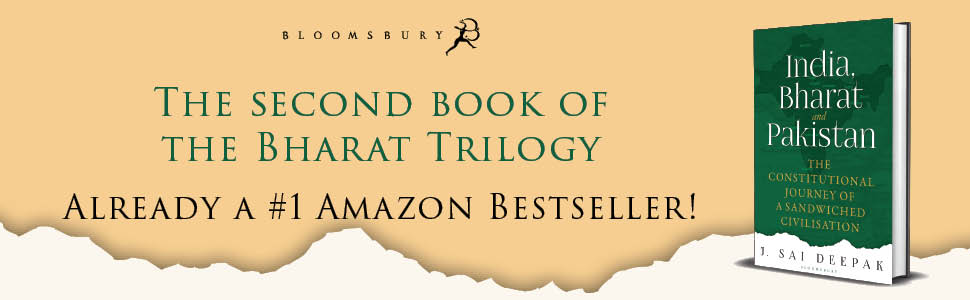
India, Bharat and Pakistan : J Sai Deepak: desertcart.in: Books Review: A Profound Exploration of Identity and Nationhood - "India, Bharat and Pakistan" by J Sai Deepak is a compelling and insightful journey into the historical, cultural, and legal dimensions that shape the complex tapestry of the Indian subcontinent. Sai Deepak's erudition and meticulous analysis make this book an invaluable resource for anyone seeking a nuanced understanding of the diverse identities and narratives that converge in this region. The strength of the book lies in Sai Deepak's ability to navigate through the intricate layers of India's history, unpacking the evolution of its identity as both India and Bharat. The author's legal acumen adds a unique dimension, offering readers a comprehensive perspective on the constitutional and legal aspects that underpin the region's political landscape. Sai Deepak's writing is both eloquent and accessible, making complex subjects comprehensible to a broad audience. His exploration of the historical events that led to the creation of Pakistan, and the subsequent divergent paths taken by India and Pakistan, is both thorough and enlightening. The book invites readers to contemplate the multifaceted dimensions of nationhood and the ongoing dialogues surrounding identity. The author's commitment to presenting a balanced narrative is commendable, fostering an environment for constructive dialogue rather than polemics. The book serves as an essential guide for those navigating the complexities of the Indian subcontinent's history, offering a bridge between academia and the general reader. "India, Bharat and Pakistan" is not just a historical account; it is a call to introspection. Sai Deepak prompts readers to reflect on the narratives that have shaped the collective consciousness of the region and the implications for the future. In conclusion, J Sai Deepak's "India, Bharat and Pakistan" is a five-star gem that deserves a place on the bookshelf of every student of history, law, and anyone curious about the intricacies of the Indian subcontinent. It is a thought-provoking exploration that transcends geographical boundaries, providing readers with a profound understanding of the interconnected threads that weave the narrative of India, Bharat, and Pakistan. Review: An extraordinary book - An accidental listening of a podcast between Shashi Tharoor and J.Sai Deepak on decolonisation ,Moplah riots and historical events with contrasting views made me dig deeper into their writings and I followed picking up the book “India,Bharat and Pakistan”, by the later.Besides the above podcast, the frequent rhetoric with heightened political debates on Indian news channels vis-a-vis India-Pakistan relations,Partition ,Hindu,Muslim unity, Ganga Jamuna tahzeeb, followed by the above authors verbatim elsewhere etc made me curious to choose the above book which happens to be the second book of the author’s comprehensive trilogy and the third of which is yet to come.The book ends with the famous quote of George Santayana which says”Those who do not learn from history are doomed and dare I say cursed and condemned to repeat it”(P-531).Sure enough the quote emphasises the fact that if we do not learn from the mistakes of our past ,we are forced to repeat the same in our future.The source of historical past that are presented in the book are referenced through the vast amount of notes or bibliography mentioned at the end I.e. from(P551 to 616).The interested readers may further enhance their knowledge perspective by going through the same referenced notes in detail.The time period of the book is mainly between (1905 - 1924) though follows with a few prefixed and suffixed overlapping mentions to maintain the sequence of historical events as well as for easier understanding of the readers.The above period was considered to be the most tumultuous period in the Indian history.We learn how India I.e. Bharat accommodated foreigners and as a consequence bruised and bled itself multiple times in the form of riots, genocides, forced religious conversations ,hooliganism’s,vandalism’s, attacking of Temples and many many more deplorable incidents.The two most shocking incidents during the period are the Jallianwala bagh massacre and the Moplah riots.In the Jallianwala carnage gunshots were fired at innocent protesters who were unharmed and silently protesting against the Rowlatt Act in which several hundred people have lost their lives and many more number of people injured. The dead and the injured include women, children and infants. The Moplah riots ,which started as a resistance against the British colonialism turned into religious riots.The riots seems to have been triggered by the Khilafat movement which started by Pan-Islamists in support of Ottoman Caliphate and took turn towards Hindus(at Malabar) as they suspected Hindus allegiance on Khilafat towards British colonisation. The violence unleashed by Mopilas is brutal and unimaginable that may shake the very foundations of humanity.Though a few leaders of Indian National Congress and pro-Islamists termed the Moplah violence against feudal landlords , I however prefer leaving the matter to the discern of the readers.Even Mahatma Gandhi (who was supporting Khilafat movement)and a few Pan-Islamic and INC leaders didn’t condemn the Moplah riots as desired,.To quote Virgil , I say “ No Day shall erase you from the memory of time”, as regards to the above two maniacal acts.India I.e. Bharat accommodated everyone from outsiders, traders, settlers and let them live in peace. It even got adjusted to invaders like Moghal regime and British colonisations for hundreds of years embracing their culture ,language ,living style etc and as a consequence it got wounded and bled severely.Inspite of all the suffering the country didn’t whither away its cultural past ,multiple ethnic beliefs, its faith and religious past etc and is able to maintain its uniqueness . An example to the above may be drawn through the words of Syed Ali Imam-(P-226) who in his speech on 30th December 1908(who later became the prime minister of Nizam)said that the verdict of History is that in holding India under subjection for centuries the Mohammedan held only her body and not her soul.Neither the Moghul Emperor Akbar with his soft approach towards Hindus as regards to religious social or political views nor Aurangzeb with his desperate approach of religious intolerance and forcible conversions could bring about the desired change in Hindus and their religious practices.A few other important aspects of the period(1905-1924) are the formation of Muslim league,Indian National Congress, and the views of moderates and the extremists, the Pan Islamic Movement, opinions of leaders like Bal Gangadhar Tilak,Lala Laj Pat Rai,Maulana Abul Kalam Azad,MK Ghandhi,Motilal and Jawahar Lal Nehru ,Lady Annie Basant etc., the various bigotry reform’s ,the partition of Bengal on the basis of religion (majority Muslim population)and later its annulment after protests, which led a few league leaders flipping into congress to fight for Muslim rights through congress(P-299),,the two nation theory which started well before 1905(P-95) and many many more such events which are all self explanatory for the readers. The overall genre of the book is simple and at most of the places ,the references are drawn from the earlier speeches, talks,reforms ,acts etc which at times found to be repetitive as a reader(Different speakers talking about the same matter).Overall an extraordinary book for everyone, particularly for Indians to read which reflects the present day Indian consciousness that evolved having an influence of its historical past and a constitution framed seemingly involving all but echoes at the cost of Indic Civilisation

| Best Sellers Rank | #2,265 in Books ( See Top 100 in Books ) #6 in Political Structure & Processes #541 in Literature & Fiction (Books) |
| Country of Origin | India |
| Customer Reviews | 4.8 4.8 out of 5 stars (2,045) |
| Dimensions | 25.4 x 4.7 x 20.3 cm |
| Generic Name | Books |
| Hardcover | 632 pages |
| ISBN-10 | 9354353010 |
| ISBN-13 | 978-9354353017 |
| Importer | Atlantic Publishers and Distributors (P) Ltd., 7/22, Ansari Road, Darya Ganj, New Delhi - 110002 INDIA, Email – [email protected], Ph – 011-47320500 |
| Item Weight | 640 g |
| Language | English |
| Net Quantity | 1 Grams |
| Packer | Bloomsbury Publishing India Pvt. Ltd |
| Publisher | Bloomsbury Publishing India Pvt. Ltd; Standard Edition (23 August 2022); Bloomsbury Publishing India Pvt. Ltd |
| Reading age | Customer suggested age: 14 years and up |
S**S
A Profound Exploration of Identity and Nationhood
"India, Bharat and Pakistan" by J Sai Deepak is a compelling and insightful journey into the historical, cultural, and legal dimensions that shape the complex tapestry of the Indian subcontinent. Sai Deepak's erudition and meticulous analysis make this book an invaluable resource for anyone seeking a nuanced understanding of the diverse identities and narratives that converge in this region. The strength of the book lies in Sai Deepak's ability to navigate through the intricate layers of India's history, unpacking the evolution of its identity as both India and Bharat. The author's legal acumen adds a unique dimension, offering readers a comprehensive perspective on the constitutional and legal aspects that underpin the region's political landscape. Sai Deepak's writing is both eloquent and accessible, making complex subjects comprehensible to a broad audience. His exploration of the historical events that led to the creation of Pakistan, and the subsequent divergent paths taken by India and Pakistan, is both thorough and enlightening. The book invites readers to contemplate the multifaceted dimensions of nationhood and the ongoing dialogues surrounding identity. The author's commitment to presenting a balanced narrative is commendable, fostering an environment for constructive dialogue rather than polemics. The book serves as an essential guide for those navigating the complexities of the Indian subcontinent's history, offering a bridge between academia and the general reader. "India, Bharat and Pakistan" is not just a historical account; it is a call to introspection. Sai Deepak prompts readers to reflect on the narratives that have shaped the collective consciousness of the region and the implications for the future. In conclusion, J Sai Deepak's "India, Bharat and Pakistan" is a five-star gem that deserves a place on the bookshelf of every student of history, law, and anyone curious about the intricacies of the Indian subcontinent. It is a thought-provoking exploration that transcends geographical boundaries, providing readers with a profound understanding of the interconnected threads that weave the narrative of India, Bharat, and Pakistan.
S**A
An extraordinary book
An accidental listening of a podcast between Shashi Tharoor and J.Sai Deepak on decolonisation ,Moplah riots and historical events with contrasting views made me dig deeper into their writings and I followed picking up the book “India,Bharat and Pakistan”, by the later.Besides the above podcast, the frequent rhetoric with heightened political debates on Indian news channels vis-a-vis India-Pakistan relations,Partition ,Hindu,Muslim unity, Ganga Jamuna tahzeeb, followed by the above authors verbatim elsewhere etc made me curious to choose the above book which happens to be the second book of the author’s comprehensive trilogy and the third of which is yet to come.The book ends with the famous quote of George Santayana which says”Those who do not learn from history are doomed and dare I say cursed and condemned to repeat it”(P-531).Sure enough the quote emphasises the fact that if we do not learn from the mistakes of our past ,we are forced to repeat the same in our future.The source of historical past that are presented in the book are referenced through the vast amount of notes or bibliography mentioned at the end I.e. from(P551 to 616).The interested readers may further enhance their knowledge perspective by going through the same referenced notes in detail.The time period of the book is mainly between (1905 - 1924) though follows with a few prefixed and suffixed overlapping mentions to maintain the sequence of historical events as well as for easier understanding of the readers.The above period was considered to be the most tumultuous period in the Indian history.We learn how India I.e. Bharat accommodated foreigners and as a consequence bruised and bled itself multiple times in the form of riots, genocides, forced religious conversations ,hooliganism’s,vandalism’s, attacking of Temples and many many more deplorable incidents.The two most shocking incidents during the period are the Jallianwala bagh massacre and the Moplah riots.In the Jallianwala carnage gunshots were fired at innocent protesters who were unharmed and silently protesting against the Rowlatt Act in which several hundred people have lost their lives and many more number of people injured. The dead and the injured include women, children and infants. The Moplah riots ,which started as a resistance against the British colonialism turned into religious riots.The riots seems to have been triggered by the Khilafat movement which started by Pan-Islamists in support of Ottoman Caliphate and took turn towards Hindus(at Malabar) as they suspected Hindus allegiance on Khilafat towards British colonisation. The violence unleashed by Mopilas is brutal and unimaginable that may shake the very foundations of humanity.Though a few leaders of Indian National Congress and pro-Islamists termed the Moplah violence against feudal landlords , I however prefer leaving the matter to the discern of the readers.Even Mahatma Gandhi (who was supporting Khilafat movement)and a few Pan-Islamic and INC leaders didn’t condemn the Moplah riots as desired,.To quote Virgil , I say “ No Day shall erase you from the memory of time”, as regards to the above two maniacal acts.India I.e. Bharat accommodated everyone from outsiders, traders, settlers and let them live in peace. It even got adjusted to invaders like Moghal regime and British colonisations for hundreds of years embracing their culture ,language ,living style etc and as a consequence it got wounded and bled severely.Inspite of all the suffering the country didn’t whither away its cultural past ,multiple ethnic beliefs, its faith and religious past etc and is able to maintain its uniqueness . An example to the above may be drawn through the words of Syed Ali Imam-(P-226) who in his speech on 30th December 1908(who later became the prime minister of Nizam)said that the verdict of History is that in holding India under subjection for centuries the Mohammedan held only her body and not her soul.Neither the Moghul Emperor Akbar with his soft approach towards Hindus as regards to religious social or political views nor Aurangzeb with his desperate approach of religious intolerance and forcible conversions could bring about the desired change in Hindus and their religious practices.A few other important aspects of the period(1905-1924) are the formation of Muslim league,Indian National Congress, and the views of moderates and the extremists, the Pan Islamic Movement, opinions of leaders like Bal Gangadhar Tilak,Lala Laj Pat Rai,Maulana Abul Kalam Azad,MK Ghandhi,Motilal and Jawahar Lal Nehru ,Lady Annie Basant etc., the various bigotry reform’s ,the partition of Bengal on the basis of religion (majority Muslim population)and later its annulment after protests, which led a few league leaders flipping into congress to fight for Muslim rights through congress(P-299),,the two nation theory which started well before 1905(P-95) and many many more such events which are all self explanatory for the readers. The overall genre of the book is simple and at most of the places ,the references are drawn from the earlier speeches, talks,reforms ,acts etc which at times found to be repetitive as a reader(Different speakers talking about the same matter).Overall an extraordinary book for everyone, particularly for Indians to read which reflects the present day Indian consciousness that evolved having an influence of its historical past and a constitution framed seemingly involving all but echoes at the cost of Indic Civilisation
A**K
Must Read
Excellent Read. Changed my perspective and cleared many doubts.
A**R
The foundations of partition of India
Very well researched and of course clinically written.
G**M
Unraveling Historical Tapestries: J. Sai Deepak's Insightful Look.
This book offers a compelling analysis of the historical and cultural evolution of the Indian subcontinent. The book explores the intricate relationships between India, Bharat, and Pakistan, examining how colonial legacies and historical events have shaped their modern identities. Deepak provides a critical perspective on the impact of partition and the ongoing geopolitical and cultural challenges. His insightful narrative combines historical facts with philosophical reflections, making the book a valuable resource for understanding the deep-rooted connections and divisions within the region. It’s a thought-provoking read for anyone interested in South Asian history and contemporary issues.
J**A
Wonderful Book
Definitely a Must Read Book for Every Indian
C**U
Commande arrivée très rapidement. Article conforme à la description du vendeur. Merci.
G**S
Beginning with the wrongly-named European “Enlightenment” and then spreading out across the world through its imposition of coloniality, the world has been increasingly operating through a well-disguised form of false consciousness. Based on the first book in Sai Deepak’s trilogy (India That Is Bharat), Latin-American thinkers apparently played a leading role in identifying this false consciousness. But perhaps, by the time they did so, they no longer had the cultural wherewithal to stop its further spread and entrenchment. Indic thinkers like Sai Deepak, on the other hand—who operate within a still robust non-western civilization—just might succeed at pushing this much-needed “Counter-Enlightenment” all the way through. At least that is the direction he continues to head in with this second book, in which he calls out the false consciousnesses of, not just the British (as in the first book), but also the British-appeasing Indian National Congress and Muslim League. What is this false consciousness? I would sum it up as the assumption that only western-style civilization (and imperialist civilization in general, which includes Islam) is fully legitimate—according to its own, supposedly “universal” standard; and therefore anything that is done to further its dominance—no matter how vicious or destructive this may be for other, supposedly “illegitimate” cultural forms—is ultimately acceptable and even necessary. By whatever means, a modern, western-style, supposedly universalist imperialism must rule the world. The depth of detail Sai Deepak goes into in order to carefully build his case—that the Indian National Congress and the Muslim League have promoted this false consciousness and have shaped India accordingly—can be challenging at times; but the overall effect is that the case he builds feels very solid; and it is actually quite fascinating to watch it unfold, detail by detail. The standard story of India’s Hindu-Muslim divide is not what it appears to be. Sai Deepak digs beneath the surface to reveal the false consciousness that the surface story conceals. The entire world should be watching this grand drama—the exposing of a globe-dominating false consciousness—as it plays out in the sharp minds of the current crop of anti-coloniality thinkers. All of us across the world are profoundly negatively impacted by false consciousness (including its Euro-American originators and perpetrators) and so we all stand to gain greatly if thinkers like Sai Deepak succeed in their bold mission.
R**H
Must read book to learn the truth and correct history.
A**K
India, Bharat and Pakistan is a compelling reminder that to understand the present, one must first look squarely at the past—and that the past, in turn, becomes far clearer after reading J. Sai Deepak’s work. The book deserves careful reading for anyone who wishes to know what was said and done by the key political actors at the turn of the nineteenth and twentieth centuries. It offers an overwhelming and meticulously documented account of the speeches, ideas, negotiations, and actions of those who ultimately led India toward Partition. Written with notable clarity and discipline of thought, the work reflects the author’s training as an advocate of the Supreme Court. Arguments are laid out systematically, sources are foregrounded, and conclusions are drawn from the record rather than assertion. The presentation of facts is precise and deliberate—leaving the reader, as it should in any serious historical inquiry, to be the judge.
ம**ா
An easier read than the first book. A totally different understanding of the two nation theory. To those who believe the freedom struggle from the Attenborough movie Gandhi this may seem a bit too partisan. This narrative took its time and about time too. Wake up call indeed. I'm now looking forward to its sequel. Well done.
TrustPilot
1天前
1 个月前