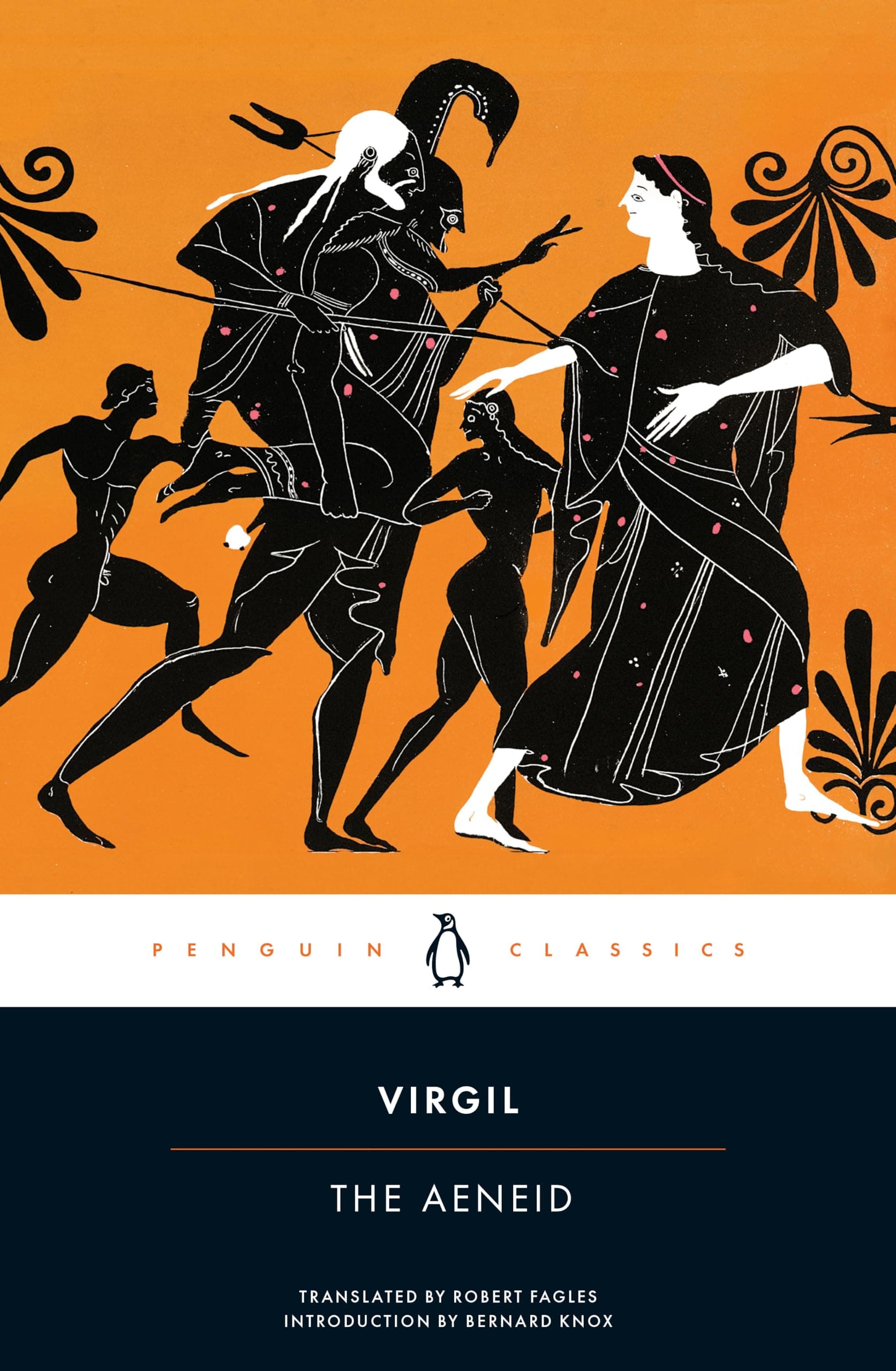
desertcart.com: The Aeneid (Penguin Classics): 9780143106296: Virgil, Fagles, Robert, Knox, Bernard: Books Review: Fagles's Translation of Virgil - This review is not a review of the story of Aeneas, but rather a review of Robert Fagles's translation of the Aeneid. Fagles's work in this translation is readable, accessible, and over-all well executed. The Penguin Classics version of Fagles's translation is a great book to hold in your hand. The book FEELS good. Also, the book has some extras that make it essential. First, Barnard Knox has written an excellent introduction to the text. He explains Virgil's cultural and literary context, and he discusses the Aeneid's relationship to its Homeric predecessors. Highly recommended reading. Second, the book has a helpful map of Aeneas's wanderings which helps orient the reader. Third, in the back of the book is a pronunciation guide and glossary. Some of these names are a bit strange, so it's a good idea to refer to the back sometimes for some help. Every character and place in the book, no matter how minor, is explained in the glossary. In addition to all these benefits, this translation of the text is quite good. Fagles has produced a verse translation, which preserves the poetic nature of the original. If you're looking for a prose version of the Aeneid, then this book might not be for you (but I'd suggest you give the verse a try). The other verse translation that I would recommend is Robert Fitzgerald's ( The Aeneid ). Both translations are very good, and I believe that some passages in Fitzgerald's are better than Fagles's, and vice versa. However, the Fitzgerald translation does not contain the same helpful extras that I mentioned above. Penguin Classics provides superb auxiliary materials in all their volumes. The following are the opening lines of both Fitzgerald and Fagles to provide an example of their stylistic differences. Fagles: Wars and a man I sing--an exile driven on by Fate, // he was the first to flee the coast of Troy, // destined to reach Lavinian shores and Italian soil, // yet many blows he took on land and sea from the gods above-- // thanks to cruel Juno's relentless rage-- Fitzgerald: I sing of warfare and a man at war // From the sea-coast of Troy in early days // He came to Italy by destiny, // To our Lavinian western shore, // A fugitive, this captain, buffeted // Cruelly on land as on the sea // By blows from powers of the air--behind them // Baleful Juno in her sleepless rage. Review: The Aeneid as it was meant to be: for the ear - A work for the ages. In a word: Magnificent. I don't like to read translations because I know that so much is lost from the original language. As a poet and writer, I know how important the play of language is, its rhythms, a word's several meanings. But when it comes to The Classics, I have to set that issue aside and try to find the "best" translation I can find. I also realize that people in antiquity read aloud, even when alone. This was such a common practice, in fact, that Augustine remarked in his Confessions (c. 398) how surprised he was when he found a friend in his room reading to himself, silently. So, when I learned of Robert Fagles translation of Virgil's The Aeneid, I got excited. The NYT wrote of it: "Fagles always aimed to produce translations for reading aloud, and for his translations to be fully savored you have to take them in by the ear." I downloaded Fagles' The Aeneid as an audiobook and started listening. But I soon found myself getting "lost" while listening. Maybe it was me as a modern reader (not a listener), maybe it was the flow of words. The language seemed so rich that it felt like I was hitting a wall of sound and words. The story was there somewhere but I had a hard time following it. So, I bought a paperback copy of the book, too. Then I listened and followed the text as well. What a delightful experience! I could follow along the text and listen, and I have to say, it was incredible. Now that I've finished this Fagles translation, I just might try his Homer. I've already read Pope's translation of both The Illiad and The Odyssey. But now I feel encouraged to try listening to both. I did not understand what was meant by "epic poetry" until I read those two works. Now, with Virgil's The Aeneid, my trifecta is complete. If you've hesitated about The Classics, don't. Jump in here with Fagles' The Aeneid. And to feel the joy of the language that Virgil wanted his audience to experience, give it a listen, too. It just might open a whole new world for you, as the poet meant it to be.
| Best Sellers Rank | #84,719 in Books ( See Top 100 in Books ) #111 in Epic Poetry (Books) #1,220 in Classic Literature & Fiction #2,660 in Literary Fiction (Books) |
| Customer Reviews | 4.6 out of 5 stars 528 Reviews |
G**Y
Fagles's Translation of Virgil
This review is not a review of the story of Aeneas, but rather a review of Robert Fagles's translation of the Aeneid. Fagles's work in this translation is readable, accessible, and over-all well executed. The Penguin Classics version of Fagles's translation is a great book to hold in your hand. The book FEELS good. Also, the book has some extras that make it essential. First, Barnard Knox has written an excellent introduction to the text. He explains Virgil's cultural and literary context, and he discusses the Aeneid's relationship to its Homeric predecessors. Highly recommended reading. Second, the book has a helpful map of Aeneas's wanderings which helps orient the reader. Third, in the back of the book is a pronunciation guide and glossary. Some of these names are a bit strange, so it's a good idea to refer to the back sometimes for some help. Every character and place in the book, no matter how minor, is explained in the glossary. In addition to all these benefits, this translation of the text is quite good. Fagles has produced a verse translation, which preserves the poetic nature of the original. If you're looking for a prose version of the Aeneid, then this book might not be for you (but I'd suggest you give the verse a try). The other verse translation that I would recommend is Robert Fitzgerald's ( The Aeneid ). Both translations are very good, and I believe that some passages in Fitzgerald's are better than Fagles's, and vice versa. However, the Fitzgerald translation does not contain the same helpful extras that I mentioned above. Penguin Classics provides superb auxiliary materials in all their volumes. The following are the opening lines of both Fitzgerald and Fagles to provide an example of their stylistic differences. Fagles: Wars and a man I sing--an exile driven on by Fate, // he was the first to flee the coast of Troy, // destined to reach Lavinian shores and Italian soil, // yet many blows he took on land and sea from the gods above-- // thanks to cruel Juno's relentless rage-- Fitzgerald: I sing of warfare and a man at war // From the sea-coast of Troy in early days // He came to Italy by destiny, // To our Lavinian western shore, // A fugitive, this captain, buffeted // Cruelly on land as on the sea // By blows from powers of the air--behind them // Baleful Juno in her sleepless rage.
R**Y
The Aeneid as it was meant to be: for the ear
A work for the ages. In a word: Magnificent. I don't like to read translations because I know that so much is lost from the original language. As a poet and writer, I know how important the play of language is, its rhythms, a word's several meanings. But when it comes to The Classics, I have to set that issue aside and try to find the "best" translation I can find. I also realize that people in antiquity read aloud, even when alone. This was such a common practice, in fact, that Augustine remarked in his Confessions (c. 398) how surprised he was when he found a friend in his room reading to himself, silently. So, when I learned of Robert Fagles translation of Virgil's The Aeneid, I got excited. The NYT wrote of it: "Fagles always aimed to produce translations for reading aloud, and for his translations to be fully savored you have to take them in by the ear." I downloaded Fagles' The Aeneid as an audiobook and started listening. But I soon found myself getting "lost" while listening. Maybe it was me as a modern reader (not a listener), maybe it was the flow of words. The language seemed so rich that it felt like I was hitting a wall of sound and words. The story was there somewhere but I had a hard time following it. So, I bought a paperback copy of the book, too. Then I listened and followed the text as well. What a delightful experience! I could follow along the text and listen, and I have to say, it was incredible. Now that I've finished this Fagles translation, I just might try his Homer. I've already read Pope's translation of both The Illiad and The Odyssey. But now I feel encouraged to try listening to both. I did not understand what was meant by "epic poetry" until I read those two works. Now, with Virgil's The Aeneid, my trifecta is complete. If you've hesitated about The Classics, don't. Jump in here with Fagles' The Aeneid. And to feel the joy of the language that Virgil wanted his audience to experience, give it a listen, too. It just might open a whole new world for you, as the poet meant it to be.
K**N
The Ersatz Epic
After a generation of civil war, Octavian consolidated power and took the new title, "Augustus, son of a god" (referring to the newly deified Julius Caesar, his posthumously adoptive father). Augustus needed to unify the various Roman peoples and embarked on a program to give the people a common heritage. He commissioned Vergil, the greatest poet of his age, to write a Roman epic rivaling Homer that would also glorify the Julian family, validate their claim to be descended from Venus, and put across the idea that Augustus was destined to rule Rome. So basically The Aeneid is official government propaganda. As anyone who has studied propaganda knows, the language of propaganda is cliché. And The Aeneid abounds with clichés. Of course, Vergil was working at a huge disadvantage and died before The Aeneid was completely finished, but even so, I'm afraid that Vergil is no Homer. He wrote in a different language and lived in a different culture. He also had a different motive for writing. And that is the problem with this translation. Fagles is a great translator of Homer and I like his work on Sophocles, too, but I think he's a bad fit for Vergil. His muscular sensibility feels like a bull in a china shop. But if you're just reading for basic information, Fagles is acceptable. Even though I think most of The Aeneid is a bore, I also think The Aeneid is a major literary touchstone of Western culture. Its influence on English literature is inestimable. Shakespeare may have had "little Latin," but the little Latin he possessed obviously included Vergil. For that reason Vergil is a must-read for serious students of English literature. Three and a half stars rounded up to four.
D**R
My favorite translation
There are scores of translations of the Aeneid, with many being excellent choices - but for me, Fagles' rendering is the most readable, fluid, and clear option available. There are other very good translations that typically sacrifice clarity for the sake of poetry, and while this is understandable given the genre, for the first-time reader there really needs to be more of a balance. For me, that balance came with Fagles' translation. The introduction by Knox, who has provided introductions for all of Fagles translations, is, once again, excellent and adds just that much more value to an already outstanding work. Of course there will be those that parse the text and quibble over this or that choice of words, but this is largely for the much more serious Latinist to debate; for the average reader just looking for an easy version of the epic to enter - this is it. But, Fagles is hardly a slouch when it comes to academic credentials or previous success with translating, so I think it's reasonable to assume we're in good hands. If you REALLY want to understand Virgil, learn Latin (there is, of course, no substitute for that), but if you want a wonderfully fluid, engaging and clear translation, you'd due well to pick up Fagles' work. Other translations that I liked and are very close behind Fagles are that by Mandelbaum and Fitzgerald.
D**R
No formatting issues
This review is for the kindle version of the Penguin Classics Deluxe Edition translated by Fagle. Some reviewers have complained about past formatting issues, but I experienced none reading on the kindle app for iPad. The lines of the poem were all separate, and the line numbers were unobtrusively set to the right. Fagle's translation is lively, readable, and accurate (at least in the passages that I checked). Regarding the poem itself, the Aeneid left something to be desired, and this could be because Vergil never got to finish it. While it has a number of riveting passages, it largely reads like a poor imitation of Homer's epics with Roman propaganda mixed in. The work is immensely influential, so I encourage anyone interested in the poem to read despite my complaints. And this is certainly the English translation that I recommend.
S**N
Classic translation
A wonderfully entertaining classic of the mythical foundation of the Roman empire. Virgil did not simply convey a mythical foundations story but he did so with a particular style and flair reminiscent of, yet uniquely different from, Homer's tales. Indeed, this is a wonderful translation to have beside the equally grand The Iliad (Penguin Classics Deluxe Edition) and The Odyssey . Heroism, intrigue, betrayal, jealous gods, and battle - all the makings of an ancient classic. A translation that retains the poetic style of the original. I never grow tired of the story nor this translation. A must have in either the book form or the Recorded Books version, The Aeneid .
R**P
Great classic
I am extremely happy to have Fagle's translation of the Aeneid. I'll be using it in teaching a class in the Aeneid in a local Senior College, and although there have been other very good translation since Fagle's, his is still among the best, and a good one to use as the standard.
J**R
UPDATE - No Formatting Issues
Many other reviewers have pointed out that this edition of The Aeneid has major formatting issues on the Kindle. I really wanted to read the Robert Fagles translation, as I had enjoyed his versions of The Iliad and The Odyssey. I decided that I could probably deal with some spacing issues if it meant I could read the Fagles translation. I was pleasantly surprised once I purchased the eBook. There are NO formatting issues of any kind on my Kindle Paperwhite. I'm not sure if this was because of an update to the document itself, or just because of the specific Kindle I was using. Fagles, again, does a great job making the epic poetry readable. But The Aeneid ultimately gets four stars because it's a somewhat contrived, convoluted story, especially in comparison to Homer's epics. It's definitely not bad, though. The Aeneid is a sequel to Homer's Iliad and Odyssey, written around 700 years after them. Written by Virgil, a Roman poet, The Aeneid is the missing link in our pop-culture portrayal and understanding of the Trojan War. This is the volume that describes the Trojan Horse episode, the fall of Troy, and the Trojan invasion of Italy. The epic follows Trojan warrior Aeneas as he journeys from Troy and invades Italy. By linking Rome with Troy, Virgil gave the Roman people a sense of entitlement in conquest and revenge against Carthage and Greece. But since Rome and Troy are not linked together in historical reality, Virgil manufactures a bunch of cop-out reasons for why the Italians maintained their own culture even after being conquered by the Trojans. This entire epic reminded me of an unnecessary Hollywood sequel, made purely as a cash-in. That being said, there are many really interesting and entertaining moments in this epic, and I enjoyed it overall.