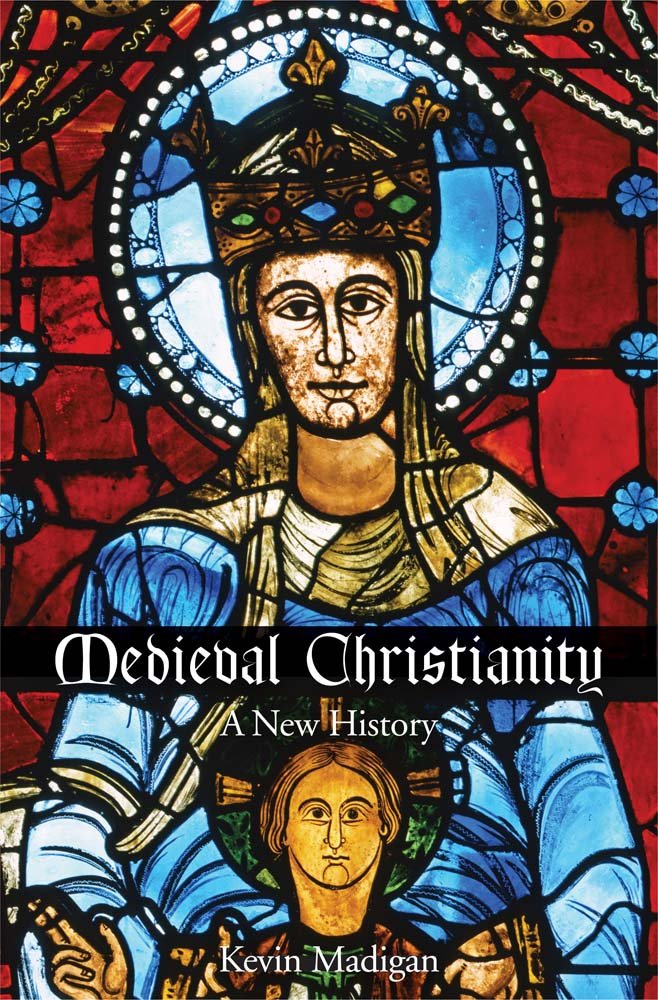
Medieval Christianity: A New History [Madigan, Kevin] on desertcart.com. *FREE* shipping on qualifying offers. Medieval Christianity: A New History Review: A Must Read on the Medieval Church - Medieval Christianity is a very readable and comprehensive book covering Western Europe from about 500 AD until 1400 AD, albeit edging down to 150 and up to 1500 at its extreme. The book is well balanced, well researched and accessible to all readers. The title also states it as “A New History” but just what is “new” and “well known” is not as clear perhaps as the author may have desired. Notwithstanding, what the author has presented is useful for the newly informed as well as the “well informed”. The author starts with a brief discussion of early Christianity from 150 to 600. This has as its center piece Augustine and his writings. One of the most difficult problems with early Christianity is the complexity of Greek thought and the Eastern Church and the slow evolution of a Western Church. Southern has examined this in detail and it is the complexity of Eastern thought which in many ways was a departing point for the west and it was it abandonment by Augustine via his Roman way of thinking that opened the Western Church and what we now think of Medieval Christianity. Augustine introduced many ideas in a manner that reformed Western beliefs. His battle with Pelagius is clearly one and his emphasis on grace another. There is an interesting discussion on p 29-30 on when this stage of early Christianity ended. One way to pinpoint this change perhaps is the time of Gregory I. The reason is that at this time Gregory breached with Byzantium by severing with the ruler in Ravenna and taking both religious and political control in Rome. The author’s discussion on Gregory is very limited in scope and here I would fault the author for an opportunity to use this figure as a major break point for the establishment of the Western Church (see pp 45-62). It can be argued that it was Gregory who de factor created Medieval Christianity. The Bishop of Rome in 600 was still just that, the Bishop of Rome. The Emperor in Constantinople was a de facto head of the Church, calling various Councils to discuss major religious issues. Gregory had been in the court in Constantinople, had been Mayor of Rome, had come from an old line Roman family and desired to be a monk along the lines of Benedict. However he was drawn to the Bishop of Rome slot by the people of Rome who required his leadership. Also Gregory was looking westward, seeing Constantinople as an aging confluence of political intrigue. Thus by looking west his communications with the Merovingian queen Brunhilda is a classic example of Rome becoming pari passu with leaders and influencing them via religion and charm. On the other hand the likes of Brunhilda were brutal to the point of savagery and Gregory seems in his writing to have avoided discussion of these facts. Likewise he dealt with the Lombards as well as sending the Italian Bishop Augustine to England. This latter act however can be viewed as an affront to the Irish who were still adhering to the Eastern Church ways and saw Gregory as an equal in debate. In essence Gregory set up the conflict between Ireland and England. But it was Gregory and his looking westward rather than Eastward that made for the seminal start of the Medieval Church. In this section it would have been useful to explore in some detail the lengthy discussions between Columbanus and Gregory I. There was but a brief mention on p 48 of Columbanus. First the Latin of Columbanus, the Irish monk, was dramatically different from Gregory. Gregory had evolved to almost a koine type Latin while Columbanus seems to have retained almost Ciceronian Latin. The Irish monks had learned Latin almost independently from Rome based upon classic texts and this in a way strongly influenced their style. In addition Columbanus and all the Irish monks had never been under the Roman yoke and thus in dealing with Rome they dealt with them as almost an independent thinker. Chapter 4 introduces Charlemagne. Charlemagne was a follow on to the Merovingians, albeit the descendent of a Merovingian court official. Charlemagne in 800 gets coroneted by the Bishop of Rome, now viewed as both a religious figure and putative political player. Chapter 5 deals with the parochial life. There was a local parish alongside the monastic monasteries. The local priests were typically less well educated that the monks who spent much of their time reading and writing. In contrast the local parish priest was dealing with local matters of lesser import. Chapter 6 deals with the Jews, an issue always made complex, especially in the West. Chapter 7 considers the Crusades and Islam. A great deal has been written on crusades and this presentation is brief. The complexity of the expansion and acceptance of Muslim beliefs was often seen by the Christians as another heretic sect, especially their belief in polygamy. There did not seem to be any attempt to “understand” their thought throughout this period. Starting in Chapter 8 the author moves to what he calls the era of High Medieval Christianity. This is from 1050 through 1300. There is a discussion of the reforms to what had become a Church with many small faults, and this included Rome itself. By this time Rome had clearly become a Papacy in terms of its singular position. Chapter 10 discusses some of the heretical movements during this early period of the High Medieval Church. Chapters 11 and 12 present the Dominicans and the Franciscans respectively. Whereas the Dominicans were always positioned as intellectually elite, Aquinas was a Dominican, the Franciscans presented a possible threat to Rome, and they advocated a return to early Christian belief of poverty. However Rome managed them quite well and the net result was a Franciscan order that was on a par with the Dominicans and in a sense often superior. One needs look no further than Ockham and his Franciscan followers. The author then details many of the elements of religious life and affairs. At this time the Church was becoming a dominant part of the lives of the people. On pp 262-266 the author presents Abelard and Heloise. This is one of the classic tales of this time. This is one of the best descriptions and one in context that I have seen. This alone is worth reading. On pp 277-283 there is a brief discussion on Aquinas. I would have liked to see a more detailed presentation. Aquinas became a figure of the Aristotelian movement and after his death his works were banned by some but they came back in the 19th century and the basis of Church belief and doctrine. Some more detailed discussion of his work would have been useful. I felt his presentation was too brief in passing. As noted, the author discusses Aquinas but fails to discuss Ockham, the Franciscan, albeit a brief note on the next to last page ((p434).Ockham was a nominalist, one who denied universals, and thus in contradistinction to Aquinas. Ockham also reinvigorated the idea of the Individual and as such was a catalyst for many works emanating from his. Also Ockham demonstrated confrontational intellectual opposition to the Avignon Popes resulting in his fleeing eastward and being supported by German Princes. Here is an example of quasi-national opposition to the non-Roman Pope, a conflict that was just starting to brew. Late Medieval Christianity occurs from 1350 to 1500 and the author does a good job in details the key points. Again there are “heretical” movements such as Hus and Wyclif and the Lollards. He discusses the changes and discusses Prague in some detail. Prague was a cauldron of religious dissent, as the statue to Hus demonstrates in the square of present day Prague, a statue I passed daily on my way to my office, ironically across from the house of Kafka! Understanding central Europe more would have been helpful in explaining this effect. The Avignon papacy from 1309-1378 (pp 374-378) blends Middle and High Medieval Christianity and represents a clear distortion of the Bishop of Rome and the attempted, and in many ways total, control by the French throne over the Pope. Here we have most likely the first instance of having a Pope as a separate entity from the Bishop of Rome. For centuries before this, when the Pope qua leader of the Church was mentioned, the position was synonymous with the Bishop of Rome. In fact the true title should be Bishop of Rome, since that is the position of such a leader. It would have been helpful to have an expanded discussion on this topic. This period of fighting Popes has in my opinion left an indelible scar on the Western Church. Overall this is a superb book and worth reading and rereading. The author builds upon Southern and his work as he indicates. However there are many other views of the issue he presents and space being limited his presentation is fair, well balanced, and exceptionally readable. In contrast one might also read, if available, the works of Henri Daniel-Rops (a pseudonym for Henri Tetiot) who albeit an apologist for the Church, has added insight on many of these issues discussed by the author. Review: but excellent and thorough - It is a big tough going for laypeople, but excellent and thorough.
| Best Sellers Rank | #105,747 in Books ( See Top 100 in Books ) #249 in History of Christianity (Books) #317 in Christian Church History (Books) #365 in European History (Books) |
| Customer Reviews | 4.6 4.6 out of 5 stars (131) |
| Dimensions | 9.2 x 6.1 x 1 inches |
| Edition | Illustrated |
| ISBN-10 | 0300216777 |
| ISBN-13 | 978-0300216776 |
| Item Weight | 1.63 pounds |
| Language | English |
| Print length | 512 pages |
| Publication date | November 24, 2015 |
| Publisher | Yale University Press |
D**Y
A Must Read on the Medieval Church
Medieval Christianity is a very readable and comprehensive book covering Western Europe from about 500 AD until 1400 AD, albeit edging down to 150 and up to 1500 at its extreme. The book is well balanced, well researched and accessible to all readers. The title also states it as “A New History” but just what is “new” and “well known” is not as clear perhaps as the author may have desired. Notwithstanding, what the author has presented is useful for the newly informed as well as the “well informed”. The author starts with a brief discussion of early Christianity from 150 to 600. This has as its center piece Augustine and his writings. One of the most difficult problems with early Christianity is the complexity of Greek thought and the Eastern Church and the slow evolution of a Western Church. Southern has examined this in detail and it is the complexity of Eastern thought which in many ways was a departing point for the west and it was it abandonment by Augustine via his Roman way of thinking that opened the Western Church and what we now think of Medieval Christianity. Augustine introduced many ideas in a manner that reformed Western beliefs. His battle with Pelagius is clearly one and his emphasis on grace another. There is an interesting discussion on p 29-30 on when this stage of early Christianity ended. One way to pinpoint this change perhaps is the time of Gregory I. The reason is that at this time Gregory breached with Byzantium by severing with the ruler in Ravenna and taking both religious and political control in Rome. The author’s discussion on Gregory is very limited in scope and here I would fault the author for an opportunity to use this figure as a major break point for the establishment of the Western Church (see pp 45-62). It can be argued that it was Gregory who de factor created Medieval Christianity. The Bishop of Rome in 600 was still just that, the Bishop of Rome. The Emperor in Constantinople was a de facto head of the Church, calling various Councils to discuss major religious issues. Gregory had been in the court in Constantinople, had been Mayor of Rome, had come from an old line Roman family and desired to be a monk along the lines of Benedict. However he was drawn to the Bishop of Rome slot by the people of Rome who required his leadership. Also Gregory was looking westward, seeing Constantinople as an aging confluence of political intrigue. Thus by looking west his communications with the Merovingian queen Brunhilda is a classic example of Rome becoming pari passu with leaders and influencing them via religion and charm. On the other hand the likes of Brunhilda were brutal to the point of savagery and Gregory seems in his writing to have avoided discussion of these facts. Likewise he dealt with the Lombards as well as sending the Italian Bishop Augustine to England. This latter act however can be viewed as an affront to the Irish who were still adhering to the Eastern Church ways and saw Gregory as an equal in debate. In essence Gregory set up the conflict between Ireland and England. But it was Gregory and his looking westward rather than Eastward that made for the seminal start of the Medieval Church. In this section it would have been useful to explore in some detail the lengthy discussions between Columbanus and Gregory I. There was but a brief mention on p 48 of Columbanus. First the Latin of Columbanus, the Irish monk, was dramatically different from Gregory. Gregory had evolved to almost a koine type Latin while Columbanus seems to have retained almost Ciceronian Latin. The Irish monks had learned Latin almost independently from Rome based upon classic texts and this in a way strongly influenced their style. In addition Columbanus and all the Irish monks had never been under the Roman yoke and thus in dealing with Rome they dealt with them as almost an independent thinker. Chapter 4 introduces Charlemagne. Charlemagne was a follow on to the Merovingians, albeit the descendent of a Merovingian court official. Charlemagne in 800 gets coroneted by the Bishop of Rome, now viewed as both a religious figure and putative political player. Chapter 5 deals with the parochial life. There was a local parish alongside the monastic monasteries. The local priests were typically less well educated that the monks who spent much of their time reading and writing. In contrast the local parish priest was dealing with local matters of lesser import. Chapter 6 deals with the Jews, an issue always made complex, especially in the West. Chapter 7 considers the Crusades and Islam. A great deal has been written on crusades and this presentation is brief. The complexity of the expansion and acceptance of Muslim beliefs was often seen by the Christians as another heretic sect, especially their belief in polygamy. There did not seem to be any attempt to “understand” their thought throughout this period. Starting in Chapter 8 the author moves to what he calls the era of High Medieval Christianity. This is from 1050 through 1300. There is a discussion of the reforms to what had become a Church with many small faults, and this included Rome itself. By this time Rome had clearly become a Papacy in terms of its singular position. Chapter 10 discusses some of the heretical movements during this early period of the High Medieval Church. Chapters 11 and 12 present the Dominicans and the Franciscans respectively. Whereas the Dominicans were always positioned as intellectually elite, Aquinas was a Dominican, the Franciscans presented a possible threat to Rome, and they advocated a return to early Christian belief of poverty. However Rome managed them quite well and the net result was a Franciscan order that was on a par with the Dominicans and in a sense often superior. One needs look no further than Ockham and his Franciscan followers. The author then details many of the elements of religious life and affairs. At this time the Church was becoming a dominant part of the lives of the people. On pp 262-266 the author presents Abelard and Heloise. This is one of the classic tales of this time. This is one of the best descriptions and one in context that I have seen. This alone is worth reading. On pp 277-283 there is a brief discussion on Aquinas. I would have liked to see a more detailed presentation. Aquinas became a figure of the Aristotelian movement and after his death his works were banned by some but they came back in the 19th century and the basis of Church belief and doctrine. Some more detailed discussion of his work would have been useful. I felt his presentation was too brief in passing. As noted, the author discusses Aquinas but fails to discuss Ockham, the Franciscan, albeit a brief note on the next to last page ((p434).Ockham was a nominalist, one who denied universals, and thus in contradistinction to Aquinas. Ockham also reinvigorated the idea of the Individual and as such was a catalyst for many works emanating from his. Also Ockham demonstrated confrontational intellectual opposition to the Avignon Popes resulting in his fleeing eastward and being supported by German Princes. Here is an example of quasi-national opposition to the non-Roman Pope, a conflict that was just starting to brew. Late Medieval Christianity occurs from 1350 to 1500 and the author does a good job in details the key points. Again there are “heretical” movements such as Hus and Wyclif and the Lollards. He discusses the changes and discusses Prague in some detail. Prague was a cauldron of religious dissent, as the statue to Hus demonstrates in the square of present day Prague, a statue I passed daily on my way to my office, ironically across from the house of Kafka! Understanding central Europe more would have been helpful in explaining this effect. The Avignon papacy from 1309-1378 (pp 374-378) blends Middle and High Medieval Christianity and represents a clear distortion of the Bishop of Rome and the attempted, and in many ways total, control by the French throne over the Pope. Here we have most likely the first instance of having a Pope as a separate entity from the Bishop of Rome. For centuries before this, when the Pope qua leader of the Church was mentioned, the position was synonymous with the Bishop of Rome. In fact the true title should be Bishop of Rome, since that is the position of such a leader. It would have been helpful to have an expanded discussion on this topic. This period of fighting Popes has in my opinion left an indelible scar on the Western Church. Overall this is a superb book and worth reading and rereading. The author builds upon Southern and his work as he indicates. However there are many other views of the issue he presents and space being limited his presentation is fair, well balanced, and exceptionally readable. In contrast one might also read, if available, the works of Henri Daniel-Rops (a pseudonym for Henri Tetiot) who albeit an apologist for the Church, has added insight on many of these issues discussed by the author.
A**R
but excellent and thorough
It is a big tough going for laypeople, but excellent and thorough.
T**S
Worthy of the Great Historians Before Him
While this work carries in its subtitle the phrase "New History," Kevin Madigan begins with kudos to the revered and knighted British historian R. W. Southern, whose 1970 work "Western Society and the Church in the Middle Ages" was the gold standard of one volume medieval treatments. Madigan indicates that his 2015 work at hand is no way a repudiation of Southern's generation of scholars, but an attempt to integrate four decades of recent research and discovery into the baseline of existing work (6). In his bibliography comments, Madigan describes his work as a "book for beginners" (441) and he provides a rich treasury of primary and secondary sources for further pursuit. Do not be fooled; "Medieval Christianity" is a fascinating synthesis of historical fact and intelligent but not overbearing interpretation. As with all general medieval histories, the author must find a point in time to start: he sets his early boundaries back to about 150 A.D. His discussion of second century Gnosticism, Marcion and Montanism may seem eccentric until the reader discerns how dissonant patterns of religious thought, such as extreme contempt of created matter, flare up repeatedly in medieval controversies among mystics and the fringes of religious orders such as the Franciscans. I get the impression that this was a hard book to write in terms of inclusion. For example, Madigan summarizes the entire era of the ancient Church in about thirty pages, including the roles of Constantine and Augustine in the unfolding of the Christian story, but there is not a whiff of superficiality. We take away enough to understand later medieval self-understanding; the indulgence controversy of the late medieval era makes sense because the author’s treatment of the Augustine-Pelagius controversy of a millennium earlier has prepared us well. Madigan dates the early medieval period as 600-1050, a time marked by considerable demographic shift. This corresponds to what we traditionally think of as "The Dark Ages," a term the author does not apply here (saving it instead for the Avignon papacy and the Western Schism of the 1300’s and 1400’s.) This is a period of evolution, with major institutions of the Church setting roots, such as monasticism, organized learning, and the concept of theocracy as embodied in Leo's coronation of Charlemagne in 800. The treatment of monastic life is intriguing in that Madigan describes the various efforts of women and laity to embrace this life in experiments of joint or community ventures. Eventually Innocent III would forbid women from joining the Praemonstratensian Order in 1198, a fair indication of how widespread and diverse monastic life had become. A major theme that continues throughout the high medieval era (1050-1500) as well is the surprising strength and diversity of what we might call grassroots spirituality. The Franciscans did not invent the nomadic lifestyle of prayer, penance and paucity; they were in fact a product of the times who happened to enjoy the good fortune of a charismatic leader who caught the eye of the age's most powerful pope, Innocent III. A special feature of this work is its attention to the regional forms of mysticism and their proponents, some of whom were highly regarded in their own time (Hildegard of Bingen) and some who went to the executioner’s flames (Marguerite Porete). I should add here that a number of spiritual writers and mystics cited in this work are available in Paulist Press’s “Classics of Western Spirituality” series. Of course, the status and power of the papacy is a major staple of any medieval treatment, and the analysis here is instructive. The limited actual powers of a Pope Leo in 800--who needed the Frankish consortium to hold himself in place--had nowhere to go but up, and four centuries later the Church's most powerful pontiff in every respect, Innocent III, used his time prior to his premature death at 52 to invoke the most impressive of the Medieval councils, IV Lateran, which consolidated spiritual and secular power to an unequalled degree not seen before or since. With this power Innocent dared to call for a Fourth Crusade. Ironically, it may have been the mayhem of this ill-fated military venture that contributed to a relentless decline in the papacy's political influence. Madigan's treatment of Boniface VIII is particularly helpful; this pontiff's extraordinary claims of authority in his encyclical "Unam Sanctam" in 1302 was, in the author's view, a jeremiad of the lost glory of the papacy (373). Madigan brings his overview of the age to a climax of sorts by highlighting the increasing intensity and volatility of the spirituality of the fifteenth century. In many respects I found this the most impressive sequence of the entire work. Contrary to popular belief, the Church was not moribund on the eve of the Reformation. Religious orders on the whole were energetically revitalizing themselves. If anything, the fifteenth century spiritual life of the Catholic Church might best be described as bipolar. On the one hand were those who worked day and night, to the point of mania, to assure themselves escape from hell fire. It is little surprise that the concept and practice of gaining indulgences would take hold among sellers and buyers alike. On the other hand were those who regarded the efforts to save one's self by doing (what Madigan calls the "Facere" Doctrine) with fatalism, particularly in Germany. Just how many indulgences, rosaries, Masses, confessions and the like were necessary to be saved? In truth, no one could say, and anxious souls like Martin Luther would despair of salvation altogether until a new collective mood of passivity and absolute trust in God, "justification by faith, not works," would effectively end the age of the Medieval Synthesis.
W**H
quite detailed for a general summary
This book covers a long period of history, and, as a result the last hundred years seem disconnected from yje first hundred years that are covered. But Madigan gives a good account of the changes that affected the church over thia 1,000 year span. While somewhat familiar with this period, Madigan's is the first book that I have read that actually gives the backgrounds of Dominic and Francis who formed the first two orders of preaching friars. He also separates the beliefs of Hus and Wyccliffe from the accretions of centuries that have changed their messages. Madigan did an excellent job of identifying who was heterodox (like Wycliffe) and who was orthodx (like Hus). madigan also showed that the use of the word 'heretic' was not used consistently. Madigan identifies this book as a general history, but he provides data that only whets my appetiti for more narrowly focused reading. It had quite a few eye-opening moments for me.
L**R
pay attention to the newer scholarship for each period and topic -- and so is quite a good summary for someone unfamiliar with t
This is more a summary textbook than a real in-depth study. It does, however, pay attention to the newer scholarship for each period and topic -- and so is quite a good summary for someone unfamiliar with the periods covered.
R**L
An EXCELLENT addition to the library of all who love church ...
An EXCELLENT addition to the library of all who love church history and historical theology! I do believe that this will be the definitive "go to" book on this subject for many years to come. The author's engaging style is backed by sound scholarship. This is no dry, dusty tome; rather, it brings to life the issues and personalities that shaped the medieval church. The author's enthusiasm for his subject is contagious. Read and enjoy!
R**E
I consider this the best comprehensive review of the history of Christianity in the Middle Ages. It is well-written, balanced and most informative. Highly recommended.
TrustPilot
2 周前
3 周前