
下载应用程序


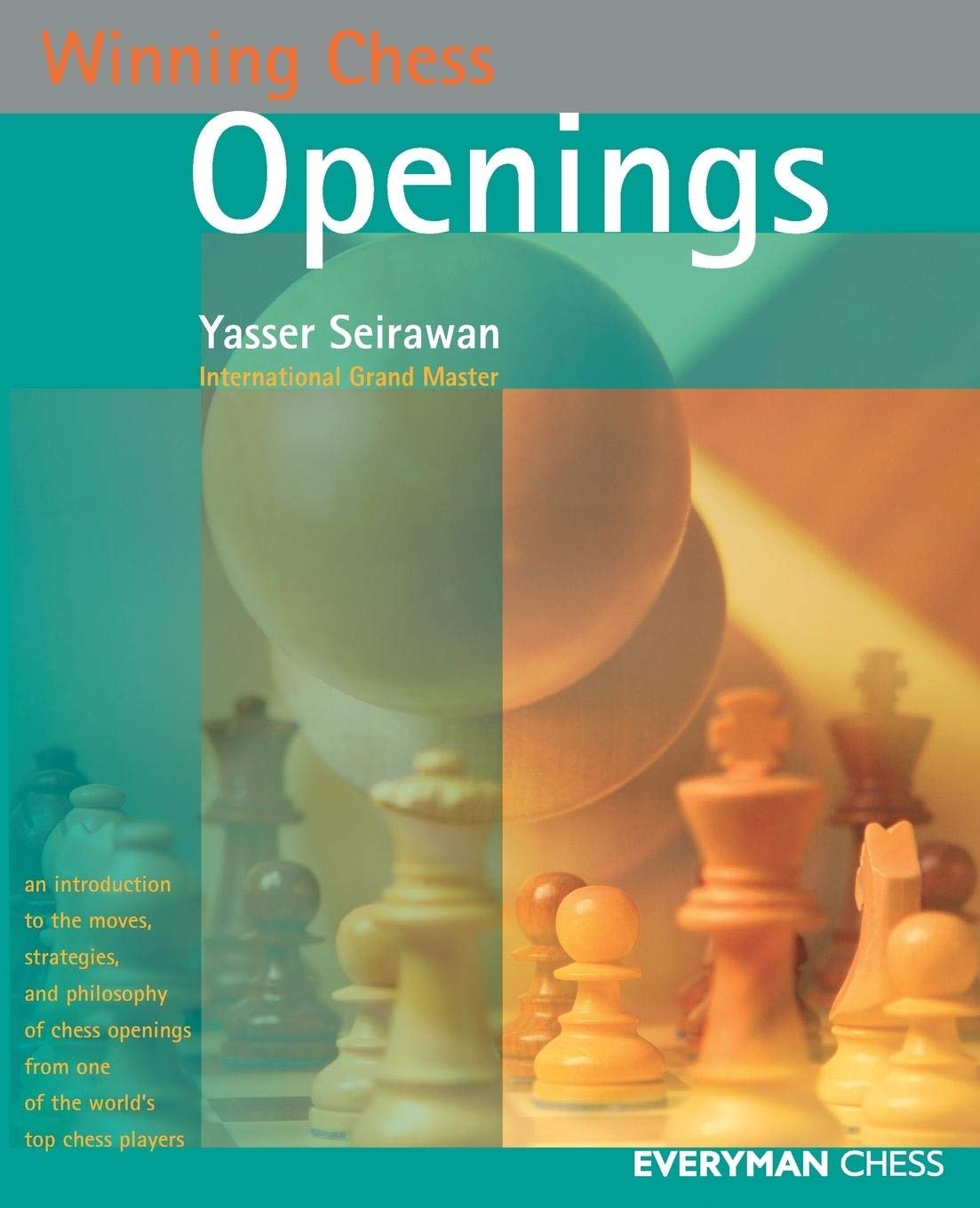
Winning Chess Openings (Winning Chess - Everyman Chess) [Seirawan, Yasser] on desertcart.com. *FREE* shipping on qualifying offers. Winning Chess Openings (Winning Chess - Everyman Chess) Review: Very Good Book on Openings - I am still working my way through this book, but I like it so far. As an intermediate player, I find the descriptions very informative. Plus, GM Yasser Seirawan conveniently gives the move orders repeatedly in the descriptions of variations, so you don't have to keep flipping back and forth to see how the move orders developed. I don't think this is for advanced players, but for beginners or intermediate players, this is a fine choice. Review: Incredibly helpful! - I am a relatively new player. The book has proved extremely helpful in my understanding of openings and chess in general. This is not a cook book style presentation, rather it provides easy to comprehend reasoning behind the various opening approaches. You come away with a more thorough knowledge of openings, their variations along and corresponding defenses - along with understanding how and why they were developed and used.
| Best Sellers Rank | #517,365 in Books ( See Top 100 in Books ) #444 in Chess (Books) #448 in Board Games (Books) |
| Customer Reviews | 4.4 out of 5 stars 335 Reviews |
S**T
Very Good Book on Openings
I am still working my way through this book, but I like it so far. As an intermediate player, I find the descriptions very informative. Plus, GM Yasser Seirawan conveniently gives the move orders repeatedly in the descriptions of variations, so you don't have to keep flipping back and forth to see how the move orders developed. I don't think this is for advanced players, but for beginners or intermediate players, this is a fine choice.
D**Z
Incredibly helpful!
I am a relatively new player. The book has proved extremely helpful in my understanding of openings and chess in general. This is not a cook book style presentation, rather it provides easy to comprehend reasoning behind the various opening approaches. You come away with a more thorough knowledge of openings, their variations along and corresponding defenses - along with understanding how and why they were developed and used.
M**N
Outstanding
I bought this book for Chapters 7-9 where Yasser gives his solution to the beginners problems with studying openings. His recommendations are very close to those given to me by my chess coach, and I wanted to see what he had to say about these openings. While I didn't gain much new knowledge, the book did confirm some things for me, and provided another view of how to handle the openings if you aren't interested, or don't have the time, to study, and memorize, an infinite number of obscure lines. For the club player this is an excellent approach to playing as both white and black.
S**N
great except for a glaring omission
Seirawan's book has a great deal to recommend it. He not only covers most of the openings and defenses you're likely to see, but gives you the reasons behind all the important moves. This is important because in any number of openings it looks like the logical move would be something completely different than what the book recommends, but in all those circumstances (or all the ones I've encountered) Seirawan shows why and how this "logical" move is in fact not so logical at all. Another great plus is that in looking at Seirawan's commentary on the openings and defenses you'll learn something about positional play rather than just memorize rote openings. Probably the biggest plus this book has for intermediate players is that, by showing us his own blunders, Seirawan keeps one from getting discouraged. Finally, he mentions quite a few books on the openings he discusses, so the book points the reader in the right directions if she's interested in a certain opening. So now to the glaring omission: As other reviewers have pointed out, he doesn't cover the English Opening (1.c4). What makes this more than a mere gripe, besides the fact the English is a rather common opening, is that at the beginning of the chapter 7 he groups the English with the Barcza Opening, KID, and Pirc Defense as an opening he recommends and implies that he will discuss it in detail. My theory is that at one time the manuscript did cover the English and editorial pressures forced Seirawan to shorten the book, which he did by cutting his long discussion of the English, and as he planned to discuss it at length there is naturally no short section on the opening and no one remembered to include one. It seems an odd coincidence that this book and the other title in the series I happen to own (Winning Chess Strategies) are exactly the same length. If this is the case they should definitely lengthen the book in future editions, and even if not coverage of the English would be nice. It is exactly the sort of quiet opening that deserves to be discussed with the Barcza. At any rate the recommendations I've gotten say to respond to the English with a Hedgehog Defense, which Seirawan does cover. All an all despite this wart it's still a good book to help one get a grip on openings.
L**2
A great book and fun to read!
This book is informative and easy to read, and Yasser Seirawan is a great author. It feels like he's sitting next to you and talking to you as a friend, ready to congratulate you on your wins (and chide you about your losses). In the introductory chapter, he relates his own experiences learning chess, and the evolution of his ideas about how to win games, and how to lose them. He then goes on to talk about the most popular openings, with many details and variations. Yasser Seirawan's writing style is fun to read and is perfect for a beginner or intermediate player hoping to improve their game.
E**E
Sometimes Too Little, Sometimes Too Much
The fifth book of International Grand Master Yasser Seirawan's "Winning Chess" series leaves much more to be desired than his other works, and that may be because this was not a labor of love. In the introduction, Seirawan clearly states that his intention was for book 5 to be about the endgame, which is the area he insists everyone must work on most (he's right). His publishers, though, nearly insisted that a book on openings come first, and this persuasion might have caused this to be a forced labor on his part. This is all conjecture, though, and what matters is the contents of the book itself. As usual, the information Seirawan provides is gold. His insistence that every opening is about controlling the center is right on the money. His description of opening "rules" (don't develop the queen early, develop knights before bishops, et cetera) is likewise sound. You could expect nothing less from a GM of Seirawan's caliber, really. The problems appear when Seirawan begins to discuss actual openings themselves. While it is apparent that Seirawan doesn't have much space to delve, many of the openings he discusses are restricted to the main lines only. Instead of going with other variations of these lines, he instead moves on to much more obscure variations that the novice is much less likely to encounter in real play. The book is divided into Classical King Pawn Openings, Classical Queen Pawn Openings, Modern King Pawn Defenses and Modern Queen Pawn Defenses, followed by tests and solutions. Don't expect to touch on Knight openings like the Reti Opening. Seirawan's hesitance to cover unconventional openings is well-founded, though, because spending too much time on opening study can be detrimental to the beginner. Ignoring the middle and engames only insures that each step takes the player further and further from his or her comfort zone and into unfamiliar territory. It is far better to learn opening principles and a few good openings than to spend hours and hours and hours grinding away at the million and one variations of the Sicilian Defense. Particularly off-putting to me, though, was the tone. Seirawan writes as if he is writing to children, which made it very difficult for me to want to read the book. I'm sure the simplicity of the information and the exuberant writing style are beneficial to some, I found it detracted from the value of the information itself. Still, I would recommend the read, even to players of my level (1500) who are probably familiar with many opening variations presented because Seirawan's understanding of what makes a good opening may come as a shock to the amateur.
B**R
A must have book
The book is excellent. I am sure it will take me a year or more to learn from it. I am really just a beginner at chess.
H**A
Great book!
Opening theory is the driest part of chess. It's going to take a lot of readings before some of these variations are going to stick, so thankfully the style in Yasser Seirawan's 'Openings' is lively and entertaining. How generous of him to start off with a confession of his own reckless and doomed yet hilarious opening ideas from his early chess playing days. One thing I miss in this book is an Index listing all the openings, attacks and variations alphabetically. Most enlightening are the final chapters revealing Yasser Seirawan's own opening and defense solutions. I highly recommend all of Seirawan's books in the Winning Chess series.
TrustPilot
1天前
3天前