We remain fully operational. Our teams are working around the clock to ensure your deliveries continue safely.

下载应用程序


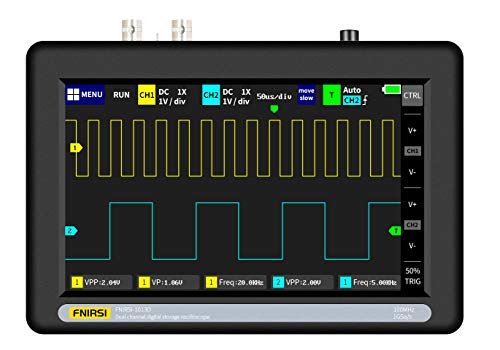
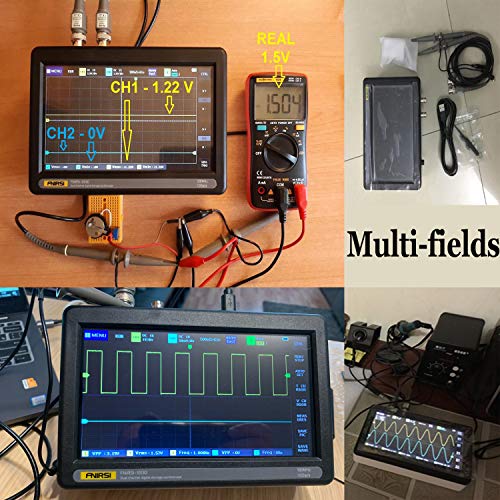
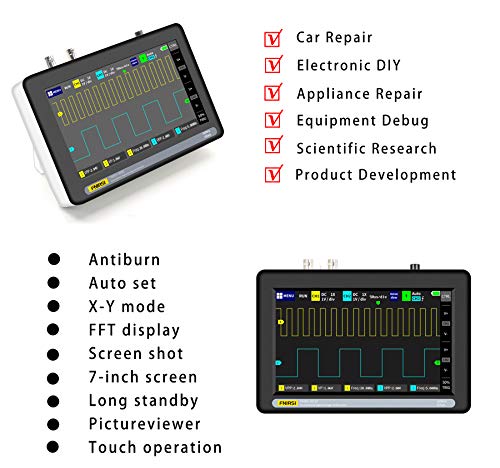
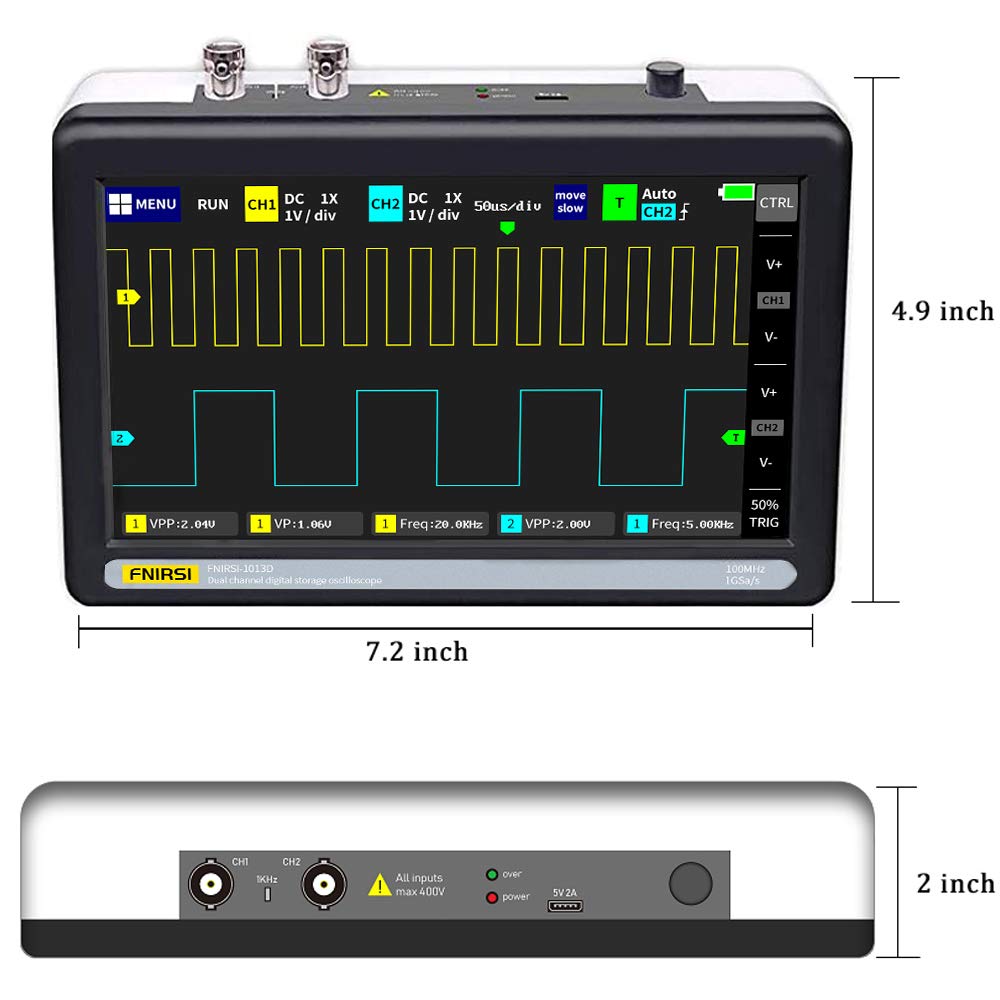
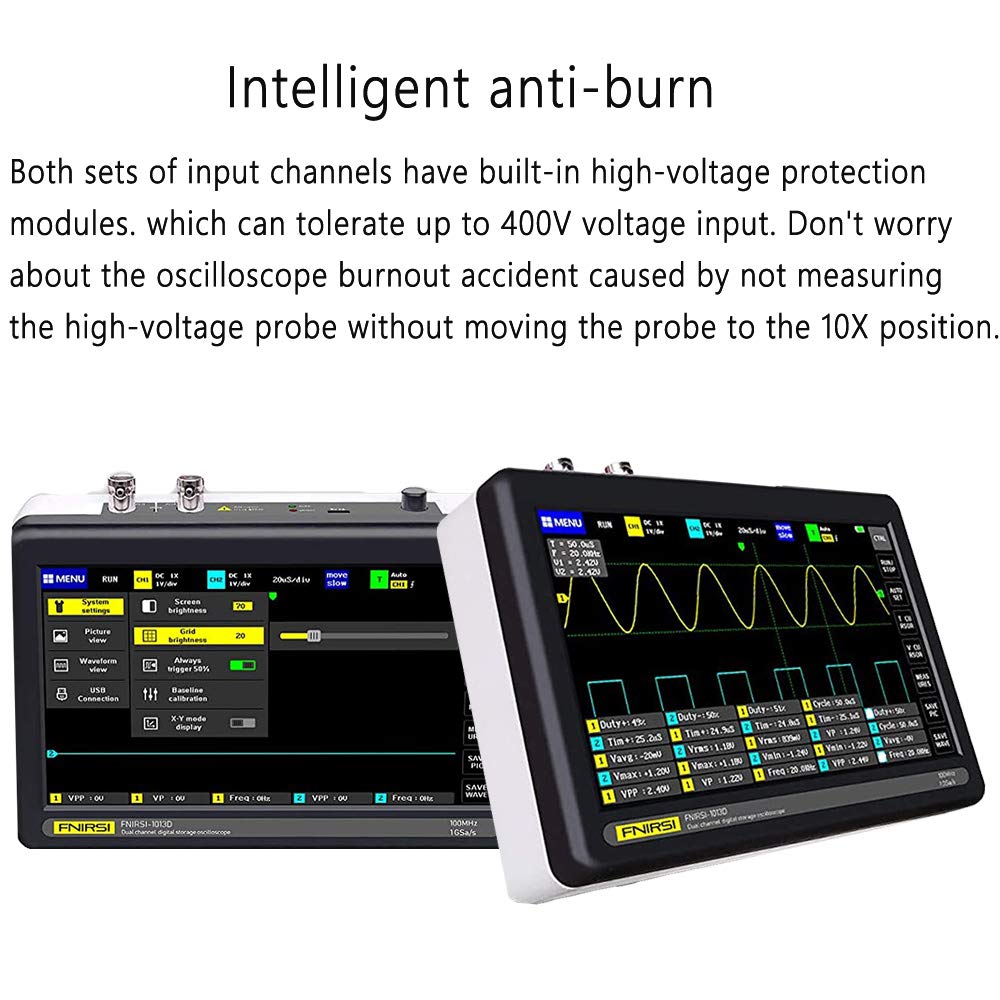

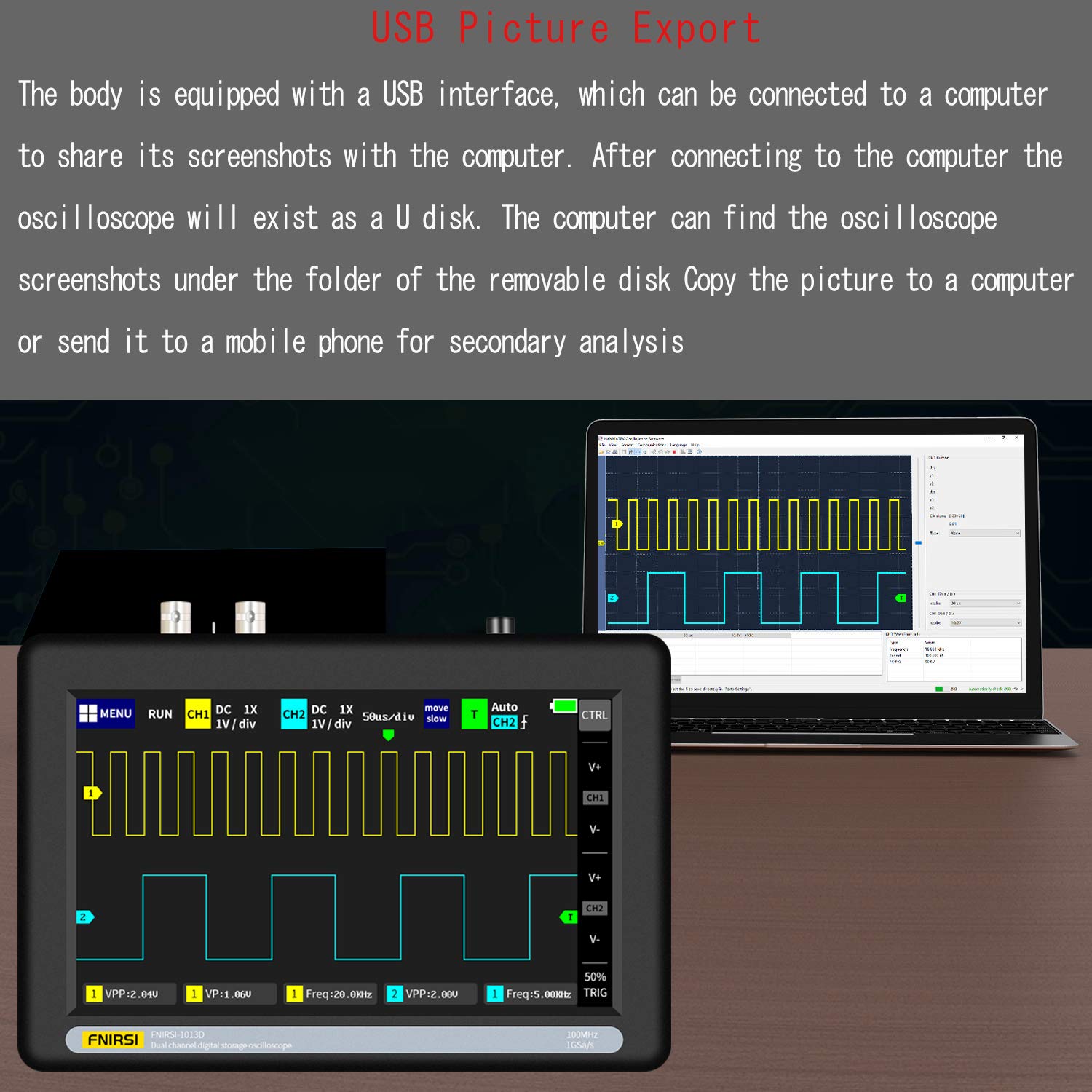


⚡ Power meets precision — your portable oscilloscope revolution!
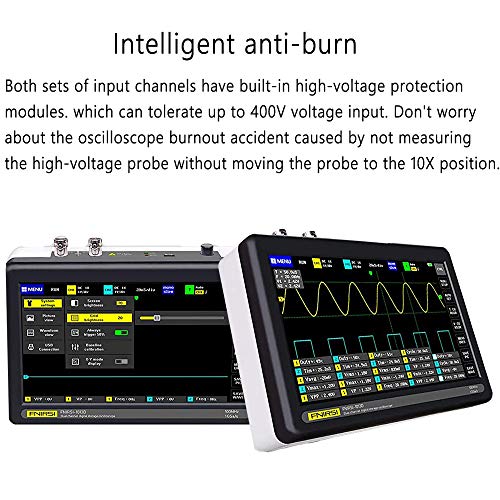
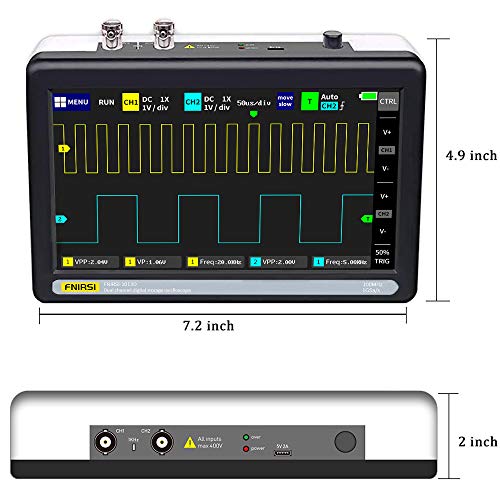
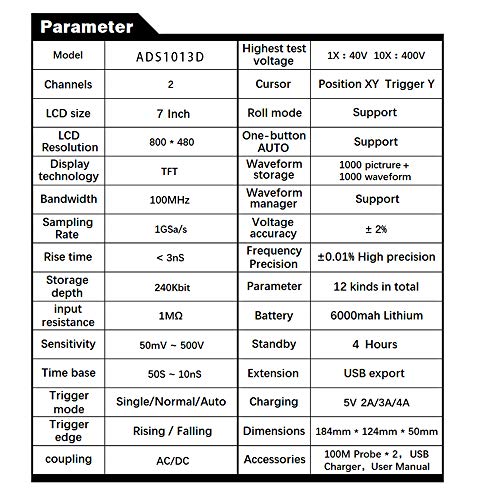
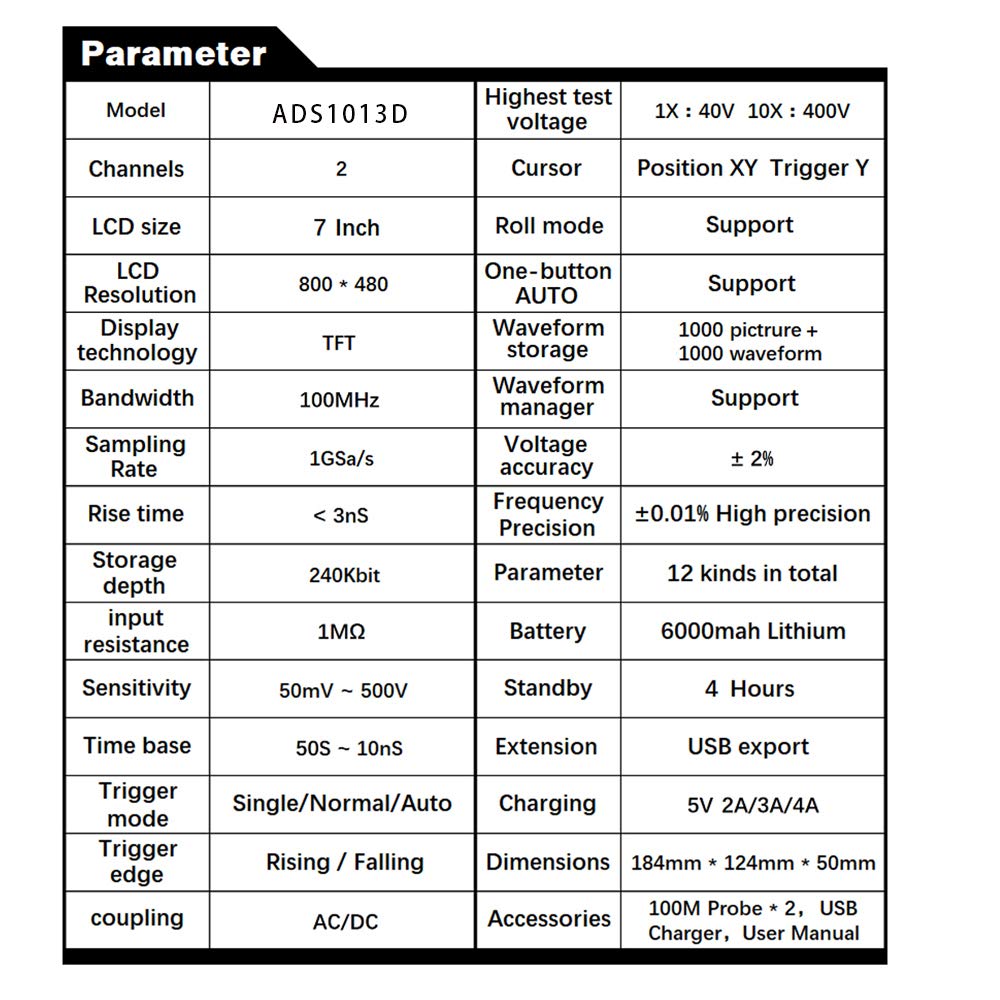
The ADS1013 is a sleek, ultra-portable 2-channel digital oscilloscope featuring a 7-inch capacitive touchscreen with 800x480 resolution, a robust 6000mAh battery for 4 hours of continuous use, and a high 400V withstand voltage. It offers intuitive one-button waveform saving, 1GB onboard storage for up to 1000 screenshots and waveform sets, and USB connectivity for easy data transfer. Designed for professionals who demand mobility without sacrificing performance, it supports up to 12 measurement parameters and advanced waveform management, making it ideal for field diagnostics and lab work alike.


| ASIN | B087TBFB3K |
| Batteries | 2 Lithium Ion batteries required. (included) |
| Best Sellers Rank | #586,791 in Industrial & Scientific ( See Top 100 in Industrial & Scientific ) #299 in Lab Oscilloscopes |
| Date First Available | April 29, 2020 |
| Item Weight | 2.14 pounds |
| Manufacturer | Aiteme |
| Product Dimensions | 1.93 x 0.79 x 2.83 inches |
M**G
Very capable scope for the price!
I wanted a small, portable, battery-operated oscilloscope having reasonable performance at a reasonable price. This oscilloscope is much more than merely satisfactory! I could have bought more performance for less money with one of the units that uses a laptop PC as its host, display and power source, but I find that a very cumbersome arrangement for portable use. And most of the outboard units that use a PC do not protect the PC from over-voltage spikes and ground faults, from my viewpoint a crippling (and potentially expensive) deficiency. I read comments that indicated that packaging had been a problem for some buyers, so I made a point of buying my scope from Anmascop-US, a storefront in the US for the Chinese manufacturer that stocks items in the US. My unit arrived within a week, well packed and in perfect condition. This unit is sold under several different brand names, but the model number appears to always be ADS1013D-II. There are two versions available: the older ADS1013D has the probe connections projecting from the top edge of the case, while the ADS1013D-II has the probe connections inset into a well in the top edge of the case. The ADS1013D-II also has a shiny "picture frame" around the display screen. Price is about the same for the two versions, but it appears that the -II version that I bought has some updates. Like many offshore designs, the user manual requires some interpretation because the writer was clearly not a native speaker of English. However if you know how a conventional oscilloscope works, you can make sense of it after several readings and some experimentation. Also, you have to remember that a small device like this one has no space for knobs; all settings are made via the touch screen (which has VERY fast response) and thus you have to get used to operating it via that interface. A few settings are "hidden", in that there was no obvious way for the manufacturer to incorporate them. For example it took me awhile to understand that the time-base setting is adjusted up and down by tapping on the right and left sides of the screen. I was astonished to find that the two input channels use 12-bit converters; I had expected to find 8-bit resolution which would have been good enough for my needs. However testing against an adjustable DC supply, monitored by a 3 1/2 digit DVM, made it clear that the display is indeed 4000 counts from bottom to top and the trace on the screen does not reveal the 100 steps per division that careful testing indicates. The specifications are unclear about this, but the unit automatically handles + and - inputs with a seamless crossover as you would expect. The on-screen digital voltage readings indicated very good linearity and accuracy. And the display is very sharp and clear. Are there weak spots or missing features? Of course, what would you expect for $150? But for me they are not a problem. The biggest weakness is in triggering, and use of a common timebase. There is no external triggering input, and the two channels are driven from the same trigger; you select which channel, voltage level and direction. And for long timebase settings, the triggering is one-shot, not recurring. Since the two channels use the same timebase you can't trigger from one channel and then display the result on the other channel using a faster timebase setting. The approach for saving the waveform works OK but it wasn't clear from the instructions that tapping the saved image would add the annotation overlay that isn't shown on the thumbnails. The file saved to the PC is in a format that I haven't been able to open, but as long as a high-resolution screenshot "photo" is OK for your needs, no problem. The battery takes a long time to charge, and I suspect a higher-current adapter would be OK; 4 hours use time is great but 6 hours to charge isn't. The inset BNC connectors for the probes provide a sleek appearance but getting the probe connector for Channel 1 attached requires small fingers. And I would be astonished if the scope has anywhere near the 1GS/sec sampling performance listed in the specs. Each input appears to have a dual A/D converter and perhaps the timebases are "verniered" so that on a sampling basis you have 1GS/sec sampling. I'm not likely to ever need even as much as a 20MHz real-time capture, so don't anticipate a problem. And like any semiconductor A/D converter, be careful about input voltage. You're not applying the input to the grid of a tube that can handle over-voltage, as in my younger days with Tektronix scopes. I am glad I bought this scope! Martt
A**O
Excellent Value, Intuitive and Portable
I would say a very good basic 2-channel oscilloscope made by Fei Ni Rui Si Technology, in PRC - China. Simple and intuitive touchscreen layout that responds and works well. Several YouTube videos confirm the Bandwidth is around 27-30 MHz as opposed to the claimed 100 MHz and the sampling rate around 200 Ms/s as opposed to the claimed 1 Gs/s, but I knew this going in and for the price you simply cannot ask for more. I intend to use mostly for automotive where unnecessarily high bandwidth is undesirable anyway because it introduces more noise. I understand the bandwidth requirement for automotive is at least 5 MHz to 20 MHz and Sampling Rate cannot be lower than 10 MS/s or it won't be fast enough for certain scenarios such as CAN (more is better), so this product seems to fit the bill. In terms of portability and integration to me this layout beats the virtual scopes that require you to drag a laptop (added risk). It seems to me the best and most practical scope solutions for automotive are exactly tablet touchscreen standalone solutions, where if Android-based is better and if designed for automotive even better. This scope comes with basic probes not suitable for automotive. I will end up spending three times as much on leads, adapters and accessories since a good current clamp meter is a must. The AESWave U-scope was also on my list but it is just 1-channel and you need at least two channels (CAN Bus testing). On my list are also the Micsig STO1104E (Android-based), Micsig ATO1104 Automotive Tablet (impressive) and of course the Virtual Scope Pico 4425A and the 2405A. Micsig is also PRC-Chinese and Pico Technologies is out of UK. Of all, Pico offers the most impressive array of support, plus their software is also quite good. I wish Pico would come out with Android-based solutions and touchscreen tablets. I am a DIYer and not a professional mechanic so my situation and needs are different.
E**N
Great for my application
This is written prior to any extensive examination, but I have to say, for $150, the is a good deal. Mine did come with a case, BTW. It takes a little getting used to the interface, and another review stated that you better know how to use an oscilloscope before you get this, and that is certainly true, as the instructions, in 2 point type (I.e., tiny) only identifies what is what. I did manage to figure out how to use it, sometimes by accident. The icon for edge trigger always shows rising edge, even when I select falling edge (it does work as I have selected, but the icon does not change). Minor bug I guess. Accuracy? Not sure. But for $150, don't expect high accuracy. I have no need for 100 MHz bandwidth or 1 G/s so that is not a problem - I am working at 7 MHz or below. I was surprised by the 500 mv/div being the most sensitive setting. To me, that is the most important drawback. I have one of those $250 range scopes, which is superior in that is operates like a regular scope, with a smaller screen. Lots of knobs and buttons. I think it needs an isolation transformer, because there is always a lot of noise when I bring up the gain, even with shorted probes. I have not fixed that (yet). This unit does not have that problem, but then at 500 mv/div it should not... :) Anyway, for my application - checking voltages, and frequencies when bringing up a product on the manufacturing line, it is perfect, and I love the big bright screen. I hope they come out with a more expensive version with better specs, i.e., higher gains, more accurate, and maybe even meet the specs they claim on this unit... :)
M**C
Good product no any problem I like it
S**W
Very capable unit. A little lacking on teh refinement but not costing too much either. The auto feature needs to be pressed before reading the result - it doesn't just keep working. Way better than the little units - the big screen is easy to see and makes it more intuitive. Nice add to the Lab bench. Would definitely buy it again.
A**R
Am surprised by the quality of this 'scope considering the price . Initially thought there was an issue on one channel due to inability to calibrate 'scope probe correctly , however replacing the supplied probe allowed calibration to be successful . Minor niggle are BNC skts placed close together making attaching probes a little tricky . Generally performs ok ,seems to be able to capture one off events well considering the sampling limits . Touch screen control of parameters is ok once familiar with the operation .
S**E
Don't waste your money!
M**.
I am writing this review after using device for 10 days and I find everything perfect and I am very happy to purchase this device and I am recommended it because it is cheapest and work as expected
TrustPilot
1天前
2 周前