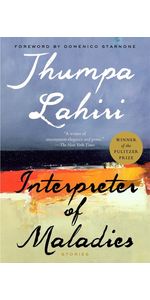
Interpreter Of Maladies: A Novel [Lahiri, Jhumpa] on desertcart.com. *FREE* shipping on qualifying offers. Interpreter Of Maladies: A Novel Review: Interesting book - Really interesting book-I enjoy this author! Review: Some great stories, others not memorable - I liked most of these stories. The first story, "A Temporary Matter," made me cry and lament a tragic failure of people to communicate and understand one another. The last story, "The Third and Final Continent," was equally moving, and restored my faith that there is innocence in love. Overall, Lahiri's keen understanding of the nuances of relationships is impressive. In her brief stories, the complicated relationships between the characters are remarkably well-developed. She is equally deft at capturing the nuances of the human personality- her characters often can't be labeled as protagonists or antagonists. Rather, they exist in the same gray moral area as the typical reader. The main fault I find with this collection, however, is a lack of consistency. It is easy for me to pick out the stories that were extraordinary in the book and, as for the rest, they tend to be somewhat forgettable. To be honest,I was also a bit put off by the sparsity of Lahiri's writing and the absence of figurative language which, for me, is a beautiful and important element of short fiction. Metaphor and other figurative techniques can add, succinctly, a deeper layer of meaning which Lahiri's stories lack somewhat.


| Best Sellers Rank | #8,562 in Books ( See Top 100 in Books ) #79 in Short Stories (Books) #428 in Classic Literature & Fiction #728 in Literary Fiction (Books) |
| Customer Reviews | 4.5 out of 5 stars 9,255 Reviews |
L**.
Interesting book
Really interesting book-I enjoy this author!
K**E
Some great stories, others not memorable
I liked most of these stories. The first story, "A Temporary Matter," made me cry and lament a tragic failure of people to communicate and understand one another. The last story, "The Third and Final Continent," was equally moving, and restored my faith that there is innocence in love. Overall, Lahiri's keen understanding of the nuances of relationships is impressive. In her brief stories, the complicated relationships between the characters are remarkably well-developed. She is equally deft at capturing the nuances of the human personality- her characters often can't be labeled as protagonists or antagonists. Rather, they exist in the same gray moral area as the typical reader. The main fault I find with this collection, however, is a lack of consistency. It is easy for me to pick out the stories that were extraordinary in the book and, as for the rest, they tend to be somewhat forgettable. To be honest,I was also a bit put off by the sparsity of Lahiri's writing and the absence of figurative language which, for me, is a beautiful and important element of short fiction. Metaphor and other figurative techniques can add, succinctly, a deeper layer of meaning which Lahiri's stories lack somewhat.
M**O
The Sizzle of True Writing (by Ana O'Quin)
“Brimming bowls and colanders lined the countertop, spices and pastes were measured and blended, and eventually a collection of broths simmered over periwinkle flames on the stove.” (p. 117) With the sizzling descriptions of Indian food and eye-opening moments portraying the juxtaposition of American and Indian culture, the award-winning Jhumpa Lahiri crafts a collection of 9 breathtaking stories that make up the Interpreter of the Maladies. With its beautiful writing, plot twists, and personal significance in my own life, I fell in love with the novel. Its craftminship and cultural significance outweights the minor flaws it has. Beautiful writing and twists in the plot, along with its personal significance in my own life, adds to my love of the book, outweighing the minor flaws it has. Throughout the story Lahiri uses clever imagery and diction to both capture moments in the novel and reveal underlining problems of dysfunctional relationships. As Shoba, the newly miscarried wife of Shukumar, refuses to put her shoes in the closet Lahiri tells of her reluctance to continue living as a wife. Mr. Pizarda, a Bengali man stuck in America as his wife and children suffer from the Pakistan war, gives a young girl Lilia a “steady stream of honey-filled lonzenges, raspberry truffles, slender rolls of sour pastilles”, telling bounds about his grief and longing for his own children (p. 29). Spot-on descriptions of the daily life of both Americans and Indians combine together in her stories yet are made fresh and insightful in their shocking endings. Her shrewd, but not judgmental tone, captures both the flaws and perfection of Indian culture, creating a true page-turner. The stories, in their individuality, are weaved together in their themes of accepting American culture and loving Indian culture. This thread of unification continues in the stories’ emphasis on love, and the toll that these moves take on relationships. Throughout the novel, characters such as Mrs. Das deal with the guilt of having a boy after an affair, Miranda choose to stop her affair with the married Dev, and Elliot struggle to adapt to life with the carefree Twinkle.The couples struggle with the stress of adapting to a chaotic and forein life in America in contrast to the culturally rich and slow life of India. Yet the relationships born from love, lust, and arrangement overcome their flaws at the end of each story either with a tough ending or a rebirth. Personally, this stress deeply resonates with my own life. I’ve also had to face this move from a foreign country to America. This chaos and unfamiliarity easily can take a toll on all of my relationships, with both family and friends. My favorite story in the book, The Third and Final Continent, reflects this move in my life as a man moves from India to England and then to America. He struggles with noise “constantly distracting, at time suffocating” with “the simply chore of buying milk”, and with very new relationship of an arranged marriage (p. 175) While reading the chapter I couldn’t help but smile as I identified with his adjustment to America. As the story progresses, he develops a relationship with an old women, Mrs. Croft, yet is grieved by her death. Even so he pushes on and becomes closer to his wife, taking steps every day to love his new life in America; it became an inspiration for me to take life “one meal” at a time(p. 198). Every relationship has its flaws, as does every book. Even with its beautiful and smooth writing,the Interpreter of the Maladies at times can drone on. The emphasis of describing settings and one broken relationship after another can at times cause the stories to feel as they were, in the words of a customer on Amazon, “written from recipe.” Shocking endings can leave readers in confusion. Personally I cannot think of a sentence that describes exactly what Jumpha Lahiri was trying to convey or reveal in her book; true themes and meanings are very hard to find. Her diction and stirring statements can distract from the plot add to this confusion. “Still, there are times I am bewildered by each mile I have traveled, each meal I have eaten, each person I have known, each room in which I have slept. As ordinary it all appears, there at times when it is beyond my imagination.” (p. 198) Even with its minor flaws, Jumpa Lahiri’s beautiful description of Indian cultures, the struggle of living in America, and truths of relationships along with its personal significance inmy life adds it to my list of my favorite books. Ending with this impactful sentence that gives me personal motivation, I recommend it for anyone with a love for truth, relationships, and culture.
J**L
Excellent Stories with Splendid Character-Portrayals
This is a collection of stories about the lives of Indian and Indian-Americans who are nostalgic for their home on the other side of the world but are also trying very hard to adjust to their life in their adopted country. The book was first published in 1999 and it won the Pulitzer and the Hemingway /PEN award. The nine stories in the book are: 1. A Temporary Matter : A happy couple, Shukumar and Shoba who are hard-working Indian-Americans, lose their baby, and through their grief, they are alienated from each other. Environment in the background, such as the electrical power, the candles, and Indian food, provides the mood of this story. 2. When Mr. Pirzada Came to Dine: This story reflects the feelings of innocent people from a personal level on both sides of a complicated political struggle. Told from the ten-year old Lilia’s point of view, this story tells of the concerns of immigrants for their old countries. Mr. Pirzada, from Pakistan, is friends with Lilia’s parents and visits them often, bringing sweets to the girl. He is concerned of the safety of his daughters back home, as things can go awry during a war. Since Lilia is a second-generation American, she views all this with deep emotion, yet childish understanding, and she misses Mr. Pirzada when he leaves for Pakistan. 3. Interpreter of Maladies: An Indian-American couple visit their old country and hire a tour-guide as their driver. The driver talks about his other job as an interpreter in a doctor’s office. Something resembling a romance starts to develop between the wife and the driver. In the story each character is flawed in some way and sees the others from a mistaken angle, and each character ends up feeling disappointed. 4. A Real Durwan: The Durwan, a stair-sweeper of an old apartment building who is an old woman, attracts the pity and the kindness of the residents, since she does this work without expecting anything. The old woman feels just as strongly about the residents and the building, as well. When a sink in the stairway is stolen, however, the residents turn their backs on the old woman, kick her out of the building and start looking for a “real Durwan.” 5. Sexy: Miranda and Laxmi work for a public radio station in Boston. Miranda is having an affair with Dev, an older, married Indian man. At work she hears Lami’s phone calls through her cubicles. Laxmi’s cousin’s husband is having an affair, and the grief of it has made the cousin unable to care for her son. When The cousin comes to visit Laxmi, Miranda babysits for her son, Rohin. Laxmi’s cousin is the victim of infidelity. It is through her stories that Miranda starts to feel and then face her own guilt and aimlessness. 6. Mrs. Sen's: An eleven year-old boy is babysat by Mrs. Sen in her own home. Mrs. Sen is a university professor’s wife who is homesick for her native land and is obsessed with objects like her special vegetable cutting blade and fish from the market. She also resists to attempt to the new country and learning to drive. One day, on a whim, she drives to the market on her own and has an accident with the boy in the car. Afterwards, the boy stops staying with her. 7. This Blessed House: An Indian-American couple, newly married, try to adjust to each other and their new house, which was owned by a fanatically religious Christian people who left artifacts hidden inside the house. The clash of cultures and the young couple’s ineptitude to accept each other’s different qualities are highlighted in this story. 8. The Treatment of Bibi Haldar: Bibi Haldar is a twenty-nine year-old spinster who has a strange ailment. From the descriptions of her symptoms in the story, she suffers from seizures. The cure is marriage, the doctors have said, and that’s what Bibi Haldar wants, but despite all the efforts, she lacks the qualities of being marriage-able. Bibi keeps the inventory of her brother's cosmetics stall, but when the brother’s wife becomes pregnant, she is afraid Bibi will infect her unborn child. When a daughter is born to her and the child becomes ill, a seriously prejudiced treatment of Bibi begins. Women of the community sympathizing with Bibi stop their purchases from the brother, causing the brother to go bankrupt, leave his store, and move out. Bibi is left to live in the storage room, which she fixes to make it livable. Then it is discovered that Bibi is pregnant, but the father of the baby is a mystery for she might have been attacked during a seizure. The women help her with the care of her son and Bibi starts her own business with the old wares of his brother’s store and manages to raise her son on her own, with her ailment now cured. 9. The Third and Final Continent: An Indian-descent young man, a newcomer to the United States from London, rents a room from a quirky old woman in Cambridge, Mass. After living with her for six weeks, he feels attached to her. When the young man’s new wife arrives from India, he moves out to an apartment in the campus of MIT. As he is trying to adjust to his wife, whom he doesn’t know well, the old woman dies. After a while, the young man starts feeling love for his wife, but he also remembers the old woman, as she was the first person he liked in the new country, which started his adaptation process to USA. This book not only it gives a glimpse into another culture, but also, it is a learning experience if the reader can analyze and interpret it with a discerning eye.
F**T
Compelling Stories
This is a collection of short stories about Indian Americans. In just a few pages, Lahiri created characters that I felt I had known all my life - that is to say, they were real people. I could feel the suffocation of a monotonous marriage and the strange void when an elderly friend passes away. The characters, not so much their stories, are my favorite thing about the book. Seems ironic to say since the stories drive the characters, especially in a short story. Lahiri's writing reminds me of one my favorite authors, Flannery O'Conner. There are few literary characters that I despise more than Grandma from A Good Man is Hard to Find and yet, I didn't want to see her die on the side of the road. In the same way, Mrs. Sen drove me batty (no pun intended) with her neediness but I didn't want Eliot removed from her care. While cultural differences are a recurring theme, human struggles (like loneliness or sympathy) take center stage. This is a great book that I recommend others to read.
D**A
Glimpses of Indian-American Diaspora
Reviewed by C. J. Singh Jhumpa Lahiri's "Interpreter of Maladies," a collection of nine stories, marked the debut of a remarkable Indian-American writer. A grand debut it was! Her title story was selected for both the O'Henry award and the annual Best American Short Stories. Topping this, the book won her the Pulitzer Prize for fiction. Born in London of Indian parents and raised in Rhode Island, Jhumpa Lahiri studied at Boston University, receiving an MFA in creative writing. The stories in her first book focus on the intercultural miscommunications and conflicts all too often experienced by Indian immigrants and second generation Indian-Americans. "Interpreter of Maladies," at 27 pages the longest in the collection, is a multi-layered story about a second-generation Indian-American couple, who along with their three children are visiting India and hire a tour-guide to see the famous Sun Temple at Konarak. Their guide, Mr. Kapasi (we never learn his first name), becomes curious about the couple who look Indian, yet dress like American tourists and speak with an American accent he had heard many times on American TV shows. The opening sentences expose the bickering that symptomizes the couple's failing marriage. Mr. Kapasi works as a tour guide only on weekends, and has another job during the weekdays as an interpreter in a doctor's office -- translating the Gujarati spoken by some of his patients. Mina Das, the wife tells him that his job as an interpreter of maladies must be "romantic." Perked up, Mr. Kapasi, from whose point of view the whole story is told and whose own marriage is faltering, looks at her closely: "Her sudden interest in him, an interest she did not express in either her husband or her children, was mildly intoxicating. When Mr. Kapasi thought once again about how she had said 'romantic,' the feeling of intoxication grew." He begins to fantasize a romantic relationship with her. The couple invite him to be included in the photographs they take; Mina asks him for his address so they can send him copies from America. This feeds his fantasy. At the crisis point of the story, when the two of them are in the car, Mina discloses (the author uses the word "confesses") to Mr. Kapasi that one of the couple's two boys was clandestinely fathered by her husband's Punjabi-Indian friend during a brief visit. This is the malady which she hopes Mr. Kapasi will provide a remedy for. However, all the interpreter of maladies can come up with is: "Is it really pain you feel, Mrs. Das, or is it guilt?" After all, he is only a translator of native languages. In the closing paragraph, Mr. Kapasi observes the little paper on which he had so carefully written his address slip out of Mina's handbag. "No one but Mr. Kapasi noticed. He watched as it rose, carried higher and higher by the breeze, into the trees where the monkeys now sat, solemnly observing the scene below. Mr. Kapasi observed it too, knowing that this was the picture of the Das family he would preserve forever in his mind." "The Third and Final Continent" is a first-person story of an Indian immigrant who looks back at his first few weeks in America, thirty years ago. In the late 1960s, at age thirty-six, he arrives to work as a librarian at the Massachusetts Institute of Technology, after having studied for four years in London (his second continent). Just before coming to America, he takes a trip to Calcutta to "attend" his arranged marriage, staying there only a week, barely getting acquainted with his bride. She has to await her visa for six weeks before she can join him in America. On arrival in Cambridge, Massachusetts, the narrator checks into the local YMCA and later rents a room in the home of a 103-year-old widow, Mrs. Croft, who lives by herself. She is a stay-at-home eccentric mother of a 68-year-old daughter, who thinks it improper that her visiting daughter wears a dress high above her ankle. "For your information, Mother, it's 1969. What would you do if you actually left the house one day and saw a girl in a miniskirt?" Mrs. Croft sniffs: "I'd have her arrested." When the narrator's wife, Mala, arrives from Calcutta, Mrs. Croft scrutinizes her ". . . from top to toe with what seemed to be placid disdain. I wondered if Mrs. Croft had ever seen a woman in a sari, with a dot painted on her forehead and bracelets stacked on her wrists. I wondered what she would object to. I wondered if she could see the red dye still vivid on Mala's feet, all but obscured by the bottom edge of her sari. At last Mrs. Croft declared, with equal measure of disbelief and delight I know well: 'She is a perfect lady!' " It is this scrutiny that first evokes the narrator's empathy with his bride for it reminds him of his own experiences as a bewildered stranger in London. Looking back, "I like to think of that moment in Mrs. Croft's parlor as the moment when the distance between Mala and me began to lessen." All nine of the stories are a showcase of elegant craft.
J**Z
Ordinary short stories with extraordinary writing and characters!
My 1st Jhumpa Lahiri book and the last few lines of the book summarizes it beautifully and relatable... "I know that my achievement is quite ordinary. I am not the only man to seek his fortune far from home, and certainly I am not the first. Still, there are times I am bewildered by each mile I have traveled, each meal I have eaten, each person I have known, each room in which I have slept. As ordinary as it all appears, there are times when it is beyond my imagination." Her stories are ordinary, and her writing is extraordinary. She makes you travel through the times of India - Pakistan partition, caste issues, loveless marriages, from strangers to strong survivors in a marriage, streets of Calcutta even if you've never been there, subtle yet relatable differences of emigrating continents - all through her characters. Her sentence structure is perfect. Articulation of the surroundings and supporting characters is a bound movie script waiting to be made. Endearing read indeed!
M**A
Character over Culture
Jhumpa Lahiri’s short story collection, Interpreter of Maladies, explores the tales of ten different characters, all of whom bear some connection to India. Having been raised by Indian parents in a small town in Rhode Island, Lahiri is able to punctuate her writing with her own personal Asian-American background. She uses her background directly in creating characters such as Shukumar, the protagonist in “A Temporary Matter,” who possesses Indian roots, but an American upbringing. Indeed, many of Lahiri’s stories in the collection, Interpreter of Maladies, are focused on more Americanized characters with only a small exposure to India. The protagonist in “Sexy,” is an American Northerner infatuated with a married Indian man, while the focus of “Mrs. Sen’s” is on an 11-year old American boy, looked after by a young Indian housewife. Lahiri does extend from the bounds of her Asian-American upbringing in stories such as “The Treatment of Bibi Haldar,” a tale of an Indian woman whose spastic condition can supposedly only be remedied with marriage. This short story embraces a unique relation to India, as do the other nine tales in the collection. Lahiri makes use of different settings and cultural backgrounds to create a broad range of experiences; but rather than emphasize the ethnicity of each character, she taps into a specific human emotion to show how people are defined more by their humanitarianism than their culture. In “When Mr. Pirzada Came to Dine,” for example, Lahiri marks the distinctly young narrator, Lilia, by her intuition and empathy rather than her Indian-American background. As her parents welcome a local Muslim professor to their home, Lilia is challenged to define her Indian culture, but mistakenly does so using certain surface-level qualities: “It made no sense to me. Mr. Pirzada and my parents spoke the same language, laughed at the same jokes, looked more or less the same” (Lahiri, 25). Lahiri uses the lens of a child to show the instinctual nature of grouping people by their appearances. Lilia is defined by this cultural naiveté, as well as a feeling of powerlessness in worldly issues. She dwells on how she can do little for Mr. Pirzada’s family in war-struck Dacca: “I wanted to join them, wanted, above all, to console Mr. Pirzada somehow. But apart from eating a piece of candy for the sake of his family and praying for their safety, there was nothing I could do” (Lahiri, 34). This quote shows the depth of Lilia’s character as she yearns to help a people she knows little about. Her upbringing as an Indian-American has no influence on her desire to help a struggling people, nor does it stop her from instinctively aligning herself with Mr. Pirzada based on their outward appearances. Basic human emotions dominate each of Lahiri’s characters, including the main character in the short story that shares the collection’s title, “Interpreter of Maladies.” Though the protagonist Mr. Kapasi is a native of India, Lahiri defines him more by his desire to escape the banality of life than by his Indian homeland. She includes a significant amount of information on Mr. Kapasi’s strained marriage and how he views his medical interpreting job as “a sign of his failings” (Lahiri, 52). Overshadowing Mr. Kapasi’s Indian background are these basic human emotions of disappointment and desperation. Perhaps most central to Mr. Kapasi’s character is how he desperately clings to the small doses of intimacy offered by Mrs. Das, an Indian-American woman on his tour who depicts his job as some heroic deed. “Her sudden interest in him,” Mr. Kapasi found “was mildly intoxicating.” (pg. 51) As Mrs. Das inquires about his job, Mr. Kapasi blows every hint of interest out of proportion – imagining a day where he will exchange intimate letters with this woman he hardly knows. As Mr. Kapasi becomes more infatuated with Mrs. Das, his Indian background takes a backseat to his resolution of using love as an escape. In defining Lilia by her intuition and empathy and Mr. Kapasi by his belief in love, Lahiri gracefully demonstrates how human emotions supersede cultural barriers. We do not see Mr. Kapasi merely as an Indian tour guide or Lilia as another Indian-American child. Lahiri brings to light the individuality of each character, showing how culture is an important, but not defining feature of any one person. She purposefully weaves culture into small details of the story, such as the food Lilia’s mother prepares and the marriage customs forced on Mr. Kapasi, but she leaves the core of her characterization to explore basic human sentiments.
TrustPilot
1 个月前
2 周前