We remain fully operational. Our teams are working around the clock to ensure your deliveries continue safely.

下载应用程序


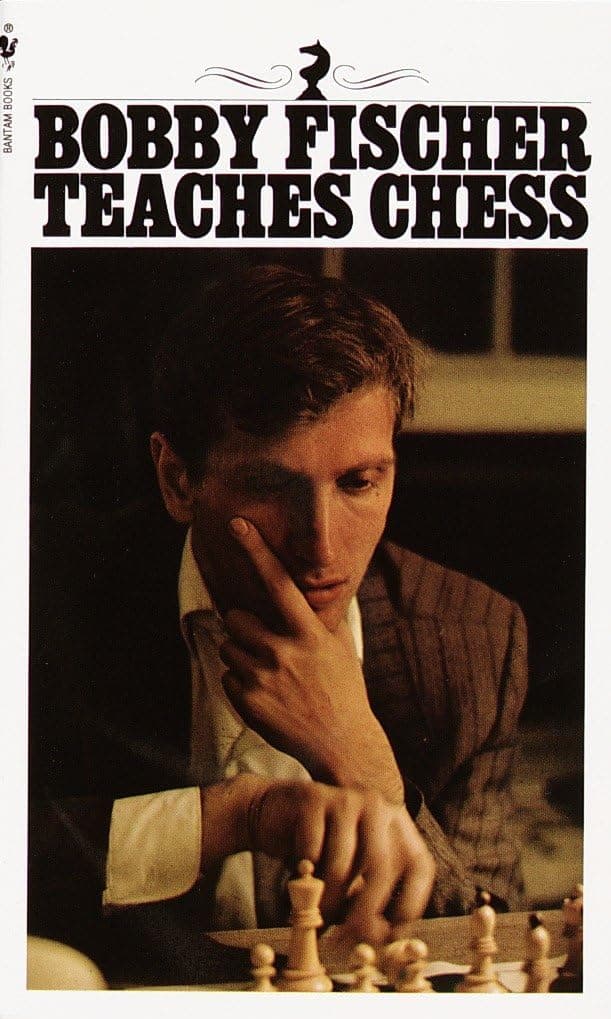
♟️ Upgrade your brain’s chess firmware with Fischer’s ultimate checkmate blueprint!
Bobby Fischer Teaches Chess is a compact, 352-page instructional book that uses an innovative interactive format to teach chess endgames and checkmate patterns. Praised for its focused, no-nonsense approach and unique upside-down page design, it’s a top-rated bestseller with over 10,000 reviews, perfect for both beginners and serious players seeking a strategic edge anytime, anywhere.


| Best Sellers Rank | #5,844 in Books ( See Top 100 in Books ) #4 in Chess (Books) #8 in Puzzle & Game Reference (Books) #295 in Reference (Books) |
| Customer Reviews | 4.6 4.6 out of 5 stars (10,266) |
| Dimensions | 4.13 x 0.75 x 6.85 inches |
| Edition | Reissue |
| ISBN-10 | 0553263153 |
| ISBN-13 | 978-0553263152 |
| Item Weight | 6 ounces |
| Language | English |
| Print length | 352 pages |
| Publication date | July 1, 1982 |
| Publisher | Bantam |
| Reading age | 12 - 17 years |
M**S
Fisching for Perfection?
Having previously attempted to optimize various aspects of my existence – from the psychological to the biochemical – I decided it was high time to upgrade my strategic processing capabilities. My previous attempts at chess involved a lot of hopeful piece-shoving and bewildered staring, a highly inefficient algorithm for achieving victory. Recognizing the need for a more direct data injection, I acquired Bobby Fischer Teaches Chess. I didn't see it as a book, but rather as a firmware update for my brain's chess module, delivered via a 1982 analog interface. From a purely functional standpoint, this 352-page volume is a masterclass in efficient knowledge transfer. It bypasses the often-tedious theoretical lectures and gets straight to the core function: achieving checkmate. The programmed learning method feels less like reading and more like interacting with an early, highly effective training program. Each page presents a problem, a challenge to your pattern recognition subroutines, followed by the solution on the next page. The physical design, with left-hand pages printed upside down, is a stroke of genius in user interface design for self-discipline. It's the book's way of saying, "Prove you've processed the data before you get the answer, buddy." It's a physical barrier to premature gratification, a feature I honestly appreciate in a world of instant digital answers. The near-perfect 4.6-star rating from thousands of users is compelling empirical evidence of its efficacy in upgrading human chess-playing units. The inherent humor in this artifact lies in its earnest, almost relentless focus on checkmate. It's like buying a comprehensive guide to automotive repair and finding that 90% of it is just detailed instructions on how to install lug nuts. Essential? Absolutely. But the singular dedication to this one critical task is delightfully intense. One can almost hear Bobby's voice echoing from the pages, demanding, "Did you find the checkmate? No? Flip the page (and the book!) and try again." It's a no-nonsense approach that borders on the comically rigid, yet it undeniably works. Positively speaking, this book delivers precisely what it promises. It doesn't clutter your mental RAM with obscure opening variations. It focuses on the critical end-game sequence, the digital handshake of victory. Working through the problems felt like debugging a complex system, identifying the faulty moves and correcting them based on the provided optimal path. It built my confidence not by explaining why a move was good in abstract terms, but by showing me, repeatedly, how to achieve the desired outcome. It's like getting a cheat code for the final boss, but you still have to earn it by solving the puzzle yourself. In conclusion, if you're looking for a unique, highly effective, and humorously direct method to hardwire checkmate patterns into your strategic thinking, Bobby Fischer Teaches Chess is an exceptional tool. It provides the structured training environment and the built-in anti-cheat mechanism; the resulting ability to confidently deliver checkmate is the highly satisfying system upgrade. I highly recommend it for anyone ready to move beyond random piece-pushing and start finishing chess games with purpose.
K**D
Great book, and would highly recommend.
I loved this book. I had never played chess before, and I knew nothing. This book taught me EVERYTHING I needed to know to start playing, and has little exercises all the way through it. I think this is a fantastic book to learn chess.
F**I
Classic item for chess
Wonderful/ classic
F**.
Tiny book, second half printed upside down on purpose
I don’t like how the printing is upside down for the second half of book but it did do a good job of teaching basic principles of chess
P**L
Excellent first chess book
In short, I think Bobby Fischer Teaches Chess is a great introduction to the game for children and adults alike. Most people barely know how the pieces move, so if you are interested in learning the game for casual play, or if you are thinking about becoming a tournament player one day, this would be a great way to get your feet wet and learn the building blocks of successful play. ________________________________ Many reviews already, but just want to highlight that this is the first chess book for my almost-7-year-old son. He loved it and would always brag about his progress. He already knew how the pieces moved, but the tactics were all new. Features of the book: - Interactive learning; most of the material is taught through puzzles. - Content: movement of pieces; rules of the game; check and checkmate; the vast majority of the book teaches basic checkmating patterns with increasing difficulty/complexity. You will learn the fundamentals of calculation, looking for mates, basic mate patterns, recognizing whether pieces/squares are defended or undefended. Also important here is that you will learn the importance of finding the best defense for your opponent when you are trying to attack, as well as learn to calculate different variations (i.e., it's not always a forced mate). - Chess notation is NOT used in the book, which is another positive feature for beginners and/or children (i.e., they say things like "rook takes rook" instead of Rxg8, etc.) - Most puzzles basically will ask "Can White mate?" with the next page giving the answer. (Hint: the answer is not always Yes, which teaches the reader accuracy in calculation and looking for your opponent's defenses)
M**E
A good first chess book!
The perfect first tactics book for any new player
B**N
Sayfaların ters-düz/karışık olması gerekiyormuş. Kitabı aldım ve sayfaların bir kısmı ters bir kısmı düz ve sayfalar karışık biçimdeydi. Yanlış basıldığını sanıp değişime gönderdim ve elime ulaşan diğer kitap da aynı şekilde basılmıştı. Ufak bir araştırmadan sonra bu basımın bilinçli olduğunu öğrendim. Kitabı normal düz bir şekilde bitirdikten sonra ters çevirip kaldığınız yerden (sağ taraftaki sayfalardan) devam ediyorsunuz. Kitapta bunun açıklaması mevcut.
K**A
There is a reason why Fischer is considered to be one of the best chess players of all times, so needless to say that the book would be high quality as expected. The book is more a strategy book for check mates than a complete chess tutorial. As you work through Fischer's puzzles, it kind of opens you up to the number of ways you can check mate the opponent. The book is quite lucid and exciting as well and focuses on a few strategies. However, if you are a beginner and want to learn about the game as a whole (opening, mid game, ending), then Logical Chess Move my Move is a good choice.
M**.
I haven't played chess for over 20 years, and even then only occasionally and to no great skill level. Now, approaching my 60's, for some reason I've become interested in it as a brain exercise. This paperback was cheap and seems to have a lot of favourable reviews so I gave it a go. I can see why it would be great for total beginners, but it's also fantastic for those of us who want to feel good about ourselves - i.e. that our brain still functions at a reasonbale level). I have had great pleasure in realising that by following each of the panels of questions posed in the book, I still grasp the essentials of the game and, more than that, I'm remembering what I used to like about it. It's structure is excellent, and I particularly like the upside down alternate pages...it might seem quirky but it means that all answers to each question posed cannot be glanced at on the open pages...you have to turn over the page if you want to cheat! Maybe only a chess player of repute would come up with that...or it's very common in these kind of books and I'm just poorly read. Overall, for a book from someone considered by many to be the greatest ever chess player, it is entirely unpatronising to us chess neanderthals and it has raised my interest in the game to a new level. For those who are more advanced or even frequent players for fun, this book maybe a little too basic, but for total beginners or those who have been away from the game for years, it's a great way to become absorbed.
J**.
Livro de muito valor para iniciantes no Xadrez (suponho na faixa de rating 300-1500). Aborda conceitos fundamentais de maneira prática, de fácil entendimento através de posições extraídas de jogos do próprio Bob Fischer. Em Inglês mas fácilmente palatável até para os mais resistentes. Vale a pena!
J**H
Good book for beginners