
下载应用程序


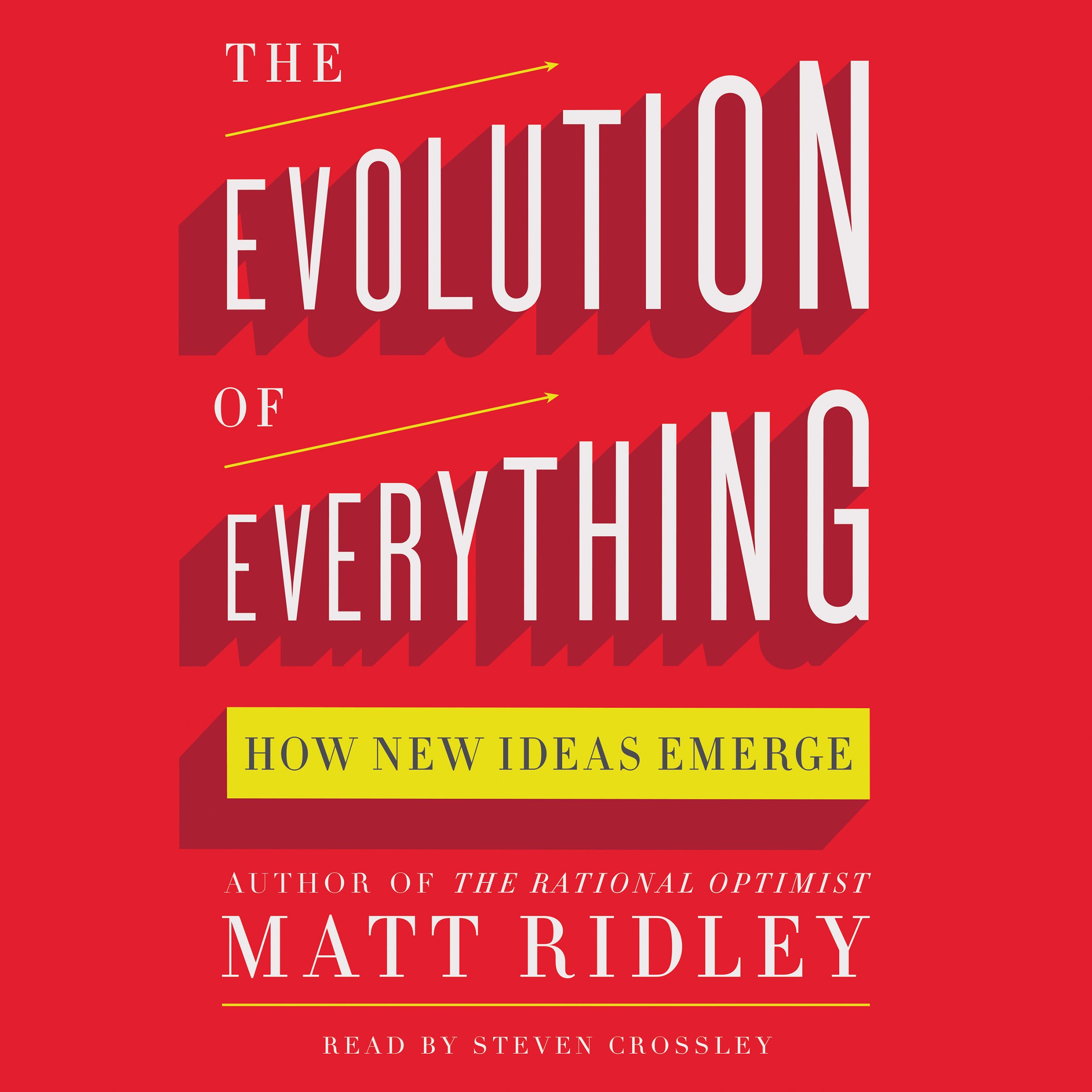
desertcart.com: The Evolution of Everything: How New Ideas Emerge (Audible Audio Edition): Matt Ridley, Steven Crossley, Harper: Audible Books & Originals Review: Rationalist look into the evolutionary of (almost) everything - The evolution of everything is Matt Ridley's most recent published book coming after the Rational Optimist. It is a brief history from a rationalist point of view of a host of interesting topics ranging from hard sciences to philosophy. At times it can seem quite cold but it is always based on reason and thus the perspective is always worth reading, even if it is disagreed with. If one wants to get a sense of how many of mankind's culture evolved this book is a great resource. The evolution of everything gives a synthesis of a host of topics that often define humanity. The author begins with the Universe and starts by introducing the idea of a skyhook. In particular that when at a loss for explanation defer to the divine as a hook to hang the answer on. Matt Ridley endeavors to remove skyhooks across a host of topics throughout the book. He begins with Morality and discusses how Smith in Theory of Moral Sentiments was on to a very important idea when he discusses how morality evolves to create social stability. The book is a great composition of history, science and philosophy. The author discusses evolution as an idea and how intelligent design has been shown to hang itself on skyhooks that time has removed. The author discusses genes and the idea of the selfish gene and in particular that genes don't evolve to fit a function but rather surviving genes somehow improve chances of success in unbeknownst to them. The author gives great overviews of how culture can change over time and is contextual he tackles how the economy evolved. The author gets into topics like education and will likely cause alarm with his criticisms of modern education. In particular the author discusses how the modern education system was developed to modernize the Prussian state and doesn't encourage creativity. The author gets into the benefits of the Montessori system. The author also discusses historically sensitive subjects like population and how Malthusian and Social Darwinist ideas dominated the last 200 years inclusive of even recent history. In particular the author is highly critical of population containment policy advocated even in the last two decades towards poor countries as paternalist and Malthusian. The author is critical of government and discusses how the state arose not out of benevolence but as a kind of social parasite preying on the productivity of its citizens. The author also documents how societies function much better than imagined in the absence of government and the Hobbesian outcome of life being brutish and short in the absence of government is an overstatement. There is an extremely strong libertarian narrative throughout the book. The author spends a lot of time discussing how the idea of government sponsored research as being the bedrock of modern development is nonsense and how ideas like the internet being developed by the government reinforce his point. In particular the author feels strongly that individuals don't make as large of a difference as is usually advocated and that important developments are usually being considered by contemporaneous citizens (calculus, the lightbulb, the steam engine all had multiple simultaneous people realizing their significance). The author takes aim at lots of people including those fearful of global warming. These arguments aren't taken as anti scientific but rather that becoming obsessed with an idea that isnt well understood can be similar to becoming religious about the cause. The author discusses things like bitcoin as well and the likely creator and ends with the internet which is of course a force that we are still coming to grips with. It is hard not to learn something from the evolution of everything. Personally there is much that i agree with and much that i don't but everything in the book has supporting evidence and is argued with reason. It is not all fact as reasoned opinion remains opinion but one should not dismiss any of this commentary because it disagrees with ones beliefs. Definitely an enjoyable read, most sections retain the readers interest, others draw sympathy and some cause irritation but they do not bore. Review: Most constructively thought-provoking book of 2015? - This is not my favorite book of 2015, but it is the one that I will most recommend to friends. The reason is simple: It is the most constructively thought-provoking. It is also well-written, humorous and smart without being pedantic -- not a combination that one always finds! And it will be a great source for friendly debate. Ridley's argument is that we over-estimate the power of "design from above" (human or otherwise), while underestimating the power of "spontaneous, organic and constructive change driven from below." His paradigm is his own area of expertise, biological evolution, but he argues that evolution is much more pervasive and as a concept is more explanatory in many other spheres, as well, e.g., morals, economics, technology, etc. Like many arguments for a grand thesis, Ridley is inclined to over-state some of his claims, at least in my opinion. And some cases are clearly stronger or at least better argued than others: For example, I don't find his discussion of "mind" in the context of arguments over fate, determinism and free will persuasive. But if the reader finds himself or herself arguing with some of Ridley's claims, that is not a bad thing. On the contrary, one of the great strengths of the book is Ridley's clear articulation of his theory and evidence in support, thus forcing the reader to think through his or her own assumptions. While not all the claims are original to Ridley (he is the first to point this out), his presentation has the particular merit of genuinely inviting one to reconsider how one looks at a great many topics. It was fun to read and will be the fodder for much reflection and discussion. In our era of "trigger warnings," I note that Ridley makes no bones about his atheism (or at least strong agnosticism), and does not bother to disguise his distain for much religious thinking, which he considers mostly superstitious. Although an agnostic myself, I think he underestimates the significance of religious thought. That being said, this book is not a polemic on religion or an atheistic screed, and one can certainly appreciate, learn from (and even enjoy) Ridleys analysis and argument, even if one doesn't share his views on philosophy or religion. Incidentally, I will add (as others have) that Ridley's earlier (but still recent and up-to-date) book, "The Rationale Optimist," also is a great read, and likely will be enjoyed by anyone who likes this volume.
A**N
Rationalist look into the evolutionary of (almost) everything
The evolution of everything is Matt Ridley's most recent published book coming after the Rational Optimist. It is a brief history from a rationalist point of view of a host of interesting topics ranging from hard sciences to philosophy. At times it can seem quite cold but it is always based on reason and thus the perspective is always worth reading, even if it is disagreed with. If one wants to get a sense of how many of mankind's culture evolved this book is a great resource. The evolution of everything gives a synthesis of a host of topics that often define humanity. The author begins with the Universe and starts by introducing the idea of a skyhook. In particular that when at a loss for explanation defer to the divine as a hook to hang the answer on. Matt Ridley endeavors to remove skyhooks across a host of topics throughout the book. He begins with Morality and discusses how Smith in Theory of Moral Sentiments was on to a very important idea when he discusses how morality evolves to create social stability. The book is a great composition of history, science and philosophy. The author discusses evolution as an idea and how intelligent design has been shown to hang itself on skyhooks that time has removed. The author discusses genes and the idea of the selfish gene and in particular that genes don't evolve to fit a function but rather surviving genes somehow improve chances of success in unbeknownst to them. The author gives great overviews of how culture can change over time and is contextual he tackles how the economy evolved. The author gets into topics like education and will likely cause alarm with his criticisms of modern education. In particular the author discusses how the modern education system was developed to modernize the Prussian state and doesn't encourage creativity. The author gets into the benefits of the Montessori system. The author also discusses historically sensitive subjects like population and how Malthusian and Social Darwinist ideas dominated the last 200 years inclusive of even recent history. In particular the author is highly critical of population containment policy advocated even in the last two decades towards poor countries as paternalist and Malthusian. The author is critical of government and discusses how the state arose not out of benevolence but as a kind of social parasite preying on the productivity of its citizens. The author also documents how societies function much better than imagined in the absence of government and the Hobbesian outcome of life being brutish and short in the absence of government is an overstatement. There is an extremely strong libertarian narrative throughout the book. The author spends a lot of time discussing how the idea of government sponsored research as being the bedrock of modern development is nonsense and how ideas like the internet being developed by the government reinforce his point. In particular the author feels strongly that individuals don't make as large of a difference as is usually advocated and that important developments are usually being considered by contemporaneous citizens (calculus, the lightbulb, the steam engine all had multiple simultaneous people realizing their significance). The author takes aim at lots of people including those fearful of global warming. These arguments aren't taken as anti scientific but rather that becoming obsessed with an idea that isnt well understood can be similar to becoming religious about the cause. The author discusses things like bitcoin as well and the likely creator and ends with the internet which is of course a force that we are still coming to grips with. It is hard not to learn something from the evolution of everything. Personally there is much that i agree with and much that i don't but everything in the book has supporting evidence and is argued with reason. It is not all fact as reasoned opinion remains opinion but one should not dismiss any of this commentary because it disagrees with ones beliefs. Definitely an enjoyable read, most sections retain the readers interest, others draw sympathy and some cause irritation but they do not bore.
M**E
Most constructively thought-provoking book of 2015?
This is not my favorite book of 2015, but it is the one that I will most recommend to friends. The reason is simple: It is the most constructively thought-provoking. It is also well-written, humorous and smart without being pedantic -- not a combination that one always finds! And it will be a great source for friendly debate. Ridley's argument is that we over-estimate the power of "design from above" (human or otherwise), while underestimating the power of "spontaneous, organic and constructive change driven from below." His paradigm is his own area of expertise, biological evolution, but he argues that evolution is much more pervasive and as a concept is more explanatory in many other spheres, as well, e.g., morals, economics, technology, etc. Like many arguments for a grand thesis, Ridley is inclined to over-state some of his claims, at least in my opinion. And some cases are clearly stronger or at least better argued than others: For example, I don't find his discussion of "mind" in the context of arguments over fate, determinism and free will persuasive. But if the reader finds himself or herself arguing with some of Ridley's claims, that is not a bad thing. On the contrary, one of the great strengths of the book is Ridley's clear articulation of his theory and evidence in support, thus forcing the reader to think through his or her own assumptions. While not all the claims are original to Ridley (he is the first to point this out), his presentation has the particular merit of genuinely inviting one to reconsider how one looks at a great many topics. It was fun to read and will be the fodder for much reflection and discussion. In our era of "trigger warnings," I note that Ridley makes no bones about his atheism (or at least strong agnosticism), and does not bother to disguise his distain for much religious thinking, which he considers mostly superstitious. Although an agnostic myself, I think he underestimates the significance of religious thought. That being said, this book is not a polemic on religion or an atheistic screed, and one can certainly appreciate, learn from (and even enjoy) Ridleys analysis and argument, even if one doesn't share his views on philosophy or religion. Incidentally, I will add (as others have) that Ridley's earlier (but still recent and up-to-date) book, "The Rationale Optimist," also is a great read, and likely will be enjoyed by anyone who likes this volume.
S**S
Very interesting argument.
This is a well written argument that evolution controls the development of everything. Trigger warning! It is very anti organized religion of any type. If the reader can handle this it is interesting and entertaining and well worth reading. The bible begins with God creating everything, then it goes on to say that he didn't do it all at once. That he did it in steps and that he stopped and reviewed what he had done and saw that each step was good. This went on over several periods the bible calls days. The ancients had no comprehension of millions of years so the use of days terminology makes some sense today. Matt Ridley uses evolution to explain development very clearly. Each chapter begins with a quote from Lucretius, the ancient philosopher who impressed Thomas Jefferson and who is becoming more popular in todays literature. This book is suggested for well read readers.
P**N
Ridley attempts to explain; how evolution occurs, in almost all parts of our life and society. This process is a bottom up procedure. New ideas emerge and take root in society. The best ideas develop and grow into common social practices. The bad ideas eventually die out. The comparision to Darwin`s Theory of Evolution becomes obvious to the reader. Adam Smith made the observation, that a complex economy can exist without a central plan. Both Darwin and Smith`s ideas, are at the core of Ridley`s message. Ridley divides the book, into different examples of the bottom up process. Culture, the economy, religion, education, and government, are just a few of the subjects considered. According to Ridley; the bottom up natural selection system, yeilds positive results. Ridley also notes; how Human Beings are forever trying to interfere, with this wonderful bottom up process. Elitists, planners, and other do-gooders, are constantly introducing top down solutions. These top down arrangements inevitably fail. This was a phenomenal book and an entertaining read.
A**E
Excellent book.
H**N
I can only recommend reading this book. I enjoyed its insights from the beginning to the end. It really makes you ponder about statism and interventionism.
ジ**ウ
Book is divided into sections of evolution of different topics. Even in topics you think you know well, there are some new historic facts or perspectives to pick up. Good read overall.
A**L
Leí una recomendación de este autor y compré este libro. Tiene algunas partes que me gustaron y otras muchas a mi juicio un poco espesas que hicieron que no disfrutara demasiado.