We remain fully operational. Our teams are working around the clock to ensure your deliveries continue safely.

下载应用程序


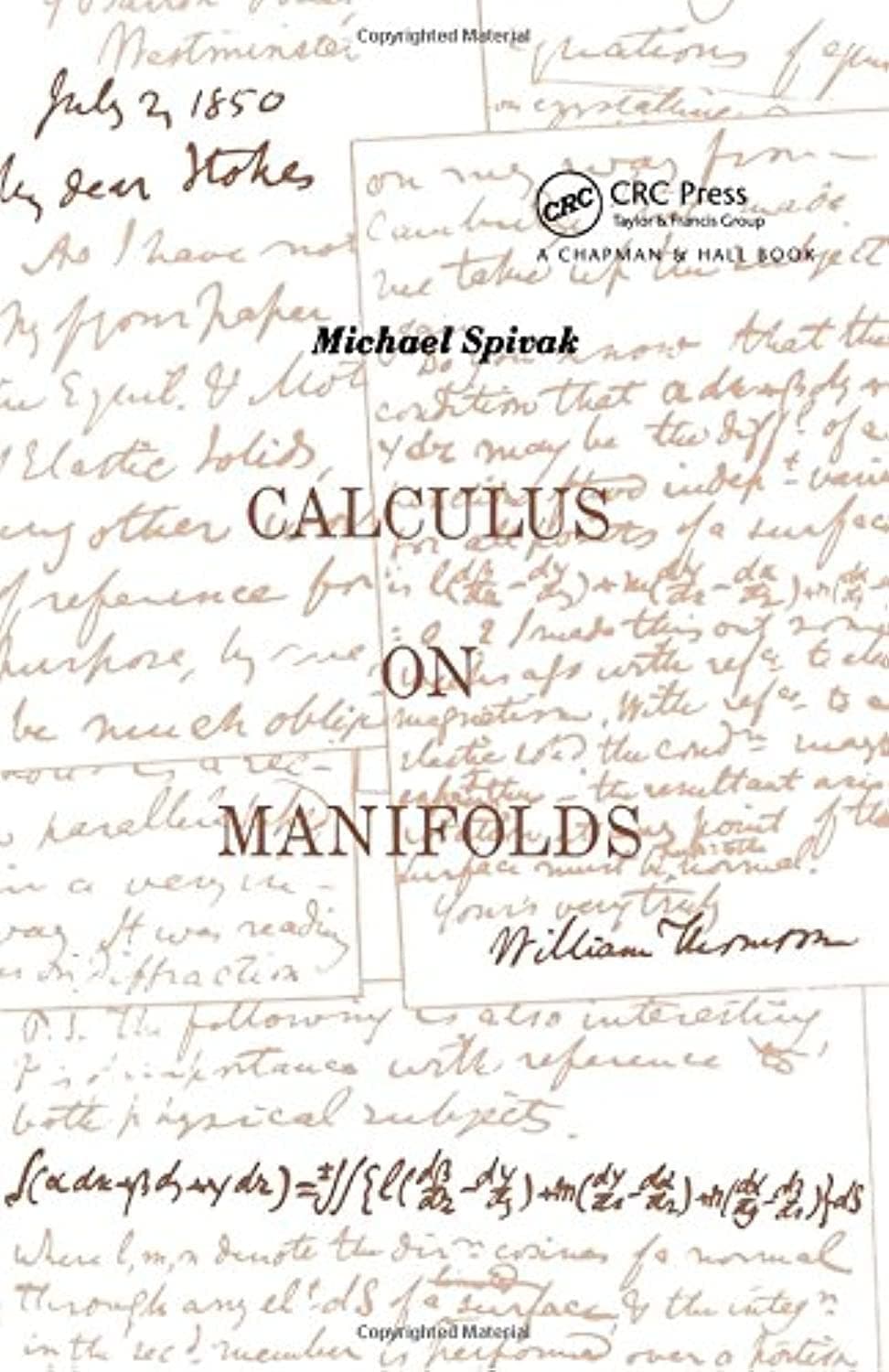

Buy Calculus On Manifolds: A Modern Approach To Classical Theorems Of Advanced Calculus on desertcart.com ✓ FREE SHIPPING on qualified orders Review: Though I have learnt nothing about manifold from this book, 5-star! - First of all, don’t be fooled by the “prerequisite” in the preface. You should have completed one term of linear algebra, analysis and multi-variable calculus. As I have already self learnt these topic, I took this book as another self learning challenge. This book is really well written. I really like its compactness and conciseness, though this means not much explanation is given usually. I have read through chapter 1 to 4, these chapter give complete building block for doing calculus on higher dimensions. By the time I finally get to the stoke theorem, I was really excited. This definition about forms, chains, d and ' are quite complicated. But after all, the stoke theorem and the problems can explain everything about stuff like curl, div, grad, and other “stoke type theorems” you learnt from multi-variable calculus course. So the effort have paid off. I and have done all the exercises. There are few reasons why you must do the exercise: 1. This book lacks example, it is filled with definition, theorems, and proofs of theorems. You can understand nothing if you omit the exercises. 2. Most of the exercises are quite doable. I can do many of them by myself (despite the fact that have I no teacher to seek for help). Though sometimes I am stuck, I usually find the answer from the internet. 3. Some exercises are targeted at the given theorem. They explain why such condition in the theorem is necessary, and what counter-example will appear if they don’t. Sometimes the text even rely on results proven in previous exercises. By the way, you must get involved in the context. Sometimes when you feel the context is not enough, search from the internet, and you learn more. As for the downside, this books contain quite a few flaws. Sometimes the assumption of exercise problems are not clearly stated. Now I have finished chapter 4, the reason I choose to pause here is because I found that in chapter 5, the definition of manifold is over simplified. I don’t feel it is suitable to learn such a important concept from this thin final chapter. I will probably seek for another book. So after all, I learnt nothing about manifold from this “calculus on manifolds”. Review: Great book - Used as a reference for my real analysis of several variables course. Exercises are tough and require a fair amount of thought, which is exactly how math books should be. The book has some antiquated formatting in comparison with more modern books, but shouldn't confuse anyone too much. Don't let the size fool you, more is contained in here than in most calculus of several variables books. EDIT: I've since purchased Spivak's "A Comprehensive Introduction to Differential Geometry, vol. 1". Chapters 4 and 5 of "Calculus on Manifolds" are essentially contained in this book as well. However, they are explained in much fuller detail, and the book contains much more information regarding the subject. I would greatly suggest it to anyone reading this who felt unfulfilled or yearning for more from chapters 4 and 5.
| ASIN | 0805390219 |
| Best Sellers Rank | #134,494 in Books ( See Top 100 in Books ) #67 in Calculus (Books) #104 in Mathematics (Books) |
| Customer Reviews | 4.5 4.5 out of 5 stars (144) |
| Dimensions | 5.25 x 0.25 x 8.25 inches |
| Edition | 1st |
| ISBN-10 | 9780805390216 |
| ISBN-13 | 978-0805390216 |
| Item Weight | 7.2 ounces |
| Language | English |
| Print length | 162 pages |
| Publication date | January 22, 1971 |
| Publisher | CRC Press |
J**N
Though I have learnt nothing about manifold from this book, 5-star!
First of all, don’t be fooled by the “prerequisite” in the preface. You should have completed one term of linear algebra, analysis and multi-variable calculus. As I have already self learnt these topic, I took this book as another self learning challenge. This book is really well written. I really like its compactness and conciseness, though this means not much explanation is given usually. I have read through chapter 1 to 4, these chapter give complete building block for doing calculus on higher dimensions. By the time I finally get to the stoke theorem, I was really excited. This definition about forms, chains, d and ' are quite complicated. But after all, the stoke theorem and the problems can explain everything about stuff like curl, div, grad, and other “stoke type theorems” you learnt from multi-variable calculus course. So the effort have paid off. I and have done all the exercises. There are few reasons why you must do the exercise: 1. This book lacks example, it is filled with definition, theorems, and proofs of theorems. You can understand nothing if you omit the exercises. 2. Most of the exercises are quite doable. I can do many of them by myself (despite the fact that have I no teacher to seek for help). Though sometimes I am stuck, I usually find the answer from the internet. 3. Some exercises are targeted at the given theorem. They explain why such condition in the theorem is necessary, and what counter-example will appear if they don’t. Sometimes the text even rely on results proven in previous exercises. By the way, you must get involved in the context. Sometimes when you feel the context is not enough, search from the internet, and you learn more. As for the downside, this books contain quite a few flaws. Sometimes the assumption of exercise problems are not clearly stated. Now I have finished chapter 4, the reason I choose to pause here is because I found that in chapter 5, the definition of manifold is over simplified. I don’t feel it is suitable to learn such a important concept from this thin final chapter. I will probably seek for another book. So after all, I learnt nothing about manifold from this “calculus on manifolds”.
D**S
Great book
Used as a reference for my real analysis of several variables course. Exercises are tough and require a fair amount of thought, which is exactly how math books should be. The book has some antiquated formatting in comparison with more modern books, but shouldn't confuse anyone too much. Don't let the size fool you, more is contained in here than in most calculus of several variables books. EDIT: I've since purchased Spivak's "A Comprehensive Introduction to Differential Geometry, vol. 1". Chapters 4 and 5 of "Calculus on Manifolds" are essentially contained in this book as well. However, they are explained in much fuller detail, and the book contains much more information regarding the subject. I would greatly suggest it to anyone reading this who felt unfulfilled or yearning for more from chapters 4 and 5.
B**N
A Must Read Book
Many years ago, when I was a freshman in a Physics class, my Calculus teacher gave me this small book. It changed the way I viewed mathematics. Spellbound, I turned page after page enjoying the beauty of the theorems and the logic of the whole construction. This books explains the reason behind Stokes and Gauss theorems and introduces many useful concepts. It is a must read book for anybody seriously interested in the modern Calculus. It does not require exotic mathematical background, and any reader having some classes in classical Calculus can read it. I recently reread this book and was happy to recall the magic of this great introduction to the real mathematics.
R**N
A Pedantic Breakthrough
A good improvement on most text on this subject. Spivak has condensed the salient features of the subject and its notation into a description that is readable by students wishing to learn this material. There are a few areas (tensors/forms) where a little effort would have rendered something more readable, but overall this is an excellent presentation.
D**L
Five Stars
Clear and understandable. A treasure.
A**R
Calculus on Manifolds was undoubtedly one of the more enticing, challenging and inspiring textbooks I have ever studied. This is not intended for the average student. This book IS NOT for students trying to pass their multivariate calculus course. Spivak takes you on a unique journey beginning in simple topological notions of the euclidean n-dimensional space to the fundamentals of differential manifolds and differential geometry. Between the first and the last of the one hundred and few pages are a gauntlet of challenging exercises, original out of the box proofs and clever insights, all of these seasoned with "Spivakisms" which make his textbooks stand a cut above the rest. The first 3 chapters are accessible for pretty much anyone, but the real challenge begins in chapter 4. You need to fight the book. But it is worth it. In the preface, he writes "the backgorund needed are a strong semester on calculus and linear algebra, acquaintance with notions from set theory and a certaint, perhaps latent rapport with abstract mathematics". I would add, A LOT OF PRESISTENCE. If you are struggling with chapter four onwards, I highly suggest complementing it with Munkres Analysis on Manifolds, which is much more accessible and should have been called instead "Spivak for Dummies". Enjoy, I am sure that with presistence this would be the book you would marry to if you could marry a book.
K**I
高名な著書でありながら、読まずにいたので、読むのが楽しみです。
A**N
Arrived in great condition
A**R
Very good
R**A
Un libro difícil, excelente; sólo para personas con conocimientos de cálculo bastante avanzados.
TrustPilot
3 周前
2 周前