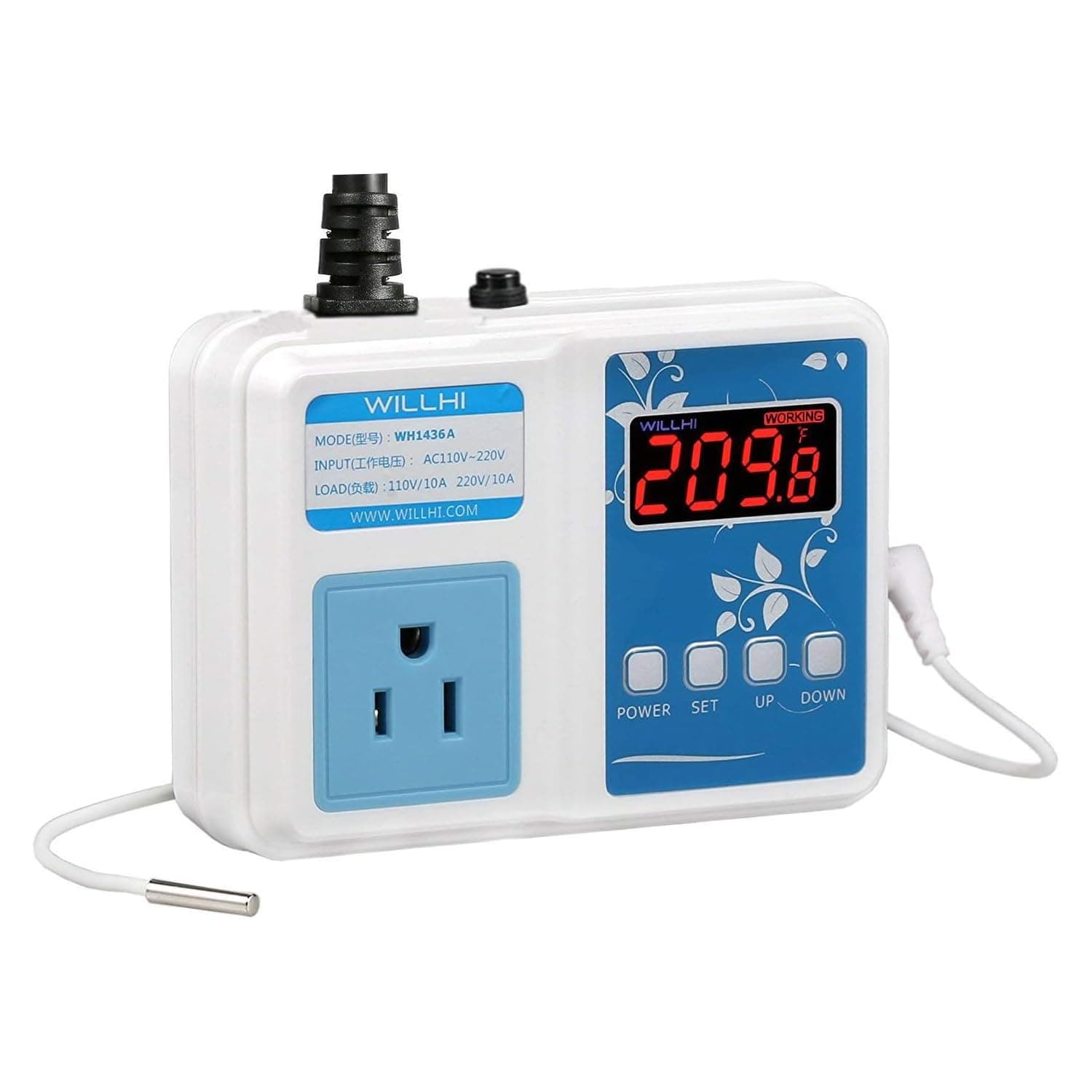
🌡️ Master your environment with smart, no-fuss temperature control!
The WH1436A is a robust digital temperature controller designed for precise heating or cooling management up to 1100W at 110V. Featuring a wide measurement range (-58°F to 230°F), 0.1°F resolution, and a waterproof 3m sensor probe, it supports plug-and-play operation without WiFi, making it ideal for sous vide, fermentation, pet breeding, aquariums, and more. Its memory retention, compressor delay protection, and high/low alarms ensure reliable, professional-grade temperature regulation.


| Brand | WILLHI |
| Color | White |
| Item Weight | 1.04 Pounds |
| Material | Plastic |
| Product Dimensions | 4.9"L x 3.6"W x 1.8"H |
| Voltage | 110 Volts, 220 Volts |
A**R
Great Thermostatically Controlled AC Outlet
We purchased this controller along with a 110 VAC, 3/4" Brass Electric Solenoid Valve to control water flow to our outdoor water misting systems. It was super easy to hook up and program to do what we wanted it to do. The instruction sheet we received with the product was fairly comprehensive and adequate for us to get the controller to work like we wanted. But in addition, the manufacturer took the time to send us an email giving additional instructions and explanations on how to set up the controller. We didn't ask for this, they just did it on their own to try to provide the best customer service (I suppose some people weren't as comfortable with the instruction sheet that comes with the unit). The controller works perfectly and we are very happy with our purchase. We highly recommend it for those needing to have a thermostatically controlled AC outlet. A couple of things we learned in the process of using this controller in an outdoor environment: First, if you are using the product outdoors, you don't want the temperature sensor to be near the ground or in direct sunlight. Ideally, you want the sensor (that's the 10-foot white cable that plugs into the side of the controller) to be a minimum of 6 feet above the ground, or even higher if over pavement or concrete that radiates heat. The reason for this is that the sensor will register anywhere from 5-10 degrees too high on a sunny day and stay high even after the sun goes down because of the heat radiation from the ground. This is not a problem with the controller sensor, it is only responding to the environment you place it in and we checked its accuracy and it is very accurate. You also want the sensor to be shaded from direct sunlight. If in direct sunlight, the sensor will read about 2-3 degrees too high because of the sun's radiation. We placed the controller in a waterproof bag and both the controller and electric valve in a waterproof container with a sealed lid to protect it from rain and the elements. The sensor extends outside the container and is about 7-8 feet above the ground suspended on a pole. It's now been operating satisfactorily for 2 weeks and has survived a couple of aggressive rainstorms out here in the Midwest. The unit also has internal memory and remembers its settings in case of a power failure so that when you restore the power, the unit resumes normal operation. Also, our water valve is a "normally closed" valve so if there is a power failure, the solenoid valve automatically shuts the water off. The valve does not come with this product, you have to purchase it separately and is available here on Amazon. This controller is a great product and we're glad we bought it!
R**S
It is durable, reasonably priced and does the job.
I purchased this controller back in 2018 to keep some new chicks warm. I have used it several times since then for that purpose. I am setting it up again for the same job and realized I never gave a review. Positive Features: * It allows you to set a low and high threshold allowing one to keep the temperature in the desired range. * It has both a high and low alarm feature, which alerts you if the temperature goes below or exceeds the desired temperature range. * It allows the temperature probe to be calibrated with an offset. I found my probe was accurate enough over the desired range, not requiring an offset be entered. * It can be used with both heat devices, a heat lamp in my case, and cool things. The maximum controlled power is limited (1100 w), so it would not work with a high power refrigeration unit without an additional relay. Not a problem in my case. * For cooling, it allows you to set a compressor on time to prevent rapid cycling which could be bad. * The manual, if one ignores a few typos, is detailed enough to make setting up fairly easy. Just don’t lose the manual. * It does not require wifi, does not phone home, so it does not clog up your internet connection. A very positive feature. Negative Issues: The case is yellowing slightly, which happens with this type plastic. Not a deal stopper. Would I buy it again, yes.
A**R
So far works pretty well
I bought this to control the temperature of a water bath for making kefir, which ferments at 75 degrees. I use it to cycle an old slow cooker and use an old aquarium air pump for water circulation (see photo) to approximate a sous vide immersion circulator. The probe is sealed and waterproof, which allows me to submerge it in the bath to monitor temperature. I also plan to use it to cycle a space heater in an oven to proof dough, though I haven't tried this yet. Using the controller to cycle a slow cooker works for this application but isn't ideal. Because slow cookers work by heating a ceramic insert which then heats the water, the insert tends to be heated to a higher temperature then the water and continues to heat the water when power to the cooker is shut off. This causes the controller to overshoot the target temperature. If the water is already at about the target temperature it only overshoots by a small amount (for my application about a degree), but if the water is being brought up to temperature it can overshoot the target temperature by at least 5-10 degrees. So if you are using this as a sous vide cooker for food which demands accurate temperature control, I would recommend letting the temperature stabilize before adding your food to the water bath. Or use this controller to power a small immersion water heater of the sort used for heating water in a coffee cup (make sure to select one which uses less power than the controller's maximum power output rating). Since an immersion heater heats the water instead of the insert and does not "store" as much heat as a slow cooker ceramic insert, it will not continue to heat the water when it's turned off. This is what commercial sous vide circulators use to heat water, and they circulate the water to prevent a "hot spot" immediately around the heating element. Beyond that, the temperature measured by the controller is accurate to within a degree of what's measured by my kitchen thermometers, the controller is easy to set up, and the instruction sheet is adequate. The on/off temperatures can be adjusted in increments of a tenth of a degree, so even though it's not a PID controller it can still accurately control temperature under the right circumstances. This is a nice tool, but to get good results from it you have to have an understanding of the environment in which it's being used.
A**I
Works as advertised, should have a PID controller
This product works exactly as expected and advertised. Choose either heating or cooling, set lower and upper temperature bounds, and place the temperature sensor wherever you need it. The controller will turn on power to the outlet when the temperature reaches one bound, and will turn it off when it reaches the other. As long as the device you plug in is configured to turn on automatically once it receives power, it should power cycle as the temperature fluctuates. The reason it only gets 4 stars is because this simple on/off mechanism is not a very good design for a temperature controller. For a system where the temperature changes relatively slowly, like a sous-vide, it should work fine because the temperature won't change much after the power is turned off. For a system where the temperature changes quickly, like a toaster oven, it won't work very well - the heating elements are still hot when the controller shuts the system off, so the temperature will overshoot. Similarly, when the temperature comes back down and the controller turns the oven back on, it takes time for the elements to heat up so the temperature will undershoot. The proper way to do this is with a PID controller, which keeps track of the temperature history and how fast temperature is changing, in addition to the current temperature. Such a controller can maintain the temperature precisely regardless of how quickly the system being controlled works. Also, it's not much more work to implement than a simple on/off controller. From a practical standpoint, for those of you facing this problem, an alternate solution is to put a large thermal mass (e.g. a big hunk of steel) into the toaster oven, and attach the temperature sensor directly to that mass. This will slow down the rate at which temperature changes, so the controller should work properly (although it'll take longer to get up to temperature, and to come back down after).
T**R
Working great so far.
I bought this for a small greenhouse heater control, but I'm testing it out with an oil-filled radiator in the house. Setup was easy. Construction seems solid. Temperature control has been great. It is designed to control either a heater or an air conditioner. I have it set to come on at 66 degrees and go off at 70 degrees. I also have a nearby thermometer at about the same height. Temperature readout is closely consistent with my AccuRite thermometer/humidity sensor, and the heater is appropriately turned on and off. The built-in temperature control on the heater was never accurate and always made an annoying click. At night, that click would wake me up. But, with this temperature controller, the heater makes no sound at all. It's great. It is also possible to adjust the controller thermometer reading if you find it to be off. I haven't had to do that. I love the sensor wire as it allows me to put the thermometer sensor at person height or plant height, unlike other options where the sensor is attached directly to the controller. I've only been using it for a couple of days, so I don't know about durability, but so far, it's great. I might get a couple more for other locations. Recommended! Nov 29, 2020: Still using this in my study and am delighted with it. It reliably turns a small oil-filled radiator on and off to maintain an even temperature. The unit is rated for up to 1100 watts so it is important to stay within that range. I had intended to use this in my small greenhouse but it works so well in my study that I have kept it there and bought a second one for the greenhouse. It is also working great there. To not exceed the power rating in the greenhouse, I have 2 heaters: one 400 watt heater set on a timer to come on in the evening, and another 1000 watt heater hooked up to this temperature controller. Even in the low 30's my greenhouse stays within the desired range. Both of my units have worked flawlessly. One improvement would be the option to turn off the display. At night in a dark room it can be quite prominent. I can always cover it with a heavy cloth or small cardboard box, but it would be nice if I didn't need to. That is the only thing holding me back from getting a third unit for my bedroom, which I might get anyway and just deal with it. 3/2/2021: I now have 3 of these units. All have worked flawlessly. The unit in the greenhouse would occasionally trip. This seemed to be due to a small 1000 watt ceramic heater which does have a higher current draw on startup. I turned that heater down to the 500 watt setting and no further issues. I also put one of these in my small bedroom. It seemed that I could never get the temperature in the room right, and I would find myself either too cold or too hot at night. I got one of these controllers, put the sensor at bed height and plugged in a small oil-filled heater. After some experimentation I found the perfect temperature for sleeping, and the controller silently keeps the temperature consistently even. It's great! I did need to lay a cloth over the display to block the light, but that was all. I marvel at how perfectly comfortable my rooms are now.
N**I
Works on 240v -- GREAT for our apartment!!! FULL PRICE REVIEW
PAID FULL PRICE, just to be clear!!! No discounts offered, nor would they be accepted either. Honest positive experience from a guy who searched damn near everywhere for this!!! Although the product description specifies 120V only, and the seller stated it was only meant to be used on 120v devices, the box listed specifications for 120v to 240v. I only realized I had 240v A/C units after trying to install it and unplugging the A/C to find the top two pins were sideways, dead giveaway that it's a high-voltage device. After days of searching for 240v thermostats with US plugs ("NEMA 6-15" or "NEMA 6-20" by the way) and coming up empty, I finally tried to find adapters, and found them! A/C to Thermostat --> "EVSE Adapter" (Dostar Duosida). Electric vehicle charger adapter I think. Thermostat to wall --> "6-15P to C13". Normally used to power desktop computers from 240v lines. Both can be readily found on eBay. No Prime options existed -- I checked. Pictured is my setup, fully functional. Instructions were clear, no issues installing at all, just put a couple screws for it to mount on, wired it up, instantly works great! It comes with two nail slots, round on the bottom, narrow on top, to "lock in" better. I have three running at the moment, but only one has the proper cable. Has me antsy for the other two cables to arrive so I can have all three running!!! Only real gripe is that the "temperature alarms" are set to serious extremes. High temp alarm is at about 240 F, low temp alarm was somewhere between 0 F and (-110) F -- yes, negative! Thankfully holding down the relevant "up" or "down" button does make it move faster, but still takes about a minute of holding to get it down to 80 F where I wanted it. That said, it seems to have an incredible range of temperatures it senses, but makes me wonder if the device itself can withstand those temps (most electronics can't for the record, I would be surprised if it could), although I'm pretty certain the sensor alone could handle those extremes. Wouldn't trust putting the box in any temperature humans can't tolerate, to put it that way.
R**S
Great if you love codebreaking....I think it works.
I think this works. If you are the type of person who loves to remember cryptic instructions, this will be great. If you love codebreaking games, this is for you. I have read the instructions, and watched multiple videos and have gotten it work once. This should be great to keep something at a certain temperature--a cheap sou vide. I intended to use it for making yogurt in a slow cooker--don't go above 108. We all use thermostats--we expect to select a temperature and be done with it. This one takes multiple steps where you are selecting HC or H or LP (is that a long playing record). Even after checking everything I have no idea what they mean. If you're old enough to remember typing letters on a phone where you had to press each number 1, 2, or 3 times to get the right letter plus the pound afterwards to move to the next, this is for you. Setting this should mean setting a start and a stop temperature, perhaps a number to allow for wiggle room.) It just turns the power on and off for another device. But it has so many variables to enter, none of which are clear. It shouldn't matter if it's a cooler or a heater--turn on at one temp and off at another to keep within a certain range, but this one has different instructions for each. Even so, a simple table could show you the instructions for each possibility you needed, showing what button to press and what you will see in sequence for each possibility. I am trying to write one just for my one "on until you reach x degrees f" and that's going to take me more time as I'm not certain it is doing that or not and I'm not a code breaker. I'd even give it to the manufacturer as a template for them to include.
S**I
Accurate temperatures; works as expected
I use this to control temperature in a food dehydrator that didn't have a thermostat installed. It's very flexible in how you can configure it, but that means it might not be as straight forward as some people may expect. However, it's pretty easy to set once you get the hang of it, and the temperature probe is accurate (I double-checked it using two other digital temperature probes). It also seems well built, and it's been working as expected for a few years now.