We remain fully operational. Our teams are working around the clock to ensure your deliveries continue safely.

下载应用程序


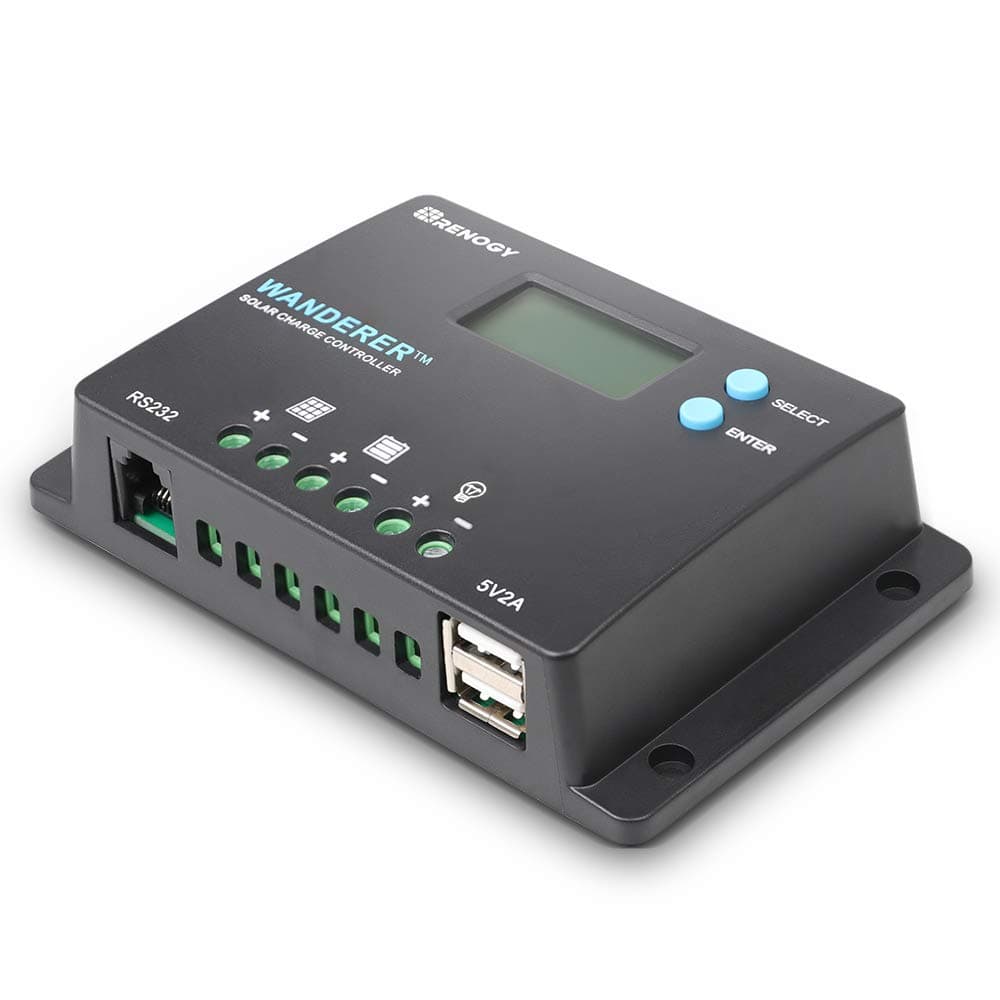
🔆 Power Smarter, Live Freer — The Renogy Wanderer 10A Charge Controller
The Renogy Wanderer 10A PWM Solar Charge Controller is a compact, durable, and intelligent solution designed to optimize solar charging for 12V/24V systems. Featuring advanced 4-stage charging, multi-battery compatibility, and robust system protections, it extends battery life by up to 30% while minimizing power loss with ultra-low self-consumption. Its backlit LCD display offers real-time monitoring and error diagnostics, complemented by a handy USB charging port. Ideal for RV, marine, and off-grid applications, this controller delivers professional-grade performance at an affordable price.

















| ASIN | B07NPDWZJ7 |
| Best Sellers Rank | #4,541 in Patio, Lawn & Garden ( See Top 100 in Patio, Lawn & Garden ) #1 in Renewable Energy Controllers |
| Brand | Renogy |
| Brand Name | Renogy |
| Color | black |
| Customer Reviews | 4.4 out of 5 stars 7,220 Reviews |
| Display Type | LCD |
| Global Trade Identification Number | 00816360029953 |
| Included Components | Wanderer 10A solar charge controller |
| Item Dimensions L x W x H | 4.69"L x 2.95"W x 1.08"H |
| Item Type Name | Compact Design w/ LCD Display for AGM, Gel, Flooded and Lithium Battery, Wanderer 10A |
| Item Weight | 0.27 Pounds |
| Manufacturer | Renogy |
| Material | Gel |
| Material Type | Gel |
| Product Dimensions | 4.69"L x 2.95"W x 1.08"H |
| UPC | 816360029953 |
| Voltage | 24 Volts |
| Warranty Description | 2-year material and workmanship warranty |
A**X
Better than the cheap rebranded PWM controllers.
Far better than any of the cheap junk off brand PWM controllers I've used that break and don't work correctly. This Renogy PWM controller works flawlessly compared to the tons of junk PWM controllers on the market. It is actually a 10 Amp controller, and actually charges and floats batteries correctly. And actually has a website and support and a real company that provides documentation. It properly uses solar panel power to charge flooded lead acid batteries up to 13.8V, and floats them at 13.8V. At high noon it regulates my 21v solar input perfectly. The voltage display is accurate enough, plus or minus a tenth or two of a volt. Only downside/drawback is the battery low voltage cutoff for the load connection. It's set to 10.8V and can't be changed. Which is far too low for flooded lead acid batteries. Draining a lead acid battery all the way down to 10.8v can damage it. If you don't have a separate low voltage disconnect or accidentally let a lead acid battery drain that far down, it might damage the battery. If you use a lithium battery that has a built in BMS you should not have to worry about that. I went through two cheap no brand $10 PWM controllers that were very inaccurate and quickly broke before buying this controller that actually works correctly.
T**Y
Exactly what I needed
I have an IRLP node with a 12V lithium battery for backup should the power go out and I needed a charge controller as the DC in I have is about 20V, which is naturally too high to simply directly connect. This controller is exactly what I needed. It will do SLA, flooded and lithium chemistries, you need to select type of battery manually, and you can dial in what charge voltage you want, in my case, according to the battery I have connected, it wants to see 14.4V. You can set up the LCD readout to display what you want for the most part and it has performed flawlessly since I have had it. The instructions are fairly clear on what you need to do to set it up and it actually is pretty easy. It has worked well during outages, switching from the input source to the battery is seamless. I am very happy with this controller and have already recommended this brand to my friends that were looking for one for their various reasons.
R**R
Significant battery voltage reading error with temp sensor attached.
4 stars explained Pros -charging algorithm voltage values are correct as measured with DVM (only flooded, agm and LiFePo4 tested) -LiFePO4 charge voltages can be set by user from 14.2 default to most common values depending on battery manufacturer spec. I use 14.6 volts (new). 2018 version default was 14.4 volts -Completely sealed against elements -When equipped with Temp sensor, will include battery temp on the display rotation (new). Previous version required manually toggling the display -shows input Panel voltage (new). Cons -Battery voltage readings can be inaccurate for all battery types and worsen with temp sensor attached (but solar panel voltage readings OK). -Exchange to get a controller that read accurately resulted in an improvement, but attaching temp sensor again introduced .2v to .4v error. -Battery type selected does not display by default (previous versions did, i.e. Gel, Wet, LiFePo4, AGM) Have to push buttons on new version to go into Select Batt Type menu. -Battery type selection button often unresponsive. -Selecting LiFePo4 charge voltage values sometimes not responsive; if desired value is passed up in scrolling, could not scroll back; had to scroll through full range and couldn't get a response for each push of the button. -Panel and battery connection LEDs no longer present. Loss of an EZ visual status observation, possibly an energy saver. Must wait for status to scroll automatically or must scroll manually through display to see status. --Auto scroll interval too long to see 5 parameters. Two secs per parameter should do it. -Hard reset process discussed with Renogy to clear possible errors not described in manual and might or might not work. (later determined attaching temp sensor caused the incorrect readings) In a nutshell, some of the improvements in this version are welcome and some of the old features are missed. But that isn't the problem. This newer version had inexplicable battery voltage reading errors not present in in 2018 versions I own. Amazon and Renogy were great in trying to get a working replacement, but in the end, decided to abandon that effort in favor of a refund for now. LiFePo4 does not use temp compensated charging as lead acid batteries do. So, when the LiFePO4 battery voltage read spot on, backtracked to see what was different. The difference turned out to be the temperature sensor. I used the sensor for flooded and AGM, but disconnected it for LiFePo4. Attaching it caused a substantial voltage reading error for all battery types that made it impossible to accurately determine battery state of charge. Charge algorithms didn't seem to be affected when measured with an external DVM. Neither of the 2018 versions I own are affected by attaching the temp sensor. One other thing to remember about LiFePo4 batteries is they do not like to "float" at much above 13.6 volts after reaching full charge. This isn't much of a concern in solar charging because charging ceases in the absence of solar energy. Thus there is no real need to have a voltage limited float stage setting after the battery is fully charged and balanced. This is the very first time I've given 4 stars to an item I've been dissatisfied with, but this controller, even with the battery voltage reading issue still offers useful functionality once set up. Use an external monitor if you want accurate voltage readings to monitor state of charge when using with the temperature sensor. Otherwise, I especially like the user defined charging voltages for LiFePO4 as values can vary among LiFePO4 manufacturers. It's important to use the right setting. The temperature sensor addition should only cause the controller to do its job of reducing charging voltages above 77 deg F and increasing charging voltages below 77 deg F where temp compensated charging is necessary. It should NOT affect the accuracy of reading battery voltage. An otherwise 5 star controller gets a "pushed" 4 stars. It does all things well except show acceptable values for temperature compensated flooded and AGM battery voltage. Both the original and the replacement returned to Amazon citing the Renogy case number. If the accuracy of the resting voltage is of utmost importance, then 3 stars.
H**0
Works much better than the knock off
I like the battery types this controller can support. You can program the load to kick on when the panel stops producing power, though I'm using a photo sensor cell at the moment. Overall, I'm pleased so far. Oh, and not to mention the blue tooth addon.
A**Y
Review of the Renogy Wanderer 10A Charge Controller
I recently purchased the Renogy Wanderer 10A PWM solar charge controller for my off-grid setup, and so far, I'm very happy with its performance. It's a great piece of equipment that offers a lot of value for its compact size and price. Connectivity (and Bluetooth): One of the standout features is its connectivity. The controller has an RS232 port, which allows you to connect a BT-1 Bluetooth module (sold separately). This is a game-changer because it enables real-time monitoring of your system right from your phone using the Renogy DC Home app. I love being able to check the battery voltage, power input, and charging status without having to physically be next to the controller. The controller also has a handy 5V 2A USB port for charging small devices, which is a great bonus. Temperature and Voltage Control: The controller uses smart 4-stage PWM charging (Bulk, Boost, Float, and Equalization) to optimize battery health. It also includes temperature compensation to automatically adjust charging parameters based on the ambient temperature. This is a crucial feature for extending the lifespan of your batteries. It's designed to work with both 12V and 24V systems and automatically detects the voltage, which simplifies the setup process. Power and Brightness: This 10A controller is rated for a maximum PV input of 130W for a 12V system and 260W for a 24V system. It's perfect for a small-scale solar project, like powering lights or charging devices in a cabin or RV. The integrated backlit LCD screen is bright and easy to read, clearly displaying important information like voltage, charging current, and load status. The display provides a constant, real-time look at how your system is performing. Overall Impression: The Renogy Wanderer 10A is a solid, reliable charge controller. It's well-built and includes a variety of electronic protections to prevent damage from overcharging, short-circuits, and reverse polarity. Its user-friendly interface and the option for remote monitoring via the Bluetooth module make it an excellent choice for both beginners and those with more experience. I highly recommend it for anyone building a small, efficient solar power system.
Z**A
Bad controller
This controller did not even last one month. I started to get E01 and E08 error codes after 2 weeks usage on my lead acid batteries. Sometimes I would get an error code as soon as I hooked it up, and sometimes it would give me the error code after a few hours. I get these errors on three different battery banks that I have on my RV. I have installed this on my original solar suitcase (not my Eclipse model), replacing my 5 year old Viewstar controller. I called Renogy and they told me to check the battery voltage and voltage at the controller terminals. I did previously and both were at 12.4 volts, which should be fine. So I guess this controller just does not work for me and I have to purchase another now, and reinstall it to my suitcase. Of course I will use a different model. I actually again checked the voltage after the Renogy tech person seem to really question the voltage at the controller. I disconnected my Battery Tender, and the battery read 13.03 volts after settling down a few minutes, and it registered 12.94 at the controller terminals. So I am pretty sure my connection and wires are ok. By the way, now I am getting more error codes today, EO and EO2, the controller is going crazy with error codes, then it connects and seems to work after a while. Seems to connect and disconnect at random. On a side note, the manual is somewhat vague, on page 14 it says to set the ‘charge voltage’ for a lithium battery (LiFepo4), but makes no mention of what voltage to set it at. There are about 21 different choices with no direction on what they mean or what to use. It goes from 12 volts up to 16 volts in .2 amounts of progression. On page 21, it talks about ‘Boost Voltage’, I have never heard of this, I know the 4 stages of charging a lead acid battery, but what is boost voltage? I guess I need to read up on this. I have had many questions on my reviews for other Renogy products, and I have recently purchased several items; the 100aH LiFePO4 battery, a DC to DC charger (wait till I review the manual on this thing!), several PWM controllers, and several other smaller items. I am also trying to update my current review of the Eclipse suitcase with a major edit concerning the ‘plastic blocks’ that connect the legs to the frame but been have a little technical difficulty with the website. I decided to install another solar controller due to all the problems with this one. I installed the Renogy Voyager 20A Waterproof Solar Controller, and so far it works perfect, no error codes. It also has a better manual and it at least tell me that the ‘charging voltage’ for lithium batteries is set at a default amount of 14.2 volts. Bummer, my first negative review of a Renogy product, but it just did not work well.
P**.
Simple, reliable PWM controller. Gets the job done.
I built a small, off-grid solar system for my shed to power LED lights and a small ventilation fan that consisted of a 50W 12V-class panel (open circuit voltage around 20V), a 10 amp-hour LiFePo4 battery, and this charge controller. In that setup, it's worked great. It's a basic, workaday PWM charge controller that had worked great in my shed for several years until I decided to upgrade the system and added more panels and put in an MPPT controller. Pros: - Small size. - Reasonable price. - Terminals hold wires firmly and are easy to loosen and tighten. (Tip: crimp ferrules onto the ends of stranded wire rather and insert them into the terminals. Clamping stranded wire into the terminals is a bit harder, messier, and more prone to error.) - Backlit screen. - Easy to configure for flooded, AGM, and gel lead-acid batteries, as well as for LiFePo4 batteries. - Charging voltage is configurable for LiFePo4 batteries (in case you want to stop charging at, say, 14.4V rather than 14.6V). - USB ports are handy for charging phones or powering other devices. - It has options for turning the load on and off at and for various times. For example, the load can be turned on all the time, toggled with the push of a button, or when the sun sets (either until morning, or for various periods of time after sunset). - It supports -- but does not include -- a Renogy Bluetooth module that allows for remotely changing settings, seeing the current status, etc. from the Renogy app. - Manual is clearly written in English and explains all settings and options clearly. Cons: - This is a PWM controller which, while simpler, inherently limits its efficiency and requires a bit more planning relative to an MPPT controller. For example, connecting multiple 12V-class panels in series (or using one with a nominal open-circuit voltage greater than about 20V) provides no benefit. They need to be connected in parallel, and then one must make sure not to exceed the 10A current rating of the controller (it does not have any current limiting capability). - Turning on the load also enables the USB ports, which consume about 100mA of current when idle. With the load off, the current consumed by the controller itself is negligible. Still, it'd be nice to have the load on and disable the USB ports. - The on-device settings for having the load switched on or off at various times of day are unclear and require consulting the manual to know what the various codes mean. - The Bluetooth module is very basic and neither it nor the Wanderer 10 have any sort of data logging. You can see the current status and change settings, but no historical data is available. You apparently need some other Renogy device to accomplish that. - The Renogy app has many features, such as social features, promotions, etc. that distract from the core functionality of managing the controller. - Although the controller is reasonably priced, but the Bluetooth module is costly. Combined, their cost exceeds that of a reputable competitor's MPPT controller with built-in Bluetooth, data logging, a better app, and better integration with other devices and remote monitoring. In short, it's an inexpensive, simple PWM charge controller. If that's what you need, it'll do the job quietly and without complaint for years. However, if you want to use the Bluetooth module with this controller, you're limited to live monitoring and changing of settings only. No data logging or historical data is available. For less money than the controller + Bluetooth module, you can get a comparable-power-limit MPPT controller from a major competitor that includes better monitoring, data logging, and higher efficiency.
P**E
Nice PWM charge controller for the money
The lugs are kind of small so going bare wire to them was the only way to mount the wires in both directions. But a very nice little unit for our portable RV application.
TrustPilot
2 个月前
1 个月前