We remain fully operational. Our teams are working around the clock to ensure your deliveries continue safely.

下载应用程序


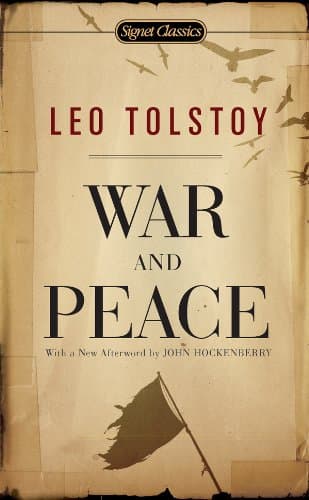
War and Peace (Signet Classics) - Kindle edition by Tolstoy, Leo, Conroy, Pat, Dunnigan, Ann, Hockenberry, John, Hockenberry, John. Download it once and read it on your Kindle device, PC, phones or tablets. Use features like bookmarks, note taking and highlighting while reading War and Peace (Signet Classics). Review: One of the greatest novels of our time - One of the greatest novels, if not the longest, ever written. This is over a thousand pages so be prepared. In essence, the story is this: We are introduced to the major families through the vehicle of a soiree at the Anna Pavlovna's home, a name-day celebration at the Rostovs, and a description of the isolated existence of the Bolkonskys at their country seat. Prince Andrey and Pierre discuss their futures and what they seek in life, both young men idealizing the"man of destiny" who is soon to invade Russia. Old Count Bezuhov dies, leaving Pierre wealthy, titled, and the most eligible bachelor in Petersburg. Nikolay Rostov and Prince Andrey undergo their first war experience at the battle of Schöngraben. They each discover the ineffectuality of the individual in a mass situation. Nikolay accepts being a"cog in a machine" and Andrey rejects being part of the administering forces, choosing, instead, to fight at the front. Pierre marries Ellen; Anatole unsuccessfully courts Marya. Andrey attends the war council on the eve of Austerlitz and wishes to be a hero. He is wounded during the battle. Compared to the limitless sky, which symbolizes death, Napoleon seems to Andrey petty and insignificant. Nikolay, with Denisov, is home on leave and he ignores his sweetheart Sonya. Pierre wounds Dolohov in a duel over Ellen's alleged infidelity. Liza Bolkonsky dies giving birth to a son, leaving Andrey with a deep sense of unassuageable guilt. Dolohov falls in love with Sonya and avenges her rejection of him by fleecing Nikolay during a card game."Intensity" is the keynote of this section, shown by incidents of love and hate, life and death. Separated from his wife, Pierre devotes himself to"goodness," by joining the masons and by an inept reforming of his estates. He and the retired Andrey have a discussion about the meaning of life and death and Andrey is inspired with new hope. The significance of their exchange points out the contrast between Pierre and Andrey. Meanwhile Nikolay has rejoined his starving regiment and Denisov faces court-martial for stealing food for his men. Nikolay asks the tsar for Denisov's pardon and witnesses the meeting between Napoleon and Alexander, a meeting between the old and new orders of government. His petition rejected, Nikolay decides the sovereign knows best and submits to"higher authority." This is an account of"real life," as opposed to politics, where the"inner man" is more significant than the"outer man." Andrey becomes involved with Speransky's circle of reformers, but when he falls in love with Natasha these activities pall for him. Pierre becomes disillusioned with masonry, while Princess Marya is made more unhappy by her father. The Rostovs' financial problems increase, and Andrey goes to Switzerland. With the wolf hunt, the sleigh ride, Christmas celebrations, and family harmony, the Rostovs enjoy the last period of their"youth." Natasha's restlessness increases during Andrey's absence, the family is almost bankrupt, and there is foreboding of hard times to come as the children enter adulthood. Natasha meets Anatole during the opera and is almost abducted by him. During her near-nervous breakdown, Pierre emerges as her comforter and their love is implied. The life-and-death struggle against France begins, with Napoleon depicted as a glory-seeking fool. Andrey turns away from his past and commits himself to the men in his regiment, who adore him. Nikolay refrains from killing a Frenchman and is decorated for bravery because he took a prisoner. Natasha slowly recovers, aided by religious faith. Petya joins the army out of a youthful patriotism which Pierre also shares. The Russians respond massively to the national threat, and Pierre feels within him an"ultimate mission" involving his love, the comet, Napoleon, and the war itself. The French who are penetrating Russia march toward their doom in the"irresistible tide" of destiny. The old prince dies and Marya moves her household to Moscow, but the war looms closer. Despite the national upheaval, the Petersburg salons remain the same. Marya and Nikolay have a romantic first meeting, while Pierre visits the deathmarked Andrey on the eve of Borodino. The battle is described as a death duel, with the Russians winning morally, if not physically. This marks the turning point from defeat to victory for Russia. Tolstoy discusses mass activity as a combination of"infinitesimal units of activity" and provides a short summary of past and future events. Moscow's abandonment and burning is the great deed that saves Russia and the moment-by-moment details of the event are discussed, including Rastoptchin's last-minute bid for glory at the expense of the cause he pretends to further. The Rostovs leave Moscow, their caravan including the mortally wounded Prince Andrey. He is reunited with Natasha, who nurses him. So close to death, Andrey understands the quality of divine love. Truth results from a life-death confrontation. Pierre conceives the plan to assassinate Napoleon, but other incidents show he is destined to fail. Nikolay and Marya meet again in the provinces, and Marya travels to see her brother. She and Natasha are with him when he dies. Pierre is nearly executed by the French, who accuse him of incendiarism. He experiences a"rebirth" in prison through Karataev, an almost mythic figure symbolizing the unity of love and hate, life and death. The end of the war is in sight as the French retreat more and more rapidly. Their retreat is the"fruit" of"unconscious activity" rather than the will of Napoleon. Pierre discovers an intense freedom in prison. This period of guerilla fighting involves Denisov, Dolohov, and Petya, who gets killed. A surprise attack led by Denisov and Dolohov frees Pierre and other prisoners. In a flashback we learn how Karataev died, and what Pierre suffered and overcame during the death march. Death and decay are part of the processes of life and growth. Natasha and Marya are recalled from their mourning into active life: Marya by her household responsibilities, Natasha by exercising love to comfort her bereaved mother. As the war history is over, Kutuzov's career ends. A new era begins to disclose itself with Russia's entrance into international leadership. Tolstoy apotheosizes Kutuzov. Pierre and Natasha meet again. Tolstoy details the"happy ending" of the careers of his fictional characters in scenes to show the domestic happiness of Nikolay and Marya Rostov, Natasha and Pierre Bezuhov. The cycle of life begins anew as Nikolinka, Andrey's son, comes of age and desires to be like Pierre and like his father. This is the philosophical exegesis wherein Tolstoy shows that"free will" is a mere construct which historians use to explain the movements of nations and people. Causality is impossible to descry when we regard the pattern of historical events, and the concept of"free will" prevents deep understanding of the nature of history. The paradox, however, is inescapable: We need to maintain the illusion of free will in order to carry on our daily lives, for our hopes, our basic beliefs depend on this notion of an inner consciousness; at the same time we are victims of innumerable and infinitesimal constraints of necessity which spell out our destiny and we are not"free" at al. Review: The Best Translation - This Briggs translation seems the most comfortable and dare I say more fun to read. The paperback itself is well done, but this is the thickest War And Peace I have ever seen. It is twice as thick as my leatherbound edition. It is cumbrsome to hold. I use a pillow to anchor it in my lap. I don't understand why Penguin had to issue this book so thick and heavy. It could have been published in two volumes or use thinner paper.
| ASIN | B001RWQVXA |
| Accessibility | Learn more |
| Best Sellers Rank | #186,761 in Kindle Store ( See Top 100 in Kindle Store ) #38 in Historical Russian Fiction #267 in Classic Historical Fiction #475 in Family Saga Fiction |
| Customer Reviews | 4.7 4.7 out of 5 stars (509) |
| Edition | Reprint |
| Enhanced typesetting | Enabled |
| File size | 2.5 MB |
| ISBN-13 | 978-1101003831 |
| Language | English |
| Page Flip | Enabled |
| Part of series | Signet Classics |
| Print length | 1440 pages |
| Publication date | June 5, 2007 |
| Publisher | Signet |
| Screen Reader | Supported |
| Word Wise | Enabled |
| X-Ray | Not Enabled |
R**N
One of the greatest novels of our time
One of the greatest novels, if not the longest, ever written. This is over a thousand pages so be prepared. In essence, the story is this: We are introduced to the major families through the vehicle of a soiree at the Anna Pavlovna's home, a name-day celebration at the Rostovs, and a description of the isolated existence of the Bolkonskys at their country seat. Prince Andrey and Pierre discuss their futures and what they seek in life, both young men idealizing the"man of destiny" who is soon to invade Russia. Old Count Bezuhov dies, leaving Pierre wealthy, titled, and the most eligible bachelor in Petersburg. Nikolay Rostov and Prince Andrey undergo their first war experience at the battle of Schöngraben. They each discover the ineffectuality of the individual in a mass situation. Nikolay accepts being a"cog in a machine" and Andrey rejects being part of the administering forces, choosing, instead, to fight at the front. Pierre marries Ellen; Anatole unsuccessfully courts Marya. Andrey attends the war council on the eve of Austerlitz and wishes to be a hero. He is wounded during the battle. Compared to the limitless sky, which symbolizes death, Napoleon seems to Andrey petty and insignificant. Nikolay, with Denisov, is home on leave and he ignores his sweetheart Sonya. Pierre wounds Dolohov in a duel over Ellen's alleged infidelity. Liza Bolkonsky dies giving birth to a son, leaving Andrey with a deep sense of unassuageable guilt. Dolohov falls in love with Sonya and avenges her rejection of him by fleecing Nikolay during a card game."Intensity" is the keynote of this section, shown by incidents of love and hate, life and death. Separated from his wife, Pierre devotes himself to"goodness," by joining the masons and by an inept reforming of his estates. He and the retired Andrey have a discussion about the meaning of life and death and Andrey is inspired with new hope. The significance of their exchange points out the contrast between Pierre and Andrey. Meanwhile Nikolay has rejoined his starving regiment and Denisov faces court-martial for stealing food for his men. Nikolay asks the tsar for Denisov's pardon and witnesses the meeting between Napoleon and Alexander, a meeting between the old and new orders of government. His petition rejected, Nikolay decides the sovereign knows best and submits to"higher authority." This is an account of"real life," as opposed to politics, where the"inner man" is more significant than the"outer man." Andrey becomes involved with Speransky's circle of reformers, but when he falls in love with Natasha these activities pall for him. Pierre becomes disillusioned with masonry, while Princess Marya is made more unhappy by her father. The Rostovs' financial problems increase, and Andrey goes to Switzerland. With the wolf hunt, the sleigh ride, Christmas celebrations, and family harmony, the Rostovs enjoy the last period of their"youth." Natasha's restlessness increases during Andrey's absence, the family is almost bankrupt, and there is foreboding of hard times to come as the children enter adulthood. Natasha meets Anatole during the opera and is almost abducted by him. During her near-nervous breakdown, Pierre emerges as her comforter and their love is implied. The life-and-death struggle against France begins, with Napoleon depicted as a glory-seeking fool. Andrey turns away from his past and commits himself to the men in his regiment, who adore him. Nikolay refrains from killing a Frenchman and is decorated for bravery because he took a prisoner. Natasha slowly recovers, aided by religious faith. Petya joins the army out of a youthful patriotism which Pierre also shares. The Russians respond massively to the national threat, and Pierre feels within him an"ultimate mission" involving his love, the comet, Napoleon, and the war itself. The French who are penetrating Russia march toward their doom in the"irresistible tide" of destiny. The old prince dies and Marya moves her household to Moscow, but the war looms closer. Despite the national upheaval, the Petersburg salons remain the same. Marya and Nikolay have a romantic first meeting, while Pierre visits the deathmarked Andrey on the eve of Borodino. The battle is described as a death duel, with the Russians winning morally, if not physically. This marks the turning point from defeat to victory for Russia. Tolstoy discusses mass activity as a combination of"infinitesimal units of activity" and provides a short summary of past and future events. Moscow's abandonment and burning is the great deed that saves Russia and the moment-by-moment details of the event are discussed, including Rastoptchin's last-minute bid for glory at the expense of the cause he pretends to further. The Rostovs leave Moscow, their caravan including the mortally wounded Prince Andrey. He is reunited with Natasha, who nurses him. So close to death, Andrey understands the quality of divine love. Truth results from a life-death confrontation. Pierre conceives the plan to assassinate Napoleon, but other incidents show he is destined to fail. Nikolay and Marya meet again in the provinces, and Marya travels to see her brother. She and Natasha are with him when he dies. Pierre is nearly executed by the French, who accuse him of incendiarism. He experiences a"rebirth" in prison through Karataev, an almost mythic figure symbolizing the unity of love and hate, life and death. The end of the war is in sight as the French retreat more and more rapidly. Their retreat is the"fruit" of"unconscious activity" rather than the will of Napoleon. Pierre discovers an intense freedom in prison. This period of guerilla fighting involves Denisov, Dolohov, and Petya, who gets killed. A surprise attack led by Denisov and Dolohov frees Pierre and other prisoners. In a flashback we learn how Karataev died, and what Pierre suffered and overcame during the death march. Death and decay are part of the processes of life and growth. Natasha and Marya are recalled from their mourning into active life: Marya by her household responsibilities, Natasha by exercising love to comfort her bereaved mother. As the war history is over, Kutuzov's career ends. A new era begins to disclose itself with Russia's entrance into international leadership. Tolstoy apotheosizes Kutuzov. Pierre and Natasha meet again. Tolstoy details the"happy ending" of the careers of his fictional characters in scenes to show the domestic happiness of Nikolay and Marya Rostov, Natasha and Pierre Bezuhov. The cycle of life begins anew as Nikolinka, Andrey's son, comes of age and desires to be like Pierre and like his father. This is the philosophical exegesis wherein Tolstoy shows that"free will" is a mere construct which historians use to explain the movements of nations and people. Causality is impossible to descry when we regard the pattern of historical events, and the concept of"free will" prevents deep understanding of the nature of history. The paradox, however, is inescapable: We need to maintain the illusion of free will in order to carry on our daily lives, for our hopes, our basic beliefs depend on this notion of an inner consciousness; at the same time we are victims of innumerable and infinitesimal constraints of necessity which spell out our destiny and we are not"free" at al.
M**O
The Best Translation
This Briggs translation seems the most comfortable and dare I say more fun to read. The paperback itself is well done, but this is the thickest War And Peace I have ever seen. It is twice as thick as my leatherbound edition. It is cumbrsome to hold. I use a pillow to anchor it in my lap. I don't understand why Penguin had to issue this book so thick and heavy. It could have been published in two volumes or use thinner paper.
E**E
Amazing! Awesome edition
First time reading W&P (took me 6 weeks). Easy read- Briggs did a brilliant job of capturing the story in a consumable way for English readers. High-quality paper, cover, etc. Highly recommended
R**H
I may love it, but cannot yet tell
Very pleased--easier read than I thought it would be. Not finished with the book only on page 200 and the book is 1500, therefore I am at the verty beginning. Enjoying so far and if the facts are correct I am learning a lot about that time of Russian History. I may love it, but cannot yet tell.
A**Y
Loving this edition!
I am loving this edition of War and Peace! First of all, the book itself is beautiful—the cover features a delicate chandelier, which feels almost metaphorical. The font is easy on the eyes, and the book feels sturdy and well-made. I did some research about which translation to read. I actually went to a bookstore to read a few snippets of the popular Pevear and Volokhonsky (P&V) version. I didn't find the writing particularly engaging, and I didn't like to have the French passages only translated in the footnotes. Besides, the font size in the P&V edition felt small, and the paper was quite thin. Then I read reviews of the Briggs translation online, which is said to be more fluent and easier to follow—even if it sacrifices a bit of literal accuracy. That trade-off doesn’t bother me, I care more about immersion and enjoying the experience. I want the style to be clear and beautiful while still conveying the spirit of the original. Overall, I'm super excited about this purchase and can’t wait to begin reading this epic.
C**S
Tolstoy is well known and this translation is already a classic
Translations are what they are. This one has a very British flavor, but any translation is limited by the choices taken of the translator. I do not know Russian to the extent that I can criticize the choices made. Suffice it to say that War and Peace still has much to say to us and that we have to endure with subtle choice distinctions this way or that which may distort the ideas of Tolstoy so long as we lack his Russian. I have read an older Translation of the Maudes and find this as understandable, but more easily paced and somewhat less stale for the usages chosen in the 1940s for the selected options then chosen by that husband and wife. Translations are clearly subjective. My choice here may not be that of any other reader. Penguin insures that the presentation of the printing fonts, text size and book construciton will be at least adequate to the task.
L**F
Excellent Binding and Translation
To be clear this review is of the Penguin Classics; Deluxe edition (November 28, 2006). The physical book is very nice. Thick glued spine and heavy tough cover. The pages are nice and the font is not too small. Sometimes thick paperbacks just don't hold up, but this one is built like a tank. Good job! I enjoyed this translation as well. no tedious French to slog through. I wish all the translators would do it this way. It is enough to know when the characters were speaking French, I don't want to have to do my own translation every time they do.
A**A
Del título no hay nada que decir, es un muy buen clásico y si te gusta o no es algo personal. La edición muy mala a la hora de cortar las hojas y pegarlas, se ven muy feas, lo cuál es una lástima porque la portada en sí es de buena calidad y hasta agradable al tacto, la lectura es legible con letra de buen tamaño y sin problemas de impresión. Su único y enorme problema es completamente estético.
P**P
Have you ever tried to read W+P from cover to cover -- and failed as I have? Much as I have the greatest respect for any translator who attempts to tackle this "Mount Everest" of fiction, I find it is discouraging when you get bogged down by a clunky style, however faithful or literal, or slowed down by "British" English as opposed to "American". Dunnigan's version is fairly easy to read, as it was the very first attempted in American English. It reads well out loud (she was, among other things, an actress) and was chosen for a Marathon radio reading of the whole novel in December 1970, when Pacifica Radio station WBAI broadcast a reading of the entire novel read by over 140 celebrities and ordinary people. So I'll stick to the Dunnigan version for now; when I want to study this wonderful novel in more depth, I'll turn to the Mandelker (bilingual) revision of the Maude version -- or even the Pevear/Volokhonsky (bilingual) version.
H**U
Excellent!
V**E
La vita nella Russia zarista all'inizio dell'ottocento e gli orrori della guerra narrati minuziosamente da un autore straordinario. Leggetelo se potete.
A**R
The book arrived in (almost) perfect condition. As it ussually happens, the way Amazon packs books is not the best, there is always some damage of the book corners. This time, though, it was almost imperceptible. The cover is black, and it can get a little filthy with fingerprints, also, the "now a major miniseries" is not a sitcker, its full part of the cover. Apart from that, the book is gorgeous! Beautiful cover and spine :) As it is a long novel, the book itself is not so heavy and I love the "old paper-cut" style of the pages as seen from the right margin. There is an introduction, the novel (1358 pages) and then a summary of the chapters, info about the characters and battles and a commentary from the translator. Also some maps. This edition is great, I am happy!