Some deliveries may take a little longer than usual due to regional shipping conditions.

下载应用程序


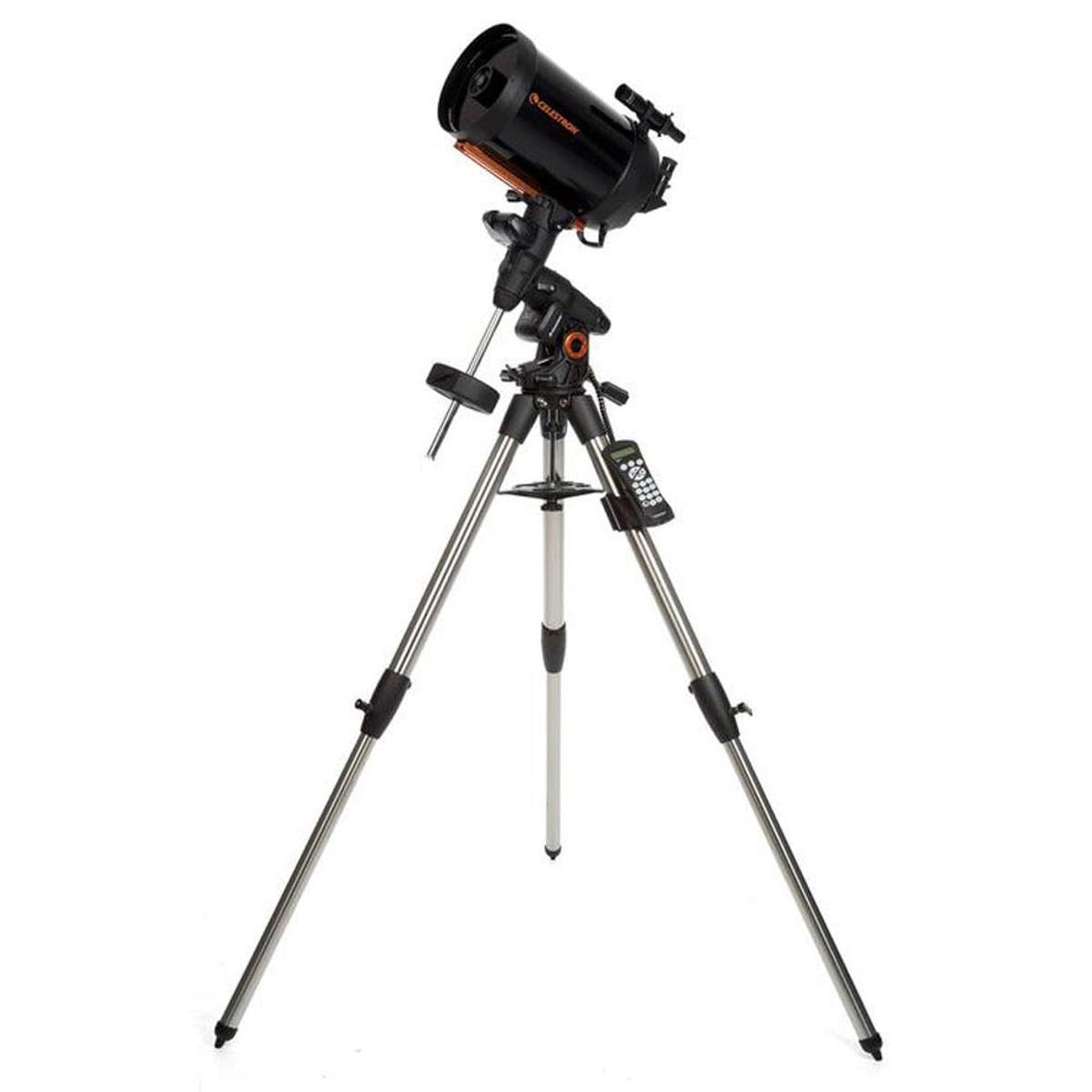
🔭 Unlock the cosmos with precision and style — your gateway to the stars!
The Celestron Advanced VX 8" Schmidt-Cassegrain Telescope combines a powerful 2032mm focal length optical system with StarBright XLT coatings and an advanced equatorial mount featuring All-Star Polar Alignment. Its flash upgradeable NexStar Hand Controller and travel-friendly design make it ideal for serious amateur astronomers seeking high performance and ease of use.
| ASIN | B00AZDDATU |
| Best Sellers Rank | #4,503 in Camera & Photo Products ( See Top 100 in Camera & Photo Products ) #30 in Catadioptric Telescopes |
| Brand | Celestron |
| Built-In Media | Advanced VX Equatorial Head and tripod Accessory Tray 1 x 12 lbs counterweight NexStar+ Hand Control DC Power Cable (item# 18769) Hand Control Holster |
| Coating | StarBright XLT |
| Compatible Devices | Camera, Smartphone |
| Customer Reviews | 3.8 out of 5 stars 30 Reviews |
| EU Spare Part Availability Duration | 2 Years |
| Eye Piece Lens Description | Plossl |
| Field Of View | 0.57 Degrees |
| Finderscope | 6x30 |
| Focal Length Description | 2032mm (80") |
| Focus Type | Manual Focus |
| Global Trade Identification Number | 00050234202619 |
| Item Dimensions D x W x H | 26"D x 12"W x 37.3"H |
| Item Weight | 80.4 Pounds |
| Manufacturer | Celestron |
| Manufacturer Part Number | 12026 |
| Model Number | 12026 |
| Mount | Equatorial Mount |
| Number of Batteries | 1 CR2032 batteries required. |
| Objective Lens Diameter | 203 Millimeters |
| Optical Tube Length | 70 Millimeters |
| Optical-Tube Length | 70 Millimeters |
| Product Dimensions | 26"D x 12"W x 37.3"H |
| Telescope Mount Description | Equatorial Mount |
| UPC | 050234202619 |
| Unit Count | 1.0 Count |
| Warranty Description | 2 Years |
| Zoom Ratio | 16.55x |
I**S
First impressions on first two weeks with first telescope
This is my first real telescope. I picked it as a compromise of weight/portability, aperture, price, capability of seeing our moon, the planets and deep-sky objects, and capability to do both visual observation and astrophotography.So far portability isn't an issue; I haven't put off using the scope due to any difficulty moving it from the garage to the driveway. I haven't tried packing it into my 05 Honda Accord yet but given the size of the parts it will fit nicely in the trunk, even leaving the OTA (optical tube assembly) in the original shipping box (which I'm using for storage/transport, since it has pre-formed non-fragmenting foam inserts and came sturdily double-boxed).Setup is fairly simple and quick once it's familiar; place the tripod aimed roughly toward the pole at about the height you're comfortable with (learned from experience), level it (I got a simple $5 hardware store level just for this purpose), attach and secure the mount, then attach the OTA (and counterweight).The entire assembly can be carried as-is if you're moderately strong and have decent dexterity/spatial awareness; if not, I believe no individual piece of the telescope is over 20 pounds / 9kg, and total weight is in the area of 65 pounds / 30kg, though I haven't actually weighed it yet. Everything seems sturdy and well-built.I don't have an ideal location for viewing outside my house at the moment, as half the sky (including the important reference point of Polaris) is blocked by trees, but even with my poor approximations of alignment the sky tracking makes keeping objects in view an occasional instead of constant annoyance. The computerized alignment setup is intuitive, just make sure you either have a GPS capable gadget with clock handy, or look up your lat/long online and write it down before going to your viewing site. You can get an add-on Celestron GPS unit to do this automatically for you but it is just a convenience, and a rather expensive one at that; so far I feel no need for it.As far as alignment, knowing your way around the sky a bit before getting this scope is a BIG plus. Calibration involves centering the telescope on stars, which are referenced by name. Everything I've read in preparation for getting a scope has said to get familiar with the sky and do some naked-eye or binocular stargazing before picking out a telescope, so this shouldn't be an issue if you've managed to pick up the names and relative locations of some of the brighter stars or come prepared with some basic star charts.The t-adapter and ring I purchased separately for my Canon DSLR work as advertised; I had the camera attached and was taking pictures with no issues due to the scope. (Celestron's T-adapter seems a bit fiddly to thread onto the back of this scope, but that's the t-adapter's fault I think, not the scope.)Included are some pictures I got with that setup (for reference, camera is a Canon EOS Rebel T3i, attached directly to the scope for "prime focus photography" with the t-adapter and Canon-appropriate t-ring). Given that it's winter the atmospheric conditions aren't ideal here in the northern United States, so I don't think the planetary pictures represent the best this scope is capable of. In particular, Saturn is fairly low in the sky right now (about 20 degrees above the horizon) so I'm getting a lot of atmospheric distortion. The live view (and videos I took) of Jupiter and especially Saturn let you 'see' a lot more detail than a simple still image gives. Still I'm pleased with the results, and looking forward to calmer skies for Saturn's opposition in May.The picture of the Orion nebula (a 10-second exposure) is adjusted on my computer, with exposure adjusted and "highlights" dimmed a bit so that the bright center isn't washed out when detecting the fainter colors surrounding it. Direct visual observation doesn't pick up the reddish and purple hues in this scope, in my limited observation. Just trying to be transparent. (to be completely fair, pretty much any pictures of nebula you see are tweaked in this way; expecting National Geographic or Sky and Telescope type pictures of nebula directly from a portable, personal-owned scope with zero image adjustment ranges from unfeasible to impossible).The picture of the first quarter moon represents the full view of my camera (which has Canon's "cropped" sensor, and therefore a narrower field of view) at prime focus. Additionally the aura/haze around the moon in that picture is due to a light sheen of clouds/haze that was in the sky at the time (notably absent in the other moon picture due to clearer skies). The picture of the waxing gibbous is actually five pictures stitched together, but still gives an idea of the telescope's capability as far as resolution. Again, trying not to be misleading.Biggest complaints:The handset's readout does not respond quickly at lower temperatures (sub freezing; the only temps available to me so far given that this is winter). I have a tough time reading what it says any time there's text scrolling across the screen. You can adjust the speed it scrolls at but either it's a glacial crawl that is still only marginally readable, or a barely decipherable jumble of letters. I adjusted the contrast and that helped marginally. Fortunately the scrolling text is usually instructions that, once you know what you need to do, you won't need to read every time. When the text is stationary it's very clear.Also, when moving the scope at the highest speed the motors seem really loud. I don't have any reference of other scopes to compare it to but at the highest setting ("9") it's loud enough that I worry it might be audible by my nearby neighbors in the dead of night (I live in a small town in rural Montana, so it's quite quiet here). The speed setting is quickly accessible though, and "8" is significantly quieter, though inconveniently slower.And on Celestron's website for this product it says it comes with a 20mm eyepiece; the one I received with the scope is a 25mm. This does not really affect me since I specifically avoided buying other eyepiece sizes before trying out the scope, but could be an issue if you based other eyepiece purchases around already having a 20mm.Overall I'm very pleased with both my choice of type of scope and mount, and this particular model's build quality and visual performance.
N**S
meh
This is a really solid piece of equipment. The optics are excellent. The SCT tube is a really nice size and very portable for the amount of aperture you get.The focal length of the scope is more suited towards planetary viewing, but for deep sky objects a focal length reducer can be used to bring the scope up to a faster f/6.3 with a wider field of view. This was a 'must have' accessory for me.Other than a focal length reducer, another 'must have' accessory would be a dew shield. If you don't have this, expect to end your nights with a fogged up corrector lense.The tripod and mount are super solid. Great steady views. I haven't tried using it for astrophotography yet, but I think it would be a decent choice for a beginner.The computer is easy to use. You'll need a power tank / battery to use with the cigarette lighter adapter it comeswith, or you'll need to purchase an ac adapter. The all star polar alignment is an amazing feature and greatly helps with making an accurate polar alignment (at least for visual use).It probably takes me about 15 minutes to setup. There's no single part heavier than 20lbs, and everything fits in a compact car nicely.The mount has a bit a friction in its movement, so it's impossible to balance perfectly. This is my only major complaint.Also, it's helpful (and this looks to be a common issue) to put a bit of locktite on the threads that supports the power plug on the mount. This comes loose over time, and you don't want to get the wires twisted up / broken inside.Overall, this is a very good scope and I don't think you'll be disappointed with it.Edit 9/1/2016:After using the scope a little more than a year, I found one of the screws holding the SCT corrector plate retaining ring missing. The threads were stripped. It looked like at least one other screw was stripped as well. I'm assuming they were over-torqued during installation. I contacted Celestron and they said they'd need to RMA it, and it would take 10-20 business days to repair. I timed it to miss some events our astronomy club had. It's been 26 *business days* and it is still in for repair, and their support people refuse to give me any sort of timeline for when the repairs will be completed. This weekend is the third event I will not have my scope for.